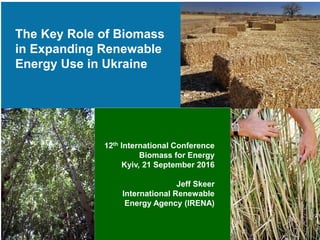
The Key Role of Biomass
in Expanding Renewable
Energy Use in Ukraine
12th International Conference
Biomass for Energy
Kyiv, 21 September 2016
Jeff Skeer
International Renewable
Energy Agency (IRENA)
2
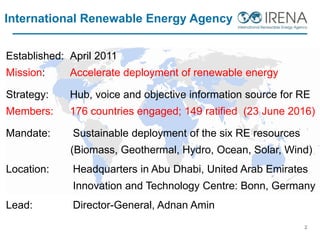
Established: April 2011
Mission: Accelerate deployment of renewable energy
Strategy: Hub, voice and objective information source for RE
Members: 176 countries engaged; 149 ratified (23 June 2016)
Mandate: Sustainable deployment of the six RE resources
(Biomass, Geothermal, Hydro, Ocean, Solar, Wind)
Location: Headquarters in Abu Dhabi, United Arab Emirates
Innovation and Technology Centre: Bonn, Germany
Lead: Director-General, Adnan Amin
International Renewable Energy Agency
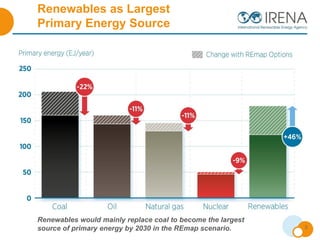
Renewables would mainly replace coal to become the largest
source of primary energy by 2030 in the REmap scenario. 3
Renewables as Largest
Primary Energy Source
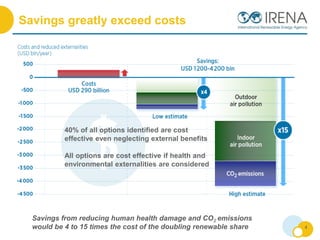
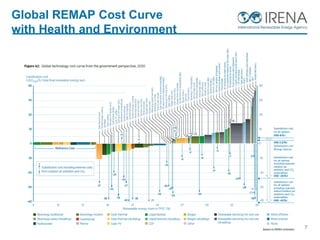
Savings from reducing human health damage and CO2 emissions
would be 4 to 15 times the cost of the doubling renewable share 4
Savings greatly exceed costs
40% of all options identified are cost
effective even neglecting external benefits
All options are cost effective if health and
environmental externalities are considered
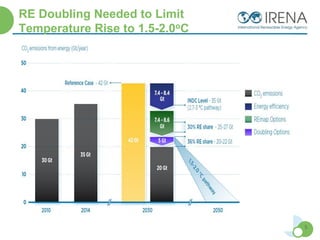
RE Doubling Needed to Limit
Temperature Rise to 1.5-2.0oC
5
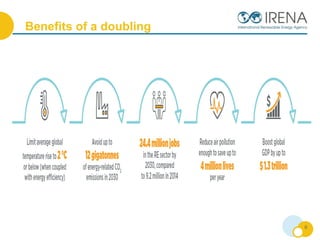
Benefits of a doubling
6
Global REMAP Cost Curve
with Health and Environment
7
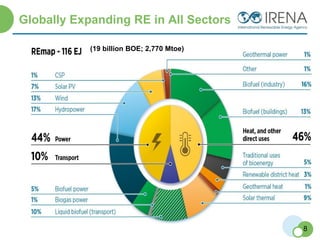
Globally Expanding RE in All Sectors
8
(19 billion BOE; 2,770 Mtoe)
9
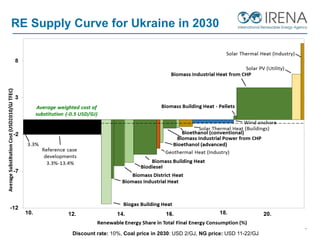
RE Supply Curve for Ukraine in 2030
Discount rate: 10%, Coal price in 2030: USD 2/GJ, NG price: USD 11-22/GJ
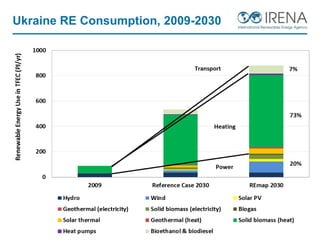
Ukraine RE Consumption, 2009-2030
10
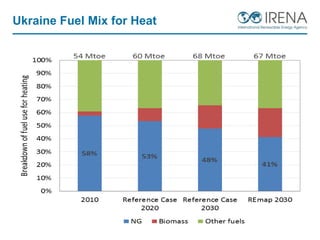
Ukraine Fuel Mix for Heat
11
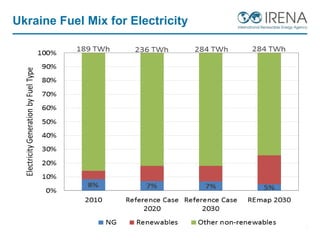
Ukraine Fuel Mix for Electricity
12
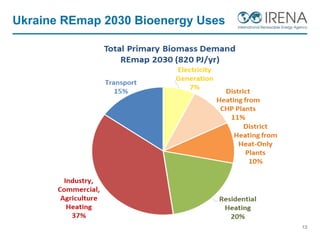
Ukraine REmap 2030 Bioenergy Uses
13
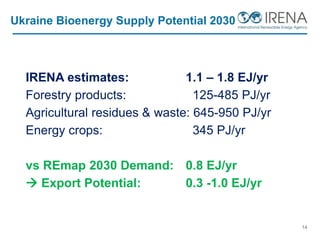
Ukraine Bioenergy Supply Potential 2030
14
IRENA estimates: 1.1 – 1.8 EJ/yr
Forestry products: 125-485 PJ/yr
Agricultural residues & waste: 645-950 PJ/yr
Energy crops: 345 PJ/yr
vs REmap 2030 Demand: 0.8 EJ/yr
 Export Potential: 0.3 -1.0 EJ/yr
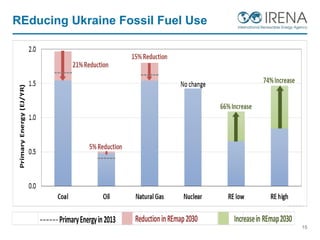
REducing Ukraine Fossil Fuel Use
15
ReductioninREmap2030PrimaryEnergyin2013 Increasein REmap2030
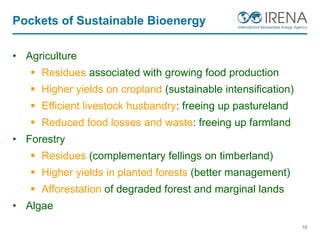
Pockets of Sustainable Bioenergy
• Agriculture
 Residues associated with growing food production
 Higher yields on cropland (sustainable intensification)
 Efficient livestock husbandry: freeing up pastureland
 Reduced food losses and waste: freeing up farmland
• Forestry
 Residues (complementary fellings on timberland)
 Higher yields in planted forests (better management)
 Afforestation of degraded forest and marginal lands
• Algae
16
Potential Land for Solid Biomass
• Closing the Yield Gap:550 M ha
• Better Use of Pasture Land: 950 M ha
• Reduced Food Chain Losses: 270 M ha
• Reafforestation: 350 M ha
• TOTAL: OVER 2 BILLION HECTARES, 300 EJ
17
Policies to Boost Solid Biomass
• Accelerate improvement of crop yields by expanding
extension services to spread modern farming techniques.
• Improve understanding of logistical approaches for cost-
effective harvesting of farm and forest residues.
• Collect comprehensive data on land that could be used for
sustainable wood and grass crops, including likely yields.
• Conduct in-depth research on practices for cultivating
rapidly growing trees and grasses on pastureland that
could sequester carbon and enhance biodiversity.
• Institute more secure land tenure and better governance
to provide incentives for more intensive land management.
• Provide Incentives to plant trees on degraded lands.
18
Forest Focus
• Harvest Most Wood As Long-Lasting Lumber
 At least two-thirds of wood extraction
 Far more valuable than energy wood
 Lasts up to a century, sequestering carbon
 Displaces carbon-intensive concrete
• Use Wood Residues for Heat and Power
 Highly efficient CHP and CHP – 80-90%
 Displaces carbon-intensive fossil fuel
19
20

UABioConf 2016 - Plenary Session 2/4 - Skeer (Eng)

  • 1.
    The Key Roleof Biomass in Expanding Renewable Energy Use in Ukraine 12th International Conference Biomass for Energy Kyiv, 21 September 2016 Jeff Skeer International Renewable Energy Agency (IRENA)
  • 2.
    2 Established: April 2011 Mission:Accelerate deployment of renewable energy Strategy: Hub, voice and objective information source for RE Members: 176 countries engaged; 149 ratified (23 June 2016) Mandate: Sustainable deployment of the six RE resources (Biomass, Geothermal, Hydro, Ocean, Solar, Wind) Location: Headquarters in Abu Dhabi, United Arab Emirates Innovation and Technology Centre: Bonn, Germany Lead: Director-General, Adnan Amin International Renewable Energy Agency
  • 3.
    Renewables would mainlyreplace coal to become the largest source of primary energy by 2030 in the REmap scenario. 3 Renewables as Largest Primary Energy Source
  • 4.
    Savings from reducinghuman health damage and CO2 emissions would be 4 to 15 times the cost of the doubling renewable share 4 Savings greatly exceed costs 40% of all options identified are cost effective even neglecting external benefits All options are cost effective if health and environmental externalities are considered
  • 5.
    RE Doubling Neededto Limit Temperature Rise to 1.5-2.0oC 5
  • 6.
    Benefits of adoubling 6
  • 7.
    Global REMAP CostCurve with Health and Environment 7
  • 8.
    Globally Expanding REin All Sectors 8 (19 billion BOE; 2,770 Mtoe)
  • 9.
    9 RE Supply Curvefor Ukraine in 2030 Discount rate: 10%, Coal price in 2030: USD 2/GJ, NG price: USD 11-22/GJ
  • 10.
  • 11.
    Ukraine Fuel Mixfor Heat 11
  • 12.
    Ukraine Fuel Mixfor Electricity 12
  • 13.
    Ukraine REmap 2030Bioenergy Uses 13
  • 14.
    Ukraine Bioenergy SupplyPotential 2030 14 IRENA estimates: 1.1 – 1.8 EJ/yr Forestry products: 125-485 PJ/yr Agricultural residues & waste: 645-950 PJ/yr Energy crops: 345 PJ/yr vs REmap 2030 Demand: 0.8 EJ/yr  Export Potential: 0.3 -1.0 EJ/yr
  • 15.
    REducing Ukraine FossilFuel Use 15 ReductioninREmap2030PrimaryEnergyin2013 Increasein REmap2030
  • 16.
    Pockets of SustainableBioenergy • Agriculture  Residues associated with growing food production  Higher yields on cropland (sustainable intensification)  Efficient livestock husbandry: freeing up pastureland  Reduced food losses and waste: freeing up farmland • Forestry  Residues (complementary fellings on timberland)  Higher yields in planted forests (better management)  Afforestation of degraded forest and marginal lands • Algae 16
  • 17.
    Potential Land forSolid Biomass • Closing the Yield Gap:550 M ha • Better Use of Pasture Land: 950 M ha • Reduced Food Chain Losses: 270 M ha • Reafforestation: 350 M ha • TOTAL: OVER 2 BILLION HECTARES, 300 EJ 17
  • 18.
    Policies to BoostSolid Biomass • Accelerate improvement of crop yields by expanding extension services to spread modern farming techniques. • Improve understanding of logistical approaches for cost- effective harvesting of farm and forest residues. • Collect comprehensive data on land that could be used for sustainable wood and grass crops, including likely yields. • Conduct in-depth research on practices for cultivating rapidly growing trees and grasses on pastureland that could sequester carbon and enhance biodiversity. • Institute more secure land tenure and better governance to provide incentives for more intensive land management. • Provide Incentives to plant trees on degraded lands. 18
  • 19.
    Forest Focus • HarvestMost Wood As Long-Lasting Lumber  At least two-thirds of wood extraction  Far more valuable than energy wood  Lasts up to a century, sequestering carbon  Displaces carbon-intensive concrete • Use Wood Residues for Heat and Power  Highly efficient CHP and CHP – 80-90%  Displaces carbon-intensive fossil fuel 19
  • 20.