BIOMASS
Leann Baer
Brooke Edwards
Nisarg Joshi
Josh Olzinski
OBJECTIVES
• Learn about the pros and cons of biomass
energy and it sustainability
• Learn about the production and
implementation of biomass energy
• Learn about technical aspects of biomass
and how they can be overcome
• Learn about the regulations impacting
biomass use
• Develop an educated opinion about the
sustainability of biomass as an alternative
energy
OVERVIEW
•Biomass is a renewable energy source that is
derived from living or recently living
organisms.
•Biomass includes biological material, not
organic material like coal.
•Energy derived from biomass is mostly used
to generate electricity or to produce heat.
•Thermal energy is extracted by means of
combustion, torrefaction, pyrolysis, and
gasification.
•Biomass can be chemically and biochemically
treated to convert it to a energy-rich fuel.
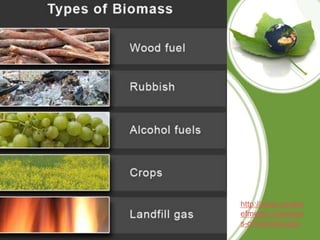
http://www.coralre
efmedia.com/type
s-of-biomass.jpg
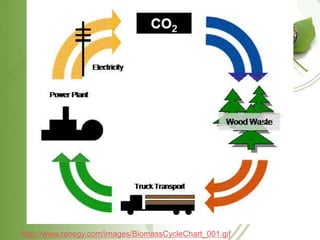
http://www.renegy.com/images/BiomassCycleChart_001.gif
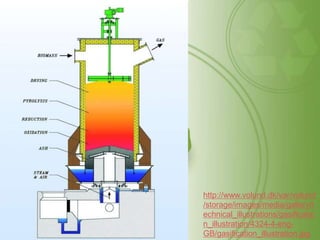
http://www.volund.dk/var/volund
/storage/images/media/gallery/t
echnical_illustrations/gasificatio
n_illustration/4324-4-eng-
GB/gasification_illustration.jpg
Potential Energy Source?
• California produces more than 60 million bone dry
tons of biomass each year.
• 5 million bone dry tons are now burned to make
electricity
• If it were all used, the 60 million tons could make
close to 2,000 megawatts of electricity
• Would give enough energy to power 2 million
homes
• About 6% of Canada’s energy needs are met by
biomass, but that could be greatly increased
Potential Energy Source?
• In the United States, we already get 45 billion kilowatt-
hours of electricity from biomass, about 1.2 percent of
our nation's total electric sales
• Estimates of the ultimate potential for biomass energy
vary, depending on agricultural forecasts, waste
reduction by industry, and paper recycling
• The Department of Energy believes that we could
produce four percent of our transportation fuels from
biomass by 2010, and as much as 20 percent by 2030
• For electricity, the U.S. Department of Energy (DOE)
estimates that energy crops and crop residues alone
could supply as much as much as 14 percent of our
power needs.
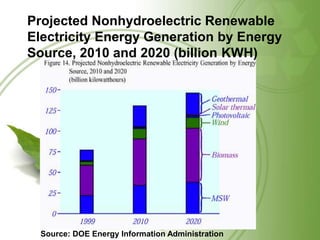
Projected Nonhydroelectric Renewable
Electricity Energy Generation by Energy
Source, 2010 and 2020 (billion KWH)
Source: DOE Energy Information Administration
DISAGREEMENTS
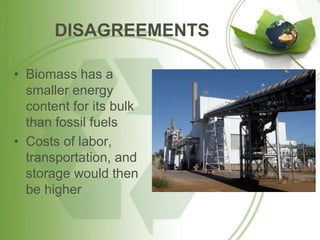
• Biomass has a
smaller energy
content for its bulk
than fossil fuels
• Costs of labor,
transportation, and
storage would then
be higher
ENVIRONMENTAL
ADVANTAGES
• Renewable resource
• Reduces landfills
• Protects clean water supplies
• Reduces acid rain and smog
• Reduces greenhouse gases
– Carbon dioxide
– Methane
BIOMASS AND CARBON
EMMISIONS
• Biomass emits carbon dioxide when it
naturally decays and when it is used as an
energy source
• Living biomass in plants and trees absorbs
carbon dioxide from the atmosphere
through photosynthesis
• Biomass causes a closed cycle with no net
emissions of greenhouse gases
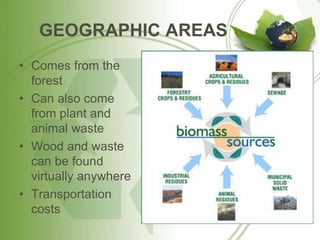
GEOGRAPHIC AREAS
• Comes from the
forest
• Can also come
from plant and
animal waste
• Wood and waste
can be found
virtually anywhere
• Transportation
costs
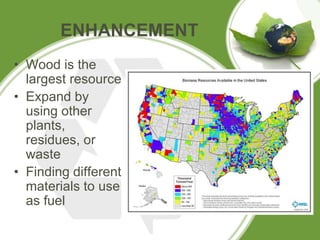
ENHANCEMENT
• Wood is the
largest resource
• Expand by
using other
plants,
residues, or
waste
• Finding different
materials to use
as fuel
DEVELOPMENT
• Many areas could be
used
• Potentially supply more
than 20% of US energy
supply
• Bioenergy crops will be
• More important in future
• Come closer to area
that
• Need energy
TECHNICAL
IMPEDIMENTS
• Trees and other biomass is hard to
gather
• There is a low output of 34% energy
gain
• Development of cheapo and reliable
combustion techniques that will not
release pollutants
http://ec.europa.eu/research/energy/nn/nn_rt/nn_rt_bm/article_1112_en.htm
TECHNICAL
IMPEDIMENTS
• Development of gasification techniques
that incorporate hydrogen to create
syngas
• Biomass contains less energy per pound
than fossil fuels
• Cost-inefficient to transport more than 50
miles before it is converted to fuel
http://ec.europa.eu/research/energy/nn/nn_rt/nn_rt_bm/article_1112_en.htm
SOLUTION
• The solution is to have decentralized
processing plants
• This means less transport of biomass
• This is more cost-efficient
• More reliable, regular, and better quality
• Less competition between companies
http://www.desipower.com/why/advntg_biomass.htm
ENVIRONMENTAL
DISADVANTAGES
•Crop and forest residues often contain high
concentrations of important nutrients
•If the residue is harvested as energy, the
nutrients can be lost to the surrounding
environment.
•Other synthetic chemical nutrients or fertilizers
can later be added
•More plants and trees must be planted,
because they will be used in a higher quantity
LAWS AND REGULATIONS
 A number of federal laws and regulation apply
to biomass energy deployment activities. For
the most part, state laws and regulations do not
apply to biomass energy development on tribal
lands. Federal legal requirements apply to
specific activities associated with biomass
energy development.
 The impacts of a specific project will be
determined by factors such as the type and size
of the biomass facility, the amount of land
disturbed by construction activities, the amount
of land in use by facilities long term, the location
of the site with respect to other resources.
GOVERNMENTAL
INITIATIVE
 California produces more than 60 million bone
dry tons of biomass each year. Of this total,
five million bone dry tons is now burned to
make electricity.
 Many states promote biomass if cost, location
and resources are to their benefit
SUSTAINIBILITY
 Biomass is sustainable but there is an
expense in producing and converting
biomass into fuels and electricity.
 Collecting biomass turned out to be very
different than harvesting, as loggers
gained more experience the process
became much more efficient.
 While biomass is one of the best forms of
renewable energy, it is not a great fuel.
SUSTAINIBILITY
 Removing too much biomass can use up
nutrients from the soil and possibly
increase erosion.
 Biomass supplies about 15 times as
much energy then solar and wind in the
United States, and has the potential to
supply much more.
CONCLUSION
•Biomass is a potential alternative to
fossil fuels but it is not very viable.
•There are many problems in the
development and transportation of it and
carbon is a byproduct of processing of
biomass, just like it is a byproduct of
fossil fuels.
•There are better alternative energies.
Template Provided By
www.animationfactory.com
500,000 Downloadable PowerPoint Templates,
Animated Clip Art, Backgrounds and Videos

biomass.09.ppt

  • 1.
  • 2.
    OBJECTIVES • Learn aboutthe pros and cons of biomass energy and it sustainability • Learn about the production and implementation of biomass energy • Learn about technical aspects of biomass and how they can be overcome • Learn about the regulations impacting biomass use • Develop an educated opinion about the sustainability of biomass as an alternative energy
  • 3.
    OVERVIEW •Biomass is arenewable energy source that is derived from living or recently living organisms. •Biomass includes biological material, not organic material like coal. •Energy derived from biomass is mostly used to generate electricity or to produce heat. •Thermal energy is extracted by means of combustion, torrefaction, pyrolysis, and gasification. •Biomass can be chemically and biochemically treated to convert it to a energy-rich fuel.
  • 4.
  • 5.
  • 6.
  • 7.
    Potential Energy Source? •California produces more than 60 million bone dry tons of biomass each year. • 5 million bone dry tons are now burned to make electricity • If it were all used, the 60 million tons could make close to 2,000 megawatts of electricity • Would give enough energy to power 2 million homes • About 6% of Canada’s energy needs are met by biomass, but that could be greatly increased
  • 8.
    Potential Energy Source? •In the United States, we already get 45 billion kilowatt- hours of electricity from biomass, about 1.2 percent of our nation's total electric sales • Estimates of the ultimate potential for biomass energy vary, depending on agricultural forecasts, waste reduction by industry, and paper recycling • The Department of Energy believes that we could produce four percent of our transportation fuels from biomass by 2010, and as much as 20 percent by 2030 • For electricity, the U.S. Department of Energy (DOE) estimates that energy crops and crop residues alone could supply as much as much as 14 percent of our power needs.
  • 9.
    Projected Nonhydroelectric Renewable ElectricityEnergy Generation by Energy Source, 2010 and 2020 (billion KWH) Source: DOE Energy Information Administration
  • 10.
    DISAGREEMENTS • Biomass hasa smaller energy content for its bulk than fossil fuels • Costs of labor, transportation, and storage would then be higher
  • 11.
    ENVIRONMENTAL ADVANTAGES • Renewable resource •Reduces landfills • Protects clean water supplies • Reduces acid rain and smog • Reduces greenhouse gases – Carbon dioxide – Methane
  • 12.
    BIOMASS AND CARBON EMMISIONS •Biomass emits carbon dioxide when it naturally decays and when it is used as an energy source • Living biomass in plants and trees absorbs carbon dioxide from the atmosphere through photosynthesis • Biomass causes a closed cycle with no net emissions of greenhouse gases
  • 13.
    GEOGRAPHIC AREAS • Comesfrom the forest • Can also come from plant and animal waste • Wood and waste can be found virtually anywhere • Transportation costs
  • 14.
    ENHANCEMENT • Wood isthe largest resource • Expand by using other plants, residues, or waste • Finding different materials to use as fuel
  • 15.
    DEVELOPMENT • Many areascould be used • Potentially supply more than 20% of US energy supply • Bioenergy crops will be • More important in future • Come closer to area that • Need energy
  • 16.
    TECHNICAL IMPEDIMENTS • Trees andother biomass is hard to gather • There is a low output of 34% energy gain • Development of cheapo and reliable combustion techniques that will not release pollutants http://ec.europa.eu/research/energy/nn/nn_rt/nn_rt_bm/article_1112_en.htm
  • 17.
    TECHNICAL IMPEDIMENTS • Development ofgasification techniques that incorporate hydrogen to create syngas • Biomass contains less energy per pound than fossil fuels • Cost-inefficient to transport more than 50 miles before it is converted to fuel http://ec.europa.eu/research/energy/nn/nn_rt/nn_rt_bm/article_1112_en.htm
  • 18.
    SOLUTION • The solutionis to have decentralized processing plants • This means less transport of biomass • This is more cost-efficient • More reliable, regular, and better quality • Less competition between companies http://www.desipower.com/why/advntg_biomass.htm
  • 19.
    ENVIRONMENTAL DISADVANTAGES •Crop and forestresidues often contain high concentrations of important nutrients •If the residue is harvested as energy, the nutrients can be lost to the surrounding environment. •Other synthetic chemical nutrients or fertilizers can later be added •More plants and trees must be planted, because they will be used in a higher quantity
  • 20.
    LAWS AND REGULATIONS A number of federal laws and regulation apply to biomass energy deployment activities. For the most part, state laws and regulations do not apply to biomass energy development on tribal lands. Federal legal requirements apply to specific activities associated with biomass energy development.  The impacts of a specific project will be determined by factors such as the type and size of the biomass facility, the amount of land disturbed by construction activities, the amount of land in use by facilities long term, the location of the site with respect to other resources.
  • 21.
    GOVERNMENTAL INITIATIVE  California producesmore than 60 million bone dry tons of biomass each year. Of this total, five million bone dry tons is now burned to make electricity.  Many states promote biomass if cost, location and resources are to their benefit
  • 22.
    SUSTAINIBILITY  Biomass issustainable but there is an expense in producing and converting biomass into fuels and electricity.  Collecting biomass turned out to be very different than harvesting, as loggers gained more experience the process became much more efficient.  While biomass is one of the best forms of renewable energy, it is not a great fuel.
  • 23.
    SUSTAINIBILITY  Removing toomuch biomass can use up nutrients from the soil and possibly increase erosion.  Biomass supplies about 15 times as much energy then solar and wind in the United States, and has the potential to supply much more.
  • 24.
    CONCLUSION •Biomass is apotential alternative to fossil fuels but it is not very viable. •There are many problems in the development and transportation of it and carbon is a byproduct of processing of biomass, just like it is a byproduct of fossil fuels. •There are better alternative energies.
  • 25.
    Template Provided By www.animationfactory.com 500,000Downloadable PowerPoint Templates, Animated Clip Art, Backgrounds and Videos