www.ieep.eu @IEEP_eu
EU Agriculture & the net-zero
challenge
What pathways towards a low-carbon and resilient EU agriculture
sector in 2050
Ben Allen & Anna Lórant
Institute for European Environmental Policy (IEEP)
UNFCCC COP23 – Bonn, 10 November 2017
www.ieep.eu @IEEP_eu
Agriculture’s contribution to EU GHG emissions
(excluding LULUCF)
29.3%
Energy supply
19.2%
Transport19.0%
Industry
11.5%
Residential &
commercial
11.3%
Agriculture
Others • Large MS Variation
• FR, DE, UK ~44%
• Contribution likely
to become more
significant over
time
www.ieep.eu @IEEP_eu
Agricultural GHG emissions (CO2/non-CO2)
42.9%
Enteric
fermentation
15.4%
Manure
38.0%
Soils
The rationale for action on agriculture
• Agriculture is a major source of GHG
emissions
• EU emissions from agriculture are
now increasing, both in absolute and
relative terms
• EU agriculture production sector has a
large land use impact outside its
boarders
‘net-zero emissions will be required from all
sectors at some point around 2050’
COP21 Paris Climate Agreement
What makes agriculture special?
• Potential to compensate for emissions
through carbon sequestration and
storage
• Mitigation actions can deliver co-
benefits: economic, environmental &
social
• Agriculture also has a role in
– ensuring EU food and nutrition security,
– Incomes and territorial developments,
– & the social & environmental benefits
delivered by the sector
‘Future climate action in the agriculture
sector relies on the choices of 12 million
farmers ’
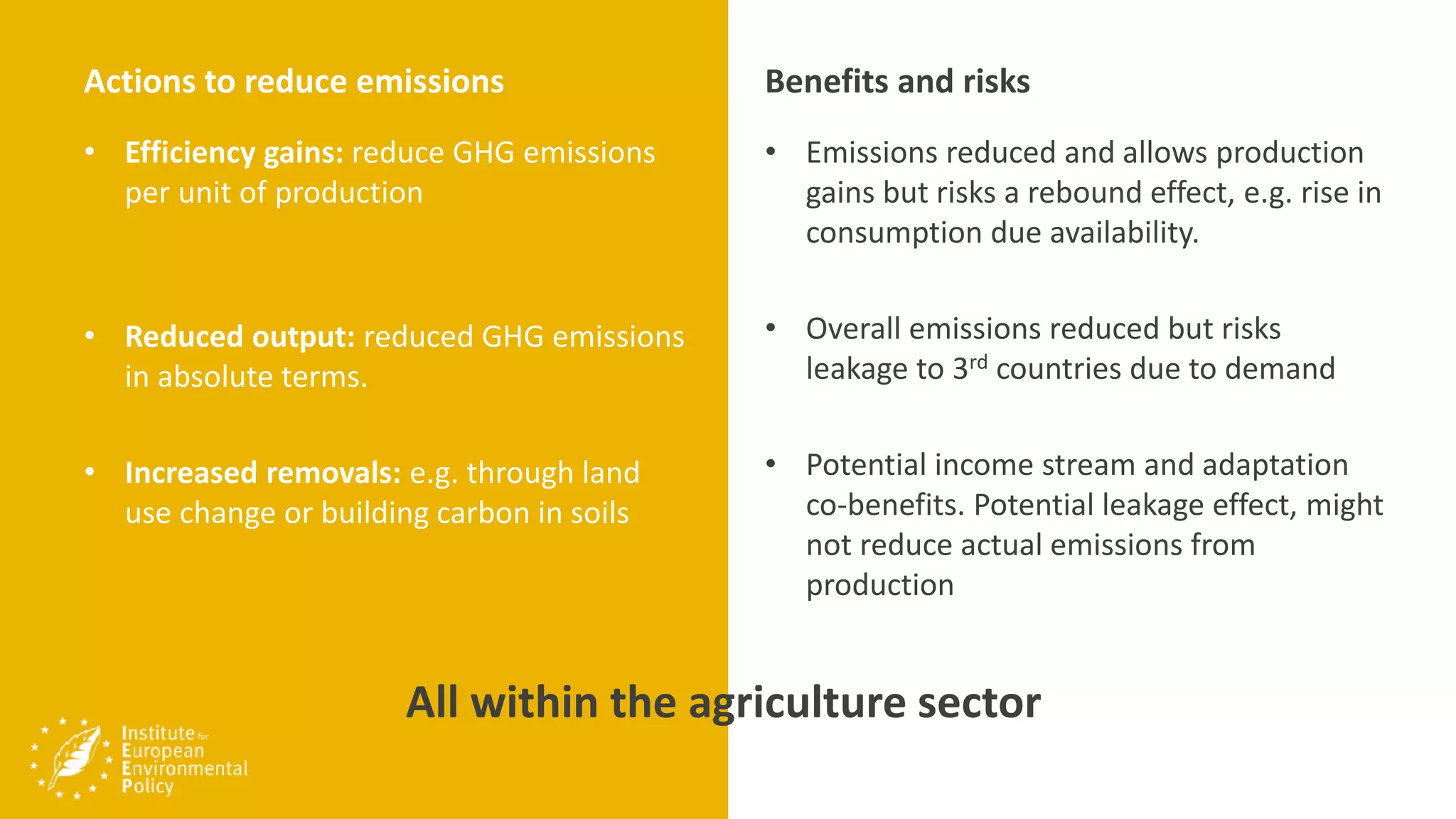
Actions to reduce emissions
• Efficiency gains: reduce GHG emissions
per unit of production
• Reduced output: reduced GHG emissions
in absolute terms.
• Increased removals: e.g. through land
use change or building carbon in soils
Benefits and risks
• Emissions reduced and allows production
gains but risks a rebound effect, e.g. rise in
consumption due availability.
• Overall emissions reduced but risks
leakage to 3rd countries due to demand
• Potential income stream and adaptation
co-benefits. Potential leakage effect, might
not reduce actual emissions from
production
All within the agriculture sector
‘reaching net-zero emissions will require a
combination of approaches: increased
efficiency, greater removals, & reduced
production of high GHG-intensity products’
Drivers of change
• changing environmental and climatic
conditions to which farming systems
need to adapt;
• technological advancements to
address challenges in the sector;
• Markets that influence production and
trade;
• policy drivers that help shape the
decisions made by Member States and
farmers.
www.ieep.eu @IEEP_eu
Consumption
Meat consumption and
production is a major source of
GHGs;
Reducing food waste is essential
Environment
Drives adaptation, not
mitigation;
Impacts crops more than
livestock
Technology
Better application of existing
techniques is as important as
new developments;
Public perception is key
Technology
Climate mitigation tech is still
rare in agriculture;
Rebound effect is a risk of
efficiency gains
Markets
EU markets are complex and
part of global commodity trade;
Long supply chains limit
reinvestment in the sector
Policy
Targets work;
External policies have significant
influence;
Climate tends to be secondary
focus of current CAP measures
Reaching net-zero emissions in the EU,
whilst avoiding external impacts, is likely to
require a more systematic change in the
way we produce and consume food.
www.ieep.eu @IEEP_eu
Thank you
For more information about IEEP’s work on climate and agriculture or the NZ2050 project,
please contact:
ballen@ieep.eu
+44(0)7421767684
@ecoboy79

EU Agriculture & the net-zero challenge

  • 1.
    www.ieep.eu @IEEP_eu EU Agriculture& the net-zero challenge What pathways towards a low-carbon and resilient EU agriculture sector in 2050 Ben Allen & Anna Lórant Institute for European Environmental Policy (IEEP) UNFCCC COP23 – Bonn, 10 November 2017
  • 2.
    www.ieep.eu @IEEP_eu Agriculture’s contributionto EU GHG emissions (excluding LULUCF) 29.3% Energy supply 19.2% Transport19.0% Industry 11.5% Residential & commercial 11.3% Agriculture Others • Large MS Variation • FR, DE, UK ~44% • Contribution likely to become more significant over time
  • 3.
    www.ieep.eu @IEEP_eu Agricultural GHGemissions (CO2/non-CO2) 42.9% Enteric fermentation 15.4% Manure 38.0% Soils
  • 4.
    The rationale foraction on agriculture • Agriculture is a major source of GHG emissions • EU emissions from agriculture are now increasing, both in absolute and relative terms • EU agriculture production sector has a large land use impact outside its boarders
  • 5.
    ‘net-zero emissions willbe required from all sectors at some point around 2050’ COP21 Paris Climate Agreement
  • 6.
    What makes agriculturespecial? • Potential to compensate for emissions through carbon sequestration and storage • Mitigation actions can deliver co- benefits: economic, environmental & social • Agriculture also has a role in – ensuring EU food and nutrition security, – Incomes and territorial developments, – & the social & environmental benefits delivered by the sector
  • 7.
    ‘Future climate actionin the agriculture sector relies on the choices of 12 million farmers ’
  • 8.
    Actions to reduceemissions • Efficiency gains: reduce GHG emissions per unit of production • Reduced output: reduced GHG emissions in absolute terms. • Increased removals: e.g. through land use change or building carbon in soils Benefits and risks • Emissions reduced and allows production gains but risks a rebound effect, e.g. rise in consumption due availability. • Overall emissions reduced but risks leakage to 3rd countries due to demand • Potential income stream and adaptation co-benefits. Potential leakage effect, might not reduce actual emissions from production All within the agriculture sector
  • 9.
    ‘reaching net-zero emissionswill require a combination of approaches: increased efficiency, greater removals, & reduced production of high GHG-intensity products’
  • 10.
    Drivers of change •changing environmental and climatic conditions to which farming systems need to adapt; • technological advancements to address challenges in the sector; • Markets that influence production and trade; • policy drivers that help shape the decisions made by Member States and farmers.
  • 11.
    www.ieep.eu @IEEP_eu Consumption Meat consumptionand production is a major source of GHGs; Reducing food waste is essential Environment Drives adaptation, not mitigation; Impacts crops more than livestock Technology Better application of existing techniques is as important as new developments; Public perception is key Technology Climate mitigation tech is still rare in agriculture; Rebound effect is a risk of efficiency gains Markets EU markets are complex and part of global commodity trade; Long supply chains limit reinvestment in the sector Policy Targets work; External policies have significant influence; Climate tends to be secondary focus of current CAP measures
  • 12.
    Reaching net-zero emissionsin the EU, whilst avoiding external impacts, is likely to require a more systematic change in the way we produce and consume food.
  • 13.
    www.ieep.eu @IEEP_eu Thank you Formore information about IEEP’s work on climate and agriculture or the NZ2050 project, please contact: ballen@ieep.eu +44(0)7421767684 @ecoboy79