Number Theory
Dr. Ravi Prasad K J
The Division Algorithm:
Prime Numbers
Definition of Divisibility:
If a, b Є Z and b ≠0,
we say that b divides a, and
we write b|a,
if there is an integer n such that
a = bn.
When this occurs we say that
b is a divisor of a, or
a is a multiple of b.
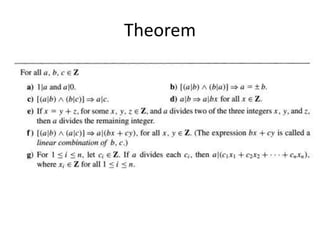
Theorem
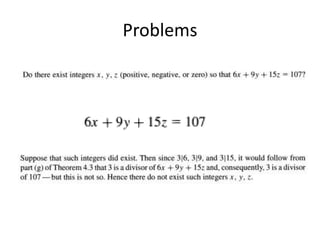
Problems
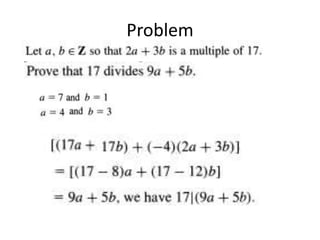
Problem
Number Theory
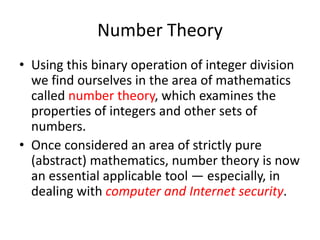
• Using this binary operation of integer division
we find ourselves in the area of mathematics
called number theory, which examines the
properties of integers and other sets of
numbers.
• Once considered an area of strictly pure
(abstract) mathematics, number theory is now
an essential applicable tool — especially, in
dealing with computer and Internet security.
Prime and Composite
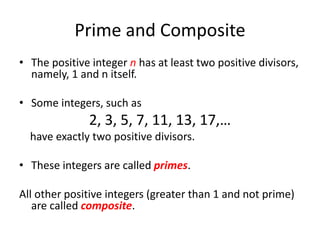
• The positive integer n has at least two positive divisors,
namely, 1 and n itself.
• Some integers, such as
2, 3, 5, 7, 11, 13, 17,…
have exactly two positive divisors.
• These integers are called primes.
All other positive integers (greater than 1 and not prime)
are called composite.
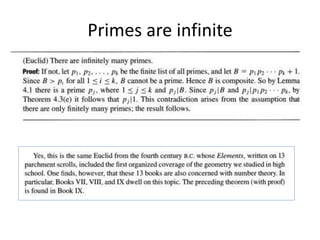
Primes are infinite
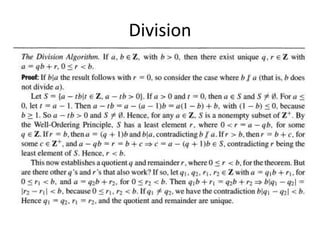
Division
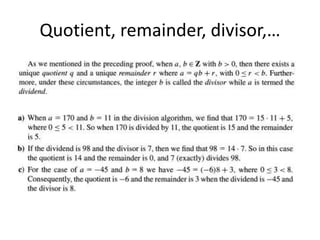
Quotient, remainder, divisor,…
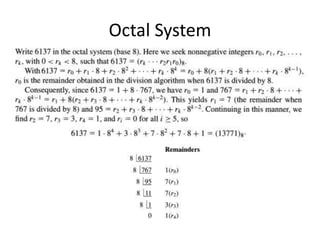
Octal System
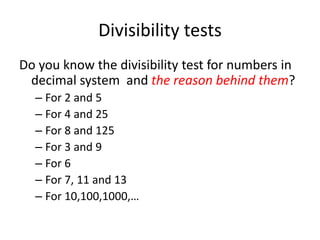
Divisibility tests
Do you know the divisibility test for numbers in
decimal system and the reason behind them?
– For 2 and 5
– For 4 and 25
– For 8 and 125
– For 3 and 9
– For 6
– For 7, 11 and 13
– For 10,100,1000,…
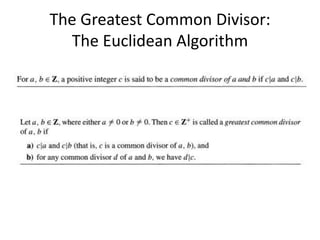
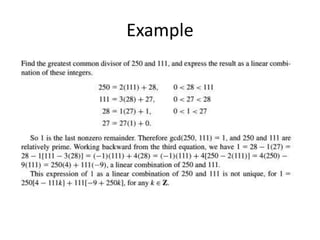
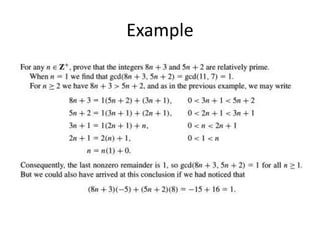
The Greatest Common Divisor:
The Euclidean Algorithm
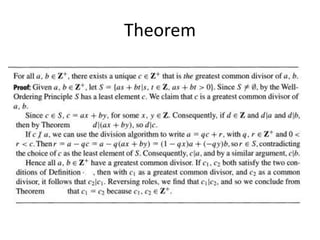
Theorem
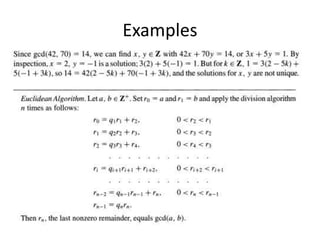
Examples
Example
Example
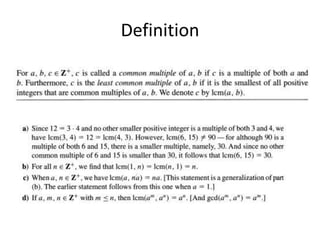
Definition
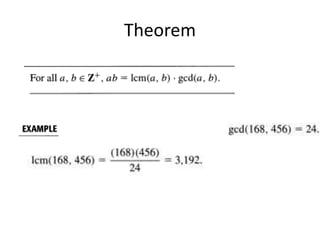
Theorem
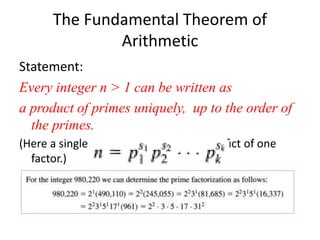
The Fundamental Theorem of
Arithmetic
Statement:
Every integer n > 1 can be written as
a product of primes uniquely, up to the order of
the primes.
(Here a single prime is considered a product of one
factor.)
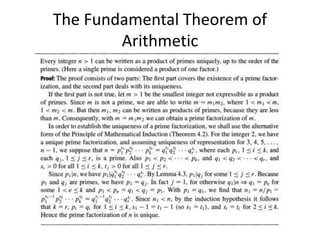
The Fundamental Theorem of
Arithmetic
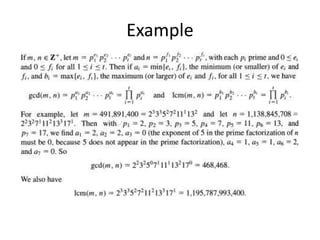
Example
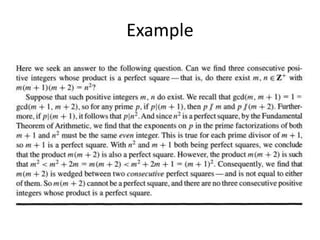
Example
Thank you.

Presentation 2c number theory