Curved mirrorsCurved mirrors
 CURVED MIRRORSCURVED MIRRORS
• A curved mirror is a mirror with a curved reflectiveA curved mirror is a mirror with a curved reflective
surface, which may be either bulging outward orsurface, which may be either bulging outward or
bulging inward.bulging inward.
• Most curved mirrors have surfaces that are shapedMost curved mirrors have surfaces that are shaped
like part of a sphere.like part of a sphere.
• But other shapes are sometimes used in opticalBut other shapes are sometimes used in optical
devices, the most common non-spherical type aredevices, the most common non-spherical type are
parabolic reflectorsparabolic reflectors
 TypES Of MIRRORSTypES Of MIRRORS
• Curved mirrors are broadly divided into 2 types:
i. Convex mirrors : the mirrors which are bulged out
wards.
ii. Concave mirrors : the mirror which is bulged
inwards.
o COnVEx MIRRORSCOnVEx MIRRORS
• A convex mirror, fish eye mirror or diverging
mirror, is a curved mirror in which the reflective
surface bulges toward the light source.
• Convex mirrors reflect light outwards, therefore
they are not used to focus light.
• Such mirrors always form a virtual image, since the
focus (F) and the centre of curvature (2F) are both
imaginary points "inside" the mirror, which cannot
be reached.
• Thus the image cannot be caught on a screen
• These mirrors are “diverging”.
Uses of convex mirrorUses of convex mirror
• Passenger-side mirror on a car is typically convex mirror.
• They provide a wider field of view as they are curved
outwards.
• These mirrors are often found in the hallway of various
buildings commonly known as “hallway safety mirrors.
• Convex mirrors are used in some automated teller
machines as a simple and handy security feature, allowing
the users to see what is happening behind them.
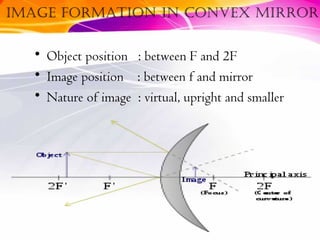
image formation in convex mirror
• Object position : between F and 2F
• Image position : between f and mirror
• Nature of image : virtual, upright and smaller
 concave mirrorconcave mirror
• A concave mirror, or converging mirror, has
a reflecting surface that bulges inward (away from
the incident light).
• Concave mirrors reflect light inward to one focal
point.
• They are used to focus light.
• Unlike convex mirrors, concave mirrors show
different image types depending on the distance
between the object and the mirror.
• These mirrors are called "converging"
Uses of concave mirrorsUses of concave mirrors
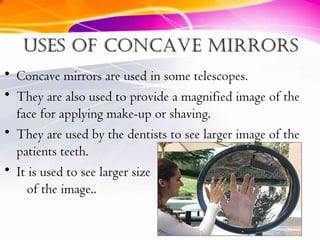
• Concave mirrors are used in some telescopes.
• They are also used to provide a magnified image of the
face for applying make-up or shaving.
• They are used by the dentists to see larger image of the
patients teeth.
• It is used to see larger size
of the image..
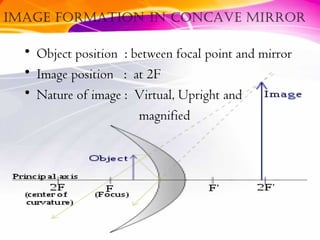
Image formatIon In concave mIrror
• Object position : between focal point and mirror
• Image position : at 2F
• Nature of image : Virtual, Upright and
magnified
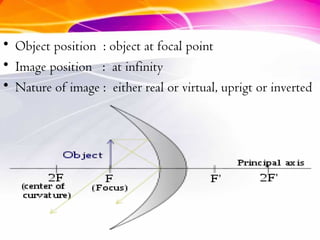
• Object position : object at focal point
• Image position : at infinity
• Nature of image : either real or virtual, uprigt or inverted
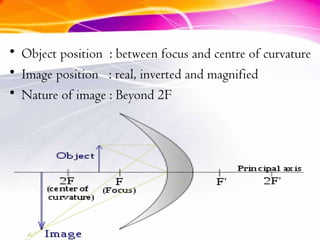
• Object position : between focus and centre of curvature
• Image position : real, inverted and magnified
• Nature of image : Beyond 2F
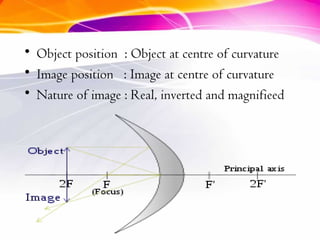
• Object position : Object at centre of curvature
• Image position : Image at centre of curvature
• Nature of image : Real, inverted and magnifieed
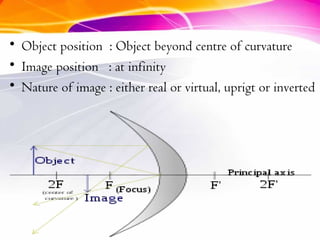
• Object position : Object beyond centre of curvature
• Image position : at infinity
• Nature of image : either real or virtual, uprigt or inverted
Thank You
Done by
P.Dhanush
Tenth ckass
Narayana e-techno

Curved mirrors

  • 1.
  • 2.
     CURVED MIRRORSCURVEDMIRRORS • A curved mirror is a mirror with a curved reflectiveA curved mirror is a mirror with a curved reflective surface, which may be either bulging outward orsurface, which may be either bulging outward or bulging inward.bulging inward. • Most curved mirrors have surfaces that are shapedMost curved mirrors have surfaces that are shaped like part of a sphere.like part of a sphere. • But other shapes are sometimes used in opticalBut other shapes are sometimes used in optical devices, the most common non-spherical type aredevices, the most common non-spherical type are parabolic reflectorsparabolic reflectors
  • 3.
     TypES OfMIRRORSTypES Of MIRRORS • Curved mirrors are broadly divided into 2 types: i. Convex mirrors : the mirrors which are bulged out wards. ii. Concave mirrors : the mirror which is bulged inwards.
  • 4.
    o COnVEx MIRRORSCOnVExMIRRORS • A convex mirror, fish eye mirror or diverging mirror, is a curved mirror in which the reflective surface bulges toward the light source. • Convex mirrors reflect light outwards, therefore they are not used to focus light. • Such mirrors always form a virtual image, since the focus (F) and the centre of curvature (2F) are both imaginary points "inside" the mirror, which cannot be reached. • Thus the image cannot be caught on a screen • These mirrors are “diverging”.
  • 5.
    Uses of convexmirrorUses of convex mirror • Passenger-side mirror on a car is typically convex mirror. • They provide a wider field of view as they are curved outwards. • These mirrors are often found in the hallway of various buildings commonly known as “hallway safety mirrors. • Convex mirrors are used in some automated teller machines as a simple and handy security feature, allowing the users to see what is happening behind them.
  • 6.
    image formation inconvex mirror • Object position : between F and 2F • Image position : between f and mirror • Nature of image : virtual, upright and smaller
  • 7.
     concave mirrorconcavemirror • A concave mirror, or converging mirror, has a reflecting surface that bulges inward (away from the incident light). • Concave mirrors reflect light inward to one focal point. • They are used to focus light. • Unlike convex mirrors, concave mirrors show different image types depending on the distance between the object and the mirror. • These mirrors are called "converging"
  • 8.
    Uses of concavemirrorsUses of concave mirrors • Concave mirrors are used in some telescopes. • They are also used to provide a magnified image of the face for applying make-up or shaving. • They are used by the dentists to see larger image of the patients teeth. • It is used to see larger size of the image..
  • 9.
    Image formatIon Inconcave mIrror • Object position : between focal point and mirror • Image position : at 2F • Nature of image : Virtual, Upright and magnified
  • 10.
    • Object position: object at focal point • Image position : at infinity • Nature of image : either real or virtual, uprigt or inverted
  • 11.
    • Object position: between focus and centre of curvature • Image position : real, inverted and magnified • Nature of image : Beyond 2F
  • 12.
    • Object position: Object at centre of curvature • Image position : Image at centre of curvature • Nature of image : Real, inverted and magnifieed
  • 13.
    • Object position: Object beyond centre of curvature • Image position : at infinity • Nature of image : either real or virtual, uprigt or inverted
  • 14.
    Thank You Done by P.Dhanush Tenthckass Narayana e-techno