Applied Economics
Types of Industries
Applied Economics
Types of Industries
Prepared by :
Efrileen Muico
Irish Kim Tolentino
Jerlyn Cauguiran
DAPDAP HIGH SCHOOL
BAMBAN, TARLAC
Objectives
You will learn
• To classify industries according to the four
different types: primary, secondary, tertiary
and quaternary
Agribusiness
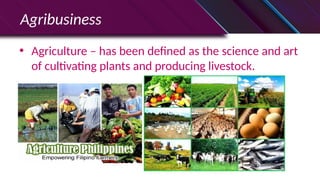
• Agriculture – has been defined as the science and art
of cultivating plants and producing livestock.
In the 1970s, 28% of the country’s Gross
Domestic Product (GDP) has been
contributed by agriculture.
After more than four decades, its share
in the economy GDP has slid down to only
11% from 54%.
Agriculture in the Philippines
employs 30% of the Filipino workforce
as of 2013, according to World Bank
statistics. Agriculture accounts for 12%
of Filipino GDP as of 2013, according to
the World Bank.
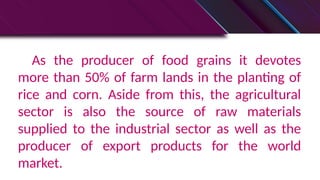
As the producer of food grains it devotes
more than 50% of farm lands in the planting of
rice and corn. Aside from this, the agricultural
sector is also the source of raw materials
supplied to the industrial sector as well as the
producer of export products for the world
market.
There are also business opportunities in the
production of other fruits and vegetables and
varieties of rice and corn that cater to the changing
tastes of Filipino consumers.
These crops are rice, corn, coconut, sugarcane,
mango, camote, tomato, abaca, calamansi, among
others.
The long coastlines of the Philippines are
endowed with marine resources for fisher folks to
harness for fish production. But aside from
commercial fishing for seafood production, there
are business prospects in municipal fishing,
aquaculture, and cage/pen operations
opportunities.
What is an Industry?
• Industry broadly refers to any form of
economic activity that has the purpose of
making money.
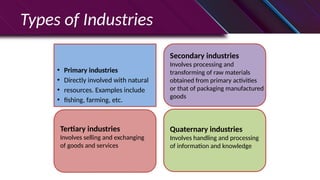
Types of Industries
• Primary industries
• Directly involved with natural
• resources. Examples include
• fishing, farming, etc.
Secondary industries
Involves processing and
transforming of raw materials
obtained from primary activities
or that of packaging manufactured
goods
Tertiary industries
Involves selling and exchanging
of goods and services
Quaternary industries
Involves handling and processing
of information and knowledge
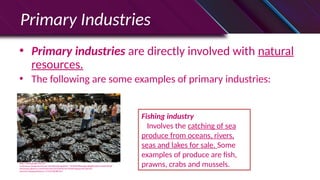
• Primary industries are directly involved with natural
resources.
• The following are some examples of primary industries:
Primary Industries
https://www.google.com/url?
sa=i&source=images&cd=&ved=2ahUKEwjNjc3qpJjlAhV_7XMBHXSRBzoQjRx6BAgBEAQ&url=http%3A%2F
%2Fstream.aljazeera.com%2Fstory%2F201506092339-0024813&psig=AOvVaw3JC-
jSmU10Cc3GeqJeab9w&ust=1571023482887967
Fishing industry
Involves the catching of sea
produce from oceans, rivers,
seas and lakes for sale. Some
examples of produce are fish,
prawns, crabs and mussels.
Primary Industries
Farming industry
Involves the cultivation of
crops and rearing of animals
for sale. Some examples
include vegetable farming,
cattle ranching and poultry
rearing.
https://www.google.com/url?
sa=i&source=images&cd=&ved=2ahUKEwjg18DIp5jlAhU86nMBHc
SlBbIQjRx6BAgBEAQ&url=http%3A%2F
%2Fwww.filipinopoultry.com%2Findex.php
%2F2016%2F05%2F21%2Flayer-farming-in-the-philippines-
achieving-optimal-lighting
%2F&psig=AOvVaw2VGbAnN38RS2xpCRIUBXLt&ust=15710242124
08321
https://www.google.com/url?
sa=i&source=images&cd=&ved=2ahUKEwiExvSaqJjlAhVkguYKHfnIC
bcQjRx6BAgBEAQ&url=https%3A%2F%2Fwww.youtube.com
%2Fwatch%3Fv%3D4Euc8cT-
UhA&psig=AOvVaw2VGbAnN38RS2xpCRIUBXLt&ust=157102421240
8321
For animal production, there are two types
that can be pursued: Livestock and poultry
production.
This can also undertake commercial
activities that can provide income and
employment opportunities to poor household.
Primary Industries
https://www.google.com/url?
sa=i&source=images&cd=&ved=2ahUKEwj42ef7qJjlAhW0gu
YKHZBVAuIQjRx6BAgBEAQ&url=https%3A%2F
%2Fwww.newscientist.com%2Farticle%2F2215913-logging-
study-reveals-huge-hidden-emissions-of-the-forestry-
industry%2F&psig=AOvVaw2HzLapi1-
bL9T9X_WKzpB7&ust=1571024607705666
Forestry industry
Involves the felling of trees in forests
for resources, especially timber. Timber
is used for shipbuilding, paper-making
and construction work.
For forestry resources the main source
of income is logging. But because of the
environmental implications of this type
of agribusiness the commercial
opportunities are becoming limited with
the implementation of the log ban.
Primary Industry
Mining industry
Involves the extraction of
minerals, such as iron and
diamonds. Also involves the
extraction of fossil fuels, such as
petroleum and natural gas.
https://www.google.com/url?
sa=i&source=images&cd=&ved=2ahUKEwiQ58aCqpjlAhXc73MBHYqMD8YQjRx6BAgBEAQ&url=https%3A%2F
%2Fwww.nozominetworks.com%2Fblog%2Fthe-three-most-common-mining-industry-cyber-threats
%2F&psig=AOvVaw3V5JYuhlCAQYpQIJdrtiMd&ust=1571024874762753
• Secondary industries involve the processing and
transforming of raw materials obtained from primary
activities or packaging of manufactured goods.
• They are also known as ‘manufacturing industries’.
Secondary Industries
Industrial sector and Manufacturing industries
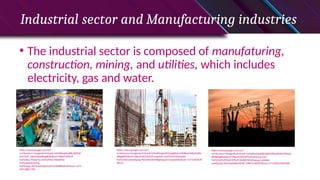
• The industrial sector is composed of manufaturing,
construction, mining, and utilities, which includes
electricity, gas and water.
https://www.google.com/url?
sa=i&source=images&cd=&ved=2ahUKEwj0x4XBvZjlAhW
zH7cAHT_aBeYQjRx6BAgBEAQ&url=https%3A%2F
%2Fwww.choosenj.com%2Fkey-industries
%2Fmanufacturing
%2F&psig=AOvVaw0aDprCyEUnGA0i8KbAtvK5&ust=1571
030128817781
https://www.google.com/url?
sa=i&source=images&cd=&ved=2ahUKEwjyw87GvpjlAhVo73MBHeOXBaAQjRx
6BAgBEAQ&url=https%3A%2F%2Funsplash.com%2Fs%2Fphotos
%2Fconstruction&psig=AOvVaw3GEWigXzegy1CmauezXJbu&ust=15710303678
38113
https://www.google.com/url?
sa=i&source=images&cd=&ved=2ahUKEwi6zuKBv5jlAhVRIbcAHdmODekQ
jRx6BAgBEAQ&url=https%3A%2F%2Fwww.vox.com
%2F2016%2F6%2F29%2F12038074%2Fpower-utilities-
suck&psig=AOvVaw0xBeO0u8f_S4MOy3dI2fE5&ust=1571030529630386
More than 70% of production of the sector
comes from manufacturing industries. Because
of the prominence of the manufacturing sector,
there are numerous subsectors within this type
of industry that can offer business
opportunities to budding entrepreneurs.
Secondary Industries
Primary industry
Logging
Secondary industry
Processed into paper
Secondary industry
Shipbuilding
Secondary industry
Construction
Secondary Industries
• Primary and secondary industries are closely linked
together because they depend on each other for
future growth.
• Secondary industries can be described as light
industries or heavy industries, mainly based on the
amount of raw materials used and the nature of
goods produced.
Light and Heavy Industries
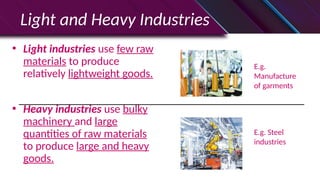
• Light industries use few raw
materials to produce
relatively lightweight goods.
• Heavy industries use bulky
machinery and large
quantities of raw materials
to produce large and heavy
goods.
E.g.
Manufacture
of garments
E.g. Steel
industries
Labour-intensive and Capital-intensive Industries
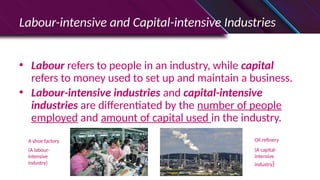
• Labour refers to people in an industry, while capital
refers to money used to set up and maintain a business.
• Labour-intensive industries and capital-intensive
industries are differentiated by the number of people
employed and amount of capital used in the industry.
A shoe factory
(A labour-
intensive
industry)
Oil refinery
(A capital-
intensive
industry)
Manufacturing establishments can be classified
as:
• Shop/factory
• Bakery
• Food establishments
• Distillery
• Refinery
• Cannery
• Abattoir
• Brewery
• Foundry
• Tannery
Tertiary Industries
• Tertiary industries are also known
as ‘service industries’. Some
examples include banking,
education, tourism,
entertainment, transportation,
and sale or distribution of food.
• Tertiary industries may be
classified as those providing basic
services (e.g. medical services at a
polyclinic) and those providing
premium services (e.g. specialist
clinics and private hospitals).
Tertiary Industry
Service Sector and Retail Services
• Service are products that are consumed when
they are produced.
With the rapid improvements of in
information and communication technology,
services are increasingly traded internationally
through various modes of supply including cross
border transactions, consumption abroad,
commercial presence, and movement of natural
persons.
Services cover a host of industries including
wholesale and retail industries, transportation,
communication, and storage including
warehousing, hotels and restaurants, financial
intermediation, real estate and business
activities, education, and other social services,
private and government services.
Quaternary Industries
• Quaternary industries involve handling and processing of
information and knowledge (e.g. research and development
(R&D), education or consultancy)
• Companies in the other types of industries may engage the
services of quaternary industries (e.g. a manufacturing
company may engage a consultancy firm to seek advice on
cost cutting, market research, etc)
• Quaternary industries also work towards developing new
products and services to meet the needs of consumers (e.g.
R&D in a pharmaceutical company to develop new drugs
and medicine)
Industrialisation of a Country
• Industrialisation is the process whereby the
machine-assisted production of goods develops
greater importance in an economy or a country.
• Industrialisation is often synonymous with the rapid
growth of the secondary industries or manufacturing
industries.
• International Trade
• An export in international trade is a
good or service produced in one country
that is bought by someone in another
country.
• An import is a good or service brought
into one country from another.
Thankyou!!!

types_of_industries_ppt.pptx.pdf

  • 1.
    Applied Economics Types ofIndustries Applied Economics Types of Industries Prepared by : Efrileen Muico Irish Kim Tolentino Jerlyn Cauguiran DAPDAP HIGH SCHOOL BAMBAN, TARLAC
  • 2.
    Objectives You will learn •To classify industries according to the four different types: primary, secondary, tertiary and quaternary
  • 3.
    Agribusiness • Agriculture –has been defined as the science and art of cultivating plants and producing livestock.
  • 4.
    In the 1970s,28% of the country’s Gross Domestic Product (GDP) has been contributed by agriculture. After more than four decades, its share in the economy GDP has slid down to only 11% from 54%.
  • 5.
    Agriculture in thePhilippines employs 30% of the Filipino workforce as of 2013, according to World Bank statistics. Agriculture accounts for 12% of Filipino GDP as of 2013, according to the World Bank.
  • 6.
    As the producerof food grains it devotes more than 50% of farm lands in the planting of rice and corn. Aside from this, the agricultural sector is also the source of raw materials supplied to the industrial sector as well as the producer of export products for the world market.
  • 7.
    There are alsobusiness opportunities in the production of other fruits and vegetables and varieties of rice and corn that cater to the changing tastes of Filipino consumers. These crops are rice, corn, coconut, sugarcane, mango, camote, tomato, abaca, calamansi, among others.
  • 8.
    The long coastlinesof the Philippines are endowed with marine resources for fisher folks to harness for fish production. But aside from commercial fishing for seafood production, there are business prospects in municipal fishing, aquaculture, and cage/pen operations opportunities.
  • 9.
    What is anIndustry? • Industry broadly refers to any form of economic activity that has the purpose of making money.
  • 10.
    Types of Industries •Primary industries • Directly involved with natural • resources. Examples include • fishing, farming, etc. Secondary industries Involves processing and transforming of raw materials obtained from primary activities or that of packaging manufactured goods Tertiary industries Involves selling and exchanging of goods and services Quaternary industries Involves handling and processing of information and knowledge
  • 11.
    • Primary industriesare directly involved with natural resources. • The following are some examples of primary industries: Primary Industries https://www.google.com/url? sa=i&source=images&cd=&ved=2ahUKEwjNjc3qpJjlAhV_7XMBHXSRBzoQjRx6BAgBEAQ&url=http%3A%2F %2Fstream.aljazeera.com%2Fstory%2F201506092339-0024813&psig=AOvVaw3JC- jSmU10Cc3GeqJeab9w&ust=1571023482887967 Fishing industry Involves the catching of sea produce from oceans, rivers, seas and lakes for sale. Some examples of produce are fish, prawns, crabs and mussels.
  • 12.
    Primary Industries Farming industry Involvesthe cultivation of crops and rearing of animals for sale. Some examples include vegetable farming, cattle ranching and poultry rearing. https://www.google.com/url? sa=i&source=images&cd=&ved=2ahUKEwjg18DIp5jlAhU86nMBHc SlBbIQjRx6BAgBEAQ&url=http%3A%2F %2Fwww.filipinopoultry.com%2Findex.php %2F2016%2F05%2F21%2Flayer-farming-in-the-philippines- achieving-optimal-lighting %2F&psig=AOvVaw2VGbAnN38RS2xpCRIUBXLt&ust=15710242124 08321 https://www.google.com/url? sa=i&source=images&cd=&ved=2ahUKEwiExvSaqJjlAhVkguYKHfnIC bcQjRx6BAgBEAQ&url=https%3A%2F%2Fwww.youtube.com %2Fwatch%3Fv%3D4Euc8cT- UhA&psig=AOvVaw2VGbAnN38RS2xpCRIUBXLt&ust=157102421240 8321
  • 13.
    For animal production,there are two types that can be pursued: Livestock and poultry production. This can also undertake commercial activities that can provide income and employment opportunities to poor household.
  • 14.
  • 15.
    For forestry resourcesthe main source of income is logging. But because of the environmental implications of this type of agribusiness the commercial opportunities are becoming limited with the implementation of the log ban.
  • 16.
    Primary Industry Mining industry Involvesthe extraction of minerals, such as iron and diamonds. Also involves the extraction of fossil fuels, such as petroleum and natural gas. https://www.google.com/url? sa=i&source=images&cd=&ved=2ahUKEwiQ58aCqpjlAhXc73MBHYqMD8YQjRx6BAgBEAQ&url=https%3A%2F %2Fwww.nozominetworks.com%2Fblog%2Fthe-three-most-common-mining-industry-cyber-threats %2F&psig=AOvVaw3V5JYuhlCAQYpQIJdrtiMd&ust=1571024874762753
  • 17.
    • Secondary industriesinvolve the processing and transforming of raw materials obtained from primary activities or packaging of manufactured goods. • They are also known as ‘manufacturing industries’. Secondary Industries
  • 18.
    Industrial sector andManufacturing industries • The industrial sector is composed of manufaturing, construction, mining, and utilities, which includes electricity, gas and water. https://www.google.com/url? sa=i&source=images&cd=&ved=2ahUKEwj0x4XBvZjlAhW zH7cAHT_aBeYQjRx6BAgBEAQ&url=https%3A%2F %2Fwww.choosenj.com%2Fkey-industries %2Fmanufacturing %2F&psig=AOvVaw0aDprCyEUnGA0i8KbAtvK5&ust=1571 030128817781 https://www.google.com/url? sa=i&source=images&cd=&ved=2ahUKEwjyw87GvpjlAhVo73MBHeOXBaAQjRx 6BAgBEAQ&url=https%3A%2F%2Funsplash.com%2Fs%2Fphotos %2Fconstruction&psig=AOvVaw3GEWigXzegy1CmauezXJbu&ust=15710303678 38113 https://www.google.com/url? sa=i&source=images&cd=&ved=2ahUKEwi6zuKBv5jlAhVRIbcAHdmODekQ jRx6BAgBEAQ&url=https%3A%2F%2Fwww.vox.com %2F2016%2F6%2F29%2F12038074%2Fpower-utilities- suck&psig=AOvVaw0xBeO0u8f_S4MOy3dI2fE5&ust=1571030529630386
  • 19.
    More than 70%of production of the sector comes from manufacturing industries. Because of the prominence of the manufacturing sector, there are numerous subsectors within this type of industry that can offer business opportunities to budding entrepreneurs.
  • 20.
    Secondary Industries Primary industry Logging Secondaryindustry Processed into paper Secondary industry Shipbuilding Secondary industry Construction
  • 21.
    Secondary Industries • Primaryand secondary industries are closely linked together because they depend on each other for future growth. • Secondary industries can be described as light industries or heavy industries, mainly based on the amount of raw materials used and the nature of goods produced.
  • 22.
    Light and HeavyIndustries • Light industries use few raw materials to produce relatively lightweight goods. • Heavy industries use bulky machinery and large quantities of raw materials to produce large and heavy goods. E.g. Manufacture of garments E.g. Steel industries
  • 23.
    Labour-intensive and Capital-intensiveIndustries • Labour refers to people in an industry, while capital refers to money used to set up and maintain a business. • Labour-intensive industries and capital-intensive industries are differentiated by the number of people employed and amount of capital used in the industry. A shoe factory (A labour- intensive industry) Oil refinery (A capital- intensive industry)
  • 24.
    Manufacturing establishments canbe classified as: • Shop/factory • Bakery • Food establishments • Distillery • Refinery • Cannery • Abattoir • Brewery • Foundry • Tannery
  • 25.
    Tertiary Industries • Tertiaryindustries are also known as ‘service industries’. Some examples include banking, education, tourism, entertainment, transportation, and sale or distribution of food. • Tertiary industries may be classified as those providing basic services (e.g. medical services at a polyclinic) and those providing premium services (e.g. specialist clinics and private hospitals).
  • 26.
    Tertiary Industry Service Sectorand Retail Services • Service are products that are consumed when they are produced.
  • 27.
    With the rapidimprovements of in information and communication technology, services are increasingly traded internationally through various modes of supply including cross border transactions, consumption abroad, commercial presence, and movement of natural persons.
  • 28.
    Services cover ahost of industries including wholesale and retail industries, transportation, communication, and storage including warehousing, hotels and restaurants, financial intermediation, real estate and business activities, education, and other social services, private and government services.
  • 29.
    Quaternary Industries • Quaternaryindustries involve handling and processing of information and knowledge (e.g. research and development (R&D), education or consultancy) • Companies in the other types of industries may engage the services of quaternary industries (e.g. a manufacturing company may engage a consultancy firm to seek advice on cost cutting, market research, etc) • Quaternary industries also work towards developing new products and services to meet the needs of consumers (e.g. R&D in a pharmaceutical company to develop new drugs and medicine)
  • 30.
    Industrialisation of aCountry • Industrialisation is the process whereby the machine-assisted production of goods develops greater importance in an economy or a country. • Industrialisation is often synonymous with the rapid growth of the secondary industries or manufacturing industries.
  • 31.
  • 32.
    • An exportin international trade is a good or service produced in one country that is bought by someone in another country. • An import is a good or service brought into one country from another.
  • 33.