THE FIRM AND ITS
ENVIRONMENT
Phases of
economic
development
ECONOMY
ORGANIZATION AND MANAGEMENT: THE FIRM AND ITS ENVIRONMENT
An economy encompasses all activity related to
production, consumption and trade of goods and
services in an area. An economy applies to everyone
from individuals to entities such as corporations and
governments. The economy of a particular region or
country is governed by its culture, laws, history, and
geography, among other factors, and it evolves due to
necessity.
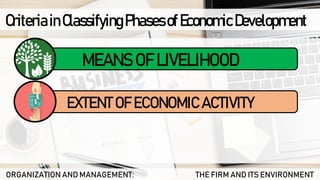
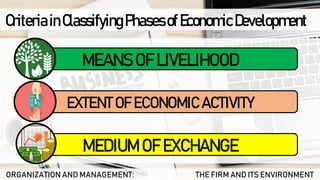
CriteriainClassifyingPhasesofEconomicDevelopment
ORGANIZATION AND MANAGEMENT: THE FIRM AND ITS ENVIRONMENT
MEANS OF LIVELIHOOD
ORGANIZATION AND MANAGEMENT: THE FIRM AND ITS ENVIRONMENT
MEANS OF LIVELIHOOD
Ancestors obtained
food by hunting and
fishing.
ORGANIZATION AND MANAGEMENT: THE FIRM AND ITS ENVIRONMENT
MEANS OF LIVELIHOOD
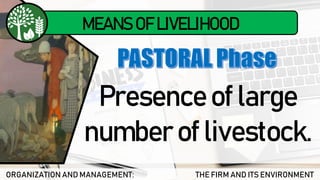
Presence of large
number of livestock.
ORGANIZATION AND MANAGEMENT: THE FIRM AND ITS ENVIRONMENT
MEANS OF LIVELIHOOD
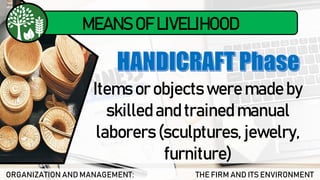
Items or objects were made by
skilled and trained manual
laborers (sculptures, jewelry,
furniture)
ORGANIZATION AND MANAGEMENT: THE FIRM AND ITS ENVIRONMENT
MEANS OF LIVELIHOOD
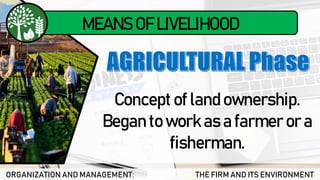
Concept of land ownership.
Began to work as a farmer or a
fisherman.
ORGANIZATION AND MANAGEMENT: THE FIRM AND ITS ENVIRONMENT
MEANS OF LIVELIHOOD
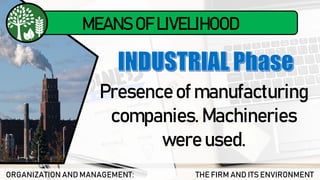
Presence of manufacturing
companies. Machineries
were used.
CriteriainClassifyingPhasesofEconomicDevelopment
ORGANIZATION AND MANAGEMENT: THE FIRM AND ITS ENVIRONMENT
MEANS OF LIVELIHOOD
EXTENT OF ECONOMIC ACTIVITY
ORGANIZATION AND MANAGEMENT: THE FIRM AND ITS ENVIRONMENT
The needs of the family
were satisfied first
through the contribution of
the family members.
EXTENT OF ECONOMIC ACTIVITY
ORGANIZATION AND MANAGEMENT: THE FIRM AND ITS ENVIRONMENT
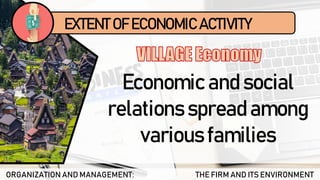
Economic and social
relations spread among
various families
EXTENT OF ECONOMIC ACTIVITY
ORGANIZATION AND MANAGEMENT: THE FIRM AND ITS ENVIRONMENT
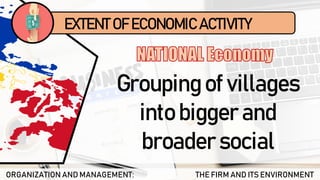
Grouping of villages
into bigger and
broader social
EXTENT OF ECONOMIC ACTIVITY
CriteriainClassifyingPhasesofEconomicDevelopment
ORGANIZATION AND MANAGEMENT: THE FIRM AND ITS ENVIRONMENT
MEANS OF LIVELIHOOD
EXTENT OF ECONOMIC ACTIVITY
MEDIUM OF EXCHANGE
ORGANIZATION AND MANAGEMENT: THE FIRM AND ITS ENVIRONMENT
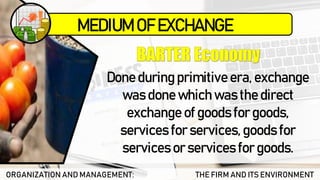
Done during primitive era, exchange
was done which was the direct
exchange of goods for goods,
services for services, goods for
services or services for goods.
MEDIUM OF EXCHANGE
ORGANIZATION AND MANAGEMENT: THE FIRM AND ITS ENVIRONMENT
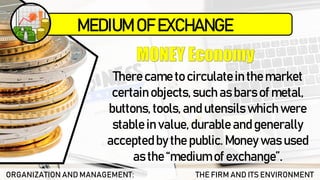
There came to circulatein the market
certain objects, such as bars of metal,
buttons, tools, and utensils which were
stable in value, durable and generally
acceptedby the public. Money was used
as the “medium of exchange”.
MEDIUM OF EXCHANGE
ORGANIZATION AND MANAGEMENT: THE FIRM AND ITS ENVIRONMENT
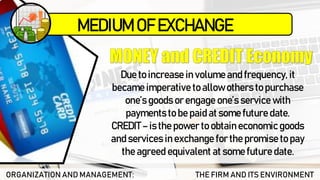
Due to increase in volume and frequency, it
became imperative to allow others to purchase
one’s goods or engage one’s service with
payments to be paid at some future date.
CREDIT – is the power to obtain economic goods
and services in exchange for the promise to pay
the agreed equivalent at some future date.
MEDIUM OF EXCHANGE
Chapter 2 lesson 3 phases of economic development

Chapter 2 lesson 3 phases of economic development

  • 1.
    THE FIRM ANDITS ENVIRONMENT
  • 2.
  • 3.
    ECONOMY ORGANIZATION AND MANAGEMENT:THE FIRM AND ITS ENVIRONMENT An economy encompasses all activity related to production, consumption and trade of goods and services in an area. An economy applies to everyone from individuals to entities such as corporations and governments. The economy of a particular region or country is governed by its culture, laws, history, and geography, among other factors, and it evolves due to necessity.
  • 4.
  • 5.
    ORGANIZATION AND MANAGEMENT:THE FIRM AND ITS ENVIRONMENT MEANS OF LIVELIHOOD Ancestors obtained food by hunting and fishing.
  • 6.
    ORGANIZATION AND MANAGEMENT:THE FIRM AND ITS ENVIRONMENT MEANS OF LIVELIHOOD Presence of large number of livestock.
  • 7.
    ORGANIZATION AND MANAGEMENT:THE FIRM AND ITS ENVIRONMENT MEANS OF LIVELIHOOD Items or objects were made by skilled and trained manual laborers (sculptures, jewelry, furniture)
  • 8.
    ORGANIZATION AND MANAGEMENT:THE FIRM AND ITS ENVIRONMENT MEANS OF LIVELIHOOD Concept of land ownership. Began to work as a farmer or a fisherman.
  • 9.
    ORGANIZATION AND MANAGEMENT:THE FIRM AND ITS ENVIRONMENT MEANS OF LIVELIHOOD Presence of manufacturing companies. Machineries were used.
  • 10.
    CriteriainClassifyingPhasesofEconomicDevelopment ORGANIZATION AND MANAGEMENT:THE FIRM AND ITS ENVIRONMENT MEANS OF LIVELIHOOD EXTENT OF ECONOMIC ACTIVITY
  • 11.
    ORGANIZATION AND MANAGEMENT:THE FIRM AND ITS ENVIRONMENT The needs of the family were satisfied first through the contribution of the family members. EXTENT OF ECONOMIC ACTIVITY
  • 12.
    ORGANIZATION AND MANAGEMENT:THE FIRM AND ITS ENVIRONMENT Economic and social relations spread among various families EXTENT OF ECONOMIC ACTIVITY
  • 13.
    ORGANIZATION AND MANAGEMENT:THE FIRM AND ITS ENVIRONMENT Grouping of villages into bigger and broader social EXTENT OF ECONOMIC ACTIVITY
  • 14.
    CriteriainClassifyingPhasesofEconomicDevelopment ORGANIZATION AND MANAGEMENT:THE FIRM AND ITS ENVIRONMENT MEANS OF LIVELIHOOD EXTENT OF ECONOMIC ACTIVITY MEDIUM OF EXCHANGE
  • 15.
    ORGANIZATION AND MANAGEMENT:THE FIRM AND ITS ENVIRONMENT Done during primitive era, exchange was done which was the direct exchange of goods for goods, services for services, goods for services or services for goods. MEDIUM OF EXCHANGE
  • 16.
    ORGANIZATION AND MANAGEMENT:THE FIRM AND ITS ENVIRONMENT There came to circulatein the market certain objects, such as bars of metal, buttons, tools, and utensils which were stable in value, durable and generally acceptedby the public. Money was used as the “medium of exchange”. MEDIUM OF EXCHANGE
  • 17.
    ORGANIZATION AND MANAGEMENT:THE FIRM AND ITS ENVIRONMENT Due to increase in volume and frequency, it became imperative to allow others to purchase one’s goods or engage one’s service with payments to be paid at some future date. CREDIT – is the power to obtain economic goods and services in exchange for the promise to pay the agreed equivalent at some future date. MEDIUM OF EXCHANGE