DAILY
LESSON LOG
School AMULUNG NATIONAL HIGH SCHOOL Grade Level 12
Teacher SM C. AGUSTIN Learning Area MEDIA & INFORMATION LITERACY
Teaching Dates
and Time
August 30-September 2, 2022 Quarter 1st SEMESTER
Monday Tuesday Wednesday Thursday Friday
I. WEEKLY OBJECTIVES
A. Content Standards
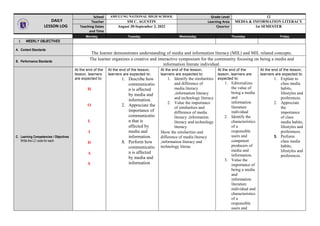
The learner demonstrates understanding of media and information literacy (MIL) and MIL related concepts.
B. Performance Standards
The learner organizes a creative and interactive symposium for the community focusing on being a media and
information literate individual.
C. Learning Competencies / Objectives
Write the LC code for each
At the end of the
lesson, learners
are expected to:
H
O
L
I
D
A
Y
At the end of the lesson,
learners are expected to:
1. Describe how
communicatio
n is affected
by media and
information.
2. Appreciate the
importance of
communicatio
n that is
affected by
media and
information.
3. Perform how
communicatio
n is affected
by media and
information
At the end of the lesson,
learners are expected to:
1. Identify the similarities
and difference of
media literacy
,information literacy
and technology literacy
2. Value the importance
of similarities and
difference of media
literacy ,information
literacy and technology
literacy
Show the similarities and
difference of media literacy
,information literacy and
technology literac
At the end of the
lesson, learners are
expected to:
1. Editorializes
the value of
being a media
and
information
literature
individual
2. Identify the
characteristics
of a
responsible
users and
competent
producers of
media and
information.
3. Value the
importance of
being a media
and
information
literature
individual and
characteristics
of a
responsible
users and
At the end of the lesson,
learners are expected to:
1. Explain to
class media
habits,
lifestyles and
preferences.
2. Appreciate
the
importance
of class
media habits,
lifestyles and
preferences.
3. Perform
class media
habits,
lifestyles and
preferences.
competent
producers of
media and
information.
4. Apply the
value of being
a media and
information
individual and
characteristics
of a
responsible
users and
competent
producers of
media and
information.
II. CONTENT
Introduction to Media and
Information Literacy
Introduction to Media and
Information Literacy
Introduction to
Media and
Information Literacy
Introduction to Media
and Information
Literacy
III. LEARNING RESOURCES
A. References
Book: K to 12 Basic Education Curriculum Senior High School – Core Subject
Code: MIL11/12IMIL-IIIa-1
1. Teacher’s Guide pages
2. Learner’s Mat erials pages
 LCD Projector, Laptop and PowerPoint Presentations
3. Textbook pages
4. Additional Materials from
Learning Resource (LR) portal
Internet based, powerpoint presentation, slideshare . net
B. Other Learning Resources
IV. PROCEDURES
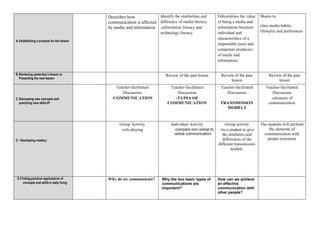
A.Establishing a purpose for the lesson
Describes how
communication is affected
by media and information
Identify the similarities and
difference of media literacy
,information literacy and
technology literacy
Editorializes the value
of being a media and
information literature
individual and
characteristics of a
responsible users and
competent producers
of media and
information.
Shares to
class media habits,
lifestyles and preferences
B.Reviewing yesterday’s lesson or
Presenting the new lesson
Review of the past lesson Review of the past
lesson
Review of the past
lesson
C.Discussing new concepts and
practicing new skills #1
Teacher-facilitated
Discussion
-COMMUNICATION
Teacher-facilitated
Discussion
-TYPES OF
COMMUNICATION
Teacher-facilitated
Discussion
-
TRANSMISSION
MODELS
Teacher-facilitated
Discussion
-elements of
communication
D. Developing mastery
Group Activity
-role playing
Individual Activity
-compare non-verbal to
verbal communication
Group activity
-As a student to give
the similaries and
differences of the
different transmission
models.
The students will perform
the elements of
communication with
proper execution
E.Finding practical applications of
concepts and skills in daily living
Why do we communicate? Why the two basic types of
communications are
important?
How can we achieve
an effective
communication with
other people?
Prepared by: Checked by: Noted:
SM C. AGUSTIN TM. GOROSPE GZ D. LUYUN
Teacher I Master Teacher II Principal II
F. Making generalizations and
abstractions about the lesson
WHAT IS
COMMUNICATION?
WHAT ARE THE TWO
BASIC TYPES OF
COMMUNICATIONS?
WHY IS
COMMUNICATION A
PROCESS?
WHAT ARE THE
IMPORTANT
ELEMENTS OF
COMMUNICATION?
G. Evaluating learning
Quiz Group activity Individual activity
- Using graphic
organizers
discuss the
Transmission
models.
Individual activity
-Picture Analysis
H. Additional activities for application or
remediation
V. REMARKS
VI. REFLECTION
A. No. of learners who earned 80% on the
formative assessment
B. No. of learners who require additional
activities for remediation.
C. Did the remedial lessons work? No. of
learners who have caught up with the
lesson.
D. No. of learners who continue to require
remediation
E. Which of my teaching strategies worked
well? Why did these work?
F. What difficulties did I encounter which my
principal or supervisor can help me solve?
G. What innovation or localized materials did I
use/discover which I wish to share with other
teachers?

1.-MEDIA-DLL week1.docx

  • 1.
    DAILY LESSON LOG School AMULUNGNATIONAL HIGH SCHOOL Grade Level 12 Teacher SM C. AGUSTIN Learning Area MEDIA & INFORMATION LITERACY Teaching Dates and Time August 30-September 2, 2022 Quarter 1st SEMESTER Monday Tuesday Wednesday Thursday Friday I. WEEKLY OBJECTIVES A. Content Standards The learner demonstrates understanding of media and information literacy (MIL) and MIL related concepts. B. Performance Standards The learner organizes a creative and interactive symposium for the community focusing on being a media and information literate individual. C. Learning Competencies / Objectives Write the LC code for each At the end of the lesson, learners are expected to: H O L I D A Y At the end of the lesson, learners are expected to: 1. Describe how communicatio n is affected by media and information. 2. Appreciate the importance of communicatio n that is affected by media and information. 3. Perform how communicatio n is affected by media and information At the end of the lesson, learners are expected to: 1. Identify the similarities and difference of media literacy ,information literacy and technology literacy 2. Value the importance of similarities and difference of media literacy ,information literacy and technology literacy Show the similarities and difference of media literacy ,information literacy and technology literac At the end of the lesson, learners are expected to: 1. Editorializes the value of being a media and information literature individual 2. Identify the characteristics of a responsible users and competent producers of media and information. 3. Value the importance of being a media and information literature individual and characteristics of a responsible users and At the end of the lesson, learners are expected to: 1. Explain to class media habits, lifestyles and preferences. 2. Appreciate the importance of class media habits, lifestyles and preferences. 3. Perform class media habits, lifestyles and preferences.
  • 2.
    competent producers of media and information. 4.Apply the value of being a media and information individual and characteristics of a responsible users and competent producers of media and information. II. CONTENT Introduction to Media and Information Literacy Introduction to Media and Information Literacy Introduction to Media and Information Literacy Introduction to Media and Information Literacy III. LEARNING RESOURCES A. References Book: K to 12 Basic Education Curriculum Senior High School – Core Subject Code: MIL11/12IMIL-IIIa-1 1. Teacher’s Guide pages 2. Learner’s Mat erials pages  LCD Projector, Laptop and PowerPoint Presentations 3. Textbook pages 4. Additional Materials from Learning Resource (LR) portal Internet based, powerpoint presentation, slideshare . net B. Other Learning Resources IV. PROCEDURES
  • 3.
    A.Establishing a purposefor the lesson Describes how communication is affected by media and information Identify the similarities and difference of media literacy ,information literacy and technology literacy Editorializes the value of being a media and information literature individual and characteristics of a responsible users and competent producers of media and information. Shares to class media habits, lifestyles and preferences B.Reviewing yesterday’s lesson or Presenting the new lesson Review of the past lesson Review of the past lesson Review of the past lesson C.Discussing new concepts and practicing new skills #1 Teacher-facilitated Discussion -COMMUNICATION Teacher-facilitated Discussion -TYPES OF COMMUNICATION Teacher-facilitated Discussion - TRANSMISSION MODELS Teacher-facilitated Discussion -elements of communication D. Developing mastery Group Activity -role playing Individual Activity -compare non-verbal to verbal communication Group activity -As a student to give the similaries and differences of the different transmission models. The students will perform the elements of communication with proper execution E.Finding practical applications of concepts and skills in daily living Why do we communicate? Why the two basic types of communications are important? How can we achieve an effective communication with other people?
  • 4.
    Prepared by: Checkedby: Noted: SM C. AGUSTIN TM. GOROSPE GZ D. LUYUN Teacher I Master Teacher II Principal II F. Making generalizations and abstractions about the lesson WHAT IS COMMUNICATION? WHAT ARE THE TWO BASIC TYPES OF COMMUNICATIONS? WHY IS COMMUNICATION A PROCESS? WHAT ARE THE IMPORTANT ELEMENTS OF COMMUNICATION? G. Evaluating learning Quiz Group activity Individual activity - Using graphic organizers discuss the Transmission models. Individual activity -Picture Analysis H. Additional activities for application or remediation V. REMARKS VI. REFLECTION A. No. of learners who earned 80% on the formative assessment B. No. of learners who require additional activities for remediation. C. Did the remedial lessons work? No. of learners who have caught up with the lesson. D. No. of learners who continue to require remediation E. Which of my teaching strategies worked well? Why did these work? F. What difficulties did I encounter which my principal or supervisor can help me solve? G. What innovation or localized materials did I use/discover which I wish to share with other teachers?