Industrial sectors
Main article: Industrial organization
Further information: Industrial loan company


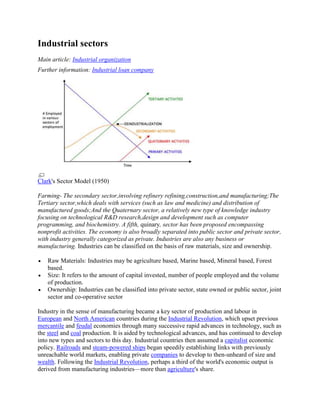
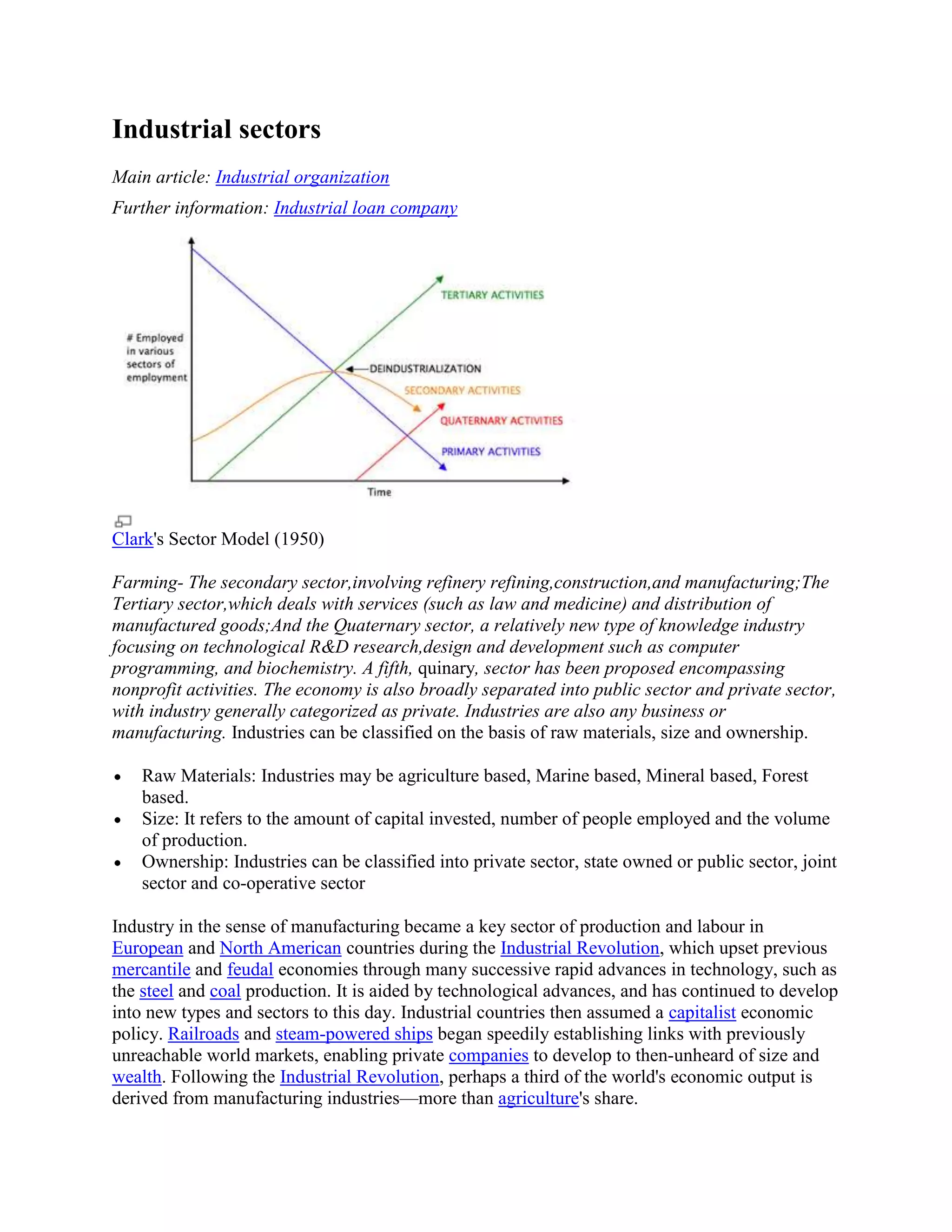
Clark's Sector Model (1950)

Farming- The secondary sector,involving refinery refining,construction,and manufacturing;The
Tertiary sector,which deals with services (such as law and medicine) and distribution of
manufactured goods;And the Quaternary sector, a relatively new type of knowledge industry
focusing on technological R&D research,design and development such as computer
programming, and biochemistry. A fifth, quinary, sector has been proposed encompassing
nonprofit activities. The economy is also broadly separated into public sector and private sector,
with industry generally categorized as private. Industries are also any business or
manufacturing. Industries can be classified on the basis of raw materials, size and ownership.

    Raw Materials: Industries may be agriculture based, Marine based, Mineral based, Forest
    based.
    Size: It refers to the amount of capital invested, number of people employed and the volume
    of production.
    Ownership: Industries can be classified into private sector, state owned or public sector, joint
    sector and co-operative sector

Industry in the sense of manufacturing became a key sector of production and labour in
European and North American countries during the Industrial Revolution, which upset previous
mercantile and feudal economies through many successive rapid advances in technology, such as
the steel and coal production. It is aided by technological advances, and has continued to develop
into new types and sectors to this day. Industrial countries then assumed a capitalist economic
policy. Railroads and steam-powered ships began speedily establishing links with previously
unreachable world markets, enabling private companies to develop to then-unheard of size and
wealth. Following the Industrial Revolution, perhaps a third of the world's economic output is
derived from manufacturing industries—more than agriculture's share.
Many developed countries and many developing/semi-developed countries (People's Republic of
China, India etc.) depend significantly on industry. Industries, the countries they reside in, and
the economies of those countries are interlinked in a complex web of interdependence.

Industry is divided into four sectors. They are:

  Sector                                         Definition
           This involves the extraction of resources directly from the Earth, this includes
Primary    farming, mining and logging. They do not process the products at all. They send it
           off to factories to make a profit.
           This group is involved in the processing products from primary industries. This
Secondary includes all factories—those that refine metals, produce furniture, or pack farm
           products such as meat.
           This group is involved in the provision of services. They include teachers, managers
Tertiary
           and other service providers.
           This group is involved in the research of science and technology. They include
Quaternary
           scientists.

As a country develops people move away from the primary sector to secondary and then to
tertiary.

There are many other different kinds of industries, and often organized into different classes or
sectors by a variety of industrial classifications.

Industry classification systems used by the government[which?] commonly divide industry into
three sectors: agriculture, manufacturing, and services. The primary sector of industry is
agriculture, mining and raw material extraction. The secondary sector of industry is
manufacturing. The tertiary sector of industry is service production. Sometimes, one talks about
a quaternary sector of industry, consisting of intellectual services such as research and
development (R&D).

Market-based classification systems such as the Global Industry Classification Standard and the
Industry Classification Benchmark are used in finance and market research. These classification
systems commonly divide industries according to similar functions and markets and identify
businesses producing related products.

Industries can also be identified by product: chemical industry, petroleum industry, automotive
industry, electronic industry, meatpacking industry, hospitality industry, food industry, fish
industry, software industry, paper industry, entertainment industry, semiconductor industry,
cultural industry, poverty industry

    labor-intensive industry - capital-intensive industry
    light industry - heavy industry

New microsoft office word document

  • 1.
    Industrial sectors Main article:Industrial organization Further information: Industrial loan company Clark's Sector Model (1950) Farming- The secondary sector,involving refinery refining,construction,and manufacturing;The Tertiary sector,which deals with services (such as law and medicine) and distribution of manufactured goods;And the Quaternary sector, a relatively new type of knowledge industry focusing on technological R&D research,design and development such as computer programming, and biochemistry. A fifth, quinary, sector has been proposed encompassing nonprofit activities. The economy is also broadly separated into public sector and private sector, with industry generally categorized as private. Industries are also any business or manufacturing. Industries can be classified on the basis of raw materials, size and ownership. Raw Materials: Industries may be agriculture based, Marine based, Mineral based, Forest based. Size: It refers to the amount of capital invested, number of people employed and the volume of production. Ownership: Industries can be classified into private sector, state owned or public sector, joint sector and co-operative sector Industry in the sense of manufacturing became a key sector of production and labour in European and North American countries during the Industrial Revolution, which upset previous mercantile and feudal economies through many successive rapid advances in technology, such as the steel and coal production. It is aided by technological advances, and has continued to develop into new types and sectors to this day. Industrial countries then assumed a capitalist economic policy. Railroads and steam-powered ships began speedily establishing links with previously unreachable world markets, enabling private companies to develop to then-unheard of size and wealth. Following the Industrial Revolution, perhaps a third of the world's economic output is derived from manufacturing industries—more than agriculture's share.
  • 2.
    Many developed countriesand many developing/semi-developed countries (People's Republic of China, India etc.) depend significantly on industry. Industries, the countries they reside in, and the economies of those countries are interlinked in a complex web of interdependence. Industry is divided into four sectors. They are: Sector Definition This involves the extraction of resources directly from the Earth, this includes Primary farming, mining and logging. They do not process the products at all. They send it off to factories to make a profit. This group is involved in the processing products from primary industries. This Secondary includes all factories—those that refine metals, produce furniture, or pack farm products such as meat. This group is involved in the provision of services. They include teachers, managers Tertiary and other service providers. This group is involved in the research of science and technology. They include Quaternary scientists. As a country develops people move away from the primary sector to secondary and then to tertiary. There are many other different kinds of industries, and often organized into different classes or sectors by a variety of industrial classifications. Industry classification systems used by the government[which?] commonly divide industry into three sectors: agriculture, manufacturing, and services. The primary sector of industry is agriculture, mining and raw material extraction. The secondary sector of industry is manufacturing. The tertiary sector of industry is service production. Sometimes, one talks about a quaternary sector of industry, consisting of intellectual services such as research and development (R&D). Market-based classification systems such as the Global Industry Classification Standard and the Industry Classification Benchmark are used in finance and market research. These classification systems commonly divide industries according to similar functions and markets and identify businesses producing related products. Industries can also be identified by product: chemical industry, petroleum industry, automotive industry, electronic industry, meatpacking industry, hospitality industry, food industry, fish industry, software industry, paper industry, entertainment industry, semiconductor industry, cultural industry, poverty industry labor-intensive industry - capital-intensive industry light industry - heavy industry