Types of Text Structures
Objectives
• At the end of this module, you are expected
to:
1. Enumerate various texts structures;
2. Extract information from different text
structures; and
3. Employ a type of language/discipline in
crafting an academic text.
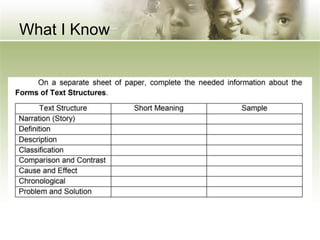
What I Know
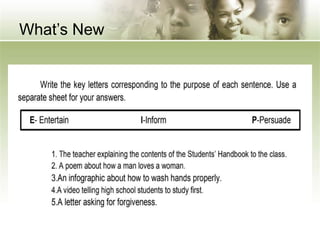
What’s New
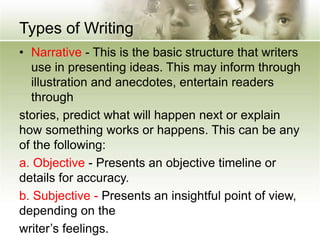
Types of Writing
• Narrative - This is the basic structure that writers
use in presenting ideas. This may inform through
illustration and anecdotes, entertain readers
through
stories, predict what will happen next or explain
how something works or happens. This can be any
of the following:
a. Objective - Presents an objective timeline or
details for accuracy.
b. Subjective - Presents an insightful point of view,
depending on the
writer’s feelings.
Argumentative
2. Argumentative - This goes beyond
giving information, writers use this to let
readers understand their side of an
argument, with analysis
and support to their claims, this should
have valid reasoning
and enough evidence.
details and well-chosen
sequences.
• This basically just to develop
ideas using techniques to present
details and well-chosen
sequences.
Types of Structures
1. Definition – used in explaining unfamiliar terms
either to explain or to convince.
• a. Standard Definition – Universally-accepted
and rarely changes.
• For example: definition of essay.
• b. Regulatory Definition – Assigned meanings
based on an organization,
• regulating body and changes on situations.
• For example: classification of typhoon signal as
per PAG-ASA
• c. Personal Definition – This depends on the
interpretations of the writer
• and as experienced by the writer.
• For Example: what is a true friend?
• d. Invented Definition – Given meanings to word
coined and as used by
• society.
• For example: the definition of “first blood” in
Mobile Legends.
• 2. Description - used by writers to describe
something. These may be an object,
• a person, place, experience, emotion, situation,
event, etc.
• 3. Classification – used by writers to organize
ideas into categories.
• For example: kinds of On-line games.
• 4. Comparison and Contrast – used to show how
two ideas are alike and different. Writers present
information by chunks and by following a
sequence.
• For example: IOS and android are both system
used in mobile cellular phones.
• IOS is a more closed system which does not
allow customer or user
• customization while android system is more open
as it allows users or
• customers to download a wider variety of
applications.
• 5. Cause and Effect – used to
explain why things happen, and
the results of a
• certain phenomenon. Writers
enumerate factors and possible
outcomes
• resulting to phenomena or events.
• 6. Chronological – used to show order of things,
how something happens and
• the logical arrangement of things. This structure
lends itself in other text
• structures in a sense that in narrating writers
need to present a timeline of
• events; in persuading people, writers enumerate
evidence in a sequence.
• 7. Problem and Solution – used in
showing patterns of organization
where a
• dilemma is explained either
through a solution or a dilemma is
explained and a
• solution/s is/are given.
Homework

Types of Text Structures.pptx

  • 1.
    Types of TextStructures
  • 2.
    Objectives • At theend of this module, you are expected to: 1. Enumerate various texts structures; 2. Extract information from different text structures; and 3. Employ a type of language/discipline in crafting an academic text.
  • 3.
  • 4.
  • 5.
    Types of Writing •Narrative - This is the basic structure that writers use in presenting ideas. This may inform through illustration and anecdotes, entertain readers through stories, predict what will happen next or explain how something works or happens. This can be any of the following: a. Objective - Presents an objective timeline or details for accuracy. b. Subjective - Presents an insightful point of view, depending on the writer’s feelings.
  • 6.
    Argumentative 2. Argumentative -This goes beyond giving information, writers use this to let readers understand their side of an argument, with analysis and support to their claims, this should have valid reasoning and enough evidence.
  • 7.
    details and well-chosen sequences. •This basically just to develop ideas using techniques to present details and well-chosen sequences.
  • 8.
    Types of Structures 1.Definition – used in explaining unfamiliar terms either to explain or to convince. • a. Standard Definition – Universally-accepted and rarely changes. • For example: definition of essay. • b. Regulatory Definition – Assigned meanings based on an organization, • regulating body and changes on situations. • For example: classification of typhoon signal as per PAG-ASA
  • 9.
    • c. PersonalDefinition – This depends on the interpretations of the writer • and as experienced by the writer. • For Example: what is a true friend? • d. Invented Definition – Given meanings to word coined and as used by • society. • For example: the definition of “first blood” in Mobile Legends.
  • 10.
    • 2. Description- used by writers to describe something. These may be an object, • a person, place, experience, emotion, situation, event, etc. • 3. Classification – used by writers to organize ideas into categories. • For example: kinds of On-line games.
  • 11.
    • 4. Comparisonand Contrast – used to show how two ideas are alike and different. Writers present information by chunks and by following a sequence. • For example: IOS and android are both system used in mobile cellular phones. • IOS is a more closed system which does not allow customer or user • customization while android system is more open as it allows users or • customers to download a wider variety of applications.
  • 12.
    • 5. Causeand Effect – used to explain why things happen, and the results of a • certain phenomenon. Writers enumerate factors and possible outcomes • resulting to phenomena or events.
  • 13.
    • 6. Chronological– used to show order of things, how something happens and • the logical arrangement of things. This structure lends itself in other text • structures in a sense that in narrating writers need to present a timeline of • events; in persuading people, writers enumerate evidence in a sequence.
  • 14.
    • 7. Problemand Solution – used in showing patterns of organization where a • dilemma is explained either through a solution or a dilemma is explained and a • solution/s is/are given.
  • 16.