SUMMARIZING
Title of your Slide
• Writing a
summary is like
picking out what
we need from a
supermarket.
• What parts of a
text are usually
the most
important? What
do we look for

when
summarizing?
Date Your Footer Here 2
SUMMARIZING
•Taking larger selections of text and reduce them
to their bare essentials: the gist, the key ideas, the
main points that are worth noting and
remembering.
•“the general idea in brief form”
•the distillation, condensation, or reduction of a
larger work into its primary notions
Date Your Footer Here 3
BASIC RULES IN SUMMARIZING
A. Erase things that don’t matter.
B. Erase things that repeat.
C. Trade, general terms for specific names.

D. Use your own words to write the summary.
Date Your Footer Here 4
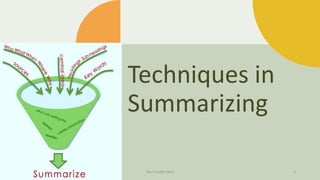
Techniques in
Summarizing
Date Your Footer Here 5
TECHNIQUES IN SUMMARIZING
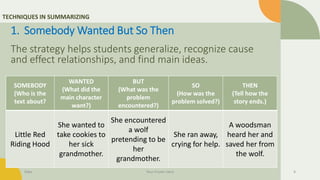
1. Somebody Wanted But So Then
The strategy helps students generalize, recognize cause
and effect relationships, and find main ideas.
Date Your Footer Here 6
SOMEBODY
(Who is the
text about?
WANTED
(What did the
main character
want?)
BUT
(What was the
problem
encountered?)
SO
(How was the
problem solved?)
THEN
(Tell how the
story ends.)
Little Red
Riding Hood
She wanted to
take cookies to
her sick
grandmother.
She encountered
a wolf
pretending to be
her
grandmother.
She ran away,
crying for help.

A woodsman
heard her and
saved her from
the wolf.
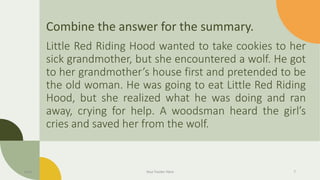
Combine the answer for the summary.
Little Red Riding Hood wanted to take cookies to her
sick grandmother, but she encountered a wolf. He got
to her grandmother’s house first and pretended to be
the old woman. He was going to eat Little Red Riding
Hood, but she realized what he was doing and ran
away, crying for help. A woodsman heard the girl’s
cries and saved her from the wolf.
Date Your Footer Here 7
TECHNIQUES IN SUMMARIZING
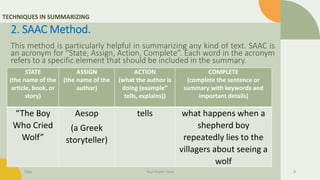
2. SAAC Method.
This method is particularly helpful in summarizing any kind of text. SAAC is
an acronym for “State, Assign, Action, Complete”. Each word in the acronym
refers to a specific element that should be included in the summary.
Date Your Footer Here 8
STATE
(the name of the
article, book, or
story)
ASSIGN
(the name of the
author)
ACTION
(what the author is
doing (example”
tells, explains))
COMPLETE
(complete the sentence or
summary with keywords and
important details)
“The Boy
Who Cried
Wolf”
Aesop
(a Greek
storyteller)
tells what happens when a
shepherd boy
repeatedly lies to the
villagers about seeing a
wolf
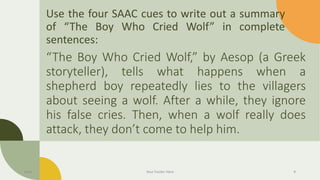
Use the four SAAC cues to write out a summary
of “The Boy Who Cried Wolf” in complete
sentences:
“The Boy Who Cried Wolf,” by Aesop (a Greek
storyteller), tells what happens when a
shepherd boy repeatedly lies to the villagers
about seeing a wolf. After a while, they ignore
his false cries. Then, when a wolf really does
attack, they don’t come to help him.
Date Your Footer Here 9
TECHNIQUES IN SUMMARIZING
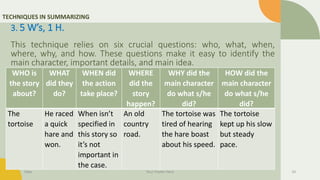
3. 5 W’s, 1 H.
This technique relies on six crucial questions: who, what, when,
where, why, and how. These questions make it easy to identify the
main character, important details, and main idea.
Date Your Footer Here 10
WHO is
the story
about?
WHAT
did they
do?
WHEN did
the action
take place?
WHERE
did the
story
happen?
WHY did the
main character
do what s/he
did?
HOW did the
main character
do what s/he
did?
The
tortoise
He raced
a quick
hare and
won.
When isn’t
specified in
this story so
it’s not
important in
the case.
An old
country
road.
The tortoise was
tired of hearing
the hare boast
about his speed.
The tortoise
kept up his slow
but steady
pace.
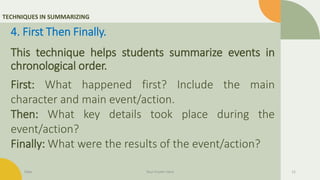
TECHNIQUES IN SUMMARIZING
4. First Then Finally.
This technique helps students summarize events in
chronological order.
First: What happened first? Include the main
character and main event/action.
Then: What key details took place during the
event/action?
Finally: What were the results of the event/action?
Date Your Footer Here 11
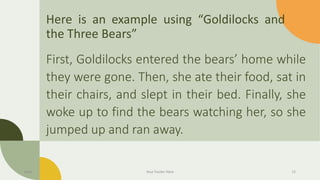
Here is an example using “Goldilocks and
the Three Bears”
First, Goldilocks entered the bears’ home while
they were gone. Then, she ate their food, sat in
their chairs, and slept in their bed. Finally, she
woke up to find the bears watching her, so she
jumped up and ran away.
Date Your Footer Here 12
TECHNIQUES IN SUMMARIZING
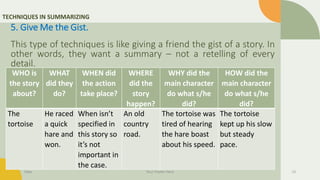
5. Give Me the Gist.
This type of techniques is like giving a friend the gist of a story. In
other words, they want a summary – not a retelling of every
detail.
Date Your Footer Here 13
WHO is
the story
about?
WHAT
did they
do?
WHEN did
the action
take place?
WHERE
did the
story
happen?
WHY did the
main character
do what s/he
did?
HOW did the
main character
do what s/he
did?
The
tortoise
He raced
a quick
hare and
won.
When isn’t
specified in
this story so
it’s not
important in
the case.
An old
country
road.
The tortoise was
tired of hearing
the hare boast
about his speed.
The tortoise
kept up his slow
but steady
pace.
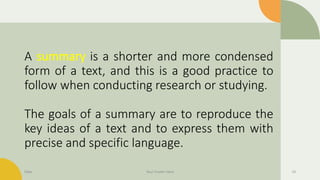
A summary is a shorter and more condensed
form of a text, and this is a good practice to
follow when conducting research or studying.
The goals of a summary are to reproduce the
key ideas of a text and to express them with
precise and specific language.
Date Your Footer Here 14
A proper summary can be used to help
you return to pertinent information you
might need for your academic writing.
Date Your Footer Here 15
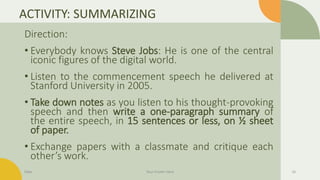
ACTIVITY: SUMMARIZING
Direction:
• Everybody knows Steve Jobs: He is one of the central
iconic figures of the digital world.
• Listen to the commencement speech he delivered at
Stanford University in 2005.
• Take down notes as you listen to his thought-provoking
speech and then write a one-paragraph summary of
the entire speech, in 15 sentences or less, on ½ sheet
of paper.
• Exchange papers with a classmate and critique each
other’s work.
Date Your Footer Here 16
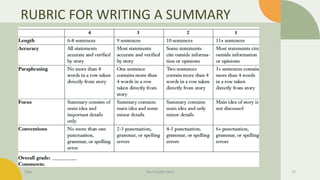
RUBRIC FOR WRITING A SUMMARY
Date Your Footer Here 17
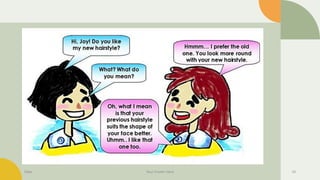
PARAPHRASING
Date Your Footer Here 19
How do
researchers
put together
a paper that
makes sense
using various
sources?
Date Your Footer Here 20
PARAPHRASING
Paraphrasing is a restatement of a text,
passage, or work and to give the
meaning in another form.
Date Your Footer Here 21
Characteristics of a Good Paraphrase
● relays the information from the source
text in your own words
● leads the readers to the source of
the information
Date Your Footer Here 22
Date Your Footer Here 23
When to Paraphrase?
•Paraphrase when dealing with short texts with one
or two sentences or a paragraph with five
sentences.
•Paraphrase when you want to minimize direct
quotation.
•Paraphrase when you want to rewrite the author’s
words without changing the meaning of the source
text.
Date Your Footer Here 24
Kinds of Paraphrasing
•change of parts of speech
•change of structure
•clause reduction
•synonym replacement
Date Your Footer Here 25
Change of Parts of Speech
The function of some words
in a sentence are changed
to a different part of
speech.
Date Your Footer Here 26
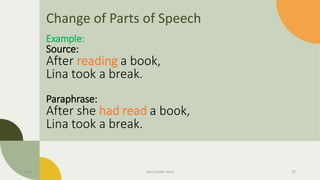
Change of Parts of Speech
Example:
Source:
After reading a book,
Lina took a break.
Paraphrase:
After she had read a book,
Lina took a break.
Date Your Footer Here 27
Change of Structure
The structure of the
sentence is changed to
reflect the writer’s
interpretation of the source
text.
Date Your Footer Here 28
Change of Structure
Source:
Ms. Jen will be teaching English
next semester.
Paraphrase:
Next semester,
English will be taught by Ms. Jen.
Date Your Footer Here 29
Clause Reduction
Clauses are reduced or
changed to phrases
to lessen confusion and
interruption
and make the sentence
simpler.
Date Your Footer Here 30
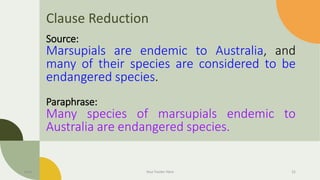
Clause Reduction
Source:
Marsupials are endemic to Australia, and
many of their species are considered to be
endangered species.
Paraphrase:
Many species of marsupials endemic to
Australia are endangered species.
Date Your Footer Here 31
Synonym Replacement
It involves the change of
words in the sentence with
similar words or synonyms.
Date Your Footer Here 32
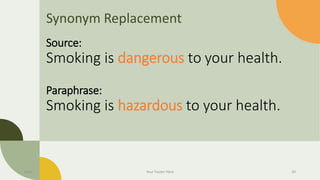
Synonym Replacement
Source:
Smoking is dangerous to your health.
Paraphrase:
Smoking is hazardous to your health.
Date Your Footer Here 33
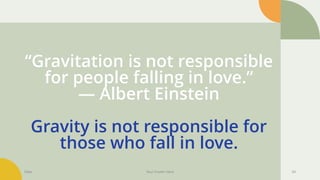
“Gravitation is not responsible
for people falling in love.”
― Albert Einstein
Gravity is not responsible for
those who fall in love.
Date Your Footer Here 34
Plagiarism
Date Your Footer Here 35
What is Plagiarism?
claiming ownership
of material that is
not your own
Date Your Footer Here 36
Kinds of
Plagiarism
Date Your Footer Here 37
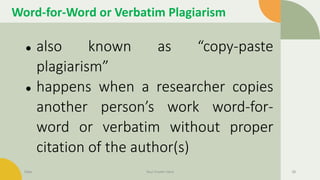
Word-for-Word or Verbatim Plagiarism
● also known as “copy-paste
plagiarism”
● happens when a researcher copies
another person’s work word-for-
word or verbatim without proper
citation of the author(s)
Date Your Footer Here 38
Word-for-Word or Verbatim Plagiarism
“The measure of intelligence is the
ability to change.”
― Albert Einstein
The measure of intelligence is the ability
to change.
Date Your Footer Here 39
Word Order Plagiarism
happens when a writer changes some
of the words of the author(s) by
looking at the synonyms of the words
and replacing or rearranging them to
make the text look as if it were their
own.
Date Your Footer Here 40
Word Order Plagiarism
“The measure of intelligence is the ability
to change.”
― Albert Einstein
The ability to change is the measure
of intelligence.
Date Your Footer Here 41
Idea Plagiarism
happens when a writer
paraphrases the work of another
in his or her own writing but does
not properly cite or attribute the
idea to the author(s)
Date Your Footer Here 42
Idea Plagiarism
“The measure of intelligence is the
ability to change.”
― Albert Einstein
Your ability to change says a lot
about your intelligence.
Date Your Footer Here 43
Idea Plagiarism
happens when a writer
paraphrases the work of another
in his or her own writing but does
not properly cite or attribute the
idea to the author(s)
Date Your Footer Here 44
What makes an
appropriate
paraphrase?
Date Your Footer Here 45
Date Your Footer Here 46
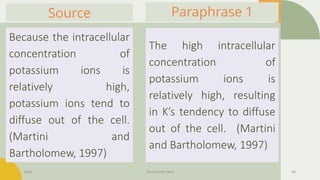
Paraphrase 1
Because the intracellular
concentration of
potassium ions is
relatively high,
potassium ions tend to
diffuse out of the cell.
(Martini and
Bartholomew, 1997)
Source
The high intracellular
concentration of
potassium ions is
relatively high, resulting
in K’s tendency to diffuse
out of the cell. (Martini
and Bartholomew, 1997)
Date Your Footer Here 47
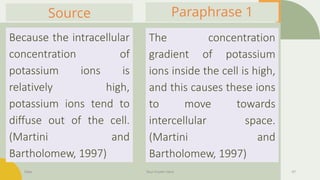
Paraphrase 1
Because the intracellular
concentration of
potassium ions is
relatively high,
potassium ions tend to
diffuse out of the cell.
(Martini and
Bartholomew, 1997)
Source
The concentration
gradient of potassium
ions inside the cell is high,
and this causes these ions
to move towards
intercellular space.
(Martini and
Bartholomew, 1997)
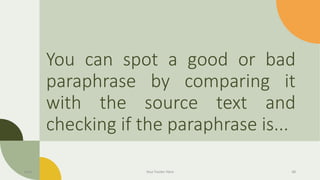
You can spot a good or bad
paraphrase by comparing it
with the source text and
checking if the paraphrase is...
Date Your Footer Here 48
❑the writer’s understanding of the
source text, or
❑copied portions of the text or
committed plagiarism.
Date Your Footer Here 49
Thank You!
Date Your Footer Here 50

EAPP LESSON 2 SUMMARIZING AND PARAPHRASING.pdf

  • 1.
  • 2.
    Title of yourSlide • Writing a summary is like picking out what we need from a supermarket. • What parts of a text are usually the most important? What do we look for when summarizing? Date Your Footer Here 2
  • 3.
    SUMMARIZING •Taking larger selectionsof text and reduce them to their bare essentials: the gist, the key ideas, the main points that are worth noting and remembering. •“the general idea in brief form” •the distillation, condensation, or reduction of a larger work into its primary notions Date Your Footer Here 3
  • 4.
    BASIC RULES INSUMMARIZING A. Erase things that don’t matter. B. Erase things that repeat. C. Trade, general terms for specific names. D. Use your own words to write the summary. Date Your Footer Here 4
  • 5.
  • 6.
    TECHNIQUES IN SUMMARIZING 1.Somebody Wanted But So Then The strategy helps students generalize, recognize cause and effect relationships, and find main ideas. Date Your Footer Here 6 SOMEBODY (Who is the text about? WANTED (What did the main character want?) BUT (What was the problem encountered?) SO (How was the problem solved?) THEN (Tell how the story ends.) Little Red Riding Hood She wanted to take cookies to her sick grandmother. She encountered a wolf pretending to be her grandmother. She ran away, crying for help. A woodsman heard her and saved her from the wolf.
  • 7.
    Combine the answerfor the summary. Little Red Riding Hood wanted to take cookies to her sick grandmother, but she encountered a wolf. He got to her grandmother’s house first and pretended to be the old woman. He was going to eat Little Red Riding Hood, but she realized what he was doing and ran away, crying for help. A woodsman heard the girl’s cries and saved her from the wolf. Date Your Footer Here 7
  • 8.
    TECHNIQUES IN SUMMARIZING 2.SAAC Method. This method is particularly helpful in summarizing any kind of text. SAAC is an acronym for “State, Assign, Action, Complete”. Each word in the acronym refers to a specific element that should be included in the summary. Date Your Footer Here 8 STATE (the name of the article, book, or story) ASSIGN (the name of the author) ACTION (what the author is doing (example” tells, explains)) COMPLETE (complete the sentence or summary with keywords and important details) “The Boy Who Cried Wolf” Aesop (a Greek storyteller) tells what happens when a shepherd boy repeatedly lies to the villagers about seeing a wolf
  • 9.
    Use the fourSAAC cues to write out a summary of “The Boy Who Cried Wolf” in complete sentences: “The Boy Who Cried Wolf,” by Aesop (a Greek storyteller), tells what happens when a shepherd boy repeatedly lies to the villagers about seeing a wolf. After a while, they ignore his false cries. Then, when a wolf really does attack, they don’t come to help him. Date Your Footer Here 9
  • 10.
    TECHNIQUES IN SUMMARIZING 3.5 W’s, 1 H. This technique relies on six crucial questions: who, what, when, where, why, and how. These questions make it easy to identify the main character, important details, and main idea. Date Your Footer Here 10 WHO is the story about? WHAT did they do? WHEN did the action take place? WHERE did the story happen? WHY did the main character do what s/he did? HOW did the main character do what s/he did? The tortoise He raced a quick hare and won. When isn’t specified in this story so it’s not important in the case. An old country road. The tortoise was tired of hearing the hare boast about his speed. The tortoise kept up his slow but steady pace.
  • 11.
    TECHNIQUES IN SUMMARIZING 4.First Then Finally. This technique helps students summarize events in chronological order. First: What happened first? Include the main character and main event/action. Then: What key details took place during the event/action? Finally: What were the results of the event/action? Date Your Footer Here 11
  • 12.
    Here is anexample using “Goldilocks and the Three Bears” First, Goldilocks entered the bears’ home while they were gone. Then, she ate their food, sat in their chairs, and slept in their bed. Finally, she woke up to find the bears watching her, so she jumped up and ran away. Date Your Footer Here 12
  • 13.
    TECHNIQUES IN SUMMARIZING 5.Give Me the Gist. This type of techniques is like giving a friend the gist of a story. In other words, they want a summary – not a retelling of every detail. Date Your Footer Here 13 WHO is the story about? WHAT did they do? WHEN did the action take place? WHERE did the story happen? WHY did the main character do what s/he did? HOW did the main character do what s/he did? The tortoise He raced a quick hare and won. When isn’t specified in this story so it’s not important in the case. An old country road. The tortoise was tired of hearing the hare boast about his speed. The tortoise kept up his slow but steady pace.
  • 14.
    A summary isa shorter and more condensed form of a text, and this is a good practice to follow when conducting research or studying. The goals of a summary are to reproduce the key ideas of a text and to express them with precise and specific language. Date Your Footer Here 14
  • 15.
    A proper summarycan be used to help you return to pertinent information you might need for your academic writing. Date Your Footer Here 15
  • 16.
    ACTIVITY: SUMMARIZING Direction: • Everybodyknows Steve Jobs: He is one of the central iconic figures of the digital world. • Listen to the commencement speech he delivered at Stanford University in 2005. • Take down notes as you listen to his thought-provoking speech and then write a one-paragraph summary of the entire speech, in 15 sentences or less, on ½ sheet of paper. • Exchange papers with a classmate and critique each other’s work. Date Your Footer Here 16
  • 17.
    RUBRIC FOR WRITINGA SUMMARY Date Your Footer Here 17
  • 18.
  • 19.
  • 20.
    How do researchers put together apaper that makes sense using various sources? Date Your Footer Here 20
  • 21.
    PARAPHRASING Paraphrasing is arestatement of a text, passage, or work and to give the meaning in another form. Date Your Footer Here 21
  • 22.
    Characteristics of aGood Paraphrase ● relays the information from the source text in your own words ● leads the readers to the source of the information Date Your Footer Here 22
  • 23.
  • 24.
    When to Paraphrase? •Paraphrasewhen dealing with short texts with one or two sentences or a paragraph with five sentences. •Paraphrase when you want to minimize direct quotation. •Paraphrase when you want to rewrite the author’s words without changing the meaning of the source text. Date Your Footer Here 24
  • 25.
    Kinds of Paraphrasing •changeof parts of speech •change of structure •clause reduction •synonym replacement Date Your Footer Here 25
  • 26.
    Change of Partsof Speech The function of some words in a sentence are changed to a different part of speech. Date Your Footer Here 26
  • 27.
    Change of Partsof Speech Example: Source: After reading a book, Lina took a break. Paraphrase: After she had read a book, Lina took a break. Date Your Footer Here 27
  • 28.
    Change of Structure Thestructure of the sentence is changed to reflect the writer’s interpretation of the source text. Date Your Footer Here 28
  • 29.
    Change of Structure Source: Ms.Jen will be teaching English next semester. Paraphrase: Next semester, English will be taught by Ms. Jen. Date Your Footer Here 29
  • 30.
    Clause Reduction Clauses arereduced or changed to phrases to lessen confusion and interruption and make the sentence simpler. Date Your Footer Here 30
  • 31.
    Clause Reduction Source: Marsupials areendemic to Australia, and many of their species are considered to be endangered species. Paraphrase: Many species of marsupials endemic to Australia are endangered species. Date Your Footer Here 31
  • 32.
    Synonym Replacement It involvesthe change of words in the sentence with similar words or synonyms. Date Your Footer Here 32
  • 33.
    Synonym Replacement Source: Smoking isdangerous to your health. Paraphrase: Smoking is hazardous to your health. Date Your Footer Here 33
  • 34.
    “Gravitation is notresponsible for people falling in love.” ― Albert Einstein Gravity is not responsible for those who fall in love. Date Your Footer Here 34
  • 35.
  • 36.
    What is Plagiarism? claimingownership of material that is not your own Date Your Footer Here 36
  • 37.
  • 38.
    Word-for-Word or VerbatimPlagiarism ● also known as “copy-paste plagiarism” ● happens when a researcher copies another person’s work word-for- word or verbatim without proper citation of the author(s) Date Your Footer Here 38
  • 39.
    Word-for-Word or VerbatimPlagiarism “The measure of intelligence is the ability to change.” ― Albert Einstein The measure of intelligence is the ability to change. Date Your Footer Here 39
  • 40.
    Word Order Plagiarism happenswhen a writer changes some of the words of the author(s) by looking at the synonyms of the words and replacing or rearranging them to make the text look as if it were their own. Date Your Footer Here 40
  • 41.
    Word Order Plagiarism “Themeasure of intelligence is the ability to change.” ― Albert Einstein The ability to change is the measure of intelligence. Date Your Footer Here 41
  • 42.
    Idea Plagiarism happens whena writer paraphrases the work of another in his or her own writing but does not properly cite or attribute the idea to the author(s) Date Your Footer Here 42
  • 43.
    Idea Plagiarism “The measureof intelligence is the ability to change.” ― Albert Einstein Your ability to change says a lot about your intelligence. Date Your Footer Here 43
  • 44.
    Idea Plagiarism happens whena writer paraphrases the work of another in his or her own writing but does not properly cite or attribute the idea to the author(s) Date Your Footer Here 44
  • 45.
  • 46.
    Date Your FooterHere 46 Paraphrase 1 Because the intracellular concentration of potassium ions is relatively high, potassium ions tend to diffuse out of the cell. (Martini and Bartholomew, 1997) Source The high intracellular concentration of potassium ions is relatively high, resulting in K’s tendency to diffuse out of the cell. (Martini and Bartholomew, 1997)
  • 47.
    Date Your FooterHere 47 Paraphrase 1 Because the intracellular concentration of potassium ions is relatively high, potassium ions tend to diffuse out of the cell. (Martini and Bartholomew, 1997) Source The concentration gradient of potassium ions inside the cell is high, and this causes these ions to move towards intercellular space. (Martini and Bartholomew, 1997)
  • 48.
    You can spota good or bad paraphrase by comparing it with the source text and checking if the paraphrase is... Date Your Footer Here 48
  • 49.
    ❑the writer’s understandingof the source text, or ❑copied portions of the text or committed plagiarism. Date Your Footer Here 49
  • 50.
    Thank You! Date YourFooter Here 50