SHRIRAMSWAROOP MEMORIAL
UNIVERSITY
DISCRETE MATHEMATICS
(MMA1010)
MCA – 1st Semester
TOPIC: Relation and its types
SUBMITTED TO: SUBMITTED BY:
Dr. Ajay Singh Mohd. Shahil Alam
202310101050006
RELATION
 Relation in Mathematics is defined as the relationship
between two sets. If we are given two sets set A and set
B and set A has a relation with set B then each value of
set A is related to a value of set B through some unique
relation. Here, set A is called the domain of the relation,
and set B is called the range of the relation.
 For example if we are given two sets, Set A = {1, 2, 3, 4}
and Set B = {1, 4, 9, 16} then the ordered pair {(1, 1), (2,
4), (3, 9), (4, 16)} represents the relation defined as, R,
A: → B {(x, y): y = x2: y ϵ B, x ϵ A}.
TYPES OF RELATIONS
 Empty relation: A relation will be known as
empty relation if the elements of set have no
relation with each other.
Example:- R = Ø
 Universal Relation: In this relation, every
element of set A has a relation with every
element of set B. That's why this relation is also
called a universal relation, and the universal
relation and empty relation are also known as
the trivial relation.
 Identity Relation: In the identity relation, every
element of A has a relation to itself only. The
identity relation is described as follows:
A : A → A
 Inverse Relation: Assume that there are two
sets, set A and set B, and they have a relation
from A to B. This relation will be described as
R∈ A × B. The inverse relation will be obtained
when we replace the first element of each pair
with the second element in a set. The inverse
relation is described as follows:
R -1 = {(b, a) : (a, b) ∈ R}
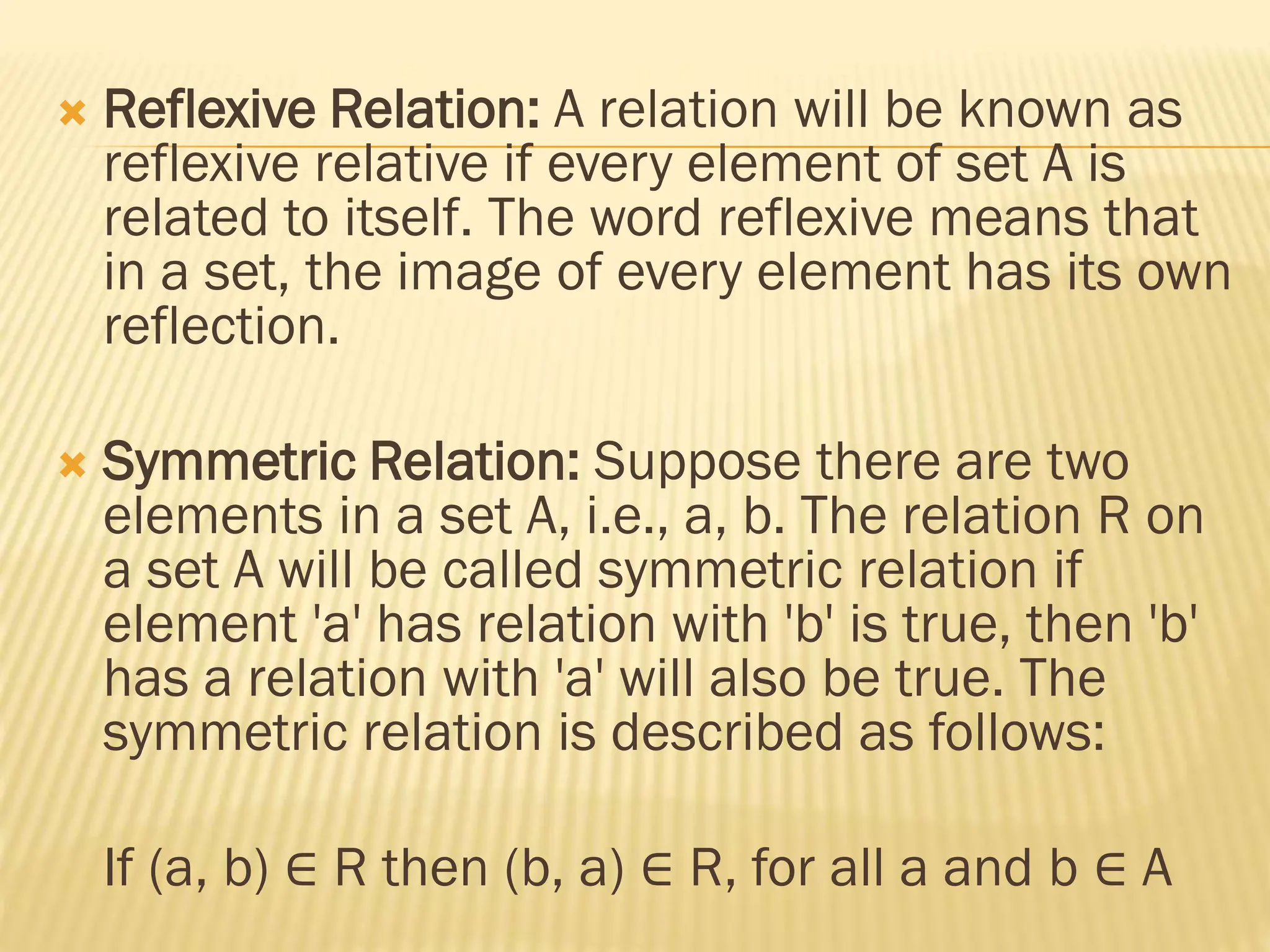
 Reflexive Relation: A relation will be known as
reflexive relative if every element of set A is
related to itself. The word reflexive means that
in a set, the image of every element has its own
reflection.
 Symmetric Relation: Suppose there are two
elements in a set A, i.e., a, b. The relation R on
a set A will be called symmetric relation if
element 'a' has relation with 'b' is true, then 'b'
has a relation with 'a' will also be true. The
symmetric relation is described as follows:
If (a, b) ∈ R then (b, a) ∈ R, for all a and b ∈ A
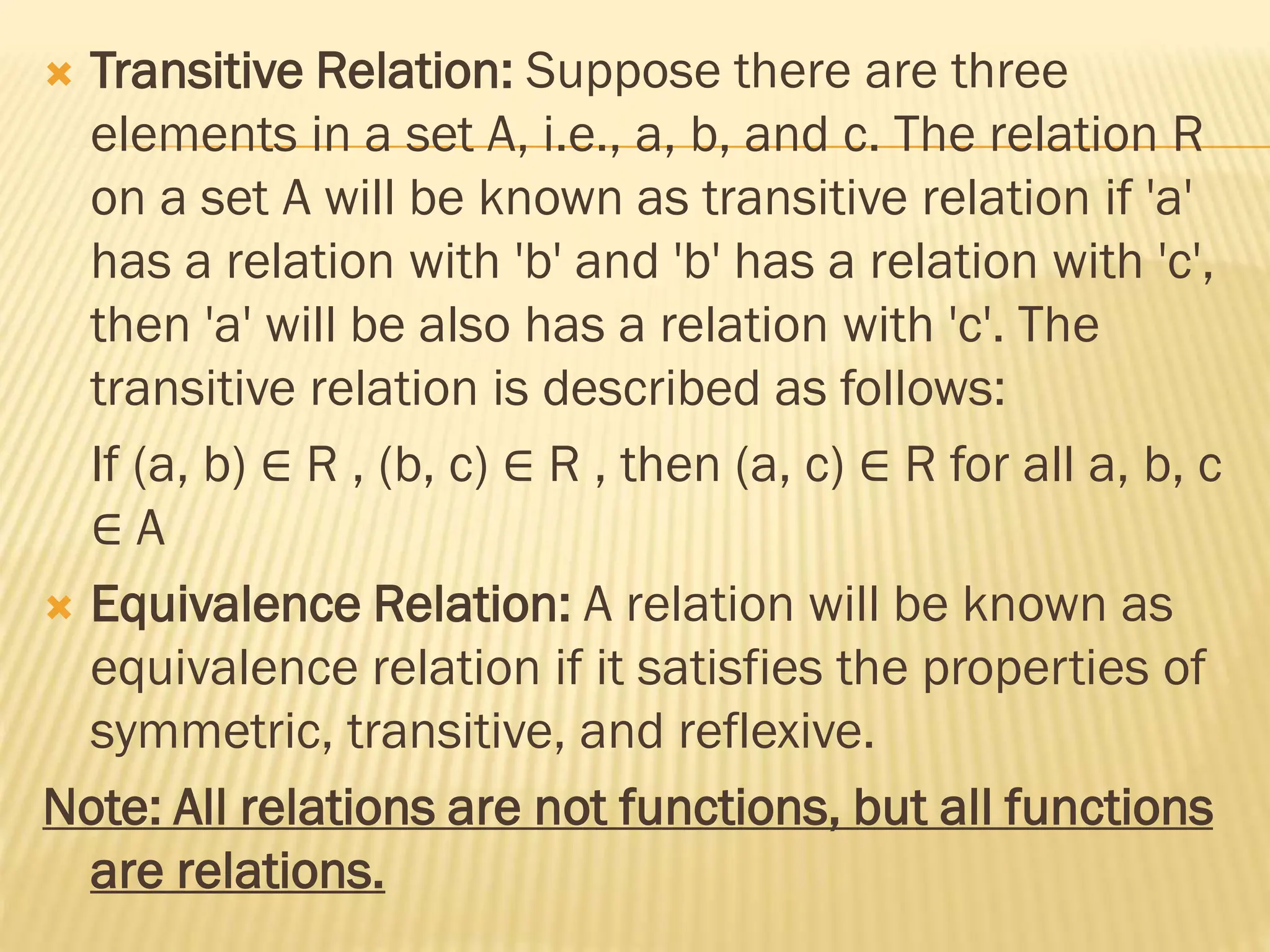
 Transitive Relation: Suppose there are three
elements in a set A, i.e., a, b, and c. The relation R
on a set A will be known as transitive relation if 'a'
has a relation with 'b' and 'b' has a relation with 'c',
then 'a' will be also has a relation with 'c'. The
transitive relation is described as follows:
If (a, b) ∈ R , (b, c) ∈ R , then (a, c) ∈ R for all a, b, c
∈ A
 Equivalence Relation: A relation will be known as
equivalence relation if it satisfies the properties of
symmetric, transitive, and reflexive.
Note: All relations are not functions, but all functions
are relations.

Relation and it's type Discrete Mathematics.pdf

  • 1.
    SHRIRAMSWAROOP MEMORIAL UNIVERSITY DISCRETE MATHEMATICS (MMA1010) MCA– 1st Semester TOPIC: Relation and its types SUBMITTED TO: SUBMITTED BY: Dr. Ajay Singh Mohd. Shahil Alam 202310101050006
  • 2.
    RELATION  Relation inMathematics is defined as the relationship between two sets. If we are given two sets set A and set B and set A has a relation with set B then each value of set A is related to a value of set B through some unique relation. Here, set A is called the domain of the relation, and set B is called the range of the relation.  For example if we are given two sets, Set A = {1, 2, 3, 4} and Set B = {1, 4, 9, 16} then the ordered pair {(1, 1), (2, 4), (3, 9), (4, 16)} represents the relation defined as, R, A: → B {(x, y): y = x2: y ϵ B, x ϵ A}.
  • 3.
    TYPES OF RELATIONS Empty relation: A relation will be known as empty relation if the elements of set have no relation with each other. Example:- R = Ø  Universal Relation: In this relation, every element of set A has a relation with every element of set B. That's why this relation is also called a universal relation, and the universal relation and empty relation are also known as the trivial relation.
  • 4.
     Identity Relation:In the identity relation, every element of A has a relation to itself only. The identity relation is described as follows: A : A → A  Inverse Relation: Assume that there are two sets, set A and set B, and they have a relation from A to B. This relation will be described as R∈ A × B. The inverse relation will be obtained when we replace the first element of each pair with the second element in a set. The inverse relation is described as follows: R -1 = {(b, a) : (a, b) ∈ R}
  • 5.
     Reflexive Relation:A relation will be known as reflexive relative if every element of set A is related to itself. The word reflexive means that in a set, the image of every element has its own reflection.  Symmetric Relation: Suppose there are two elements in a set A, i.e., a, b. The relation R on a set A will be called symmetric relation if element 'a' has relation with 'b' is true, then 'b' has a relation with 'a' will also be true. The symmetric relation is described as follows: If (a, b) ∈ R then (b, a) ∈ R, for all a and b ∈ A
  • 6.
     Transitive Relation:Suppose there are three elements in a set A, i.e., a, b, and c. The relation R on a set A will be known as transitive relation if 'a' has a relation with 'b' and 'b' has a relation with 'c', then 'a' will be also has a relation with 'c'. The transitive relation is described as follows: If (a, b) ∈ R , (b, c) ∈ R , then (a, c) ∈ R for all a, b, c ∈ A  Equivalence Relation: A relation will be known as equivalence relation if it satisfies the properties of symmetric, transitive, and reflexive. Note: All relations are not functions, but all functions are relations.