Binary Relation
Binary Relation
• Let P and Q be two non- empty sets. A binary relation R is defined
to be a subset of P x Q from a set P to Q. If (a, b) ∈ R and R ⊆ P x Q
then a is related to b by R i.e., aRb. If sets P and Q are equal, then
we say R ⊆ P x P is a relation on P e.g.
• (i) Let A = {a, b, c}
• B = {r, s, t}
• Then R = {(a, r), (b, r), (b, t), (c, s)}
• is a relation from A to B.
•
• (ii) Let A = {1, 2, 3} and B = A
• R = {(1, 1), (2, 2), (3, 3)}
• is a relation (equal) on A.
• Example1: If a set has n elements, how many
relations are there from A to A.
• Solution: If a set A has n elements, A x A has
n2 elements. So, there are 2n2 relations from A
to A.
• Example2: If A has m elements and B has n
elements. How many relations are there from
A to B and vice versa?
• solution: There are m x n elements; hence
there are 2m x n relations from A to A.
• Example3: If a set A = {1, 2}. Determine all
relations from A to A.
• Solution: There are 22= 4 elements i.e., {(1, 2), (2,
1), (1, 1), (2, 2)} in A x A. So, there are 24= 16
relations from A to A. i.e.
• {(1, 2), (2, 1), (1, 1), (2, 2)}, {(1, 2), (2, 1)}, {(1, 2),
(1, 1)}, {(1, 2), (2, 2)},
• {(2, 1), (1, 1)},{(2,1), (2, 2)}, {(1, 1),(2, 2)},{(1, 2), (2
, 1), (1, 1)}, {(1, 2), (1, 1),
• (2, 2)}, {(2,1), (1, 1), (2, 2)}, {(1, 2), (2, 1), (2, 2)}, {(
1, 2), (2, 1), (1, 1), (2, 2)} and ∅.
Domain and Range of Relation
• Domain of Relation: The Domain of relation R is the
set of elements in P which are related to some
elements in Q, or it is the set of all first entries of the
ordered pairs in R. It is denoted by DOM (R).
• Range of Relation: The range of relation R is the set of
elements in Q which are related to some element in P,
or it is the set of all second entries of the ordered pairs
in R. It is denoted by RAN (R).
• Example:
• Let A = {1, 2, 3, 4}
• B = {a, b, c, d}
• R = {(1, a), (1, b), (1, c), (2, b), (2, c), (2, d)}.
• Solution:
• DOM (R) = {1, 2}
• RAN (R) = {a, b, c, d}
Complement of a Relation
• Consider a relation R from a set A to set B. The
complement of relation R denoted by R is a
relation from A to B such that
• R = {(a, b): {a, b) ∉ R}.
• Example:
• Consider the relation R from X to Y
• X = {1, 2, 3}
• Y = {8, 9}
• R = {(1, 8) (2, 8) (1, 9) (3, 9)}
• Find the complement relation of R.
• Solution:
• X x Y = {(1, 8), (2, 8), (3, 8), (1, 9), (2, 9), (3, 9)}
Now we find the complement relation R from
X x Y R = {(3, 8), (2, 9)}
Representation of Relations
• Relations can be represented in many ways. Some of
which are as follows:
• 1. Relation as a Matrix: Let P = [a1,a2,a3,.......am] and Q
= [b1,b2,b3......bn] are finite sets, containing m and n
number of elements respectively. R is a relation from P
to Q. The relation R can be represented by m x n matrix
M = [Mij], defined as
• Mij = 0 if (ai,bj) ∉ R 1 if (ai,bj )∈ R
• Example
• Let P = {1, 2, 3, 4}, Q = {a, b, c, d}
• and R = {(1, a), (1, b), (1, c), (2, b), (2, c), (2, d)}.
The matrix of relation R is shown as
fig:
• 2. Relation as a Directed Graph: There is
another way of picturing a relation R when R
is a relation from a finite set to itself.
• Example
• A = {1, 2, 3, 4}
• R = {(1, 2) (2, 2) (2, 4) (3, 2) (3, 4) (4, 1) (4, 3)}
3. Relation as an Arrow Diagram
• If P and Q are finite sets and R is a relation from P to
Q. Relation R can be represented as an arrow diagram
as follows.
• Draw two ellipses for the sets P and Q. Write down the
elements of P and elements of Q column-wise in three
ellipses. Then draw an arrow from the first ellipse to
the second ellipse if a is related to b and a ∈ P and b ∈
Q.
• Example
• Let P = {1, 2, 3, 4}
• Q = {a, b, c, d}
• R = {(1, a), (2, a), (3, a), (1, b), (4, b), (4, c), (4, d)
• 4. Relation as a Table: If P and Q are finite sets and R is
a relation from P to Q. Relation R can be represented in
tabular form.
• Make the table which contains rows equivalent to an
element of P and columns equivalent to the element of
Q. Then place a cross (X) in the boxes which represent
relations of elements on set P to set Q.
• Example
• Let P = {1, 2, 3, 4}
• Q = {x, y, z, k}
• R = {(1, x), (1, y), (2, z), (3, z), (4, k)}.
The tabular form of relation as shown
in fig
Composition of Relations
• Let A, B, and C be sets, and let R be a relation
from A to B and let S be a relation from B to C.
That is, R is a subset of A × B and S is a subset of B
× C. Then R and S give rise to a relation from A to
C indicated by R◦S and defined by:
• a (R◦S)c if for some b ∈ B we have aRb and bSc.
• is,
• R ◦ S = {(a, c)| there exists b ∈ B for which (a, b) ∈
R and (b, c) ∈ S}
• the relation R◦S is known the composition of R
and S; it is sometimes denoted simply by RS.
• Let R is a relation on a set A, that is, R is a relation
from a set A to itself. Then R◦R, the composition
of R with itself, is always represented. Also, R◦R is
sometimes denoted by R2. Similarly, R3 = R2◦R =
R◦R◦R, and so on. Thus Rn is defined for all
positive n.
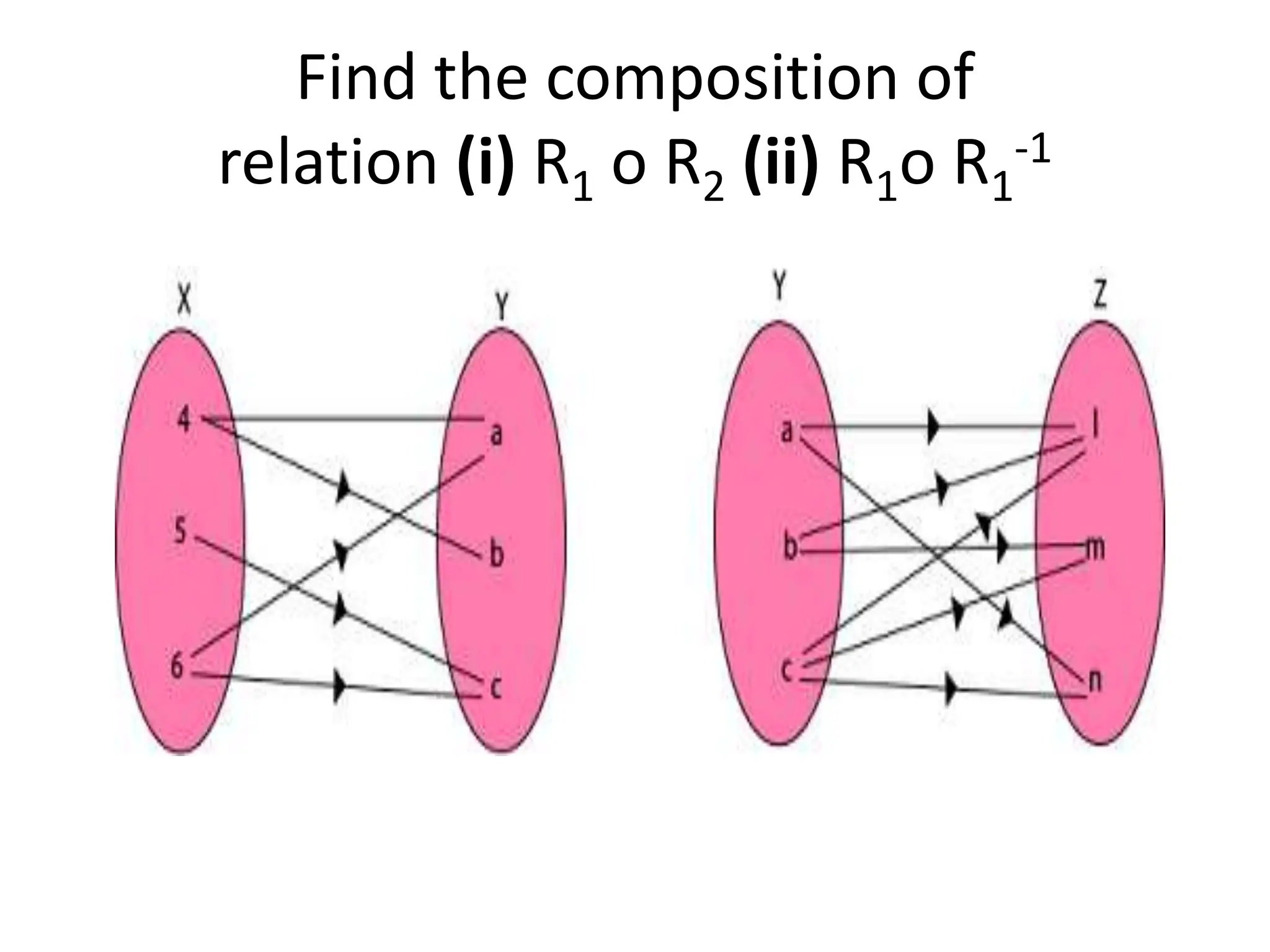
• Example1: Let X = {4, 5, 6}, Y = {a, b, c} and Z = {l,
m, n}. Consider the relation R1 from X to Y and
R2 from Y to Z.
Find the composition of
relation (i) R1 o R2 (ii) R1o R1
-1
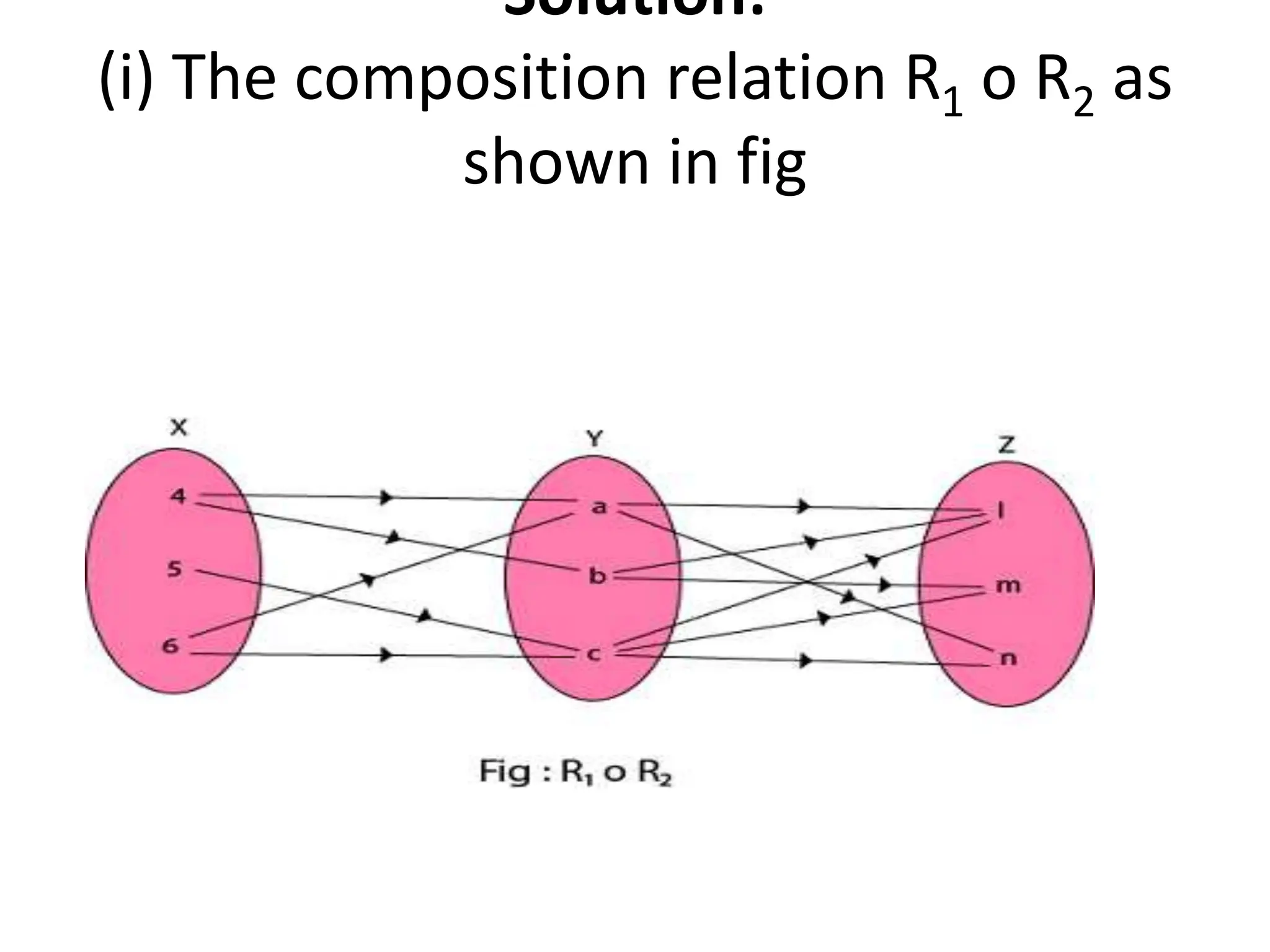
(i) The composition relation R1 o R2 as
shown in fig:
• R1 = {(4, a), (4, b), (5, c), (6, a), (6, c)}
• R2 = {(a, l), (a, n), (b, l), (b, m), (c, l), (c, m),
(c, n)}
Find the composition of
relation (i) R1 o R2 (ii) R1o R1
-1
Solution
• (i) The composition relation R1 o R2 as shown
in fig:
i) The composition relation R1 o R2 as
shown in fig:
Solution:
(i) The composition relation R1 o R2 as
shown in fig
• R1 o R2 = {(4, l), (4, n), (4, m), (5, l), (5, m), (5,
n), (6, l), (6, m), (6, n)}
Types of Relations
• 1. Reflexive Relation: A relation R on set A is
said to be a reflexive if (a, a) ∈ R for every a
∈ A.
• Example: If A = {1, 2, 3, 4} then R = {(1, 1) (2,
2), (1, 3), (2, 4), (3, 3), (3, 4), (4, 4)}. Is a
relation reflexive?
• Solution: The relation is reflexive as for every
a ∈ A. (a, a) ∈ R, i.e. (1, 1), (2, 2), (3, 3), (4, 4) ∈
R.
• 2. Irreflexive Relation: A relation R on set A is
said to be irreflexive if (a, a) ∉ R for every a ∈ A.
• Example: Let A = {1, 2, 3} and R = {(1, 2), (2, 2), (3,
1), (1, 3)}. Is the relation R reflexive or irreflexive?
• Solution: The relation R is not reflexive as for
every a ∈ A, (a, a) ∉ R, i.e., (1, 1) and (3, 3) ∉ R.
The relation R is not irreflexive as (a, a) ∉ R, for
some a ∈ A, i.e., (2, 2) ∈ R.
• 3. Symmetric Relation: A relation R on set A is said to
be symmetric iff (a, b) ∈ R ⟺ (b, a) ∈ R.
• Example: Let A = {1, 2, 3} and R = {(1, 1), (2, 2), (1, 2),
(2, 1), (2, 3), (3, 2)}. Is a relation R symmetric or not?
• Solution: The relation is symmetric as for every (a, b) ∈
R, we have (b, a) ∈ R, i.e., (1, 2), (2, 1), (2, 3), (3, 2) ∈ R
but not reflexive because (3, 3) ∉ R.
• Example of Symmetric Relation:
• Relation ⊥r is symmetric since a line a is ⊥r to b, then b
is ⊥r to a.
• Also, Parallel is symmetric, since if a line a is ∥ to b then
b is also ∥ to a.
• Antisymmetric Relation: A relation R on a set
A is antisymmetric iff (a, b) ∈ R and (b, a) ∈ R
then a = b.
• Example1: Let A = {1, 2, 3} and R = {(1, 1), (2,
2)}. Is the relation R antisymmetric?
• Solution: The relation R is antisymmetric as a
= b when (a, b) and (b, a) both belong to R.
• Example2: Let A = {4, 5, 6} and R = {(4, 4), (4,
5), (5, 4), (5, 6), (4, 6)}. Is the relation R
antisymmetric?
• Solution: The relation R is not antisymmetric
as 4 ≠ 5 but (4, 5) and (5, 4) both belong to R.
• 5. Asymmetric Relation: A relation R on a set
A is called an Asymmetric Relation if for every
(a, b) ∈ R implies that (b, a) does not belong to
R.
• 6. Transitive Relations: A Relation R on set A is
said to be transitive iff (a, b) ∈ R and (b, c) ∈ R
⟺ (a, c) ∈ R.
• Example1: Let A = {1, 2, 3} and R = {(1, 2), (2,
1), (1, 1), (2, 2)}. Is the relation transitive?
• Solution: The relation R is transitive as for
every (a, b) (b, c) belong to R, we have (a, c) ∈
R i.e, (1, 2) (2, 1) ∈ R ⇒ (1, 1) ∈ R.
• Note1: The Relation ≤, ⊆ and / are transitive,
i.e., a ≤ b, b ≤ c then a ≤ c
(ii) Let a ⊆ b, b ⊆ c then a ⊆ c
(iii) Let a/b, b/c then a/c.
• Note2: ⊥r is not transitive since a ⊥r b, b ⊥r c
then it is not true that a ⊥r c. Since no line is ∥
to itself, we can have a ∥ b, b ∥ a but a ∦ a.
Thus ∥ is not transitive, but it will be transitive
in the plane.
• 7. Identity Relation: Identity relation I on set
A is reflexive, transitive and symmetric. So
identity relation I is an Equivalence Relation.
Example: A= {1, 2, 3} = {(1, 1), (2, 2), (3, 3)}
• 8. Void Relation: It is given by R: A →B such
that R = ∅ (⊆ A x B) is a null relation. Void
Relation R = ∅ is symmetric and transitive but
not reflexive.
• 9. Universal Relation: A relation R: A →B such
that R = A x B (⊆ A x B) is a universal relation.
Universal Relation from A →B is reflexive,
symmetric and transitive. So this is an
equivalence relation.
Closure Properties of Relations
• Consider a given set A, and the collection of all
relations on A. Let P be a property of such
relations, such as being symmetric or being
transitive. A relation with property P will be
called a P-relation. The P-closure of an arbitrary
relation R on A, indicated P (R), is a P-relation
such that
• R ⊆ P (R) ⊆ S
• (1) Reflexive and Symmetric Closures: The next
theorem tells us how to obtain the reflexive and
symmetric closures of a relation easily.
• Theorem: Let R be a relation on a set A.
Then:
• R ∪ ∆A is the reflexive closure of R
• R ∪ R-1 is the symmetric closure of R.
• Example1:Let A = {k, l, m}. Let R is a relation on A defin
ed by
• R = {(k, k), (k, l), (l, m), (m, k)}.
• Find the reflexive closure of R.
• Solution: R ∪ ∆ is the smallest relation having reflexive
property, Hence,
• RF = R ∪ ∆ = {(k, k), (k, l), (l, l), (l, m), (m, m), (m, k)}.
• Example2: Consider the relation R on A = {4, 5,
6, 7} defined by
• R = {(4, 5), (5, 5), (5, 6), (6, 7), (7, 4), (7, 7)}
• Find the symmetric closure of R.
• Solution: The smallest relation containing R
having the symmetric property is R ∪ R-1,i.e.
• RS = R ∪ R-1 = {(4, 5), (5, 4), (5, 5), (5, 6), (6, 5),
(6, 7), (7, 6), (7, 4), (4, 7), (7, 7)}.
• (2)Transitive Closures: Consider a relation R on a set A. The transitive
closure R of a relation R of a relation R is the smallest transitive relation
containing R.
• ecall that R2 = R◦ R and Rn = Rn-1 ◦ R. We define
• The following Theorem applies:
• Theorem1: R* is the transitive closure of R
• Suppose A is a finite set with n elements.
• R* = R ∪R2 ∪.....∪ Rn
• Theorem 2: Let R be a relation on a set A with n elements. Then
• Transitive (R) = R ∪ R2∪.....∪ Rn
• Example1: Consider the relation R = {(1, 2), (2, 3), (3, 3)} on A = {1, 2, 3}.
Then
R2 = R◦ R = {(1, 3), (2, 3), (3, 3)} and R3 = R2 ◦ R = {(1, 3), (2, 3), (3, 3)}
Accordingly,
Transitive (R) = {(1, 2), (2, 3), (3, 3), (1, 3)}
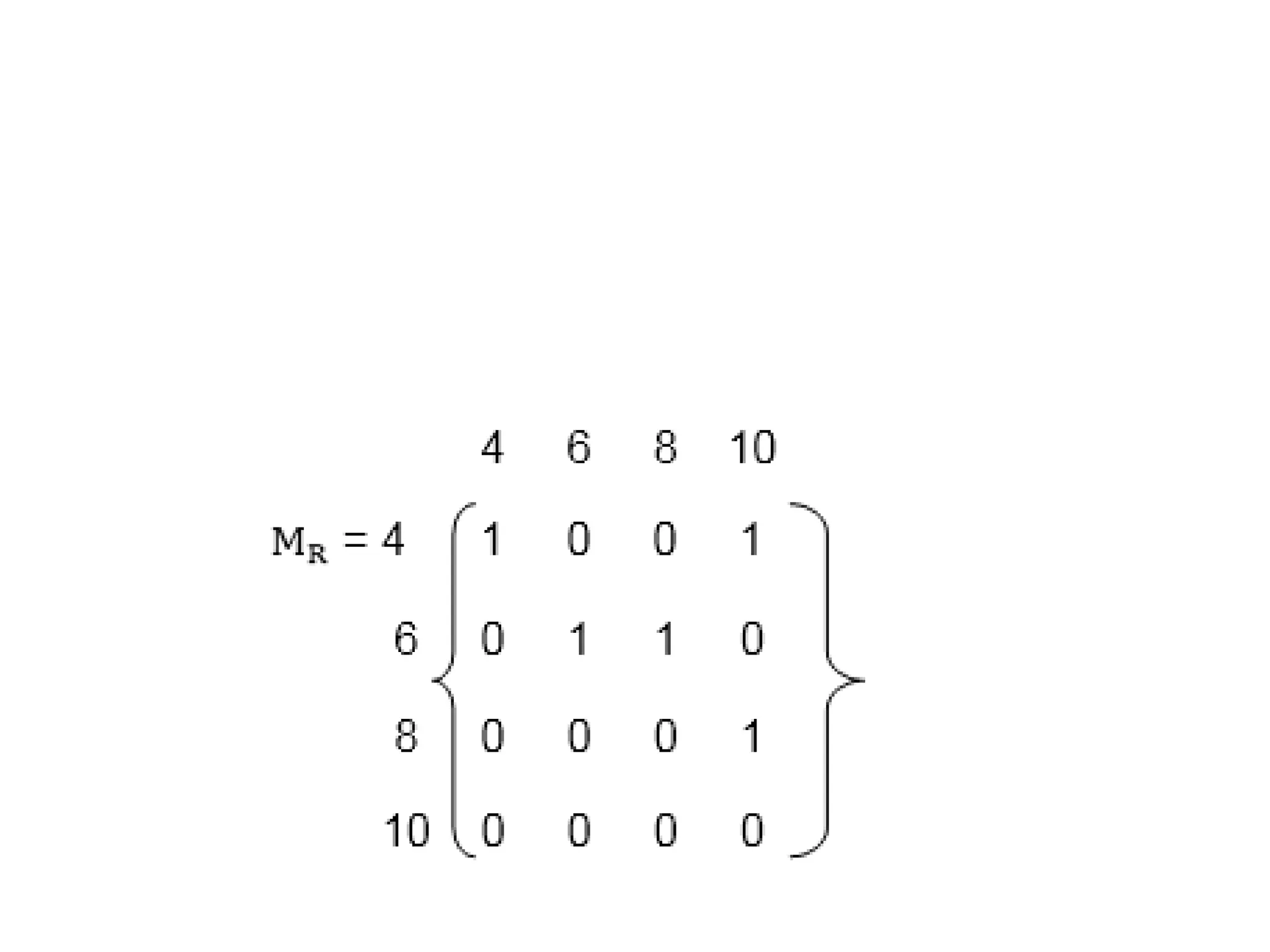
• Example2: Let A = {4, 6, 8, 10} and R = {(4, 4),
(4, 10), (6, 6), (6, 8), (8, 10)} is a relation on set
A. Determine transitive closure of R.
• Solution: The matrix of relation R is shown in
fig:
• Now, find the powers of MR as in fig:
• Hence, the transitive closure of MR is MR
* as
shown in Fig (where MR
* is the ORing of a
power of MR).
• Thus, R* = {(4, 4), (4, 10), (6, 8), (6, 6), (6, 10),
(8, 10)}.
• Note: While ORing the power of the matrix R,
we can eliminate MR
n because it is equal to
MR
* if n is even and is equal to MR
3 if n is odd.
Equivalence Relations
• A relation R on a set A is called an equivalence
relation if it satisfies following three
properties:
• Relation R is Reflexive, i.e. aRa ∀ a∈A.
• Relation R is Symmetric, i.e., aRb ⟹ bRa
• Relation R is transitive, i.e., aRb and bRc ⟹
aRc.
Example
• Let A = {1, 2, 3, 4} and R = {(1, 1), (1, 3), (2, 2), (2, 4), (3, 1), (3, 3), (4,
2), (4, 4)}.
• Show that R is an Equivalence Relation.
• Solution:Reflexive: Relation R is reflexive as (1, 1), (2, 2), (3, 3) and
(4, 4) ∈ R.
• Symmetric: Relation R is symmetric because whenever (a, b) ∈ R,
(b, a) also belongs to R.
• Example: (2, 4) ∈ R ⟹ (4, 2) ∈ R.
• Transitive: Relation R is transitive because whenever (a, b) and (b,
c) belongs to R, (a, c) also belongs to R.
• Example: (3, 1) ∈ R and (1, 3) ∈ R ⟹ (3, 3) ∈ R.
• So, as R is reflexive, symmetric and transitive, hence, R is an
Equivalence Relation
• Note1: If R1and R2 are equivalence relation
then R1∩ R2 is also an equivalence relation.
• Example: A = {1, 2, 3}
R1 = {(1, 1), (2, 2), (3, 3), (1, 2), (2, 1)}
R2 = {(1, 1), (2, 2), (3, 3), (2, 3), (3, 2)}
R1∩ R2 = {(1, 1), (2, 2), (3, 3)}
• Note2: If R1and R2 are equivalence relation
then R1∪ R2 may or may not be an
equivalence relation.
• Example: A = {1, 2, 3}
R1 = {(1, 1), (2, 2), (3, 3), (1, 2), (2, 1)}
R2 = {(1, 1), (2, 2), (3, 3), (2, 3), (3, 2)}
R1∪ R2= {(1, 1), (2, 2), (3, 3), (1, 2), (2,
1), (2, 3), (3, 2)}
• Hence, Reflexive or Symmetric are Equivalence
Relation but transitive may or may not be an
equivalence relation.
Inverse Relation
• Let R be any relation from set A to set B. The inverse of R denoted
by R-1 is the relations from B to A which consist of those ordered
pairs which when reversed belong to R that is:
• R-1 = {(b, a): (a, b) ∈ R}
• Example1: A = {1, 2, 3}
B = {x, y, z}
• Solution: R = {(1, y), (1, z), (3, y)
R-1 = {(y, 1), (z, 1), (y, 3)}
Clearly (R-1)-1 = R
• Note1: Domain and Range of R-1 is equal to range and domain of R.
• Example2: R = {(1, 1), (2, 2), (3, 3), (1, 2), (2, 3), (3, 2)}
R-1 = {(1, 1), (2, 2), (3, 3), (2, 1), (3, 2), (2, 3)}
• Note2: If R is an Equivalence Relation then R-1 is always an
Equivalence Relation.
• Example: Let A = {1, 2, 3}
R = {(1, 1), (2, 2), (3, 3), (1, 2), (2, 1)}
R-1 = {(1, 1), (2, 2), (3, 3), (2, 1), (1, 2)}
R-1 is a Equivalence Relation.
• Note3: If R is a Symmetric Relation then R-1=R
and vice-versa.
• Example: Let A = {1, 2, 3}
R = {(1, 1), (2, 2), (1, 2), (2, 1), (2,
3), (3, 2)}
R-1 = {(1, 1), (2, 2), (2, 1), (1, 2), (3,
2), (2, 3)}
• Note4: Reverse Order of Law
(SOT)-1 = T-1 or S-1
(ROSOT)-1 = T-1 or S-1 or R-1.

Binary Relation-1 ssssssssssssssssssssssss

  • 1.
  • 2.
    Binary Relation • LetP and Q be two non- empty sets. A binary relation R is defined to be a subset of P x Q from a set P to Q. If (a, b) ∈ R and R ⊆ P x Q then a is related to b by R i.e., aRb. If sets P and Q are equal, then we say R ⊆ P x P is a relation on P e.g. • (i) Let A = {a, b, c} • B = {r, s, t} • Then R = {(a, r), (b, r), (b, t), (c, s)} • is a relation from A to B. • • (ii) Let A = {1, 2, 3} and B = A • R = {(1, 1), (2, 2), (3, 3)} • is a relation (equal) on A.
  • 3.
    • Example1: Ifa set has n elements, how many relations are there from A to A. • Solution: If a set A has n elements, A x A has n2 elements. So, there are 2n2 relations from A to A.
  • 4.
    • Example2: IfA has m elements and B has n elements. How many relations are there from A to B and vice versa? • solution: There are m x n elements; hence there are 2m x n relations from A to A.
  • 5.
    • Example3: Ifa set A = {1, 2}. Determine all relations from A to A. • Solution: There are 22= 4 elements i.e., {(1, 2), (2, 1), (1, 1), (2, 2)} in A x A. So, there are 24= 16 relations from A to A. i.e. • {(1, 2), (2, 1), (1, 1), (2, 2)}, {(1, 2), (2, 1)}, {(1, 2), (1, 1)}, {(1, 2), (2, 2)}, • {(2, 1), (1, 1)},{(2,1), (2, 2)}, {(1, 1),(2, 2)},{(1, 2), (2 , 1), (1, 1)}, {(1, 2), (1, 1), • (2, 2)}, {(2,1), (1, 1), (2, 2)}, {(1, 2), (2, 1), (2, 2)}, {( 1, 2), (2, 1), (1, 1), (2, 2)} and ∅.
  • 6.
    Domain and Rangeof Relation • Domain of Relation: The Domain of relation R is the set of elements in P which are related to some elements in Q, or it is the set of all first entries of the ordered pairs in R. It is denoted by DOM (R). • Range of Relation: The range of relation R is the set of elements in Q which are related to some element in P, or it is the set of all second entries of the ordered pairs in R. It is denoted by RAN (R). • Example: • Let A = {1, 2, 3, 4} • B = {a, b, c, d} • R = {(1, a), (1, b), (1, c), (2, b), (2, c), (2, d)}.
  • 7.
    • Solution: • DOM(R) = {1, 2} • RAN (R) = {a, b, c, d}
  • 8.
    Complement of aRelation • Consider a relation R from a set A to set B. The complement of relation R denoted by R is a relation from A to B such that • R = {(a, b): {a, b) ∉ R}. • Example: • Consider the relation R from X to Y • X = {1, 2, 3} • Y = {8, 9} • R = {(1, 8) (2, 8) (1, 9) (3, 9)} • Find the complement relation of R.
  • 9.
    • Solution: • Xx Y = {(1, 8), (2, 8), (3, 8), (1, 9), (2, 9), (3, 9)} Now we find the complement relation R from X x Y R = {(3, 8), (2, 9)}
  • 10.
    Representation of Relations •Relations can be represented in many ways. Some of which are as follows: • 1. Relation as a Matrix: Let P = [a1,a2,a3,.......am] and Q = [b1,b2,b3......bn] are finite sets, containing m and n number of elements respectively. R is a relation from P to Q. The relation R can be represented by m x n matrix M = [Mij], defined as • Mij = 0 if (ai,bj) ∉ R 1 if (ai,bj )∈ R • Example • Let P = {1, 2, 3, 4}, Q = {a, b, c, d} • and R = {(1, a), (1, b), (1, c), (2, b), (2, c), (2, d)}.
  • 11.
    The matrix ofrelation R is shown as fig:
  • 12.
    • 2. Relationas a Directed Graph: There is another way of picturing a relation R when R is a relation from a finite set to itself. • Example • A = {1, 2, 3, 4} • R = {(1, 2) (2, 2) (2, 4) (3, 2) (3, 4) (4, 1) (4, 3)}
  • 14.
    3. Relation asan Arrow Diagram • If P and Q are finite sets and R is a relation from P to Q. Relation R can be represented as an arrow diagram as follows. • Draw two ellipses for the sets P and Q. Write down the elements of P and elements of Q column-wise in three ellipses. Then draw an arrow from the first ellipse to the second ellipse if a is related to b and a ∈ P and b ∈ Q. • Example • Let P = {1, 2, 3, 4} • Q = {a, b, c, d} • R = {(1, a), (2, a), (3, a), (1, b), (4, b), (4, c), (4, d)
  • 16.
    • 4. Relationas a Table: If P and Q are finite sets and R is a relation from P to Q. Relation R can be represented in tabular form. • Make the table which contains rows equivalent to an element of P and columns equivalent to the element of Q. Then place a cross (X) in the boxes which represent relations of elements on set P to set Q. • Example • Let P = {1, 2, 3, 4} • Q = {x, y, z, k} • R = {(1, x), (1, y), (2, z), (3, z), (4, k)}.
  • 17.
    The tabular formof relation as shown in fig
  • 18.
    Composition of Relations •Let A, B, and C be sets, and let R be a relation from A to B and let S be a relation from B to C. That is, R is a subset of A × B and S is a subset of B × C. Then R and S give rise to a relation from A to C indicated by R◦S and defined by: • a (R◦S)c if for some b ∈ B we have aRb and bSc. • is, • R ◦ S = {(a, c)| there exists b ∈ B for which (a, b) ∈ R and (b, c) ∈ S}
  • 19.
    • the relationR◦S is known the composition of R and S; it is sometimes denoted simply by RS. • Let R is a relation on a set A, that is, R is a relation from a set A to itself. Then R◦R, the composition of R with itself, is always represented. Also, R◦R is sometimes denoted by R2. Similarly, R3 = R2◦R = R◦R◦R, and so on. Thus Rn is defined for all positive n. • Example1: Let X = {4, 5, 6}, Y = {a, b, c} and Z = {l, m, n}. Consider the relation R1 from X to Y and R2 from Y to Z.
  • 20.
    Find the compositionof relation (i) R1 o R2 (ii) R1o R1 -1
  • 21.
    (i) The compositionrelation R1 o R2 as shown in fig: • R1 = {(4, a), (4, b), (5, c), (6, a), (6, c)} • R2 = {(a, l), (a, n), (b, l), (b, m), (c, l), (c, m), (c, n)}
  • 22.
    Find the compositionof relation (i) R1 o R2 (ii) R1o R1 -1
  • 23.
    Solution • (i) Thecomposition relation R1 o R2 as shown in fig:
  • 24.
    i) The compositionrelation R1 o R2 as shown in fig:
  • 25.
    Solution: (i) The compositionrelation R1 o R2 as shown in fig
  • 26.
    • R1 oR2 = {(4, l), (4, n), (4, m), (5, l), (5, m), (5, n), (6, l), (6, m), (6, n)}
  • 27.
    Types of Relations •1. Reflexive Relation: A relation R on set A is said to be a reflexive if (a, a) ∈ R for every a ∈ A. • Example: If A = {1, 2, 3, 4} then R = {(1, 1) (2, 2), (1, 3), (2, 4), (3, 3), (3, 4), (4, 4)}. Is a relation reflexive? • Solution: The relation is reflexive as for every a ∈ A. (a, a) ∈ R, i.e. (1, 1), (2, 2), (3, 3), (4, 4) ∈ R.
  • 28.
    • 2. IrreflexiveRelation: A relation R on set A is said to be irreflexive if (a, a) ∉ R for every a ∈ A. • Example: Let A = {1, 2, 3} and R = {(1, 2), (2, 2), (3, 1), (1, 3)}. Is the relation R reflexive or irreflexive? • Solution: The relation R is not reflexive as for every a ∈ A, (a, a) ∉ R, i.e., (1, 1) and (3, 3) ∉ R. The relation R is not irreflexive as (a, a) ∉ R, for some a ∈ A, i.e., (2, 2) ∈ R.
  • 29.
    • 3. SymmetricRelation: A relation R on set A is said to be symmetric iff (a, b) ∈ R ⟺ (b, a) ∈ R. • Example: Let A = {1, 2, 3} and R = {(1, 1), (2, 2), (1, 2), (2, 1), (2, 3), (3, 2)}. Is a relation R symmetric or not? • Solution: The relation is symmetric as for every (a, b) ∈ R, we have (b, a) ∈ R, i.e., (1, 2), (2, 1), (2, 3), (3, 2) ∈ R but not reflexive because (3, 3) ∉ R. • Example of Symmetric Relation: • Relation ⊥r is symmetric since a line a is ⊥r to b, then b is ⊥r to a. • Also, Parallel is symmetric, since if a line a is ∥ to b then b is also ∥ to a.
  • 30.
    • Antisymmetric Relation:A relation R on a set A is antisymmetric iff (a, b) ∈ R and (b, a) ∈ R then a = b. • Example1: Let A = {1, 2, 3} and R = {(1, 1), (2, 2)}. Is the relation R antisymmetric? • Solution: The relation R is antisymmetric as a = b when (a, b) and (b, a) both belong to R.
  • 31.
    • Example2: LetA = {4, 5, 6} and R = {(4, 4), (4, 5), (5, 4), (5, 6), (4, 6)}. Is the relation R antisymmetric? • Solution: The relation R is not antisymmetric as 4 ≠ 5 but (4, 5) and (5, 4) both belong to R.
  • 32.
    • 5. AsymmetricRelation: A relation R on a set A is called an Asymmetric Relation if for every (a, b) ∈ R implies that (b, a) does not belong to R. • 6. Transitive Relations: A Relation R on set A is said to be transitive iff (a, b) ∈ R and (b, c) ∈ R ⟺ (a, c) ∈ R.
  • 33.
    • Example1: LetA = {1, 2, 3} and R = {(1, 2), (2, 1), (1, 1), (2, 2)}. Is the relation transitive? • Solution: The relation R is transitive as for every (a, b) (b, c) belong to R, we have (a, c) ∈ R i.e, (1, 2) (2, 1) ∈ R ⇒ (1, 1) ∈ R.
  • 34.
    • Note1: TheRelation ≤, ⊆ and / are transitive, i.e., a ≤ b, b ≤ c then a ≤ c (ii) Let a ⊆ b, b ⊆ c then a ⊆ c (iii) Let a/b, b/c then a/c. • Note2: ⊥r is not transitive since a ⊥r b, b ⊥r c then it is not true that a ⊥r c. Since no line is ∥ to itself, we can have a ∥ b, b ∥ a but a ∦ a. Thus ∥ is not transitive, but it will be transitive in the plane.
  • 35.
    • 7. IdentityRelation: Identity relation I on set A is reflexive, transitive and symmetric. So identity relation I is an Equivalence Relation. Example: A= {1, 2, 3} = {(1, 1), (2, 2), (3, 3)}
  • 36.
    • 8. VoidRelation: It is given by R: A →B such that R = ∅ (⊆ A x B) is a null relation. Void Relation R = ∅ is symmetric and transitive but not reflexive. • 9. Universal Relation: A relation R: A →B such that R = A x B (⊆ A x B) is a universal relation. Universal Relation from A →B is reflexive, symmetric and transitive. So this is an equivalence relation.
  • 37.
    Closure Properties ofRelations • Consider a given set A, and the collection of all relations on A. Let P be a property of such relations, such as being symmetric or being transitive. A relation with property P will be called a P-relation. The P-closure of an arbitrary relation R on A, indicated P (R), is a P-relation such that • R ⊆ P (R) ⊆ S • (1) Reflexive and Symmetric Closures: The next theorem tells us how to obtain the reflexive and symmetric closures of a relation easily.
  • 38.
    • Theorem: LetR be a relation on a set A. Then: • R ∪ ∆A is the reflexive closure of R • R ∪ R-1 is the symmetric closure of R. • Example1:Let A = {k, l, m}. Let R is a relation on A defin ed by • R = {(k, k), (k, l), (l, m), (m, k)}. • Find the reflexive closure of R. • Solution: R ∪ ∆ is the smallest relation having reflexive property, Hence, • RF = R ∪ ∆ = {(k, k), (k, l), (l, l), (l, m), (m, m), (m, k)}.
  • 39.
    • Example2: Considerthe relation R on A = {4, 5, 6, 7} defined by • R = {(4, 5), (5, 5), (5, 6), (6, 7), (7, 4), (7, 7)} • Find the symmetric closure of R. • Solution: The smallest relation containing R having the symmetric property is R ∪ R-1,i.e. • RS = R ∪ R-1 = {(4, 5), (5, 4), (5, 5), (5, 6), (6, 5), (6, 7), (7, 6), (7, 4), (4, 7), (7, 7)}.
  • 40.
    • (2)Transitive Closures:Consider a relation R on a set A. The transitive closure R of a relation R of a relation R is the smallest transitive relation containing R. • ecall that R2 = R◦ R and Rn = Rn-1 ◦ R. We define • The following Theorem applies: • Theorem1: R* is the transitive closure of R • Suppose A is a finite set with n elements. • R* = R ∪R2 ∪.....∪ Rn • Theorem 2: Let R be a relation on a set A with n elements. Then • Transitive (R) = R ∪ R2∪.....∪ Rn • Example1: Consider the relation R = {(1, 2), (2, 3), (3, 3)} on A = {1, 2, 3}. Then R2 = R◦ R = {(1, 3), (2, 3), (3, 3)} and R3 = R2 ◦ R = {(1, 3), (2, 3), (3, 3)} Accordingly, Transitive (R) = {(1, 2), (2, 3), (3, 3), (1, 3)}
  • 41.
    • Example2: LetA = {4, 6, 8, 10} and R = {(4, 4), (4, 10), (6, 6), (6, 8), (8, 10)} is a relation on set A. Determine transitive closure of R. • Solution: The matrix of relation R is shown in fig:
  • 43.
    • Now, findthe powers of MR as in fig:
  • 45.
    • Hence, thetransitive closure of MR is MR * as shown in Fig (where MR * is the ORing of a power of MR).
  • 47.
    • Thus, R*= {(4, 4), (4, 10), (6, 8), (6, 6), (6, 10), (8, 10)}. • Note: While ORing the power of the matrix R, we can eliminate MR n because it is equal to MR * if n is even and is equal to MR 3 if n is odd.
  • 48.
    Equivalence Relations • Arelation R on a set A is called an equivalence relation if it satisfies following three properties: • Relation R is Reflexive, i.e. aRa ∀ a∈A. • Relation R is Symmetric, i.e., aRb ⟹ bRa • Relation R is transitive, i.e., aRb and bRc ⟹ aRc.
  • 49.
    Example • Let A= {1, 2, 3, 4} and R = {(1, 1), (1, 3), (2, 2), (2, 4), (3, 1), (3, 3), (4, 2), (4, 4)}. • Show that R is an Equivalence Relation. • Solution:Reflexive: Relation R is reflexive as (1, 1), (2, 2), (3, 3) and (4, 4) ∈ R. • Symmetric: Relation R is symmetric because whenever (a, b) ∈ R, (b, a) also belongs to R. • Example: (2, 4) ∈ R ⟹ (4, 2) ∈ R. • Transitive: Relation R is transitive because whenever (a, b) and (b, c) belongs to R, (a, c) also belongs to R. • Example: (3, 1) ∈ R and (1, 3) ∈ R ⟹ (3, 3) ∈ R. • So, as R is reflexive, symmetric and transitive, hence, R is an Equivalence Relation
  • 50.
    • Note1: IfR1and R2 are equivalence relation then R1∩ R2 is also an equivalence relation. • Example: A = {1, 2, 3} R1 = {(1, 1), (2, 2), (3, 3), (1, 2), (2, 1)} R2 = {(1, 1), (2, 2), (3, 3), (2, 3), (3, 2)} R1∩ R2 = {(1, 1), (2, 2), (3, 3)} • Note2: If R1and R2 are equivalence relation then R1∪ R2 may or may not be an equivalence relation.
  • 51.
    • Example: A= {1, 2, 3} R1 = {(1, 1), (2, 2), (3, 3), (1, 2), (2, 1)} R2 = {(1, 1), (2, 2), (3, 3), (2, 3), (3, 2)} R1∪ R2= {(1, 1), (2, 2), (3, 3), (1, 2), (2, 1), (2, 3), (3, 2)} • Hence, Reflexive or Symmetric are Equivalence Relation but transitive may or may not be an equivalence relation.
  • 52.
    Inverse Relation • LetR be any relation from set A to set B. The inverse of R denoted by R-1 is the relations from B to A which consist of those ordered pairs which when reversed belong to R that is: • R-1 = {(b, a): (a, b) ∈ R} • Example1: A = {1, 2, 3} B = {x, y, z} • Solution: R = {(1, y), (1, z), (3, y) R-1 = {(y, 1), (z, 1), (y, 3)} Clearly (R-1)-1 = R • Note1: Domain and Range of R-1 is equal to range and domain of R. • Example2: R = {(1, 1), (2, 2), (3, 3), (1, 2), (2, 3), (3, 2)} R-1 = {(1, 1), (2, 2), (3, 3), (2, 1), (3, 2), (2, 3)} • Note2: If R is an Equivalence Relation then R-1 is always an Equivalence Relation.
  • 53.
    • Example: LetA = {1, 2, 3} R = {(1, 1), (2, 2), (3, 3), (1, 2), (2, 1)} R-1 = {(1, 1), (2, 2), (3, 3), (2, 1), (1, 2)} R-1 is a Equivalence Relation. • Note3: If R is a Symmetric Relation then R-1=R and vice-versa.
  • 54.
    • Example: LetA = {1, 2, 3} R = {(1, 1), (2, 2), (1, 2), (2, 1), (2, 3), (3, 2)} R-1 = {(1, 1), (2, 2), (2, 1), (1, 2), (3, 2), (2, 3)} • Note4: Reverse Order of Law (SOT)-1 = T-1 or S-1 (ROSOT)-1 = T-1 or S-1 or R-1.