Let’s Save Mother Earth
Jassha Agir
Definition of Recycling
Jassha Agir
Recycling is the process of
converting waste materials into reusable objects to
prevent waste of potentially useful materials, reduce the
consumption of fresh raw materials, energy usage, air
pollution (from incineration) and water pollution
(from landfilling) by decreasing the need for
"conventional" waste disposal and lowering greenhouse
gas emissions compared to plastic production. Recycling
is a key component of modern waste reduction and is the
third component of the "Reduce, Reuse and
Recycle" waste hierarchy.
The 3 Main Steps on Recycling
Jassha Agir
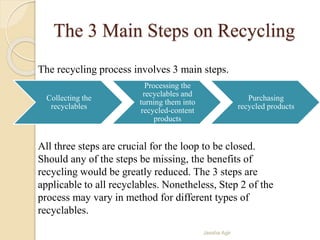
The recycling process involves 3 main steps.
All three steps are crucial for the loop to be closed.
Should any of the steps be missing, the benefits of
recycling would be greatly reduced. The 3 steps are
applicable to all recyclables. Nonetheless, Step 2 of the
process may vary in method for different types of
recyclables.
Collecting the
recyclables
Processing the
recyclables and
turning them into
recycled-content
products
Purchasing
recycled products
∞
In the first step of the recycling process, the recyclables
materials are collected.
The methods of collection may vary from community to
community. However, there are four main methods of
collection, namely curbside, drop-off centers, buy-back
centers, and deposit/refund programs.
After collection, the recyclables are then sent to a
materials-recovery facility to be sorted and prepared into
marketable commodities to be sold to processing
companies.
Jassha Agir
In the second step of the recycling process, the recyclables are
processed. Once cleaned and sorted, the recyclables are processed to
retrieve the raw materials, and the raw materials are then used in
manufacturing recycled-content products.
All recyclables need to broken down, melted or liquefied into its
basic elements, before it can be either made directly into new
materials or mixed with virgin resources and made into new
materials.
However, the method of processing for different materials varies. For
example, recyclables like glass, aluminum cans and steel need to be
melted into a liquid form and then remolded into new products.
Recyclables such as glass, paper and certain plastic products may
have to be crushed, or shredded, as part of the processing to extract
the basic elements or raw materials (e.g.. fiber in paper) for use in
making new products.
Jassha Agir
The third step involves purchasing recycled products.
This third step completes the recycling loop.
More and more of today's products are being
manufactured with total or partial recycled content.
(Read more about some of these green products).
Whether you are just an individual consumer, or are a
part of a government or business organization, you have
an important role in making recycling a success by
“buying recycled”. As consumers demand more
environmentally sound products, manufacturers will
continue to meet that demand by producing high-quality
recycled products.
Jassha Agir
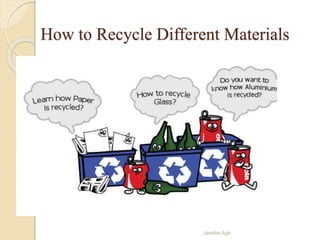
How to Recycle Different Materials
Jassha Agir
How Paper is Recycled
Jassha Agir
1. Paper is taken from the bin and deposited in a large
recycling container along with paper from other recycling
bins.
2. The paper is taken to a recycling plant where it is
separated into types and grades.
3. The separated paper is then washed with soapy water to
remove inks, plastic film, staples and glue. The paper is
put into a large holder where it is mixed with water to
create ‘slurry’.
4. By adding different materials to the slurry, different paper
products can be created, such as cardboard, newsprints
or office paper.
5. The slurry is spread using large rollers into large thin
sheets.
6. The paper is left to dry, and then it is rolled up ready to
be cut and sent back to the shops.
How Glass is Recycled
Jassha Agir
1. The consumer throws glass into a recycle bin.
2. Glass is taken from the bin and taken to a glass
treatment plant.
3. The glass is sorted by color and washed to remove any
impurities.
4. The glass is then crushed and melted, then molded
into new products such as bottles and jars. Or it may
be used for alternative purposes such as brick
manufacture or decorative uses.
5. The glass is then sent back to the shops ready to be
used again.
6. Glass does not degrade through the recycling process,
so it can be recycled again and again.
How Aluminum is Recycled
Jassha Agir
1. The consumer throws aluminum cans and foil into a recycle
bin.
2. The aluminum is then collected and taken to a treatment
plant.
3. In the treatment plant the aluminum is sorted and cleaned
ready for reprocessing.
4. It then goes through a re-melt process and turns into molten
aluminum, this removes the coatings and inks that may be
present on the aluminum.
5. The aluminum is then made into large blocks called ingots.
Each ingot contains about 1.6 million drinks cans.
6. The ingots are sent to mills where they are rolled out, this
gives the aluminum greater flexibility and strength.
7. This is then made into aluminum products such as cans,
chocolate wrapping and ready meal packaging.
8. In as little as 6 weeks, the recycled aluminum products are
then sent back to the shops ready to be used again.
Recycling is one of the best ways for you to have a positive
impact on the world in which we live. Recycling is important to
both the natural environment and us. We must act fast as the
amount of waste we create is increasing all the time.
Environmental Importance
Recycling is very important as waste has a huge negative impact
on the natural environment. Harmful chemicals and greenhouse
gasses are released from rubbish in landfill sites. Recycling helps
to reduce the pollution caused by waste.
Importance To People
Recycling is essential to cities around the world and to the people
living in them. Preserve natural resources for future generations.
Recycling reduces the need for raw materials; it also uses less
energy, therefore preserving natural resources for the future.
Jassha Agir

The Recycling Process - Agir

  • 1.
    Let’s Save MotherEarth Jassha Agir
  • 2.
    Definition of Recycling JasshaAgir Recycling is the process of converting waste materials into reusable objects to prevent waste of potentially useful materials, reduce the consumption of fresh raw materials, energy usage, air pollution (from incineration) and water pollution (from landfilling) by decreasing the need for "conventional" waste disposal and lowering greenhouse gas emissions compared to plastic production. Recycling is a key component of modern waste reduction and is the third component of the "Reduce, Reuse and Recycle" waste hierarchy.
  • 3.
    The 3 MainSteps on Recycling Jassha Agir The recycling process involves 3 main steps. All three steps are crucial for the loop to be closed. Should any of the steps be missing, the benefits of recycling would be greatly reduced. The 3 steps are applicable to all recyclables. Nonetheless, Step 2 of the process may vary in method for different types of recyclables. Collecting the recyclables Processing the recyclables and turning them into recycled-content products Purchasing recycled products
  • 4.
    ∞ In the firststep of the recycling process, the recyclables materials are collected. The methods of collection may vary from community to community. However, there are four main methods of collection, namely curbside, drop-off centers, buy-back centers, and deposit/refund programs. After collection, the recyclables are then sent to a materials-recovery facility to be sorted and prepared into marketable commodities to be sold to processing companies. Jassha Agir
  • 5.
    In the secondstep of the recycling process, the recyclables are processed. Once cleaned and sorted, the recyclables are processed to retrieve the raw materials, and the raw materials are then used in manufacturing recycled-content products. All recyclables need to broken down, melted or liquefied into its basic elements, before it can be either made directly into new materials or mixed with virgin resources and made into new materials. However, the method of processing for different materials varies. For example, recyclables like glass, aluminum cans and steel need to be melted into a liquid form and then remolded into new products. Recyclables such as glass, paper and certain plastic products may have to be crushed, or shredded, as part of the processing to extract the basic elements or raw materials (e.g.. fiber in paper) for use in making new products. Jassha Agir
  • 6.
    The third stepinvolves purchasing recycled products. This third step completes the recycling loop. More and more of today's products are being manufactured with total or partial recycled content. (Read more about some of these green products). Whether you are just an individual consumer, or are a part of a government or business organization, you have an important role in making recycling a success by “buying recycled”. As consumers demand more environmentally sound products, manufacturers will continue to meet that demand by producing high-quality recycled products. Jassha Agir
  • 7.
    How to RecycleDifferent Materials Jassha Agir
  • 8.
    How Paper isRecycled Jassha Agir 1. Paper is taken from the bin and deposited in a large recycling container along with paper from other recycling bins. 2. The paper is taken to a recycling plant where it is separated into types and grades. 3. The separated paper is then washed with soapy water to remove inks, plastic film, staples and glue. The paper is put into a large holder where it is mixed with water to create ‘slurry’. 4. By adding different materials to the slurry, different paper products can be created, such as cardboard, newsprints or office paper. 5. The slurry is spread using large rollers into large thin sheets. 6. The paper is left to dry, and then it is rolled up ready to be cut and sent back to the shops.
  • 9.
    How Glass isRecycled Jassha Agir 1. The consumer throws glass into a recycle bin. 2. Glass is taken from the bin and taken to a glass treatment plant. 3. The glass is sorted by color and washed to remove any impurities. 4. The glass is then crushed and melted, then molded into new products such as bottles and jars. Or it may be used for alternative purposes such as brick manufacture or decorative uses. 5. The glass is then sent back to the shops ready to be used again. 6. Glass does not degrade through the recycling process, so it can be recycled again and again.
  • 10.
    How Aluminum isRecycled Jassha Agir 1. The consumer throws aluminum cans and foil into a recycle bin. 2. The aluminum is then collected and taken to a treatment plant. 3. In the treatment plant the aluminum is sorted and cleaned ready for reprocessing. 4. It then goes through a re-melt process and turns into molten aluminum, this removes the coatings and inks that may be present on the aluminum. 5. The aluminum is then made into large blocks called ingots. Each ingot contains about 1.6 million drinks cans. 6. The ingots are sent to mills where they are rolled out, this gives the aluminum greater flexibility and strength. 7. This is then made into aluminum products such as cans, chocolate wrapping and ready meal packaging. 8. In as little as 6 weeks, the recycled aluminum products are then sent back to the shops ready to be used again.
  • 11.
    Recycling is oneof the best ways for you to have a positive impact on the world in which we live. Recycling is important to both the natural environment and us. We must act fast as the amount of waste we create is increasing all the time. Environmental Importance Recycling is very important as waste has a huge negative impact on the natural environment. Harmful chemicals and greenhouse gasses are released from rubbish in landfill sites. Recycling helps to reduce the pollution caused by waste. Importance To People Recycling is essential to cities around the world and to the people living in them. Preserve natural resources for future generations. Recycling reduces the need for raw materials; it also uses less energy, therefore preserving natural resources for the future. Jassha Agir