PREPARED BY
KARTIK SONI
IX – D
15
 Their are 4 parks near my house
1. DDA Park, Sector -11, Dwarka, New Delhi
2. DDA Park, Sector -9, Dwarka
3. DDA Park, Sector -6, Dwarka
4. DDA park, Sector -10, Dwarka
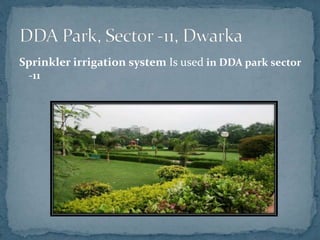
Sprinkler irrigation system Is used in DDA park sector
-11
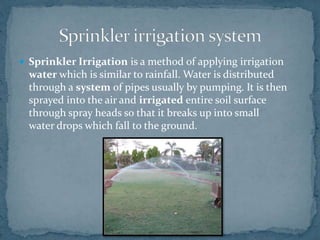
 Sprinkler Irrigation is a method of applying irrigation
water which is similar to rainfall. Water is distributed
through a system of pipes usually by pumping. It is then
sprayed into the air and irrigated entire soil surface
through spray heads so that it breaks up into small
water drops which fall to the ground.
Advantages of Sprinkler Irrigation System
 This technique enables judicious utilization of even small water flows
and permits efficient irrigation of undulated lands, and soils with
shallow depths.
 It saves 10to 16% land that is used in construction of channels and
ridges in other methods.
 Highly permeable as well as relatively less permeable soils can
be easily irrigated by sprinkler method without any risk of run-off and
erosion, inundation and seepage losses.
 Fertilizers, pesticides and weedicides can be applied along with water
spray, thus, saving extra labour.
Disadvantages of Sprinkler Irrigation Method
 High initial cost of equipments.
 Operating costs are generally higher than irrigation by surface methods.
 Winds disturb the sprinkler pattern giving uneven distribution of the irrigation
water.
 Sprinkling with water containing an appreciable amount of salts may result in
bum or death of the plants.
 Under certain climatic conditions diseases may be encouraged. The problem of
fruit rotting in tomato and strawberry gets aggravated especially in moist soil
condition.
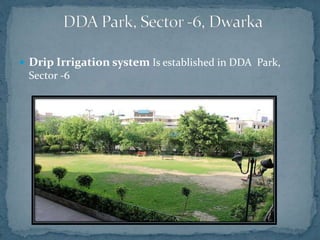
 Drip Irrigation system Is established in DDA Park,
Sector -6
 Drip System – Drip irrigation is the most water-efficient
way to irrigate many different plantings. It is an ideal way
to water in clay soils because the water is applied slowly,
allowing the soil to absorb the water and avoid runoff. Drip
devices use a fraction of the water that overhead spray
devices use. “Point source” drip systems are comprised of
drip tubing that is laid throughout a planting bed and
feeds water directly to the base of the plants at a rate the
soil can absorb without losing water to misting, overspray,
or runoff.
 Advantages of Drip Irrigation
 Water is used at maximum level.
 As water is applied locally and leaching is reduced, fertilizer/nutrient loss is
minimized.
 Weeds can not absorb water as no water is available for them.
 Yield of crops are maximum.
 Fertilizers can be used with high efficiency.
 Weed are grown in less number.
 Operational cost is low.
 Disadvantages of Drip Irrigation
 Expense specially initial cost is high.
 The lifetime of the tubes used in drip irrigation can be shortened by the sun causing
wastage.
 May cause clogging if water is not filtered correctly.
 Problems in moisture distribution.
 Salinity problem.
 Germination problem.
 High skills are required.
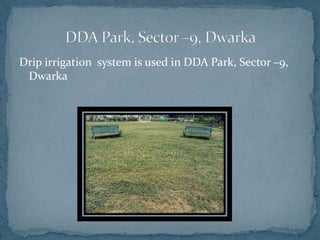
Drip irrigation system is used in DDA Park, Sector –9,
Dwarka
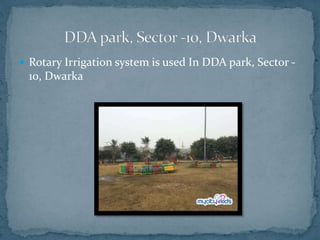
 Rotary Irrigation system is used In DDA park, Sector -
10, Dwarka
 Rotary Systems
 This method of irrigation is best suited for
larger areas, for the sprinklers can reach
distances of up to 100 feet. The word “Rotary” is
indicative of the mechanical driven sprinklers
moving in a circular motion, hence reaching
greater distances. This system waters a larger
area with small amounts of water over a longer
period of time.
 The center-pivot irrigation system is considered to be a
highly efficient system which helps conserve water.
 Center pivot irrigation typically uses less water
compared to many surface irrigation and furrow
irrigation techniques
 It reduces the expenditure of and conserves water. It
also helps to reduce labor costs compared to some
ground irrigation techniques, which are often more
labor-intensive.
 It is now understood that groundwater level elevation
decreases when the rate of extraction by irrigation
exceeds the rate of recharge.
 At some places, the water table was measured to drop
more than five feet (1.5 m) per year at the time of
maximum extraction.
 In extreme cases, the deepening of wells was required
to reach the steadily falling water table
Types of irrigation systems

Types of irrigation systems

  • 1.
  • 2.
     Their are4 parks near my house 1. DDA Park, Sector -11, Dwarka, New Delhi 2. DDA Park, Sector -9, Dwarka 3. DDA Park, Sector -6, Dwarka 4. DDA park, Sector -10, Dwarka
  • 3.
    Sprinkler irrigation systemIs used in DDA park sector -11
  • 4.
     Sprinkler Irrigationis a method of applying irrigation water which is similar to rainfall. Water is distributed through a system of pipes usually by pumping. It is then sprayed into the air and irrigated entire soil surface through spray heads so that it breaks up into small water drops which fall to the ground.
  • 5.
    Advantages of SprinklerIrrigation System  This technique enables judicious utilization of even small water flows and permits efficient irrigation of undulated lands, and soils with shallow depths.  It saves 10to 16% land that is used in construction of channels and ridges in other methods.  Highly permeable as well as relatively less permeable soils can be easily irrigated by sprinkler method without any risk of run-off and erosion, inundation and seepage losses.  Fertilizers, pesticides and weedicides can be applied along with water spray, thus, saving extra labour.
  • 6.
    Disadvantages of SprinklerIrrigation Method  High initial cost of equipments.  Operating costs are generally higher than irrigation by surface methods.  Winds disturb the sprinkler pattern giving uneven distribution of the irrigation water.  Sprinkling with water containing an appreciable amount of salts may result in bum or death of the plants.  Under certain climatic conditions diseases may be encouraged. The problem of fruit rotting in tomato and strawberry gets aggravated especially in moist soil condition.
  • 7.
     Drip Irrigationsystem Is established in DDA Park, Sector -6
  • 8.
     Drip System– Drip irrigation is the most water-efficient way to irrigate many different plantings. It is an ideal way to water in clay soils because the water is applied slowly, allowing the soil to absorb the water and avoid runoff. Drip devices use a fraction of the water that overhead spray devices use. “Point source” drip systems are comprised of drip tubing that is laid throughout a planting bed and feeds water directly to the base of the plants at a rate the soil can absorb without losing water to misting, overspray, or runoff.
  • 9.
     Advantages ofDrip Irrigation  Water is used at maximum level.  As water is applied locally and leaching is reduced, fertilizer/nutrient loss is minimized.  Weeds can not absorb water as no water is available for them.  Yield of crops are maximum.  Fertilizers can be used with high efficiency.  Weed are grown in less number.  Operational cost is low.
  • 10.
     Disadvantages ofDrip Irrigation  Expense specially initial cost is high.  The lifetime of the tubes used in drip irrigation can be shortened by the sun causing wastage.  May cause clogging if water is not filtered correctly.  Problems in moisture distribution.  Salinity problem.  Germination problem.  High skills are required.
  • 11.
    Drip irrigation systemis used in DDA Park, Sector –9, Dwarka
  • 12.
     Rotary Irrigationsystem is used In DDA park, Sector - 10, Dwarka
  • 13.
     Rotary Systems This method of irrigation is best suited for larger areas, for the sprinklers can reach distances of up to 100 feet. The word “Rotary” is indicative of the mechanical driven sprinklers moving in a circular motion, hence reaching greater distances. This system waters a larger area with small amounts of water over a longer period of time.
  • 14.
     The center-pivotirrigation system is considered to be a highly efficient system which helps conserve water.  Center pivot irrigation typically uses less water compared to many surface irrigation and furrow irrigation techniques  It reduces the expenditure of and conserves water. It also helps to reduce labor costs compared to some ground irrigation techniques, which are often more labor-intensive.
  • 15.
     It isnow understood that groundwater level elevation decreases when the rate of extraction by irrigation exceeds the rate of recharge.  At some places, the water table was measured to drop more than five feet (1.5 m) per year at the time of maximum extraction.  In extreme cases, the deepening of wells was required to reach the steadily falling water table