IRRIGATION 
BY– SAYLI SOLANKE
WHAT IS IRRIGATION ? 
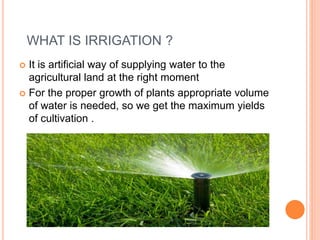
 It is artificial way of supplying water to the 
agricultural land at the right moment 
 For the proper growth of plants appropriate volume 
of water is needed, so we get the maximum yields 
of cultivation .
HISTORY 
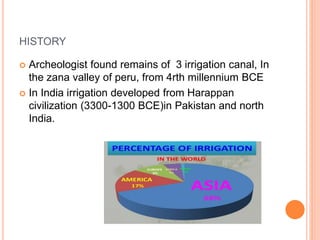
 Archeologist found remains of 3 irrigation canal, In 
the zana valley of peru, from 4rth millennium BCE 
 In India irrigation developed from Harappan 
civilization (3300-1300 BCE)in Pakistan and north 
India.
NEED OF IRRIGATION - 
 For normal growth and yield of the plant. 
 To reduce the soil temperature. 
 For easy germination of the seeds from the soil. 
 To provide crop insurance against short duration 
drought 
 Uneven Distribution of Rainfall 
 Uncertainty of Rainfall 
 Irregularity of Rainfall 
 Specialty of Crops 
 Development of agriculture in desert area
TYPES OF IRRIGATION- 
1.Surface irrigation 
2.Localized irrigation 
3.Lateral move irrigation 
4.Centre pivot irrigation
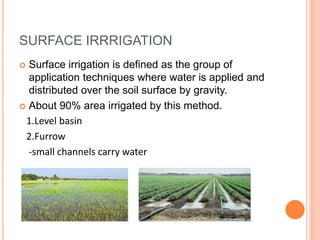
SURFACE IRRRIGATION 
 Surface irrigation is defined as the group of 
application techniques where water is applied and 
distributed over the soil surface by gravity. 
 About 90% area irrigated by this method. 
1.Level basin 
2.Furrow 
-small channels carry water
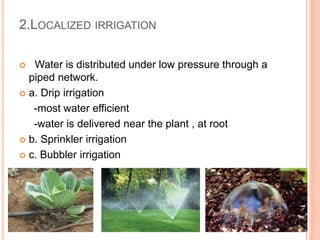
2.LOCALIZED IRRIGATION 
 Water is distributed under low pressure through a 
piped network. 
 a. Drip irrigation 
-most water efficient 
-water is delivered near the plant , at root 
 b. Sprinkler irrigation 
 c. Bubbler irrigation
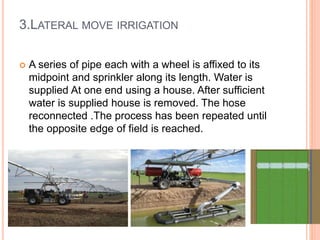
3.LATERAL MOVE IRRIGATION 
 A series of pipe each with a wheel is affixed to its 
midpoint and sprinkler along its length. Water is 
supplied At one end using a house. After sufficient 
water is supplied house is removed. The hose 
reconnected .The process has been repeated until 
the opposite edge of field is reached.
4.CENTRE PIVOT IRRIGATION 
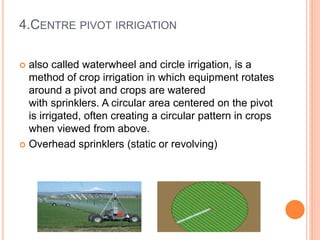
 also called waterwheel and circle irrigation, is a 
method of crop irrigation in which equipment rotates 
around a pivot and crops are watered 
with sprinklers. A circular area centered on the pivot 
is irrigated, often creating a circular pattern in crops 
when viewed from above. 
 Overhead sprinklers (static or revolving)
WHAT ARE THE ADVANTAGES OF 
IRRIGATION ? 
 Improve ground water storage. 
 Increase of food production. 
 Increase income. 
 Modify soil or climate environment 
 Increase value of land 
 Lessen risk of damage caused by drought. 
 Increase labor employment. 
 Increase standard of living.
WHAT ARE THE DISADVANTAGES OF 
IRRIGATION ? 
 Water logging. 
 Salinity and alkalinity of land. 
 Pollution of underground water. 
 Results in colder and damper climate causing 
outbreak of diseases like malaria.
WHAT ARE THE PROBLEMS 
GENERATED BY IRRIGATION ? 
 Breeding places for mosquitoes 
 Ground water table is increased 
 Water logging 
 Formation of marshy land. 
 It may cause earthquake 
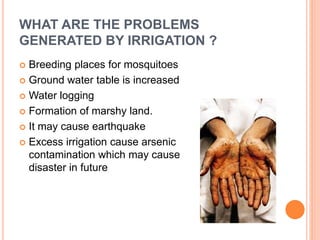
 Excess irrigation cause arsenic 
contamination which may cause greater 
disaster in future
WHAT SHOULD WE DO FOR 
OVERCOME THIS PROBLEMS 
 Use effective method of irrigation 
 Reduce water wastage 
 Salinity control program 
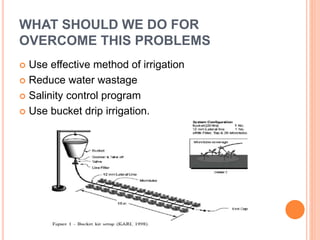
 Use bucket drip irrigation.
THANK YOU !!

By– sayli solanke.pptx 1.pptx llc.pptx 1 ugusb

  • 1.
  • 2.
    WHAT IS IRRIGATION?  It is artificial way of supplying water to the agricultural land at the right moment  For the proper growth of plants appropriate volume of water is needed, so we get the maximum yields of cultivation .
  • 3.
    HISTORY  Archeologistfound remains of 3 irrigation canal, In the zana valley of peru, from 4rth millennium BCE  In India irrigation developed from Harappan civilization (3300-1300 BCE)in Pakistan and north India.
  • 4.
    NEED OF IRRIGATION-  For normal growth and yield of the plant.  To reduce the soil temperature.  For easy germination of the seeds from the soil.  To provide crop insurance against short duration drought  Uneven Distribution of Rainfall  Uncertainty of Rainfall  Irregularity of Rainfall  Specialty of Crops  Development of agriculture in desert area
  • 5.
    TYPES OF IRRIGATION- 1.Surface irrigation 2.Localized irrigation 3.Lateral move irrigation 4.Centre pivot irrigation
  • 6.
    SURFACE IRRRIGATION Surface irrigation is defined as the group of application techniques where water is applied and distributed over the soil surface by gravity.  About 90% area irrigated by this method. 1.Level basin 2.Furrow -small channels carry water
  • 7.
    2.LOCALIZED IRRIGATION Water is distributed under low pressure through a piped network.  a. Drip irrigation -most water efficient -water is delivered near the plant , at root  b. Sprinkler irrigation  c. Bubbler irrigation
  • 8.
    3.LATERAL MOVE IRRIGATION  A series of pipe each with a wheel is affixed to its midpoint and sprinkler along its length. Water is supplied At one end using a house. After sufficient water is supplied house is removed. The hose reconnected .The process has been repeated until the opposite edge of field is reached.
  • 9.
    4.CENTRE PIVOT IRRIGATION  also called waterwheel and circle irrigation, is a method of crop irrigation in which equipment rotates around a pivot and crops are watered with sprinklers. A circular area centered on the pivot is irrigated, often creating a circular pattern in crops when viewed from above.  Overhead sprinklers (static or revolving)
  • 10.
    WHAT ARE THEADVANTAGES OF IRRIGATION ?  Improve ground water storage.  Increase of food production.  Increase income.  Modify soil or climate environment  Increase value of land  Lessen risk of damage caused by drought.  Increase labor employment.  Increase standard of living.
  • 11.
    WHAT ARE THEDISADVANTAGES OF IRRIGATION ?  Water logging.  Salinity and alkalinity of land.  Pollution of underground water.  Results in colder and damper climate causing outbreak of diseases like malaria.
  • 12.
    WHAT ARE THEPROBLEMS GENERATED BY IRRIGATION ?  Breeding places for mosquitoes  Ground water table is increased  Water logging  Formation of marshy land.  It may cause earthquake  Excess irrigation cause arsenic contamination which may cause greater disaster in future
  • 13.
    WHAT SHOULD WEDO FOR OVERCOME THIS PROBLEMS  Use effective method of irrigation  Reduce water wastage  Salinity control program  Use bucket drip irrigation.
  • 14.