



RAINFALL DISAGGREGATION USING ARTIFICIAL
NEURAL NETWORKS
Shashank Singh, R Subbaiah and H D Rank
College of Agricultural Engineering and
Technology,
Junagadh Agricultural University,
Junagadh 361 001
shashanksinghb4u@gmail.com
ARTIFICIAL NEURAL
NETWORKS
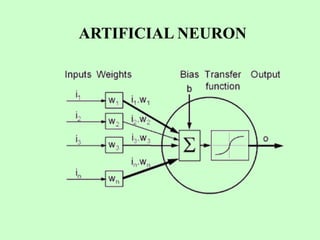
• Massively parallel distributed information
processing system resembling biological neural
networks of human brain
• First development in 1943 ( Mcculloch and Pitts)
• Engineering applications : signal processing,
robotics, control, hydrology, geotechnical
engineering to name a few
An average human brain has from 4 x 10¹⁰ to 1011
neurons. With the possibility of up to 104
interconnections per neuron, that enables 1015
interconnections (between neurons). A neuron is a
specialized cell for receiving, processing and
transmitting information by biochemical means
(neurotransmitters).
Structure of a biological neuron
ARTIFICIAL NEURON
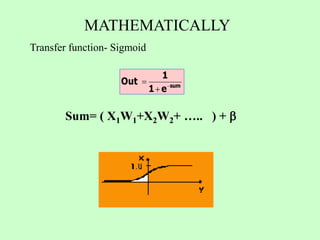
MATHEMATICALLY
Transfer function- Sigmoid
Sum= ( X1W1+X2W2+ ….. ) + 
sum
e
1
1
Out 


OBJECTIVE
To disaggregate the annual rainfall series into
monthly rainfall series and monthly series to weekly
series using feed forward artificial neural network.
Rainfall Disaggregation
Disaggregation models are widely used tools for the
stochastic simulation of hydrologic series. They divide
known higher-level values (e.g. annual) into lower level ones
(e.g. seasonal), which add up to the given higher level. Thus
ability to transform a series from a higher time scale to a
lower one.
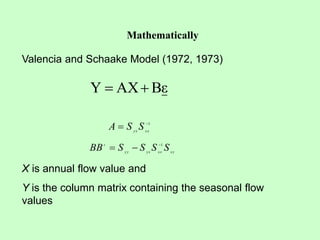
Mathematically
ε
B
AX
Y 

Valencia and Schaake Model (1972, 1973)
1

 xx
yx
S
S
A
xy
xx
yx
yy
t
S
S
S
S
BB 1



X is annual flow value and
Y is the column matrix containing the seasonal flow
values
RAINFALL DISAGGREGATION USING ARTIFICIAL
NEURAL NETWORKS
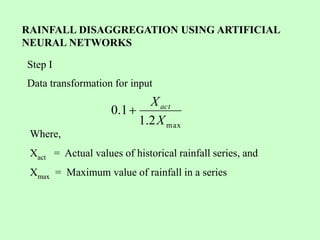
Data transformation for input
max
2
.
1
1
.
0
X
Xact

Where,
Xact = Actual values of historical rainfall series, and
Xmax = Maximum value of rainfall in a series
Step I
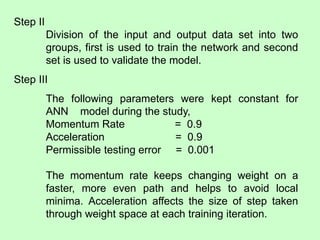
Step II
Division of the input and output data set into two
groups, first is used to train the network and second
set is used to validate the model.
Step III
The following parameters were kept constant for
ANN model during the study,
Momentum Rate = 0.9
Acceleration = 0.9
Permissible testing error = 0.001
The momentum rate keeps changing weight on a
faster, more even path and helps to avoid local
minima. Acceleration affects the size of step taken
through weight space at each training iteration.
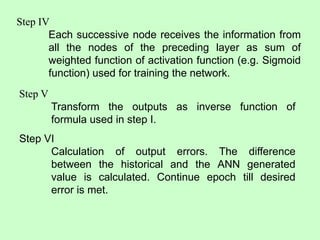
Step IV
Each successive node receives the information from
all the nodes of the preceding layer as sum of
weighted function of activation function (e.g. Sigmoid
function) used for training the network.
Step V
Transform the outputs as inverse function of
formula used in step I.
Step VI
Calculation of output errors. The difference
between the historical and the ANN generated
value is calculated. Continue epoch till desired
error is met.
Step VII
Validation the network using out-of-sample data. If
out-of-sample RMSE,BIC,AIC and coefficient of
skewness is consistent with training RMSE
BIC,AIC and coefficient of skewness the model
appears valid.
Step VIII
If the model is not valid, repeat the experiment
(a) Try different initial values for the weights.
(b) Redesign the ANN
(c) Try a different ANN method
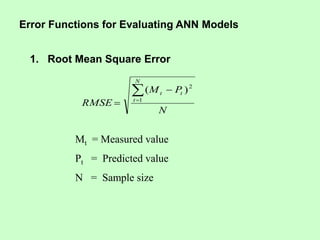
N
P
M
RMSE
N
t
t
t



 1
2
)
(
Mt = Measured value
Pt = Predicted value
N = Sample size
1. Root Mean Square Error
Error Functions for Evaluating ANN Models
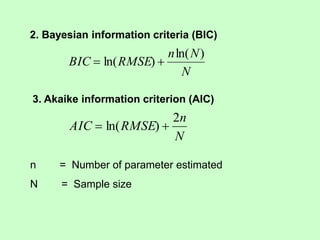
N
N
n
RMSE
BIC
)
ln(
)
ln( 

N
n
RMSE
AIC
2
)
ln( 

n = Number of parameter estimated
N = Sample size
2. Bayesian information criteria (BIC)
3. Akaike information criterion (AIC)
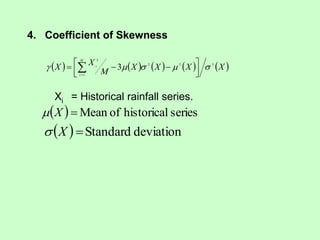
         
X
X
X
X
M
X
X
M
i
i
3
1
3
2
3
3 









 

 

4. Coefficient of Skewness
Xi = Historical rainfall series.
  series
historical
of
Mean

X

  deviation
Standard

X

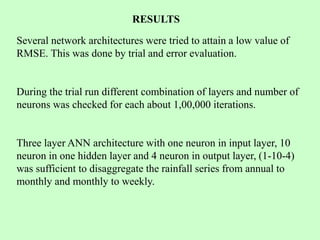
RESULTS
Several network architectures were tried to attain a low value of
RMSE. This was done by trial and error evaluation.
During the trial run different combination of layers and number of
neurons was checked for each about 1,00,000 iterations.
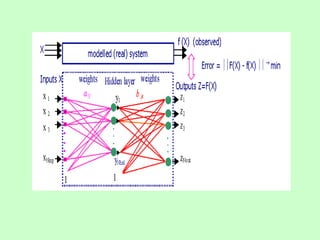
Three layer ANN architecture with one neuron in input layer, 10
neuron in one hidden layer and 4 neuron in output layer, (1-10-4)
was sufficient to disaggregate the rainfall series from annual to
monthly and monthly to weekly.
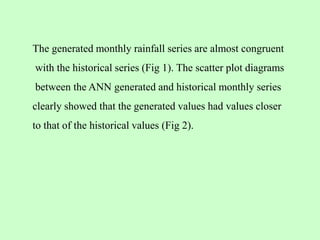
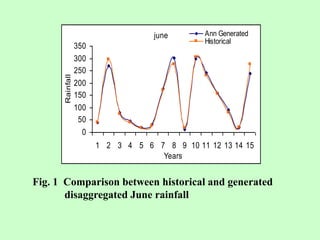
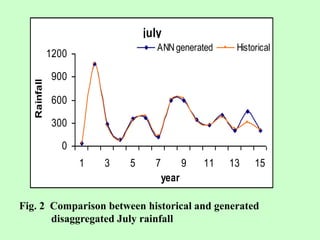
The generated monthly rainfall series are almost congruent
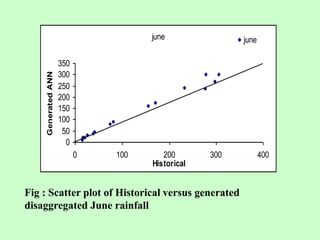
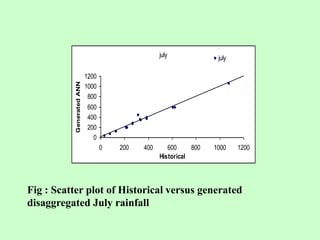
with the historical series (Fig 1). The scatter plot diagrams
between the ANN generated and historical monthly series
clearly showed that the generated values had values closer
to that of the historical values (Fig 2).
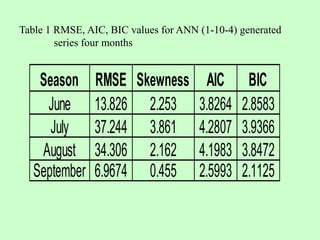
Table 1 RMSE, AIC, BIC values for ANN (1-10-4) generated
series four months
Season RMSE Skewness AIC BIC
June 13.826 2.253 3.8264 2.8583
July 37.244 3.861 4.2807 3.9366
August 34.306 2.162 4.1983 3.8472
September 6.9674 0.455 2.5993 2.1125
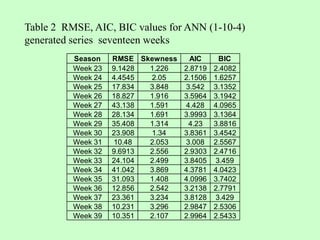
Season RMSE Skewness AIC BIC
Week 23 9.1428 1.226 2.8719 2.4082
Week 24 4.4545 2.05 2.1506 1.6257
Week 25 17.834 3.848 3.542 3.1352
Week 26 18.827 1.916 3.5964 3.1942
Week 27 43.138 1.591 4.428 4.0965
Week 28 28.134 1.691 3.9993 3.1364
Week 29 35.408 1.314 4.23 3.8816
Week 30 23.908 1.34 3.8361 3.4542
Week 31 10.48 2.053 3.008 2.5567
Week 32 9.6913 2.556 2.9303 2.4716
Week 33 24.104 2.499 3.8405 3.459
Week 34 41.042 3.869 4.3781 4.0423
Week 35 31.093 1.408 4.0996 3.7402
Week 36 12.856 2.542 3.2138 2.7791
Week 37 23.361 3.234 3.8128 3.429
Week 38 10.231 3.296 2.9847 2.5306
Week 39 10.351 2.107 2.9964 2.5433
Table 2 RMSE, AIC, BIC values for ANN (1-10-4)
generated series seventeen weeks
june
0
50
100
150
200
250
300
350
1 2 3 4 5 6 7 8 9 10 11 12 13 14 15
Years
Rainfall
Ann Generated
Historical
Fig. 1 Comparison between historical and generated
disaggregated June rainfall
july
0
300
600
900
1200
1 3 5 7 9 11 13 15
year
Rainfall
ANN generated Historical
Fig. 2 Comparison between historical and generated
disaggregated July rainfall
june
0
50
100
150
200
250
300
350
0 100 200 300 400
Historical
Generated
ANN
june
Fig : Scatter plot of Historical versus generated
disaggregated June rainfall
july
0
200
400
600
800
1000
1200
0 200 400 600 800 1000 1200
Historical
Generated
ANN
july
Fig : Scatter plot of Historical versus generated
disaggregated July rainfall

Stochastic modeling of Rainfall Disaggregation using ANN

  • 1.
    RAINFALL DISAGGREGATION USINGARTIFICIAL NEURAL NETWORKS Shashank Singh, R Subbaiah and H D Rank College of Agricultural Engineering and Technology, Junagadh Agricultural University, Junagadh 361 001 shashanksinghb4u@gmail.com
  • 2.
    ARTIFICIAL NEURAL NETWORKS • Massivelyparallel distributed information processing system resembling biological neural networks of human brain • First development in 1943 ( Mcculloch and Pitts) • Engineering applications : signal processing, robotics, control, hydrology, geotechnical engineering to name a few
  • 3.
    An average humanbrain has from 4 x 10¹⁰ to 1011 neurons. With the possibility of up to 104 interconnections per neuron, that enables 1015 interconnections (between neurons). A neuron is a specialized cell for receiving, processing and transmitting information by biochemical means (neurotransmitters). Structure of a biological neuron
  • 4.
  • 5.
    MATHEMATICALLY Transfer function- Sigmoid Sum=( X1W1+X2W2+ ….. ) +  sum e 1 1 Out   
  • 7.
    OBJECTIVE To disaggregate theannual rainfall series into monthly rainfall series and monthly series to weekly series using feed forward artificial neural network.
  • 8.
    Rainfall Disaggregation Disaggregation modelsare widely used tools for the stochastic simulation of hydrologic series. They divide known higher-level values (e.g. annual) into lower level ones (e.g. seasonal), which add up to the given higher level. Thus ability to transform a series from a higher time scale to a lower one.
  • 9.
    Mathematically ε B AX Y   Valencia andSchaake Model (1972, 1973) 1   xx yx S S A xy xx yx yy t S S S S BB 1    X is annual flow value and Y is the column matrix containing the seasonal flow values
  • 10.
    RAINFALL DISAGGREGATION USINGARTIFICIAL NEURAL NETWORKS Data transformation for input max 2 . 1 1 . 0 X Xact  Where, Xact = Actual values of historical rainfall series, and Xmax = Maximum value of rainfall in a series Step I
  • 11.
    Step II Division ofthe input and output data set into two groups, first is used to train the network and second set is used to validate the model. Step III The following parameters were kept constant for ANN model during the study, Momentum Rate = 0.9 Acceleration = 0.9 Permissible testing error = 0.001 The momentum rate keeps changing weight on a faster, more even path and helps to avoid local minima. Acceleration affects the size of step taken through weight space at each training iteration.
  • 12.
    Step IV Each successivenode receives the information from all the nodes of the preceding layer as sum of weighted function of activation function (e.g. Sigmoid function) used for training the network. Step V Transform the outputs as inverse function of formula used in step I. Step VI Calculation of output errors. The difference between the historical and the ANN generated value is calculated. Continue epoch till desired error is met.
  • 13.
    Step VII Validation thenetwork using out-of-sample data. If out-of-sample RMSE,BIC,AIC and coefficient of skewness is consistent with training RMSE BIC,AIC and coefficient of skewness the model appears valid. Step VIII If the model is not valid, repeat the experiment (a) Try different initial values for the weights. (b) Redesign the ANN (c) Try a different ANN method
  • 14.
    N P M RMSE N t t t     1 2 ) ( Mt =Measured value Pt = Predicted value N = Sample size 1. Root Mean Square Error Error Functions for Evaluating ANN Models
  • 15.
    N N n RMSE BIC ) ln( ) ln(   N n RMSE AIC 2 ) ln(   n= Number of parameter estimated N = Sample size 2. Bayesian information criteria (BIC) 3. Akaike information criterion (AIC)
  • 16.
             X X X X M X X M i i 3 1 3 2 3 3                 4. Coefficient of Skewness Xi = Historical rainfall series.   series historical of Mean  X    deviation Standard  X 
  • 17.
    RESULTS Several network architectureswere tried to attain a low value of RMSE. This was done by trial and error evaluation. During the trial run different combination of layers and number of neurons was checked for each about 1,00,000 iterations. Three layer ANN architecture with one neuron in input layer, 10 neuron in one hidden layer and 4 neuron in output layer, (1-10-4) was sufficient to disaggregate the rainfall series from annual to monthly and monthly to weekly.
  • 18.
    The generated monthlyrainfall series are almost congruent with the historical series (Fig 1). The scatter plot diagrams between the ANN generated and historical monthly series clearly showed that the generated values had values closer to that of the historical values (Fig 2).
  • 19.
    Table 1 RMSE,AIC, BIC values for ANN (1-10-4) generated series four months Season RMSE Skewness AIC BIC June 13.826 2.253 3.8264 2.8583 July 37.244 3.861 4.2807 3.9366 August 34.306 2.162 4.1983 3.8472 September 6.9674 0.455 2.5993 2.1125
  • 20.
    Season RMSE SkewnessAIC BIC Week 23 9.1428 1.226 2.8719 2.4082 Week 24 4.4545 2.05 2.1506 1.6257 Week 25 17.834 3.848 3.542 3.1352 Week 26 18.827 1.916 3.5964 3.1942 Week 27 43.138 1.591 4.428 4.0965 Week 28 28.134 1.691 3.9993 3.1364 Week 29 35.408 1.314 4.23 3.8816 Week 30 23.908 1.34 3.8361 3.4542 Week 31 10.48 2.053 3.008 2.5567 Week 32 9.6913 2.556 2.9303 2.4716 Week 33 24.104 2.499 3.8405 3.459 Week 34 41.042 3.869 4.3781 4.0423 Week 35 31.093 1.408 4.0996 3.7402 Week 36 12.856 2.542 3.2138 2.7791 Week 37 23.361 3.234 3.8128 3.429 Week 38 10.231 3.296 2.9847 2.5306 Week 39 10.351 2.107 2.9964 2.5433 Table 2 RMSE, AIC, BIC values for ANN (1-10-4) generated series seventeen weeks
  • 21.
    june 0 50 100 150 200 250 300 350 1 2 34 5 6 7 8 9 10 11 12 13 14 15 Years Rainfall Ann Generated Historical Fig. 1 Comparison between historical and generated disaggregated June rainfall
  • 22.
    july 0 300 600 900 1200 1 3 57 9 11 13 15 year Rainfall ANN generated Historical Fig. 2 Comparison between historical and generated disaggregated July rainfall
  • 23.
    june 0 50 100 150 200 250 300 350 0 100 200300 400 Historical Generated ANN june Fig : Scatter plot of Historical versus generated disaggregated June rainfall
  • 24.
    july 0 200 400 600 800 1000 1200 0 200 400600 800 1000 1200 Historical Generated ANN july Fig : Scatter plot of Historical versus generated disaggregated July rainfall