COOPERATIVE SOCIETY
OBJECTIVES
 Define a Cooperative Society.
 Understanding the different types of societies and their differences.
WHAT IS A COOPERATIVE SOCIETY?
The word ‘Cooperative’ means working together and with others for a common
purpose. A Cooperative Society is a voluntary association of persons, who join
together with the motive of welfare of the members.
Various types of cooperative societies based on the nature of their operations are
mentioned below:
A. Consumer’s cooperative societies
B. Producer’s cooperative societies
C. Marketing cooperative societies
D. Farmer’s cooperative societies
E. Credit cooperative societies
F. Cooperative housing societies
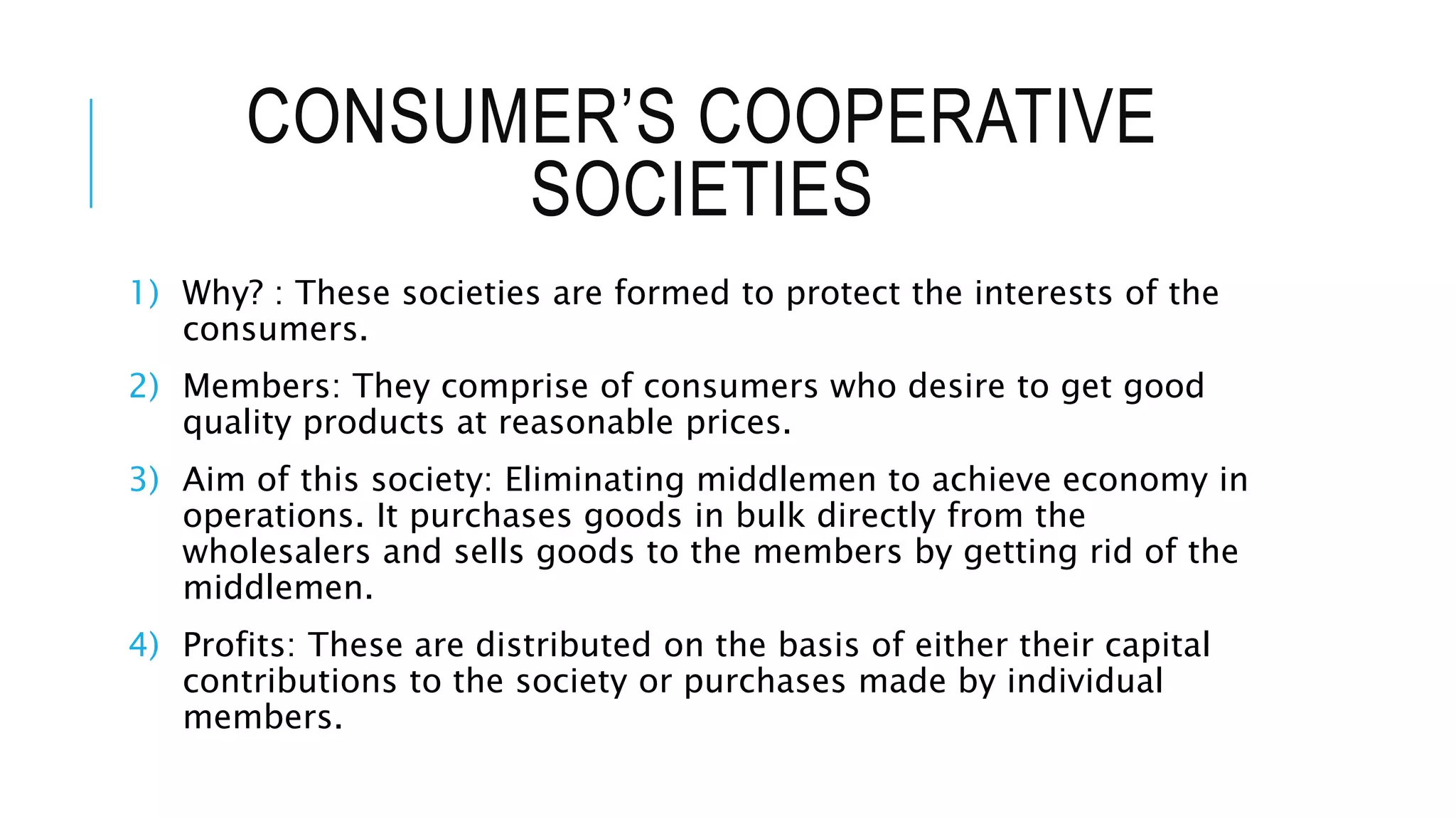
CONSUMER’S COOPERATIVE
SOCIETIES
1) Why? : These societies are formed to protect the interests of the
consumers.
2) Members: They comprise of consumers who desire to get good
quality products at reasonable prices.
3) Aim of this society: Eliminating middlemen to achieve economy in
operations. It purchases goods in bulk directly from the
wholesalers and sells goods to the members by getting rid of the
middlemen.
4) Profits: These are distributed on the basis of either their capital
contributions to the society or purchases made by individual
members.
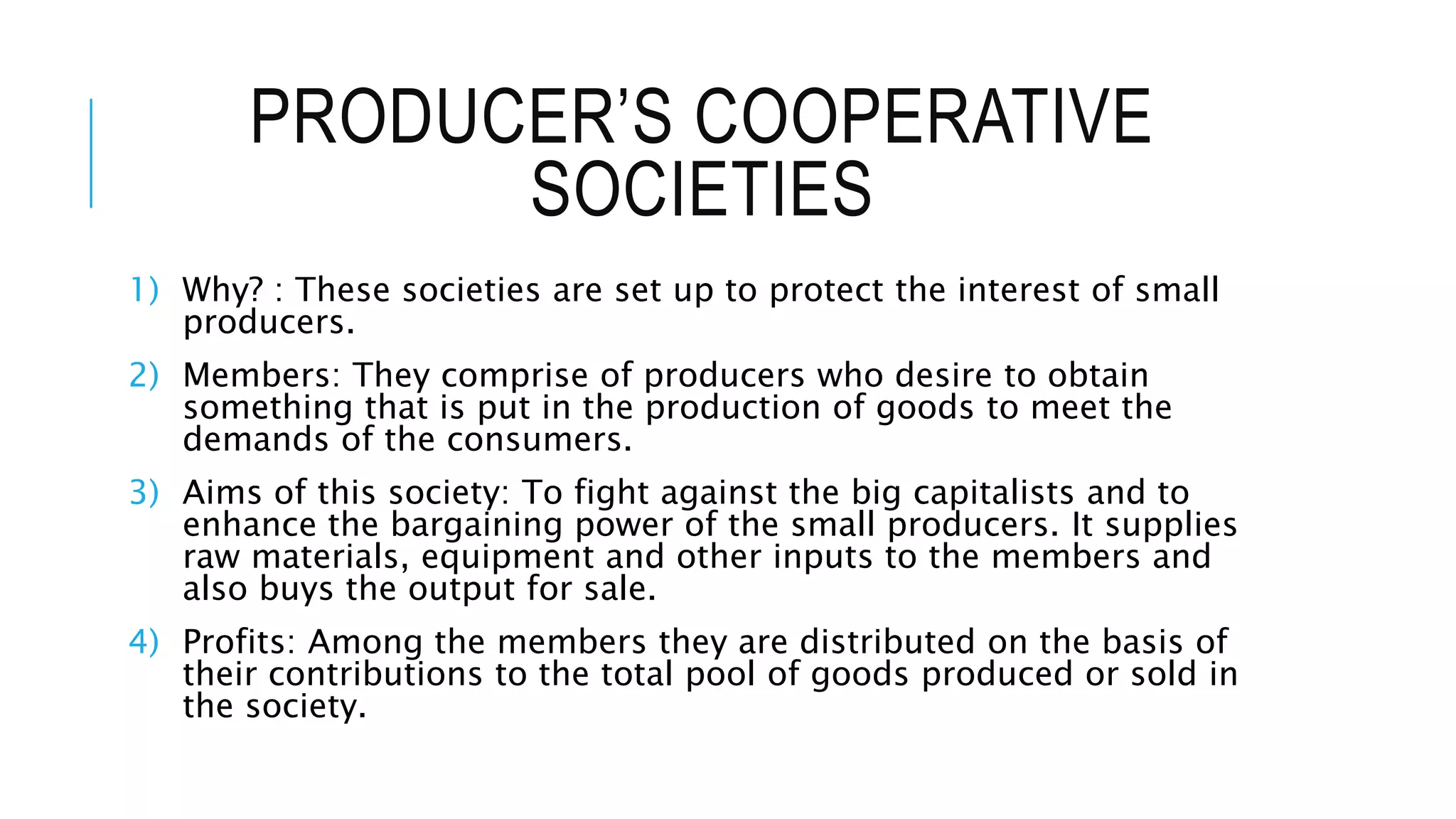
PRODUCER’S COOPERATIVE
SOCIETIES
1) Why? : These societies are set up to protect the interest of small
producers.
2) Members: They comprise of producers who desire to obtain
something that is put in the production of goods to meet the
demands of the consumers.
3) Aims of this society: To fight against the big capitalists and to
enhance the bargaining power of the small producers. It supplies
raw materials, equipment and other inputs to the members and
also buys the output for sale.
4) Profits: Among the members they are distributed on the basis of
their contributions to the total pool of goods produced or sold in
the society.
MARKETING COOPERATIVE
SOCIETIES
1) Why? : Such societies are established to help small producers in
selling their products.
2) Members: They consist of producers who wish to obtain
reasonable prices for their output.
3) Aims of this society: To get rid of middlemen and improve
competitive position of its members by securing a favorable
market of the products. Its pools the output of individual members
and performing marketing functions like transportation,
warehousing, packaging etc., to sell the output at the best possible
price.
4) Profits: They are distributed according to each member’s
contribution to the pool of output.
FARMER’S COOPERATIVE
SOCIETIES
1) Why? : These societies are established to protect the interests of
farmers by providing better inputs at a reasonable cost.
2) Members: They comprise of farmers who wish to jointly take up
farming activities.
3) Aim of this society: To gain the benefits of large scale farming and
increase the productivity. Such societies provide better quality
seeds, fertilizers, machinery, and other modern techniques for use
in the cultivation crops. This helps not only in improving the yield
and returns to the farmers but also solves the problems associated
with the farming on fragmented land holdings
CREDIT COOPERATIVE SOCIETIES
1) Why? : These societies are established for providing easy credit on
reasonable terms to the members.
2) Members: They comprise of persons who seek financial help in the
form of loans.
3) Aim of this society: To protect the members from the exploitation
of lenders who charge high rates of interest on loans.
4) Profits: Such societies provide loans to members out of the
amounts collected as capital and deposits from the members and
charge low rates of interest.
COOPERATIVE HOUSING
SOCIETIES
1) Why? : These societies were established to help people with limited
income to construct houses at reasonable costs.
2) Members: They consist of people who desire to obtain residential
accommodation at lower costs.
3) Aim of the society: To solve the housing problems of the members
by constructing houses and giving the options of paying in
instalments. These societies construct flats or provide plots to
members on which the members themselves can construct the
houses as per their choice.

Types of cooperative societies

  • 1.
  • 2.
    OBJECTIVES  Define aCooperative Society.  Understanding the different types of societies and their differences.
  • 3.
    WHAT IS ACOOPERATIVE SOCIETY? The word ‘Cooperative’ means working together and with others for a common purpose. A Cooperative Society is a voluntary association of persons, who join together with the motive of welfare of the members. Various types of cooperative societies based on the nature of their operations are mentioned below: A. Consumer’s cooperative societies B. Producer’s cooperative societies C. Marketing cooperative societies D. Farmer’s cooperative societies E. Credit cooperative societies F. Cooperative housing societies
  • 4.
    CONSUMER’S COOPERATIVE SOCIETIES 1) Why?: These societies are formed to protect the interests of the consumers. 2) Members: They comprise of consumers who desire to get good quality products at reasonable prices. 3) Aim of this society: Eliminating middlemen to achieve economy in operations. It purchases goods in bulk directly from the wholesalers and sells goods to the members by getting rid of the middlemen. 4) Profits: These are distributed on the basis of either their capital contributions to the society or purchases made by individual members.
  • 5.
    PRODUCER’S COOPERATIVE SOCIETIES 1) Why?: These societies are set up to protect the interest of small producers. 2) Members: They comprise of producers who desire to obtain something that is put in the production of goods to meet the demands of the consumers. 3) Aims of this society: To fight against the big capitalists and to enhance the bargaining power of the small producers. It supplies raw materials, equipment and other inputs to the members and also buys the output for sale. 4) Profits: Among the members they are distributed on the basis of their contributions to the total pool of goods produced or sold in the society.
  • 6.
    MARKETING COOPERATIVE SOCIETIES 1) Why?: Such societies are established to help small producers in selling their products. 2) Members: They consist of producers who wish to obtain reasonable prices for their output. 3) Aims of this society: To get rid of middlemen and improve competitive position of its members by securing a favorable market of the products. Its pools the output of individual members and performing marketing functions like transportation, warehousing, packaging etc., to sell the output at the best possible price. 4) Profits: They are distributed according to each member’s contribution to the pool of output.
  • 7.
    FARMER’S COOPERATIVE SOCIETIES 1) Why?: These societies are established to protect the interests of farmers by providing better inputs at a reasonable cost. 2) Members: They comprise of farmers who wish to jointly take up farming activities. 3) Aim of this society: To gain the benefits of large scale farming and increase the productivity. Such societies provide better quality seeds, fertilizers, machinery, and other modern techniques for use in the cultivation crops. This helps not only in improving the yield and returns to the farmers but also solves the problems associated with the farming on fragmented land holdings
  • 8.
    CREDIT COOPERATIVE SOCIETIES 1)Why? : These societies are established for providing easy credit on reasonable terms to the members. 2) Members: They comprise of persons who seek financial help in the form of loans. 3) Aim of this society: To protect the members from the exploitation of lenders who charge high rates of interest on loans. 4) Profits: Such societies provide loans to members out of the amounts collected as capital and deposits from the members and charge low rates of interest.
  • 9.
    COOPERATIVE HOUSING SOCIETIES 1) Why?: These societies were established to help people with limited income to construct houses at reasonable costs. 2) Members: They consist of people who desire to obtain residential accommodation at lower costs. 3) Aim of the society: To solve the housing problems of the members by constructing houses and giving the options of paying in instalments. These societies construct flats or provide plots to members on which the members themselves can construct the houses as per their choice.