CO-OPEARTIVE SOCIETY & MARKETING
A.S.M. Fazl ul Hoque
As s i s t ant Prof es s or
Dept . of Agri bus i nes s &
Market i ng.
Sher-e -Bangl a
Agri cul t ural Uni vers i t y.
MEANING OF CO-OPERATIVE SOCIETY
 Co-operative society is a union of
individuals who generally join
together on the basis of democracy
for the purpose of economic acts of
common interests.
 It’s Primary goal is to render service
to it’s members.
Scholars Definition
According to Sherlekar and Sherlekar,
“Co-operative society is f form of
business organization, the only system
of voluntary organization suitable for
people for poorer people”.
Sir Horace Plunkett said that,
“Co-operative is an association of
individuals to secure a common economic
goal by honest means”.
Features of Co-operative Society
 Open membership.
 Voluntary organization.
 State control.
 Sources of finance.
 Service motive.
 Distribution of surplus.
Features of Co-operative Society
(Continued.)
 Equality of voting rights.
 Elimination of middlemen.
 Government regulation & control.
 Self-help through mutual cooperation.
 Transferability of shares.
 Audit of accounts.
Objectives of Co-operative Society
 Creating services.
 Bringing economic welfare.
 Creating unity & Solidarity.
 Development of efficiency.
 Supply of goods at a fair price.
Objectives of Co-operative Society
 Development of living standard.
 Defense against corruption.
 Employment.
 Learning morality.
Types of Co-operative society
Co-operative society can be classified
From five different perspective. These
are:
1.Consumer’s co-operative societies.
2.Producer’s co-operative societies.
3.Marketing co-operative societies.
4.Housing co-operative societies
5. Farming Co-operative societies.
Types of Co-operative society
(cont’d)
1.Consumer’s co-operative societies:
 Availability of high quality consumer goods
at a cheap rate.
 Eliminating the middlemen by establishing a
direct link with the producers.
 Maintaining stability in the prices of
essential commodities.
 Avoiding black marketing and hoarding
practices.
Types of Co-operative society
(cont’d)
2.Producer’s co-operative societies:
 To stimulate higher production.
 To improve quality of products.
 To utilize idle manpower.
 To make full use of the available industrial skills of individuals.
Types of Co-operative society
(cont’d)
3.Marketing co-operative societies:
 To ensure a ready, steady and favorable market for the products of
different members.
 To provide services like assembling, grading, storing packing etc.
 To control the flow of supplies and thus influence prices.
 To undertake centralized selling of the produce contributed by
their members.
Types of Co-operative society
(cont’d)
4.Housing co-operative societies:
These societies are organized to provide residential accommodation to
their member, either on an ownership basis or at fair rents.
5. Farming Co-operative societies:
These societies are voluntary associations of small farmers, who join
hands with the objectives of achieving the economies of large scale
farming and agricultural output.
Principles of Co-operative Society
Principle is the guide of action. For achieving
the objectives of the society the following
principles should be followed:
1.Unity.
2.Co-opearation.
3.Honesty.
4.Trust & Confidence.
5.Democracy.
Principles of Co-operative Society
6. Equality.
7.Friendship.
8.Economy.
9.Peace and discipline.
10. Stability.
11.Sevice.
12. Voluntary association.
13.Distribution of surplus.
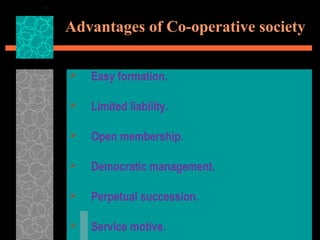
Advantages of Co-operative society
 Easy formation.
 Limited liability.
 Open membership.
 Democratic management.
 Perpetual succession.
 Service motive.
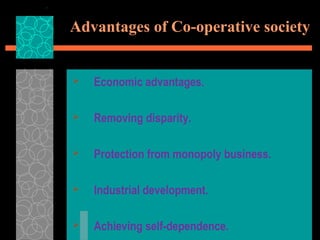
Advantages of Co-operative society
 Economic advantages.
 Removing disparity.
 Protection from monopoly business.
 Industrial development.
 Achieving self-dependence.
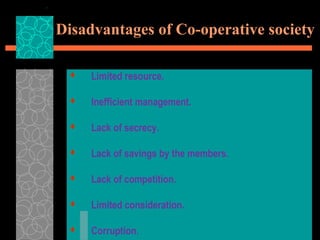
Disadvantages of Co-operative society
 Limited resource.
 Inefficient management.
 Lack of secrecy.
 Lack of savings by the members.
 Lack of competition.
 Limited consideration.
 Corruption.
Disadvantages of Co-operative society
 Complexity of formation.
 Lack of flexibility.
 Lack of education.
 Lack of expansion.
 Non-transferability of shares.
Functions of co-operative marketing
 1.Sale on commission basis
 2.purchase of members’ produce
 3.Advancement of credit
 4.Procurement & price support purchase
 5. Integrated system of co-operative marketing
 6.Other functions (assemble, grading, processing, export, distribution of
production inputs)

Co operative 9

  • 1.
    CO-OPEARTIVE SOCIETY &MARKETING A.S.M. Fazl ul Hoque As s i s t ant Prof es s or Dept . of Agri bus i nes s & Market i ng. Sher-e -Bangl a Agri cul t ural Uni vers i t y.
  • 2.
    MEANING OF CO-OPERATIVESOCIETY  Co-operative society is a union of individuals who generally join together on the basis of democracy for the purpose of economic acts of common interests.  It’s Primary goal is to render service to it’s members.
  • 3.
    Scholars Definition According toSherlekar and Sherlekar, “Co-operative society is f form of business organization, the only system of voluntary organization suitable for people for poorer people”. Sir Horace Plunkett said that, “Co-operative is an association of individuals to secure a common economic goal by honest means”.
  • 4.
    Features of Co-operativeSociety  Open membership.  Voluntary organization.  State control.  Sources of finance.  Service motive.  Distribution of surplus.
  • 5.
    Features of Co-operativeSociety (Continued.)  Equality of voting rights.  Elimination of middlemen.  Government regulation & control.  Self-help through mutual cooperation.  Transferability of shares.  Audit of accounts.
  • 6.
    Objectives of Co-operativeSociety  Creating services.  Bringing economic welfare.  Creating unity & Solidarity.  Development of efficiency.  Supply of goods at a fair price.
  • 7.
    Objectives of Co-operativeSociety  Development of living standard.  Defense against corruption.  Employment.  Learning morality.
  • 8.
    Types of Co-operativesociety Co-operative society can be classified From five different perspective. These are: 1.Consumer’s co-operative societies. 2.Producer’s co-operative societies. 3.Marketing co-operative societies. 4.Housing co-operative societies 5. Farming Co-operative societies.
  • 9.
    Types of Co-operativesociety (cont’d) 1.Consumer’s co-operative societies:  Availability of high quality consumer goods at a cheap rate.  Eliminating the middlemen by establishing a direct link with the producers.  Maintaining stability in the prices of essential commodities.  Avoiding black marketing and hoarding practices.
  • 10.
    Types of Co-operativesociety (cont’d) 2.Producer’s co-operative societies:  To stimulate higher production.  To improve quality of products.  To utilize idle manpower.  To make full use of the available industrial skills of individuals.
  • 11.
    Types of Co-operativesociety (cont’d) 3.Marketing co-operative societies:  To ensure a ready, steady and favorable market for the products of different members.  To provide services like assembling, grading, storing packing etc.  To control the flow of supplies and thus influence prices.  To undertake centralized selling of the produce contributed by their members.
  • 12.
    Types of Co-operativesociety (cont’d) 4.Housing co-operative societies: These societies are organized to provide residential accommodation to their member, either on an ownership basis or at fair rents. 5. Farming Co-operative societies: These societies are voluntary associations of small farmers, who join hands with the objectives of achieving the economies of large scale farming and agricultural output.
  • 13.
    Principles of Co-operativeSociety Principle is the guide of action. For achieving the objectives of the society the following principles should be followed: 1.Unity. 2.Co-opearation. 3.Honesty. 4.Trust & Confidence. 5.Democracy.
  • 14.
    Principles of Co-operativeSociety 6. Equality. 7.Friendship. 8.Economy. 9.Peace and discipline. 10. Stability. 11.Sevice. 12. Voluntary association. 13.Distribution of surplus.
  • 15.
    Advantages of Co-operativesociety  Easy formation.  Limited liability.  Open membership.  Democratic management.  Perpetual succession.  Service motive.
  • 16.
    Advantages of Co-operativesociety  Economic advantages.  Removing disparity.  Protection from monopoly business.  Industrial development.  Achieving self-dependence.
  • 17.
    Disadvantages of Co-operativesociety  Limited resource.  Inefficient management.  Lack of secrecy.  Lack of savings by the members.  Lack of competition.  Limited consideration.  Corruption.
  • 18.
    Disadvantages of Co-operativesociety  Complexity of formation.  Lack of flexibility.  Lack of education.  Lack of expansion.  Non-transferability of shares.
  • 19.
    Functions of co-operativemarketing  1.Sale on commission basis  2.purchase of members’ produce  3.Advancement of credit  4.Procurement & price support purchase  5. Integrated system of co-operative marketing  6.Other functions (assemble, grading, processing, export, distribution of production inputs)