Basic Principles and
Highlights of Issues in
Cooperative Societies
What is a Co-operative Society?
As the name suggests, it is a business
venture which runs on the co-
operation of and the ownership by its
customers who re-invest in the
community it served.
An autonomous association of persons
voluntarily cooperating for mutual
social, economic and cultural benefits
Evolution of Cooperative Movement


• The cooperative movement in India owes its origin to
  agriculture and allied sectors.

• It was an attractive mechanism for pooling the meagre
  resources for solving common problems relating to
  credit, supplies of inputs and marketing of agricultural
  produce
• In 1904 the government enacted Cooperative Credit Societies
  Act, 1904 a more comprehensive legislation called the
  Cooperative Societies Act was enacted.
Contd..
• Under the Montague-Chelmsford Reforms of 1919and under
  the government of India act, 1935, cooperatives were treated
  as a provincial subject. The provinces were authorised to
  make their own cooperative laws.
• After India attained Independence in
  August, 1947, cooperatives assumed a great significance in
  poverty removal and faster socio-economic growth. With the
  advent of the planning process, cooperatives became an
  integral part of the Five Year Plans.
• The item "Cooperative Societies" is a State Subject under entry
  No.32 of the State List of the Constitution of India.
Contd..
 Micro finance:
 As a way to help cooperatives and individual
 businessmen to grow and prosper their
 business, making the community financially
 self-reliant simultaneously, Micro Finance
 came up as a boon for both society and banks
 to leverage on the power of cooperatives in
 impacting the society.
VIDEO
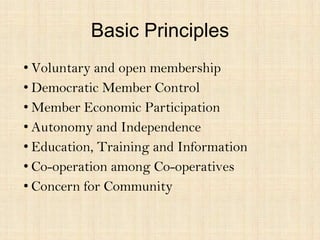
Basic Principles
• Voluntary and open membership
• Democratic Member Control
• Member Economic Participation
• Autonomy and Independence
• Education, Training and Information
• Co-operation among Co-operatives
• Concern for Community
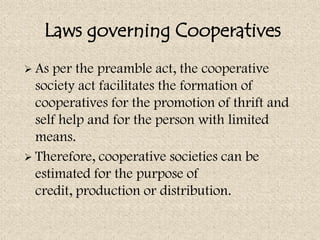
Laws governing Cooperatives
 As per the preamble act, the cooperative
  society act facilitates the formation of
  cooperatives for the promotion of thrift and
  self help and for the person with limited
  means.
 Therefore, cooperative societies can be
  estimated for the purpose of
  credit, production or distribution.
Laws governing Cooperatives
 Agricultural  credit societies must be with
  unlimited liability
 Unlimited societies, however, are not the best
  form of cooperation for agricultural
  commodities.
 A society can be formed with at least 10
  members, age above 18, all the members
  residing in same town,same tribe, class, or
  occupation unless registrar directs otherwise.
Laws governing Cooperatives
A   registered society is a corporate body with
  perpetual succession and common goal.it can
  hold properties, enter into contracts,defend suits
  and other legal proceedings and to do all things
  necessary for the purpose of its constitution.
 Each society is managed by a committee-
  committee means the governing body of a
  registered society to whom the management of
  its affair is entrusted.
Advantages
 Promotion   of Savings
 Self-Help
 Mutual-Aid
 Overcoming the constraints of agricultural
  development
 Creating conducive environment for small
  and cottage industries
Advantages
 Soften class conflicts and reduce social
  cleavages
 Reduce the bureaucratic evils and follies of
  political faction.
Issues faced by Cooperative
                Societies
•   Dormant membership
•   Lack of active participation of members in
    the management of cooperatives
•   Over-dues in cooperative credit institutions
•   Lack of mobilization of internal resources
    and over dependence on government
    assistance
•   Political interference and over politicization
    hampers their growth.
Contd..
•   predominance of vested interest of a
    particular person or a class for whom such a
    cooperatives were formed.
Setbacks of Cooperative Societies
   Poor infrastructure
   Lack of awareness
   Lack of quality management
   Neglect of professionalism
   Restricted coverage
   Over-dependence on government
   Lack of strong human resources policy
   Non-conduct of elections
Programmes in India
 National Agricultural Cooperative Marketing
Federation of India Ltd. (NAFED)
 National Cooperative Union of India (NCUI)
 National Consumer Cooperative Federation (NCCF)
 National Cooperative Development Cooperation
(NCDC)
 National Labour Cooperative Federation (NLCF)
 NDDB, IFFCO
Contributors


Kezia
Mehul
Kadambari
References
• http://www.ncui.coop/welcome.html
• Research paper by Miss Banishree Das –
  Problems and Prospects of the Cooperative
  Movement in India
• Evolution of Cooperatives in India –
  Government of India
THANK YOU !

Cooperative societies

  • 1.
    Basic Principles and Highlightsof Issues in Cooperative Societies
  • 2.
    What is aCo-operative Society? As the name suggests, it is a business venture which runs on the co- operation of and the ownership by its customers who re-invest in the community it served. An autonomous association of persons voluntarily cooperating for mutual social, economic and cultural benefits
  • 3.
    Evolution of CooperativeMovement • The cooperative movement in India owes its origin to agriculture and allied sectors. • It was an attractive mechanism for pooling the meagre resources for solving common problems relating to credit, supplies of inputs and marketing of agricultural produce • In 1904 the government enacted Cooperative Credit Societies Act, 1904 a more comprehensive legislation called the Cooperative Societies Act was enacted.
  • 4.
    Contd.. • Under theMontague-Chelmsford Reforms of 1919and under the government of India act, 1935, cooperatives were treated as a provincial subject. The provinces were authorised to make their own cooperative laws. • After India attained Independence in August, 1947, cooperatives assumed a great significance in poverty removal and faster socio-economic growth. With the advent of the planning process, cooperatives became an integral part of the Five Year Plans. • The item "Cooperative Societies" is a State Subject under entry No.32 of the State List of the Constitution of India.
  • 5.
    Contd.. Micro finance: As a way to help cooperatives and individual businessmen to grow and prosper their business, making the community financially self-reliant simultaneously, Micro Finance came up as a boon for both society and banks to leverage on the power of cooperatives in impacting the society.
  • 8.
  • 9.
    Basic Principles • Voluntaryand open membership • Democratic Member Control • Member Economic Participation • Autonomy and Independence • Education, Training and Information • Co-operation among Co-operatives • Concern for Community
  • 10.
    Laws governing Cooperatives As per the preamble act, the cooperative society act facilitates the formation of cooperatives for the promotion of thrift and self help and for the person with limited means.  Therefore, cooperative societies can be estimated for the purpose of credit, production or distribution.
  • 11.
    Laws governing Cooperatives Agricultural credit societies must be with unlimited liability  Unlimited societies, however, are not the best form of cooperation for agricultural commodities.  A society can be formed with at least 10 members, age above 18, all the members residing in same town,same tribe, class, or occupation unless registrar directs otherwise.
  • 12.
    Laws governing Cooperatives A registered society is a corporate body with perpetual succession and common goal.it can hold properties, enter into contracts,defend suits and other legal proceedings and to do all things necessary for the purpose of its constitution.  Each society is managed by a committee- committee means the governing body of a registered society to whom the management of its affair is entrusted.
  • 13.
    Advantages  Promotion of Savings  Self-Help  Mutual-Aid  Overcoming the constraints of agricultural development  Creating conducive environment for small and cottage industries
  • 14.
    Advantages  Soften classconflicts and reduce social cleavages  Reduce the bureaucratic evils and follies of political faction.
  • 15.
    Issues faced byCooperative Societies • Dormant membership • Lack of active participation of members in the management of cooperatives • Over-dues in cooperative credit institutions • Lack of mobilization of internal resources and over dependence on government assistance • Political interference and over politicization hampers their growth.
  • 16.
    Contd.. • predominance of vested interest of a particular person or a class for whom such a cooperatives were formed.
  • 17.
    Setbacks of CooperativeSocieties  Poor infrastructure  Lack of awareness  Lack of quality management  Neglect of professionalism  Restricted coverage  Over-dependence on government  Lack of strong human resources policy  Non-conduct of elections
  • 18.
    Programmes in India National Agricultural Cooperative Marketing Federation of India Ltd. (NAFED) National Cooperative Union of India (NCUI) National Consumer Cooperative Federation (NCCF) National Cooperative Development Cooperation (NCDC) National Labour Cooperative Federation (NLCF) NDDB, IFFCO
  • 19.
  • 20.
    References • http://www.ncui.coop/welcome.html • Researchpaper by Miss Banishree Das – Problems and Prospects of the Cooperative Movement in India • Evolution of Cooperatives in India – Government of India
  • 21.