Romantic Age
1798- 1837
Background Reading
Prepared by
Milan Parmar
(GSET, M.Phil)
Romantic Movement
 An artistic, literary, and intellectual movement partly a
reaction to the industrial revolution.
 It was embodied strongly in visual arts, music and literature,
and was associated with liberalism and radicalism.
 The movement was rooted in the German Strum and Drang
movement and legitimized the “individual imagination as
critical authority”
Historical Background
Begins with the publication of Wordsworth
and Samuel Coleridge’s Lyrical Ballads in 1798
and it ends with accession of queen Victoria in
1837.
George III was the king of England.
Romanticism coincided with the revolution in
France and in America.
Hence is also known as the age of
“Revolution”
Social and Economical
Background
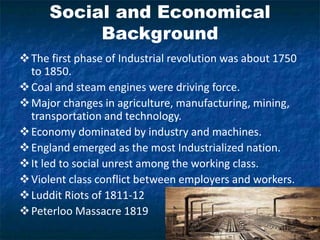
The first phase of Industrial revolution was about 1750
to 1850.
Coal and steam engines were driving force.
Major changes in agriculture, manufacturing, mining,
transportation and technology.
Economy dominated by industry and machines.
England emerged as the most Industrialized nation.
It led to social unrest among the working class.
Violent class conflict between employers and workers.
Luddit Riots of 1811-12
Peterloo Massacre 1819
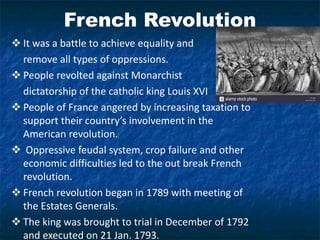
French Revolution
 It was a battle to achieve equality and
remove all types of oppressions.
 People revolted against Monarchist
dictatorship of the catholic king Louis XVI
 People of France angered by increasing taxation to
support their country’s involvement in the
American revolution.
 Oppressive feudal system, crop failure and other
economic difficulties led to the out break French
revolution.
 French revolution began in 1789 with meeting of
the Estates Generals.
 The king was brought to trial in December of 1792
and executed on 21 Jan. 1793.
French revolution and
romanticism
The French revolution sowed seeds of
revolutionary fervor in England.
“It was a single most crucial influence on British
intellectual, philosophical and political life in 19th
century.”(Wikipedia)
The writer of Romantic period inspired by the ideas
of French revolution and tried to translated these
ideas into the realm of literature.
 Free government by free man remained ideal of
English literature since centuries.
Poets such as Black, Wordsworth and Coleridge
supported the revolution and its ideas.
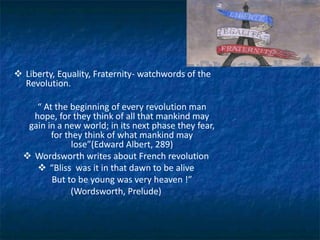
 Liberty, Equality, Fraternity- watchwords of the
Revolution.
“ At the beginning of every revolution man
hope, for they think of all that mankind may
gain in a new world; in its next phase they fear,
for they think of what mankind may
lose”(Edward Albert, 289)
 Wordsworth writes about French revolution
 “Bliss was it in that dawn to be alive
But to be young was very heaven !”
(Wordsworth, Prelude)
Literary Features of the Age
German poet Fedrich Schegel used the term
Romantic for the first time, he defined
romanticism as “Literature depicting emotional
matter in an imaginative form”
It is a shift from the structured, intellectual,
reasoned, approach of 1700s, to use of
imagination, freedom of thought and expression
and an idealization of nature.
The thinkers of Neoclassical age valued reason
and rationality, whereas romantics valued
emotions, passion, and individuality.
A shift from impersonal works to works of more
subjective and personal nature.
“The essence of romanticism was….that literature
must reflect all that is spontaneous and
unaffected in nature and in man and free to
follow its own fancy in its own way”.
-W.J. Long
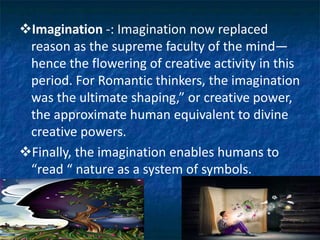
Imagination -: Imagination now replaced
reason as the supreme faculty of the mind—
hence the flowering of creative activity in this
period. For Romantic thinkers, the imagination
was the ultimate shaping,” or creative power,
the approximate human equivalent to divine
creative powers.
Finally, the imagination enables humans to
“read “ nature as a system of symbols.
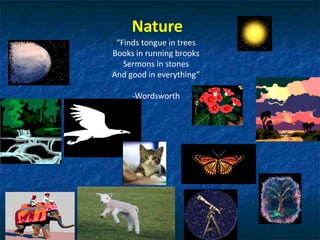
Nature
“Finds tongue in trees
Books in running brooks
Sermons in stones
And good in everything”
-Wordsworth
Nature cont..
• Nature often presented as a work of art from the
divine imagination
• Nature as a healing power
• Nature as a refuge from civilization
• Nature viewed as “organic,” (alive) rather than
“mechanical” or “rationalist”
• Nature viewed as a source of refreshment and
meditation
Symbolism and Myth
Valued as the human means for imitating
nature in art
Could simultaneously suggest many things in a
creative way
Based on a desire to “express the
inexpressible” through the resources of
language
Age of Poetry
It was essentially an age of Poetry.
Most of the Romantic writers found poetry as
language of emotion and feelings.
Poetry allows free use of imagination and fancy.
As it was an age of imagination and emotion
most of the writers turned to poetry.
First generation of poets includes, Blake,
Wordsworth, Coleridge.
Second generation of poets are, Byron, Shelley
and Keats.
Romantic Literature
Features of Non-fiction-
Personal essays
Explored psychological states of the authors
Notion of freedom and justice inspired by
French revolution
Diaries, travelogues, were also important genre
Literary criticism in the form of review essays.
Features of fiction:
Epistolary, romance, didactic, gothic, historic etc.
Novels
Fiction of sensibility
Philosophical novels-”Novels of ideas”
Evangelic and moral tales
Gothic tradition explored the darker sides of
human nature
Historical fiction and historical romance
Regional novels from Ireland and Scotland
Features of Poetry:
Nature, landscape and beauty.
Dreams, childhood, and innocence were common
themes.
Concerns with inner things; exploration of poets
mind
Use of heavy symbolism
Influenced by theories of association and drugs
Myths and images from non-European cultures
Obsession with death and unconscious.
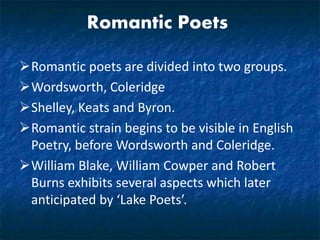
Romantic Poets
Romantic poets are divided into two groups.
Wordsworth, Coleridge
Shelley, Keats and Byron.
Romantic strain begins to be visible in English
Poetry, before Wordsworth and Coleridge.
William Blake, William Cowper and Robert
Burns exhibits several aspects which later
anticipated by ‘Lake Poets’.
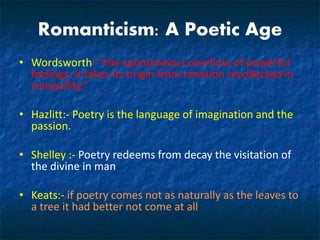
Romanticism: A Poetic Age
• Wordsworth:-"the spontaneous overflow of powerful
feelings: it takes its origin from emotion recollected in
tranquility,“
• Hazlitt:- Poetry is the language of imagination and the
passion.
• Shelley :- Poetry redeems from decay the visitation of
the divine in man
• Keats:- if poetry comes not as naturally as the leaves to
a tree it had better not come at all
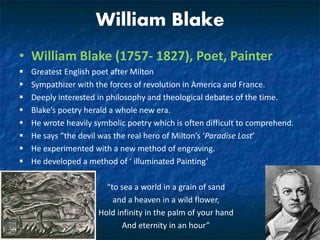
William Blake
• William Blake (1757- 1827), Poet, Painter
 Greatest English poet after Milton
 Sympathizer with the forces of revolution in America and France.
 Deeply interested in philosophy and theological debates of the time.
 Blake’s poetry herald a whole new era.
 He wrote heavily symbolic poetry which is often difficult to comprehend.
 He says “the devil was the real hero of Milton’s ‘Paradise Lost’
 He experimented with a new method of engraving.
 He developed a method of ‘ illuminated Painting’
“to sea a world in a grain of sand
and a heaven in a wild flower,
Hold infinity in the palm of your hand
And eternity in an hour”
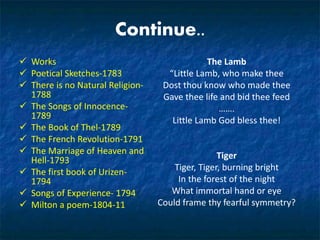
Continue..
 Works
 Poetical Sketches-1783
 There is no Natural Religion-
1788
 The Songs of Innocence-
1789
 The Book of Thel-1789
 The French Revolution-1791
 The Marriage of Heaven and
Hell-1793
 The first book of Urizen-
1794
 Songs of Experience- 1794
 Milton a poem-1804-11
The Lamb
“Little Lamb, who make thee
Dost thou know who made thee
Gave thee life and bid thee feed
…….
Little Lamb God bless thee!
Tiger
Tiger, Tiger, burning bright
In the forest of the night
What immortal hand or eye
Could frame thy fearful symmetry?
William Wordsworth
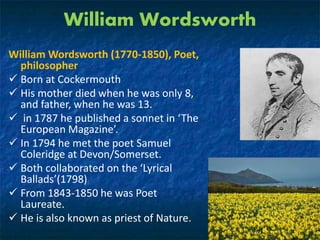
William Wordsworth (1770-1850), Poet,
philosopher
 Born at Cockermouth
 His mother died when he was only 8,
and father, when he was 13.
 in 1787 he published a sonnet in ‘The
European Magazine’.
 In 1794 he met the poet Samuel
Coleridge at Devon/Somerset.
 Both collaborated on the ‘Lyrical
Ballads’(1798)
 From 1843-1850 he was Poet
Laureate.
 He is also known as priest of Nature.
Conti..
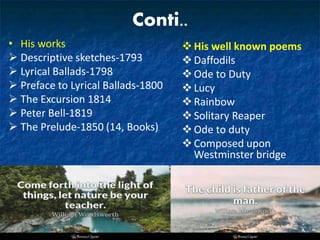
• His works
 Descriptive sketches-1793
 Lyrical Ballads-1798
 Preface to Lyrical Ballads-1800
 The Excursion 1814
 Peter Bell-1819
 The Prelude-1850 (14, Books)
His well known poems
Daffodils
Ode to Duty
Lucy
Rainbow
Solitary Reaper
Ode to duty
Composed upon
Westminster bridge
Samuel Taylor Coleridge
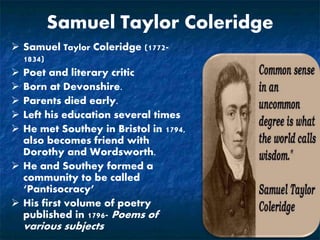
 Samuel Taylor Coleridge (1772-
1834)
 Poet and literary critic
 Born at Devonshire.
 Parents died early.
 Left his education several times
 He met Southey in Bristol in 1794,
also becomes friend with
Dorothy and Wordsworth.
 He and Southey formed a
community to be called
‘Pantisocracy’
 His first volume of poetry
published in 1796- Poems of
various subjects
Conti..
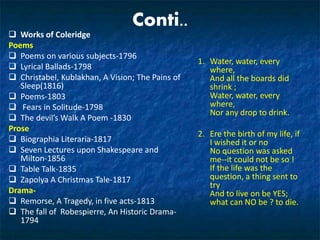
 Works of Coleridge
Poems
 Poems on various subjects-1796
 Lyrical Ballads-1798
 Christabel, Kublakhan, A Vision; The Pains of
Sleep(1816)
 Poems-1803
 Fears in Solitude-1798
 The devil’s Walk A Poem -1830
Prose
 Biographia Literaria-1817
 Seven Lectures upon Shakespeare and
Milton-1856
 Table Talk-1835
 Zapolya A Christmas Tale-1817
Drama-
 Remorse, A Tragedy, in five acts-1813
 The fall of Robespierre, An Historic Drama-
1794
1. Water, water, every
where,
And all the boards did
shrink ;
Water, water, every
where,
Nor any drop to drink.
2. Ere the birth of my life, if
I wished it or no
No question was asked
me--it could not be so !
If the life was the
question, a thing sent to
try
And to live on be YES;
what can NO be ? to die.
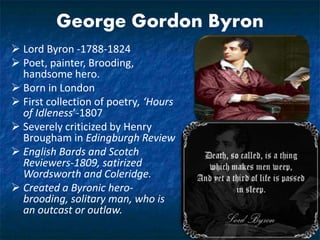
George Gordon Byron
 Lord Byron -1788-1824
 Poet, painter, Brooding,
handsome hero.
 Born in London
 First collection of poetry, ‘Hours
of Idleness’-1807
 Severely criticized by Henry
Brougham in Edingburgh Review
 English Bards and Scotch
Reviewers-1809, satirized
Wordsworth and Coleridge.
 Created a Byronic hero-
brooding, solitary man, who is
an outcast or outlaw.
Conti..
 Works of Byron
 Childe Harold’s Pilgrimage-1812-1818
 Bride of Abydos-1813
 The prisoners of Chillon-1816
 Don Juan(incomplete)
 Mazeppa-1819
 The Prophecy of Dante-1819
 The vision of Judgement-1821
 Prometheus-1816
 Beppo-1818
 Manfred-1817
 Cain-1821
 Heaven and Earth-1821
 Don Juan- 16 cantos,
mock epic, Adventures of
young Spaniard Don Juan.
 Epic satire novel in verse.
 Childe Harold’s- semi-
autobiographical poem in
4 cantos , search for
entity, poetic travelogue,
 Experience in Portugal,
Spain, Greece and
Albania.
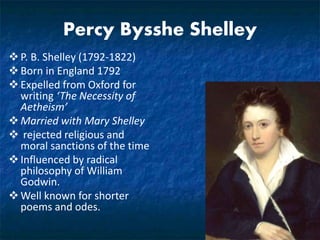
Percy Bysshe Shelley
P. B. Shelley (1792-1822)
Born in England 1792
Expelled from Oxford for
writing ‘The Necessity of
Aetheism’
Married with Mary Shelley
 rejected religious and
moral sanctions of the time
Influenced by radical
philosophy of William
Godwin.
Well known for shorter
poems and odes.
 P. B. Shelley’s Work
 The Necessity of Atheism- 1811
 Queen Mab-1813
 Alastor-1815
 Mont Blanc-1816
 Laon and Cynthia-1817
 The Revolt of Islam-A Poem in 12canto-1817
 Ozymendias-1818
 The Cency, Tragedy in five acts-1819
 Ode to the West wind-1819
 The Masque of Anarchy- 1819
 Prometheus Unbound-1820 drama in 4act.
 To Skylark-1820
 A Defence of Poetry- 1821 in response to
Peacock’s Four ages of Poetry
 Epipsychidion-1821
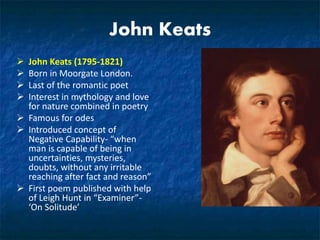
John Keats
 John Keats (1795-1821)
 Born in Moorgate London.
 Last of the romantic poet
 Interest in mythology and love
for nature combined in poetry
 Famous for odes
 Introduced concept of
Negative Capability- “when
man is capable of being in
uncertainties, mysteries,
doubts, without any irritable
reaching after fact and reason”
 First poem published with help
of Leigh Hunt in “Examiner”-
‘On Solitude’
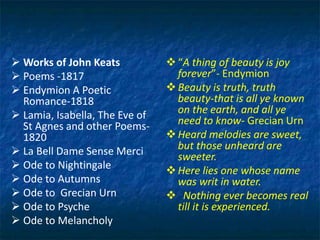
 Works of John Keats
 Poems -1817
 Endymion A Poetic
Romance-1818
 Lamia, Isabella, The Eve of
St Agnes and other Poems-
1820
 La Bell Dame Sense Merci
 Ode to Nightingale
 Ode to Autumns
 Ode to Grecian Urn
 Ode to Psyche
 Ode to Melancholy
“A thing of beauty is joy
forever”- Endymion
Beauty is truth, truth
beauty-that is all ye known
on the earth, and all ye
need to know- Grecian Urn
Heard melodies are sweet,
but those unheard are
sweeter.
Here lies one whose name
was writ in water.
 Nothing ever becomes real
till it is experienced.
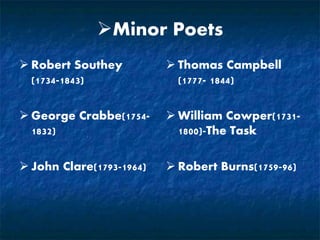
Minor Poets
 Robert Southey
(1734-1843)
 George Crabbe(1754-
1832)
 John Clare(1793-1964)
 Thomas Campbell
(1777- 1844)
 William Cowper(1731-
1800)-The Task
 Robert Burns(1759-96)
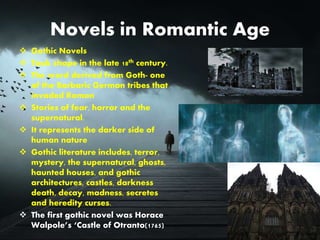
Novels in Romantic Age
 Gothic Novels
 Took shape in the late 18th century.
 The word derived from Goth- one
of the Barbaric German tribes that
invaded Roman
 Stories of fear, horror and the
supernatural.
 It represents the darker side of
human nature
 Gothic literature includes, terror,
mystery, the supernatural, ghosts,
haunted houses, and gothic
architectures, castles, darkness
death, decay, madness, secretes
and heredity curses.
 The first gothic novel was Horace
Walpole’s ‘Castle of Otranto(1765)
Gothic Novelists
• Ann Radcliffe(1764-1823)
• Pioneer of gothic novel
• Childless marriage, she began
to write fiction to amuse
herself.
• Her husband encouraged her
writing.
• She portrays the heroines as
the victim of a male
dominated society.
• Her most famous work is
“The Mysteries of
Udolpho”(4vol.1791)
• Her other works includes, The
Italian, The Romance of the
Forest etc.
• Matthew Gregory
Lewis(1775-1818)
• The separation of his
parents had adverse impact
on him,
• Because of the acrimony he
had seen between his
parents he never married.
• He wrote his popular gothic
novel ‘The Monk’ in 1796
• It is sensational story of
rape and incest
• Coleridge says “The Monk
is romance, which if parents
saw in the hand of son or
daughter, he might
reasonable turn pale”
Novelists
• William Godwin -1756-1836)
• Philosopher and novelist, atheist
• “Enquiry concerning Political
Justice”-1793
• In this book he argued that as
long people acted rationally,
they could live without laws and
institutions.
• His most successful work is
“Things as They Are or Caleb
Williams”
• It presented individual as victim
of society and condemned the
power hungry.
• Criticism of English society
• Caleb declares “is that a country
of liberty where thousands
languish in dungeons and
fetters?”
• Mary Wollstonecraft(1759-97)
• Feminist writer
• The Wrongs of Woman-1798
• Was a feminist response to
Thomas Pain’s epochal tract, The
Rights of Man
• Maria, who is forced into
asylum by her husband George,
is Wollstonecraft’s symbol of a
middleclass woman who is
wronged.
• Wollstonecraft was attempting
to show how women of all
classes are oppressed by
English patriarchal system.
• Her most famous work is
‘Vindication of the Rights of
Woman’-1792
Novelists
• Didactic novels
• Fanny Burney(1752-1840)
• This novel debates about
woman and property,
marriage and morals.
• Her tales are heroine-centric
and detailed moral tales
• She portrays the tribulations
of a young, virtuous girl in
society
• Evelina” A young woman’s
entrance into the world”
• Cecilia, Camilla, The
Wanderers
• Her novel influenced
Victorian domestic novels
• Local/Regional Novels
• Maria Edgeworth(1764-1849)
• Her concern is the provincial
life and gentry, a class
whose way of life was
under threat
• Her novels sets in Ireland
• Her works are index of
social criticism of her time
• Highlights, capitalism and
depraved lifestyle of
extravagant gentry.
• Castle Rackrent(1800)
• Her moral tales include,
• Belinda(1801)
• Patronage(1814)
• Helen(1834)
Jane Austen
• Jane Austen (1775-1817)
• Most significant novelist of the
age
• Published six novels between 1811
and 1818
• She explored themes of property,
marriage, the status of women,
English villages, and decline of the
gentry.
• In her work description of English
life is unsurpassed.
• She exposes the exploitative
nature of gender relations in
English society.
• Her novel explores the workings
of people’s minds.
• All her works published under pen
name ‘By A Lady’
• Her works
• Sense and Sensibility(1811)
• Pride and Prejudice(1813)
• Mansfield Park(1814)
• Emma(1816)
• Northanger Abbey(1818)
• Persuasion(1818)
Walter Scott
• Walter Scott (1771-1832)
• Exponent of Historical Romances
• One of the most popular authors.
• His novels revolved around Scottish
nationalism
• Wrote about the transformation of
Scottish society from feudal –agrarian
to the urban-rural.
• Fusion of realistic descriptions with
poetic representations
• Complex narratives layered with fact
and fiction
• He defines historical romance as “a
poetical imagination and strict
attention to the character and
manners of the age”.
• He exhibits his admiration for old
values that , increasingly lost or
ignored in the process towards
modernization.
• His Works
• Waverley(1814)
• Ivanhoe(1819)
• Kenilworth(1821)
• Tales of Crusaders
• Woodstock(1826)
• The Siege of Malta
• Rob Roy(1817)
• The Heart of the
Midlothian (1818)
• Poetry-
• The lady of the lake
• The field of Waterloo
• Harold Dauntless
• The Lay of the Last
Minstrel
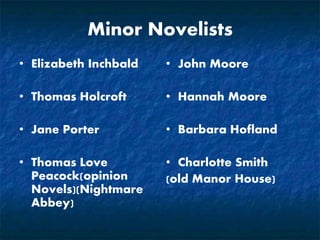
Minor Novelists
• Elizabeth Inchbald
• Thomas Holcroft
• Jane Porter
• Thomas Love
Peacock(opinion
Novels)(Nightmare
Abbey)
• John Moore
• Hannah Moore
• Barbara Hofland
• Charlotte Smith
(old Manor House)
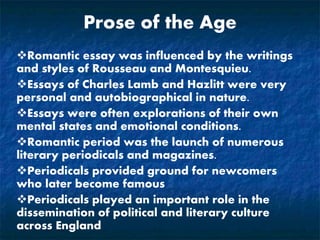
Prose of the Age
Romantic essay was influenced by the writings
and styles of Rousseau and Montesquieu.
Essays of Charles Lamb and Hazlitt were very
personal and autobiographical in nature.
Essays were often explorations of their own
mental states and emotional conditions.
Romantic period was the launch of numerous
literary periodicals and magazines.
Periodicals provided ground for newcomers
who later become famous
Periodicals played an important role in the
dissemination of political and literary culture
across England
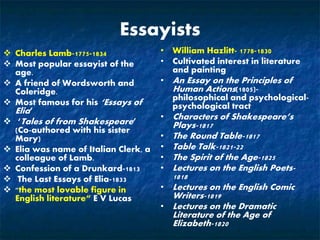
Essayists
 Charles Lamb-1775-1834
 Most popular essayist of the
age.
 A friend of Wordsworth and
Coleridge.
 Most famous for his ‘Essays of
Elia’
 ‘Tales of from Shakespeare’
(Co-authored with his sister
Mary)
 Elia was name of Italian Clerk, a
colleague of Lamb.
 Confession of a Drunkard-1813
 The Last Essays of Elia-1833
 "the most lovable figure in
English literature“ E V Lucas
• William Hazlitt- 1778-1830
• Cultivated interest in literature
and painting
• An Essay on the Principles of
Human Actions(1805)-
philosophical and psychological-
psychological tract
• Characters of Shakespeare’s
Plays-1817
• The Round Table-1817
• Table Talk-1821-22
• The Spirit of the Age-1825
• Lectures on the English Poets-
1818
• Lectures on the English Comic
Writers-1819
• Lectures on the Dramatic
Literature of the Age of
Elizabeth-1820
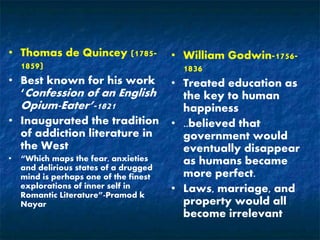
• Thomas de Quincey (1785-
1859)
• Best known for his work
‘Confession of an English
Opium-Eater’-1821
• Inaugurated the tradition
of addiction literature in
the West
• “Which maps the fear, anxieties
and delirious states of a drugged
mind is perhaps one of the finest
explorations of inner self in
Romantic Literature”-Pramod k
Nayar
• William Godwin-1756-
1836
• Treated education as
the key to human
happiness
• ..believed that
government would
eventually disappear
as humans became
more perfect.
• Laws, marriage, and
property would all
become irrelevant
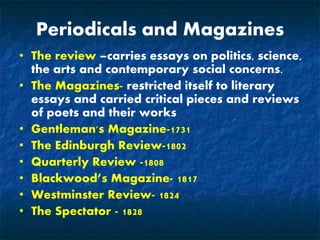
Periodicals and Magazines
• The review –carries essays on politics, science,
the arts and contemporary social concerns.
• The Magazines- restricted itself to literary
essays and carried critical pieces and reviews
of poets and their works
• Gentleman's Magazine-1731
• The Edinburgh Review-1802
• Quarterly Review -1808
• Blackwood’s Magazine- 1817
• Westminster Review- 1824
• The Spectator - 1828
Reference
• Bibliography
• Nayar, Pramod K. A Short History of English Literature. New Delhi:
Cambridge University Press India Pvt. Ltd., 2009.
• Albert, Edward. History Of English Literature. 5. New Delhi: OXFORD
UNIVERSITY PRESS-NEW DELHI, 2009.
• Wikipedia contributors. "Romanticism." Wikipedia, The Free
Encyclopedia. Wikipedia, The Free Encyclopedia, 7 Dec. 2017. Web.
8 Dec. 2017.
• http://www.bbc.co.uk/arts/romantics/poets1.shtml
• https://images.google.com/
• https://www.slideshare.net/samirbaruah/introductiontothe-
romanticageofenglishliterature?

Background reading of Romantic age

  • 1.
    Romantic Age 1798- 1837 BackgroundReading Prepared by Milan Parmar (GSET, M.Phil)
  • 2.
    Romantic Movement  Anartistic, literary, and intellectual movement partly a reaction to the industrial revolution.  It was embodied strongly in visual arts, music and literature, and was associated with liberalism and radicalism.  The movement was rooted in the German Strum and Drang movement and legitimized the “individual imagination as critical authority”
  • 3.
    Historical Background Begins withthe publication of Wordsworth and Samuel Coleridge’s Lyrical Ballads in 1798 and it ends with accession of queen Victoria in 1837. George III was the king of England. Romanticism coincided with the revolution in France and in America. Hence is also known as the age of “Revolution”
  • 4.
    Social and Economical Background Thefirst phase of Industrial revolution was about 1750 to 1850. Coal and steam engines were driving force. Major changes in agriculture, manufacturing, mining, transportation and technology. Economy dominated by industry and machines. England emerged as the most Industrialized nation. It led to social unrest among the working class. Violent class conflict between employers and workers. Luddit Riots of 1811-12 Peterloo Massacre 1819
  • 5.
    French Revolution  Itwas a battle to achieve equality and remove all types of oppressions.  People revolted against Monarchist dictatorship of the catholic king Louis XVI  People of France angered by increasing taxation to support their country’s involvement in the American revolution.  Oppressive feudal system, crop failure and other economic difficulties led to the out break French revolution.  French revolution began in 1789 with meeting of the Estates Generals.  The king was brought to trial in December of 1792 and executed on 21 Jan. 1793.
  • 6.
    French revolution and romanticism TheFrench revolution sowed seeds of revolutionary fervor in England. “It was a single most crucial influence on British intellectual, philosophical and political life in 19th century.”(Wikipedia) The writer of Romantic period inspired by the ideas of French revolution and tried to translated these ideas into the realm of literature.  Free government by free man remained ideal of English literature since centuries. Poets such as Black, Wordsworth and Coleridge supported the revolution and its ideas.
  • 7.
     Liberty, Equality,Fraternity- watchwords of the Revolution. “ At the beginning of every revolution man hope, for they think of all that mankind may gain in a new world; in its next phase they fear, for they think of what mankind may lose”(Edward Albert, 289)  Wordsworth writes about French revolution  “Bliss was it in that dawn to be alive But to be young was very heaven !” (Wordsworth, Prelude)
  • 8.
    Literary Features ofthe Age German poet Fedrich Schegel used the term Romantic for the first time, he defined romanticism as “Literature depicting emotional matter in an imaginative form” It is a shift from the structured, intellectual, reasoned, approach of 1700s, to use of imagination, freedom of thought and expression and an idealization of nature. The thinkers of Neoclassical age valued reason and rationality, whereas romantics valued emotions, passion, and individuality. A shift from impersonal works to works of more subjective and personal nature.
  • 9.
    “The essence ofromanticism was….that literature must reflect all that is spontaneous and unaffected in nature and in man and free to follow its own fancy in its own way”. -W.J. Long
  • 10.
    Imagination -: Imaginationnow replaced reason as the supreme faculty of the mind— hence the flowering of creative activity in this period. For Romantic thinkers, the imagination was the ultimate shaping,” or creative power, the approximate human equivalent to divine creative powers. Finally, the imagination enables humans to “read “ nature as a system of symbols.
  • 11.
    Nature “Finds tongue intrees Books in running brooks Sermons in stones And good in everything” -Wordsworth
  • 12.
    Nature cont.. • Natureoften presented as a work of art from the divine imagination • Nature as a healing power • Nature as a refuge from civilization • Nature viewed as “organic,” (alive) rather than “mechanical” or “rationalist” • Nature viewed as a source of refreshment and meditation
  • 13.
    Symbolism and Myth Valuedas the human means for imitating nature in art Could simultaneously suggest many things in a creative way Based on a desire to “express the inexpressible” through the resources of language
  • 14.
    Age of Poetry Itwas essentially an age of Poetry. Most of the Romantic writers found poetry as language of emotion and feelings. Poetry allows free use of imagination and fancy. As it was an age of imagination and emotion most of the writers turned to poetry. First generation of poets includes, Blake, Wordsworth, Coleridge. Second generation of poets are, Byron, Shelley and Keats.
  • 15.
    Romantic Literature Features ofNon-fiction- Personal essays Explored psychological states of the authors Notion of freedom and justice inspired by French revolution Diaries, travelogues, were also important genre Literary criticism in the form of review essays.
  • 16.
    Features of fiction: Epistolary,romance, didactic, gothic, historic etc. Novels Fiction of sensibility Philosophical novels-”Novels of ideas” Evangelic and moral tales Gothic tradition explored the darker sides of human nature Historical fiction and historical romance Regional novels from Ireland and Scotland
  • 17.
    Features of Poetry: Nature,landscape and beauty. Dreams, childhood, and innocence were common themes. Concerns with inner things; exploration of poets mind Use of heavy symbolism Influenced by theories of association and drugs Myths and images from non-European cultures Obsession with death and unconscious.
  • 18.
    Romantic Poets Romantic poetsare divided into two groups. Wordsworth, Coleridge Shelley, Keats and Byron. Romantic strain begins to be visible in English Poetry, before Wordsworth and Coleridge. William Blake, William Cowper and Robert Burns exhibits several aspects which later anticipated by ‘Lake Poets’.
  • 19.
    Romanticism: A PoeticAge • Wordsworth:-"the spontaneous overflow of powerful feelings: it takes its origin from emotion recollected in tranquility,“ • Hazlitt:- Poetry is the language of imagination and the passion. • Shelley :- Poetry redeems from decay the visitation of the divine in man • Keats:- if poetry comes not as naturally as the leaves to a tree it had better not come at all
  • 20.
    William Blake • WilliamBlake (1757- 1827), Poet, Painter  Greatest English poet after Milton  Sympathizer with the forces of revolution in America and France.  Deeply interested in philosophy and theological debates of the time.  Blake’s poetry herald a whole new era.  He wrote heavily symbolic poetry which is often difficult to comprehend.  He says “the devil was the real hero of Milton’s ‘Paradise Lost’  He experimented with a new method of engraving.  He developed a method of ‘ illuminated Painting’ “to sea a world in a grain of sand and a heaven in a wild flower, Hold infinity in the palm of your hand And eternity in an hour”
  • 21.
    Continue..  Works  PoeticalSketches-1783  There is no Natural Religion- 1788  The Songs of Innocence- 1789  The Book of Thel-1789  The French Revolution-1791  The Marriage of Heaven and Hell-1793  The first book of Urizen- 1794  Songs of Experience- 1794  Milton a poem-1804-11 The Lamb “Little Lamb, who make thee Dost thou know who made thee Gave thee life and bid thee feed ……. Little Lamb God bless thee! Tiger Tiger, Tiger, burning bright In the forest of the night What immortal hand or eye Could frame thy fearful symmetry?
  • 22.
    William Wordsworth William Wordsworth(1770-1850), Poet, philosopher  Born at Cockermouth  His mother died when he was only 8, and father, when he was 13.  in 1787 he published a sonnet in ‘The European Magazine’.  In 1794 he met the poet Samuel Coleridge at Devon/Somerset.  Both collaborated on the ‘Lyrical Ballads’(1798)  From 1843-1850 he was Poet Laureate.  He is also known as priest of Nature.
  • 23.
    Conti.. • His works Descriptive sketches-1793  Lyrical Ballads-1798  Preface to Lyrical Ballads-1800  The Excursion 1814  Peter Bell-1819  The Prelude-1850 (14, Books) His well known poems Daffodils Ode to Duty Lucy Rainbow Solitary Reaper Ode to duty Composed upon Westminster bridge
  • 24.
    Samuel Taylor Coleridge Samuel Taylor Coleridge (1772- 1834)  Poet and literary critic  Born at Devonshire.  Parents died early.  Left his education several times  He met Southey in Bristol in 1794, also becomes friend with Dorothy and Wordsworth.  He and Southey formed a community to be called ‘Pantisocracy’  His first volume of poetry published in 1796- Poems of various subjects
  • 25.
    Conti..  Works ofColeridge Poems  Poems on various subjects-1796  Lyrical Ballads-1798  Christabel, Kublakhan, A Vision; The Pains of Sleep(1816)  Poems-1803  Fears in Solitude-1798  The devil’s Walk A Poem -1830 Prose  Biographia Literaria-1817  Seven Lectures upon Shakespeare and Milton-1856  Table Talk-1835  Zapolya A Christmas Tale-1817 Drama-  Remorse, A Tragedy, in five acts-1813  The fall of Robespierre, An Historic Drama- 1794 1. Water, water, every where, And all the boards did shrink ; Water, water, every where, Nor any drop to drink. 2. Ere the birth of my life, if I wished it or no No question was asked me--it could not be so ! If the life was the question, a thing sent to try And to live on be YES; what can NO be ? to die.
  • 26.
    George Gordon Byron Lord Byron -1788-1824  Poet, painter, Brooding, handsome hero.  Born in London  First collection of poetry, ‘Hours of Idleness’-1807  Severely criticized by Henry Brougham in Edingburgh Review  English Bards and Scotch Reviewers-1809, satirized Wordsworth and Coleridge.  Created a Byronic hero- brooding, solitary man, who is an outcast or outlaw.
  • 27.
    Conti..  Works ofByron  Childe Harold’s Pilgrimage-1812-1818  Bride of Abydos-1813  The prisoners of Chillon-1816  Don Juan(incomplete)  Mazeppa-1819  The Prophecy of Dante-1819  The vision of Judgement-1821  Prometheus-1816  Beppo-1818  Manfred-1817  Cain-1821  Heaven and Earth-1821  Don Juan- 16 cantos, mock epic, Adventures of young Spaniard Don Juan.  Epic satire novel in verse.  Childe Harold’s- semi- autobiographical poem in 4 cantos , search for entity, poetic travelogue,  Experience in Portugal, Spain, Greece and Albania.
  • 28.
    Percy Bysshe Shelley P.B. Shelley (1792-1822) Born in England 1792 Expelled from Oxford for writing ‘The Necessity of Aetheism’ Married with Mary Shelley  rejected religious and moral sanctions of the time Influenced by radical philosophy of William Godwin. Well known for shorter poems and odes.
  • 29.
     P. B.Shelley’s Work  The Necessity of Atheism- 1811  Queen Mab-1813  Alastor-1815  Mont Blanc-1816  Laon and Cynthia-1817  The Revolt of Islam-A Poem in 12canto-1817  Ozymendias-1818  The Cency, Tragedy in five acts-1819  Ode to the West wind-1819  The Masque of Anarchy- 1819  Prometheus Unbound-1820 drama in 4act.  To Skylark-1820  A Defence of Poetry- 1821 in response to Peacock’s Four ages of Poetry  Epipsychidion-1821
  • 30.
    John Keats  JohnKeats (1795-1821)  Born in Moorgate London.  Last of the romantic poet  Interest in mythology and love for nature combined in poetry  Famous for odes  Introduced concept of Negative Capability- “when man is capable of being in uncertainties, mysteries, doubts, without any irritable reaching after fact and reason”  First poem published with help of Leigh Hunt in “Examiner”- ‘On Solitude’
  • 31.
     Works ofJohn Keats  Poems -1817  Endymion A Poetic Romance-1818  Lamia, Isabella, The Eve of St Agnes and other Poems- 1820  La Bell Dame Sense Merci  Ode to Nightingale  Ode to Autumns  Ode to Grecian Urn  Ode to Psyche  Ode to Melancholy “A thing of beauty is joy forever”- Endymion Beauty is truth, truth beauty-that is all ye known on the earth, and all ye need to know- Grecian Urn Heard melodies are sweet, but those unheard are sweeter. Here lies one whose name was writ in water.  Nothing ever becomes real till it is experienced.
  • 32.
    Minor Poets  RobertSouthey (1734-1843)  George Crabbe(1754- 1832)  John Clare(1793-1964)  Thomas Campbell (1777- 1844)  William Cowper(1731- 1800)-The Task  Robert Burns(1759-96)
  • 33.
    Novels in RomanticAge  Gothic Novels  Took shape in the late 18th century.  The word derived from Goth- one of the Barbaric German tribes that invaded Roman  Stories of fear, horror and the supernatural.  It represents the darker side of human nature  Gothic literature includes, terror, mystery, the supernatural, ghosts, haunted houses, and gothic architectures, castles, darkness death, decay, madness, secretes and heredity curses.  The first gothic novel was Horace Walpole’s ‘Castle of Otranto(1765)
  • 34.
    Gothic Novelists • AnnRadcliffe(1764-1823) • Pioneer of gothic novel • Childless marriage, she began to write fiction to amuse herself. • Her husband encouraged her writing. • She portrays the heroines as the victim of a male dominated society. • Her most famous work is “The Mysteries of Udolpho”(4vol.1791) • Her other works includes, The Italian, The Romance of the Forest etc. • Matthew Gregory Lewis(1775-1818) • The separation of his parents had adverse impact on him, • Because of the acrimony he had seen between his parents he never married. • He wrote his popular gothic novel ‘The Monk’ in 1796 • It is sensational story of rape and incest • Coleridge says “The Monk is romance, which if parents saw in the hand of son or daughter, he might reasonable turn pale”
  • 35.
    Novelists • William Godwin-1756-1836) • Philosopher and novelist, atheist • “Enquiry concerning Political Justice”-1793 • In this book he argued that as long people acted rationally, they could live without laws and institutions. • His most successful work is “Things as They Are or Caleb Williams” • It presented individual as victim of society and condemned the power hungry. • Criticism of English society • Caleb declares “is that a country of liberty where thousands languish in dungeons and fetters?” • Mary Wollstonecraft(1759-97) • Feminist writer • The Wrongs of Woman-1798 • Was a feminist response to Thomas Pain’s epochal tract, The Rights of Man • Maria, who is forced into asylum by her husband George, is Wollstonecraft’s symbol of a middleclass woman who is wronged. • Wollstonecraft was attempting to show how women of all classes are oppressed by English patriarchal system. • Her most famous work is ‘Vindication of the Rights of Woman’-1792
  • 36.
    Novelists • Didactic novels •Fanny Burney(1752-1840) • This novel debates about woman and property, marriage and morals. • Her tales are heroine-centric and detailed moral tales • She portrays the tribulations of a young, virtuous girl in society • Evelina” A young woman’s entrance into the world” • Cecilia, Camilla, The Wanderers • Her novel influenced Victorian domestic novels • Local/Regional Novels • Maria Edgeworth(1764-1849) • Her concern is the provincial life and gentry, a class whose way of life was under threat • Her novels sets in Ireland • Her works are index of social criticism of her time • Highlights, capitalism and depraved lifestyle of extravagant gentry. • Castle Rackrent(1800) • Her moral tales include, • Belinda(1801) • Patronage(1814) • Helen(1834)
  • 37.
    Jane Austen • JaneAusten (1775-1817) • Most significant novelist of the age • Published six novels between 1811 and 1818 • She explored themes of property, marriage, the status of women, English villages, and decline of the gentry. • In her work description of English life is unsurpassed. • She exposes the exploitative nature of gender relations in English society. • Her novel explores the workings of people’s minds. • All her works published under pen name ‘By A Lady’
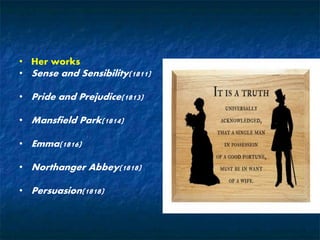
  • 38.
    • Her works •Sense and Sensibility(1811) • Pride and Prejudice(1813) • Mansfield Park(1814) • Emma(1816) • Northanger Abbey(1818) • Persuasion(1818)
  • 39.
    Walter Scott • WalterScott (1771-1832) • Exponent of Historical Romances • One of the most popular authors. • His novels revolved around Scottish nationalism • Wrote about the transformation of Scottish society from feudal –agrarian to the urban-rural. • Fusion of realistic descriptions with poetic representations • Complex narratives layered with fact and fiction • He defines historical romance as “a poetical imagination and strict attention to the character and manners of the age”. • He exhibits his admiration for old values that , increasingly lost or ignored in the process towards modernization. • His Works • Waverley(1814) • Ivanhoe(1819) • Kenilworth(1821) • Tales of Crusaders • Woodstock(1826) • The Siege of Malta • Rob Roy(1817) • The Heart of the Midlothian (1818) • Poetry- • The lady of the lake • The field of Waterloo • Harold Dauntless • The Lay of the Last Minstrel
  • 40.
    Minor Novelists • ElizabethInchbald • Thomas Holcroft • Jane Porter • Thomas Love Peacock(opinion Novels)(Nightmare Abbey) • John Moore • Hannah Moore • Barbara Hofland • Charlotte Smith (old Manor House)
  • 41.
    Prose of theAge Romantic essay was influenced by the writings and styles of Rousseau and Montesquieu. Essays of Charles Lamb and Hazlitt were very personal and autobiographical in nature. Essays were often explorations of their own mental states and emotional conditions. Romantic period was the launch of numerous literary periodicals and magazines. Periodicals provided ground for newcomers who later become famous Periodicals played an important role in the dissemination of political and literary culture across England
  • 42.
    Essayists  Charles Lamb-1775-1834 Most popular essayist of the age.  A friend of Wordsworth and Coleridge.  Most famous for his ‘Essays of Elia’  ‘Tales of from Shakespeare’ (Co-authored with his sister Mary)  Elia was name of Italian Clerk, a colleague of Lamb.  Confession of a Drunkard-1813  The Last Essays of Elia-1833  "the most lovable figure in English literature“ E V Lucas • William Hazlitt- 1778-1830 • Cultivated interest in literature and painting • An Essay on the Principles of Human Actions(1805)- philosophical and psychological- psychological tract • Characters of Shakespeare’s Plays-1817 • The Round Table-1817 • Table Talk-1821-22 • The Spirit of the Age-1825 • Lectures on the English Poets- 1818 • Lectures on the English Comic Writers-1819 • Lectures on the Dramatic Literature of the Age of Elizabeth-1820
  • 43.
    • Thomas deQuincey (1785- 1859) • Best known for his work ‘Confession of an English Opium-Eater’-1821 • Inaugurated the tradition of addiction literature in the West • “Which maps the fear, anxieties and delirious states of a drugged mind is perhaps one of the finest explorations of inner self in Romantic Literature”-Pramod k Nayar • William Godwin-1756- 1836 • Treated education as the key to human happiness • ..believed that government would eventually disappear as humans became more perfect. • Laws, marriage, and property would all become irrelevant
  • 44.
    Periodicals and Magazines •The review –carries essays on politics, science, the arts and contemporary social concerns. • The Magazines- restricted itself to literary essays and carried critical pieces and reviews of poets and their works • Gentleman's Magazine-1731 • The Edinburgh Review-1802 • Quarterly Review -1808 • Blackwood’s Magazine- 1817 • Westminster Review- 1824 • The Spectator - 1828
  • 45.
    Reference • Bibliography • Nayar,Pramod K. A Short History of English Literature. New Delhi: Cambridge University Press India Pvt. Ltd., 2009. • Albert, Edward. History Of English Literature. 5. New Delhi: OXFORD UNIVERSITY PRESS-NEW DELHI, 2009. • Wikipedia contributors. "Romanticism." Wikipedia, The Free Encyclopedia. Wikipedia, The Free Encyclopedia, 7 Dec. 2017. Web. 8 Dec. 2017. • http://www.bbc.co.uk/arts/romantics/poets1.shtml • https://images.google.com/ • https://www.slideshare.net/samirbaruah/introductiontothe- romanticageofenglishliterature?