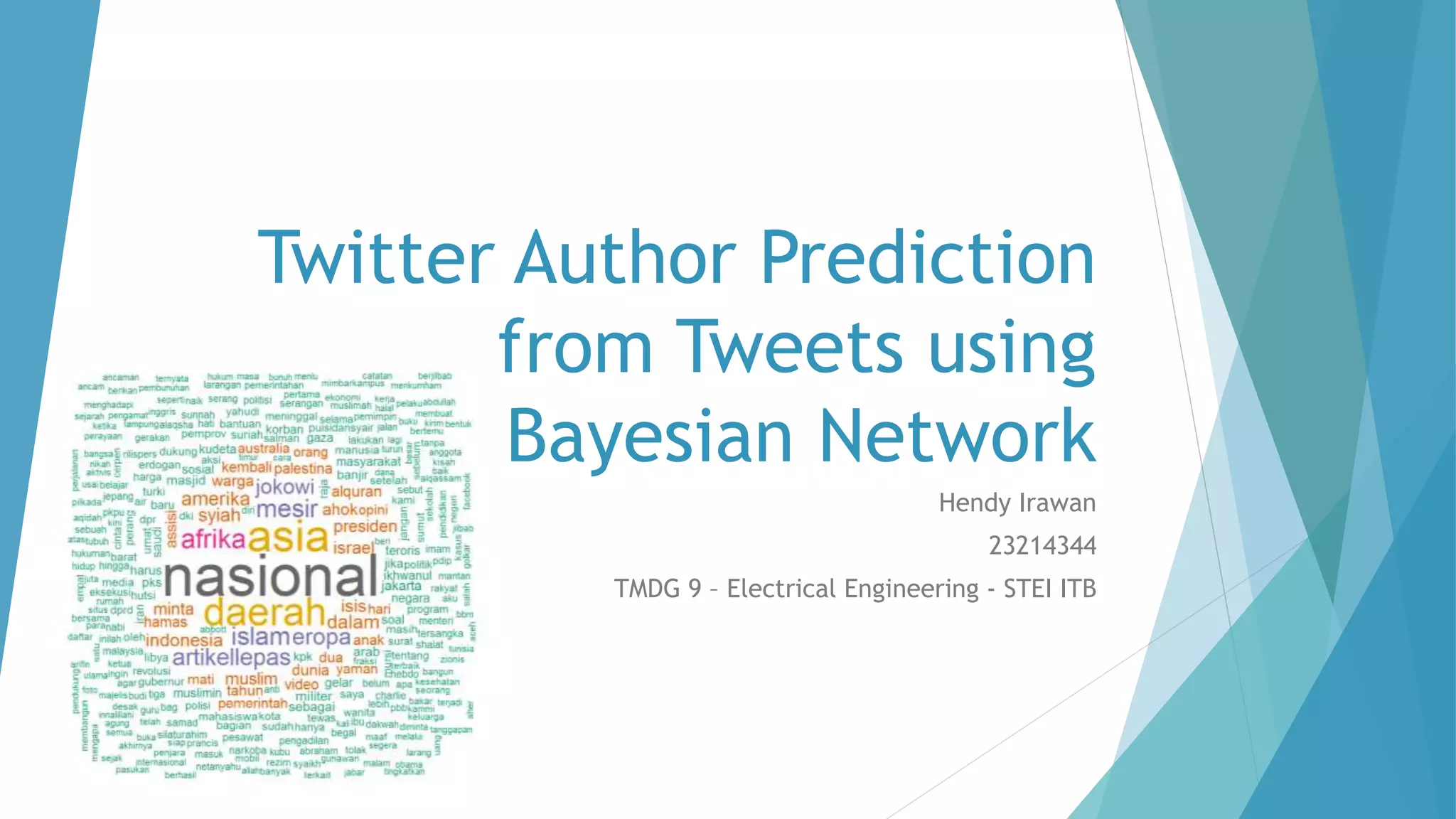

Twitter Author Prediction
from Tweets using
Bayesian Network
Hendy Irawan
23214344
TMDG 9 – Electrical Engineering - STEI ITB
Can We Predict the Author from a
Tweet?
 Most authors have a distinct writing style
 ... And unique topics to talk about
 ... And signature distribution of words used to tweet
 Can we train Bayesian Network so that occurrence of words in a tweet can be
used to infer the author of that tweet?
 In summary: YES!
 Disclaimer: Accuracy varies
 In a test suite with @dakwatuna vs @farhatabbaslaw (very different tweet topics)
– 100% prediction accuracy is achieved
Analysis & Implementation Plan
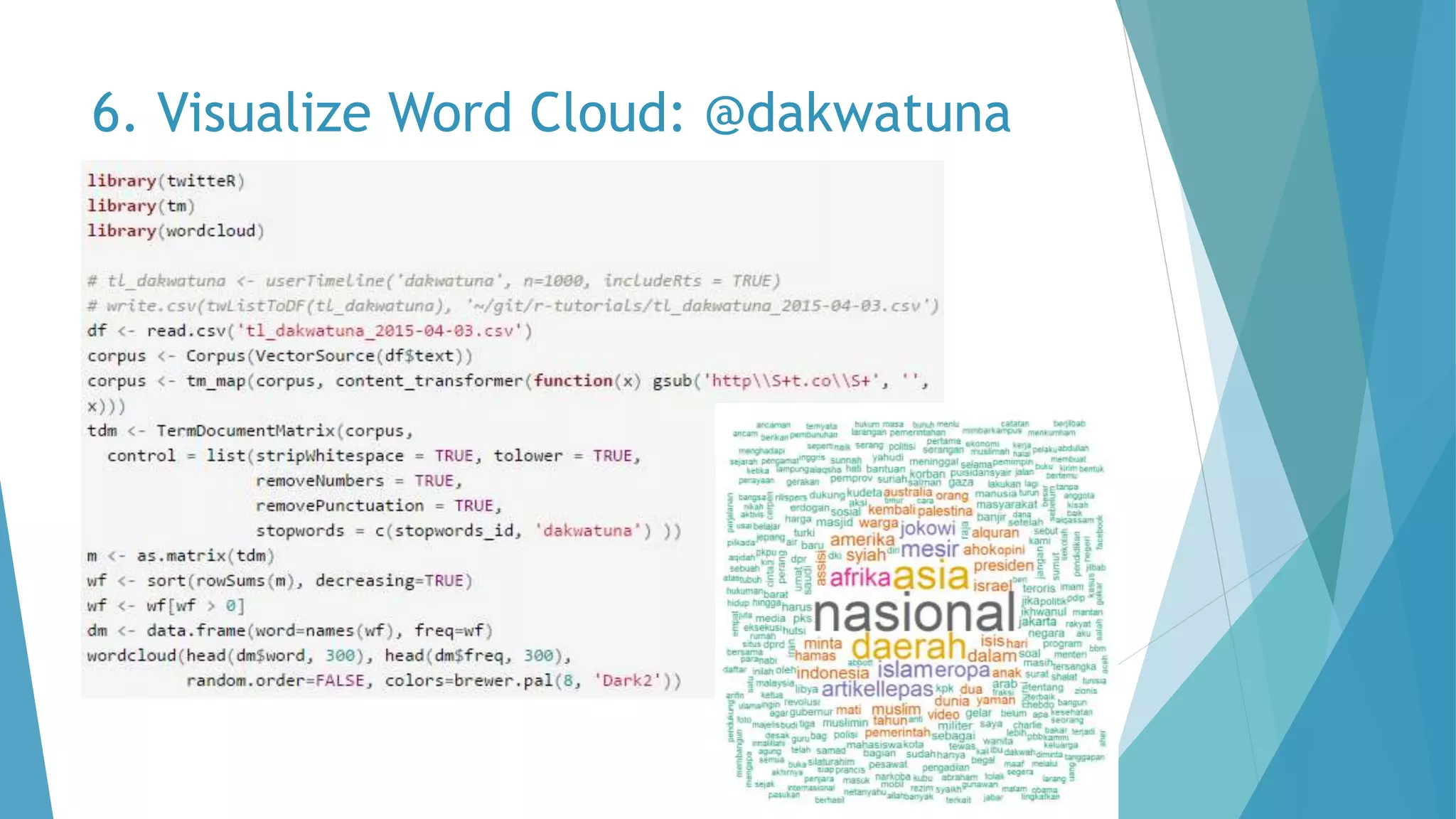
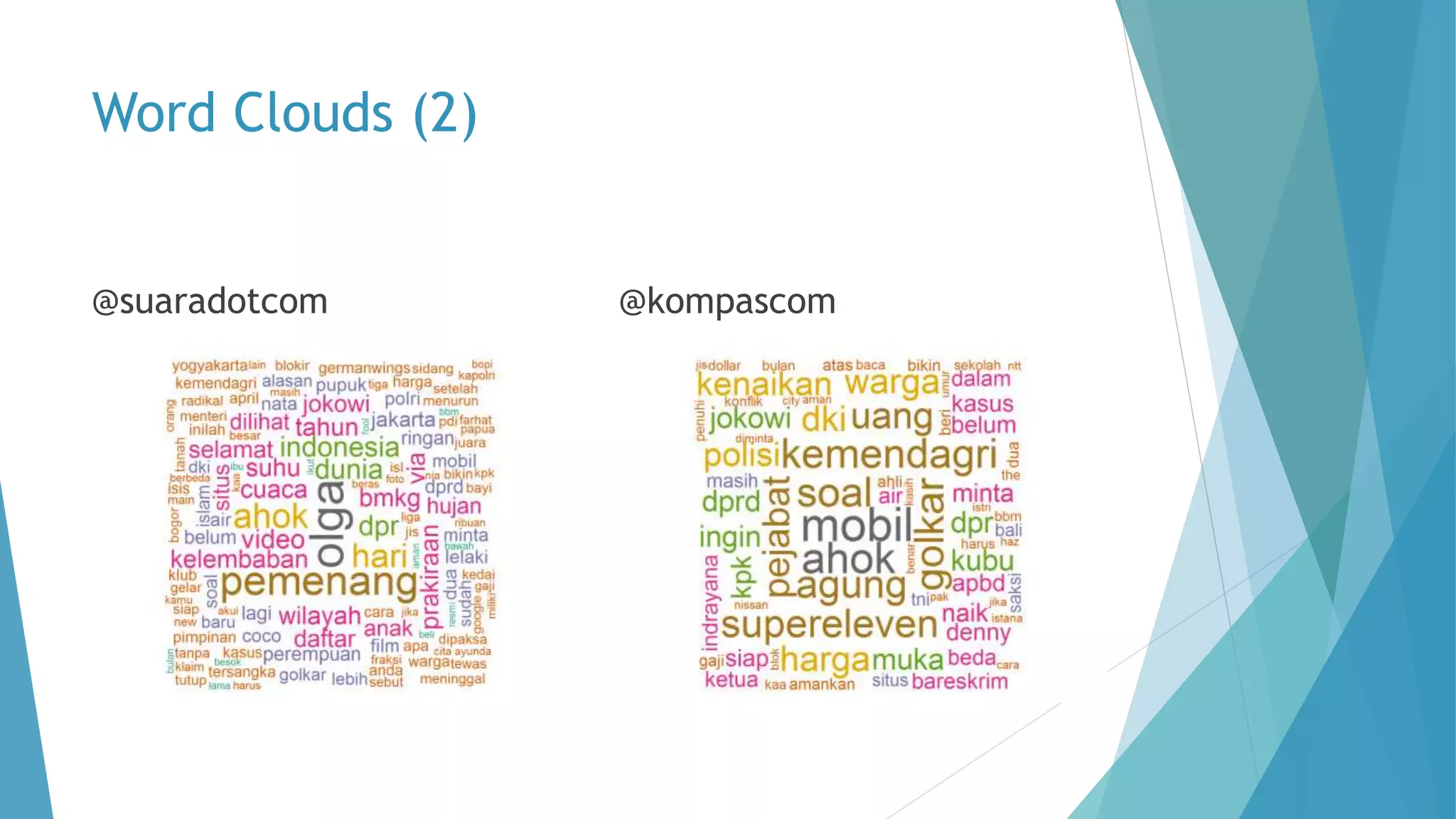
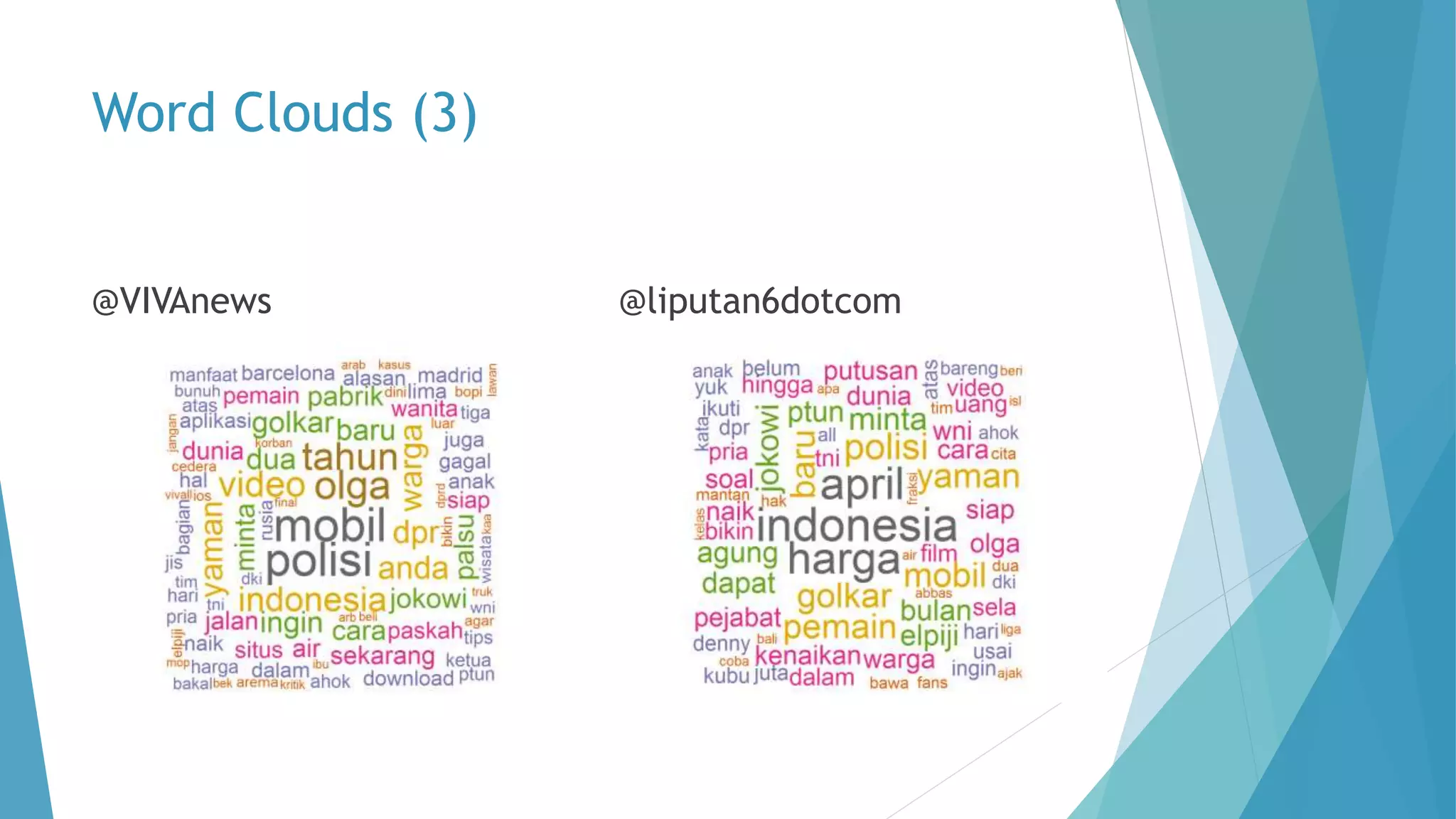
 Visualize Word Distribution in Tweets with Word Clouds
 Using R Statistical Language in RStudio
 Implement in Java
 Natural Language Preprocessing
 Train Bayesian Network
 Predict Tweet Author
Visualize Word Distribution in Tweets
with Word Clouds
Using R Statistical Language in RStudio
All documentation and sources (open
source) available at:
http://ceefour.github.io/r-tutorials/
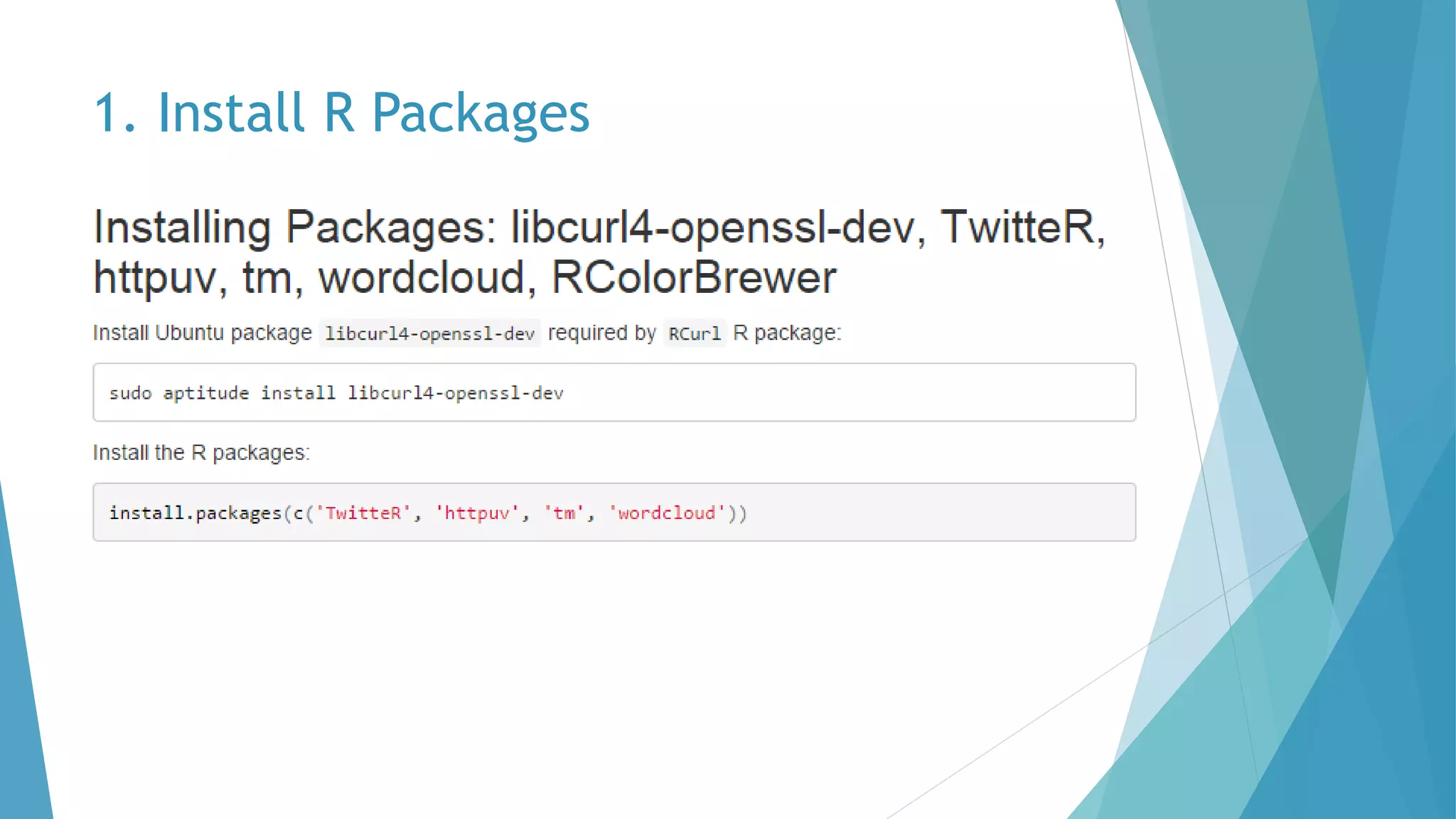
 Install R Packages
 libcurl4-openssl-dev, TwitteR,
httpuv, tm, wordcloud,
RColorBrewer
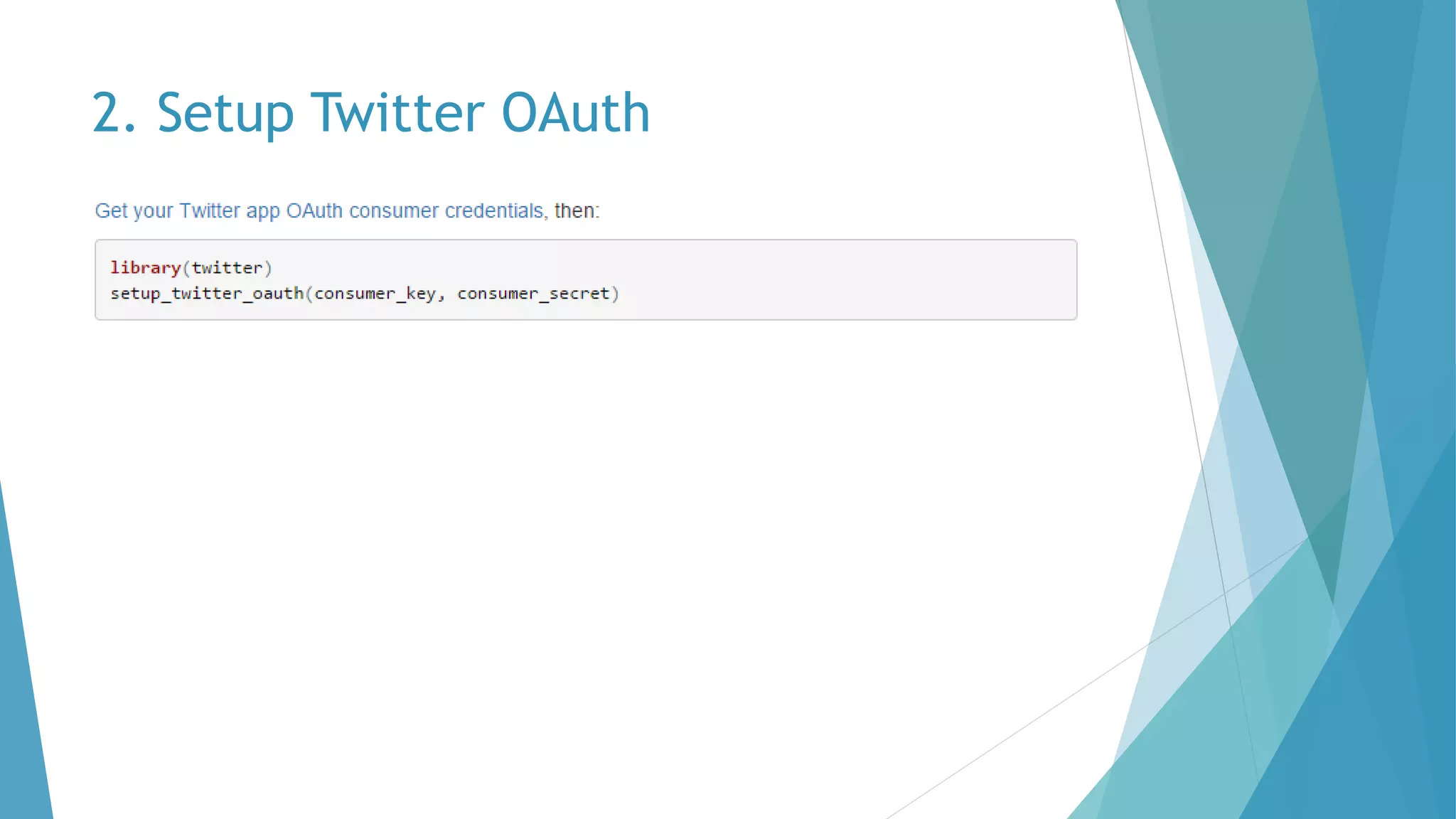
 Setup Twitter Oauth
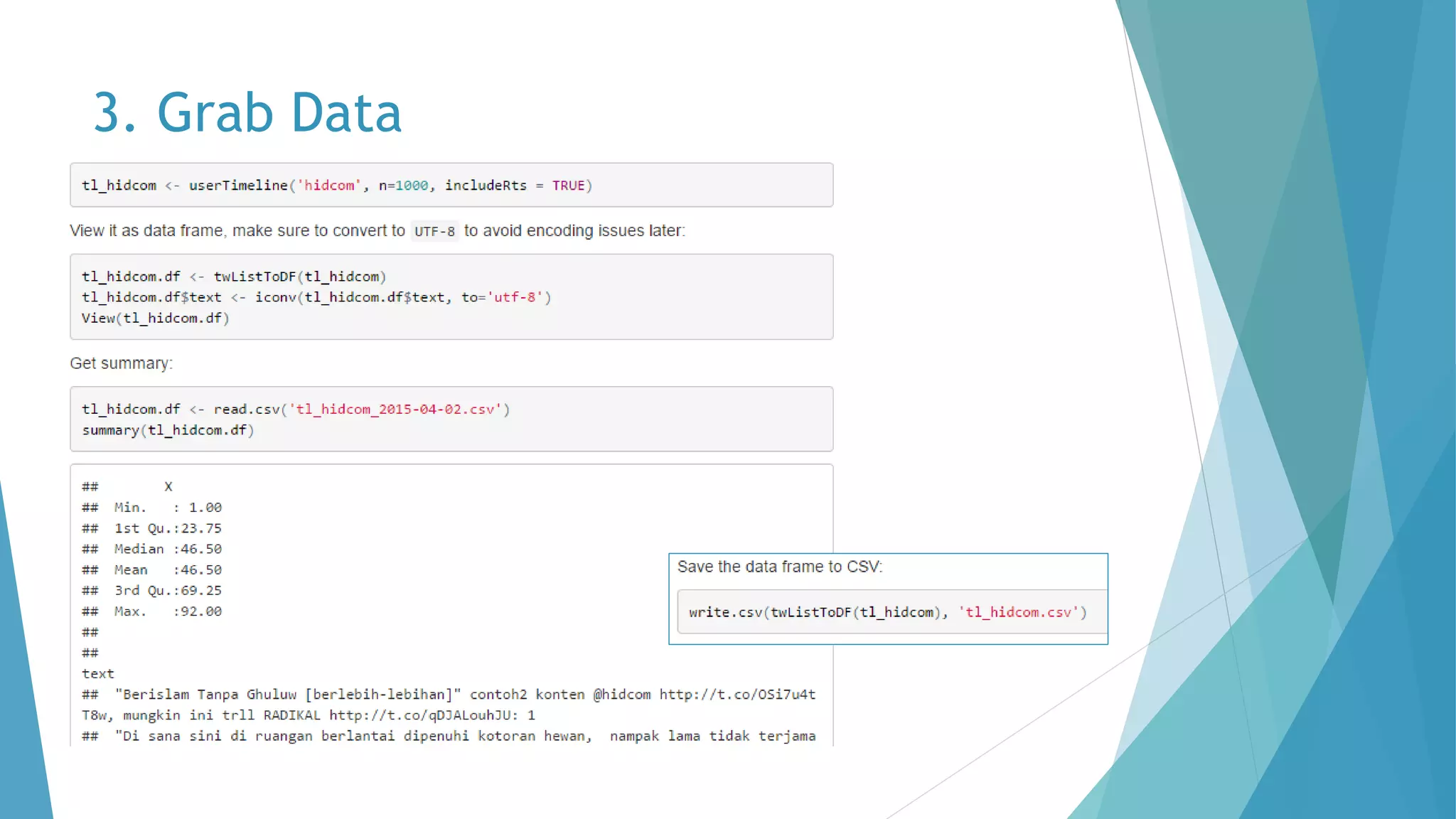
 Grab Data
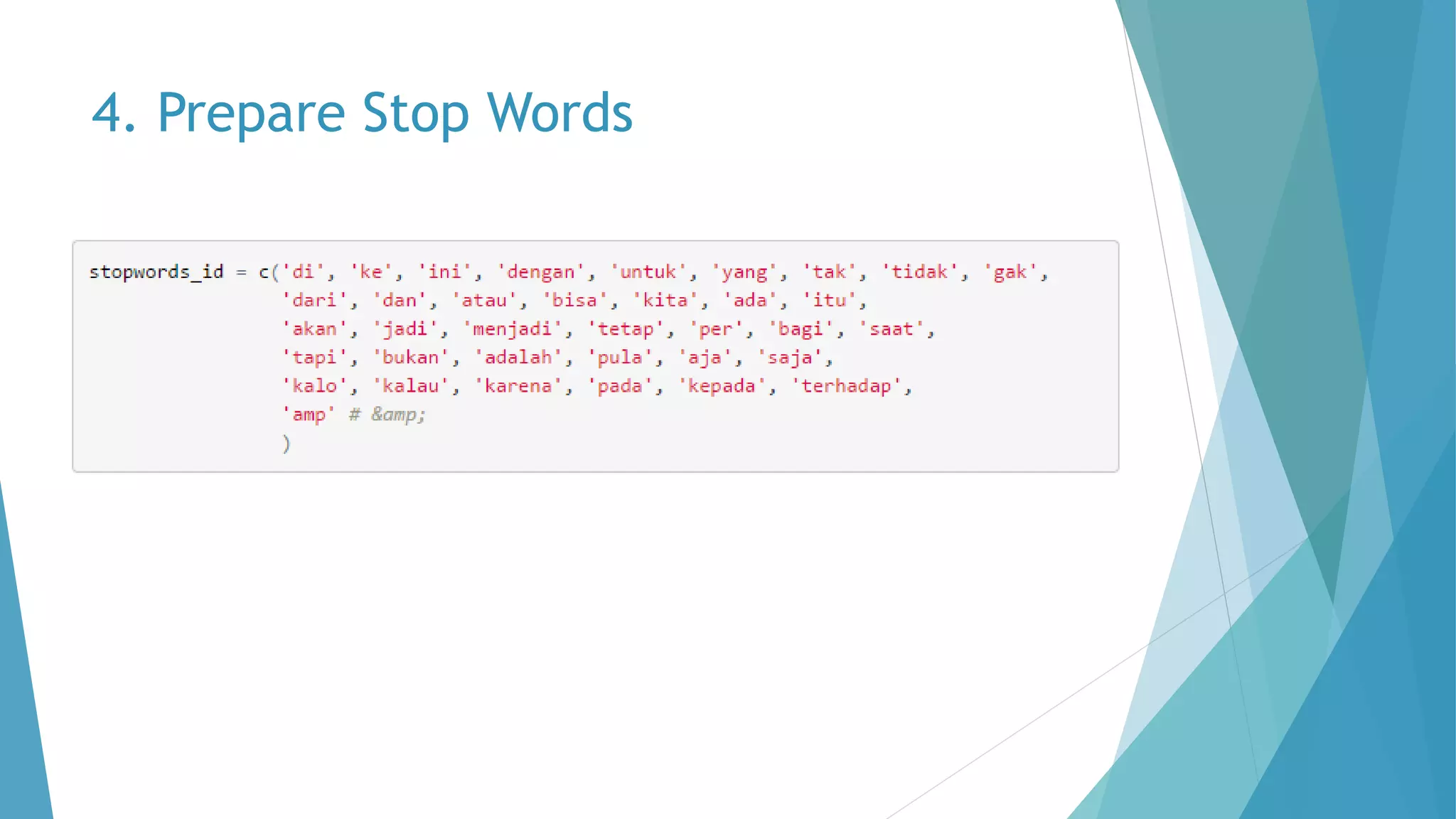
 Prepare Stop Words
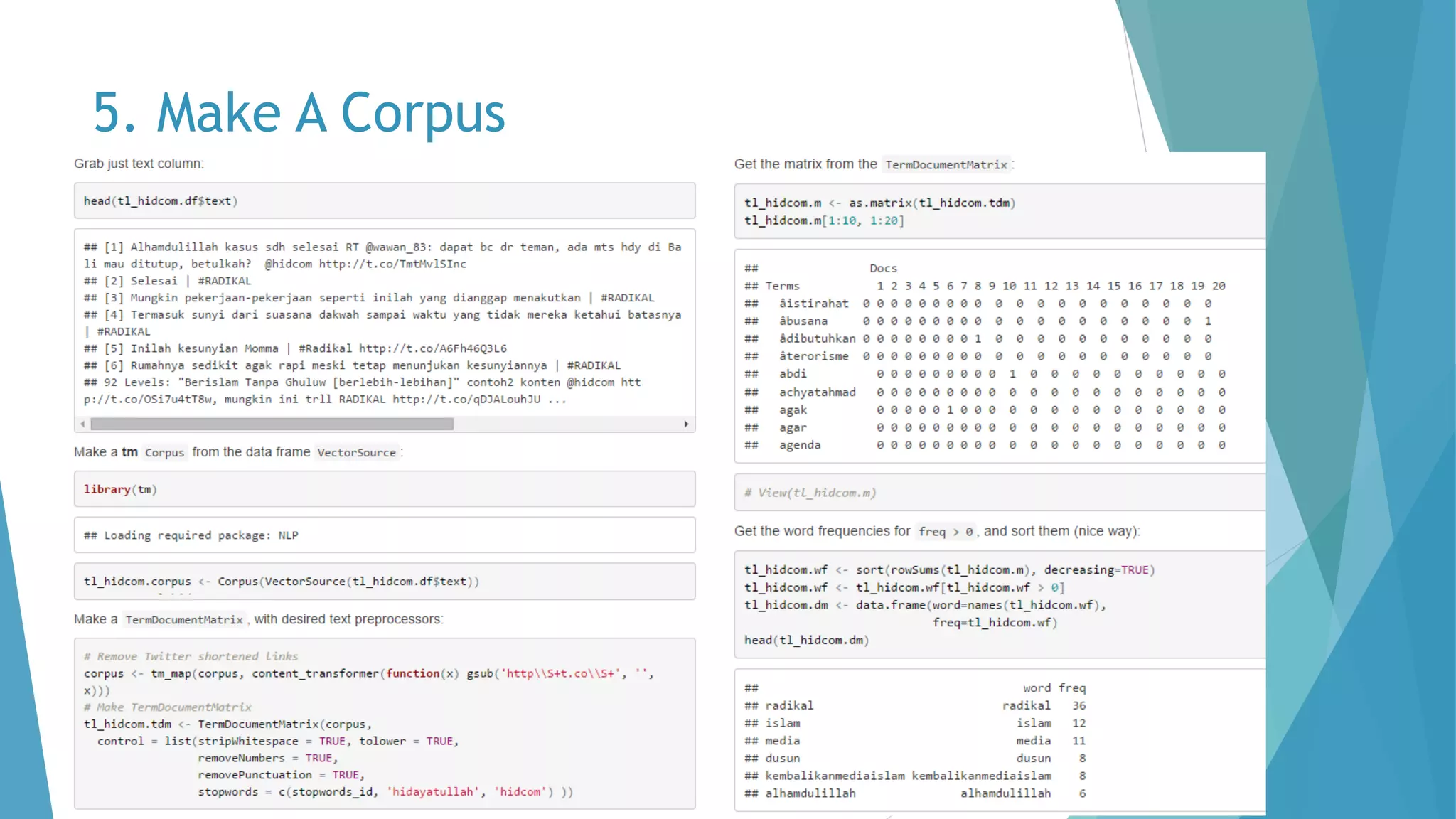
 Make A Corpus
 Word Cloud
1. Install R Packages
2. Setup Twitter OAuth
3. Grab Data
4. Prepare Stop Words
5. Make A Corpus
6. Visualize Word Cloud: @dakwatuna
Word Clouds (2)
@suaradotcom @kompascom
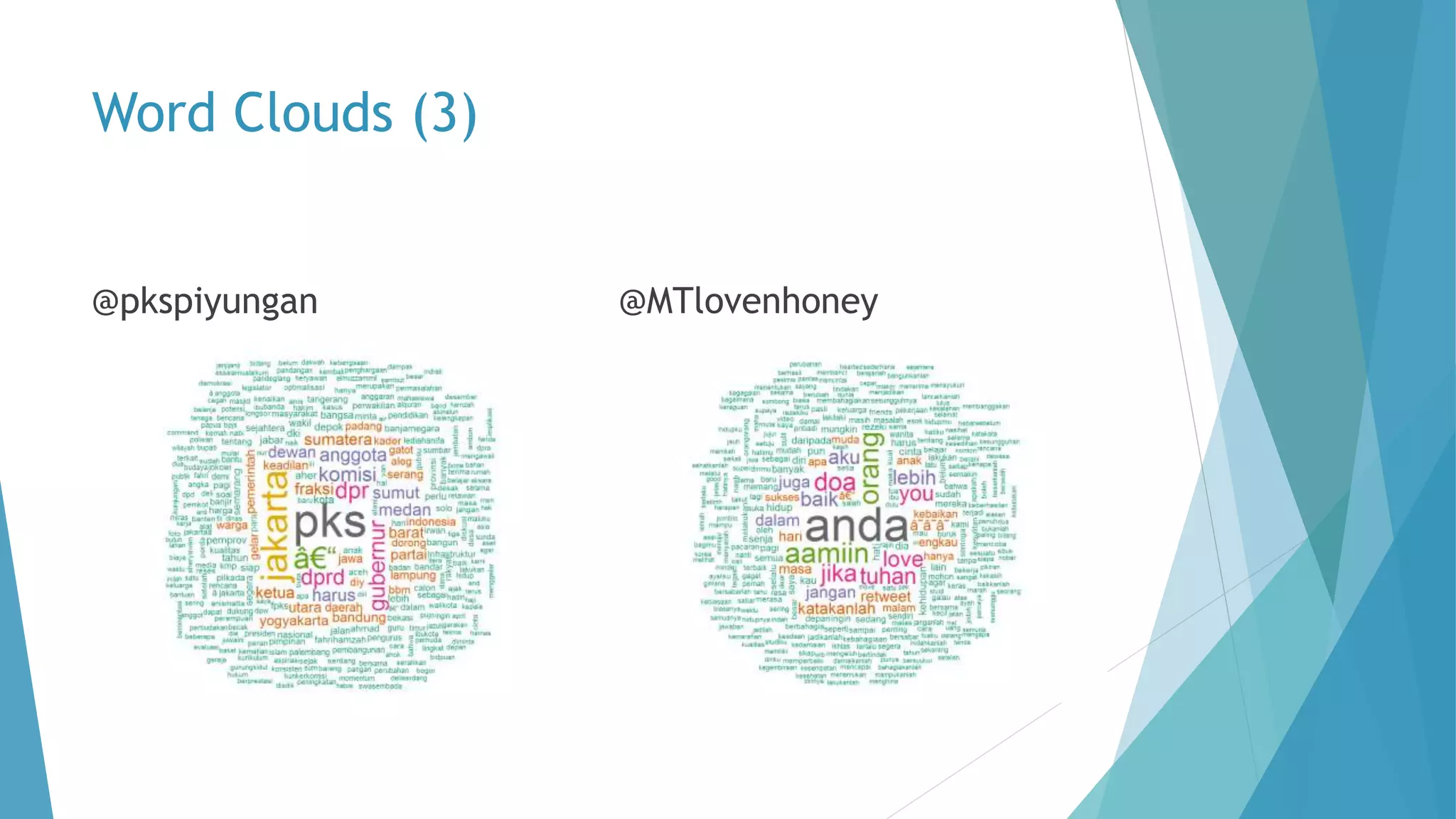
Word Clouds (3)
@VIVAnews @liputan6dotcom
Word Clouds (3)
@pkspiyungan @MTlovenhoney
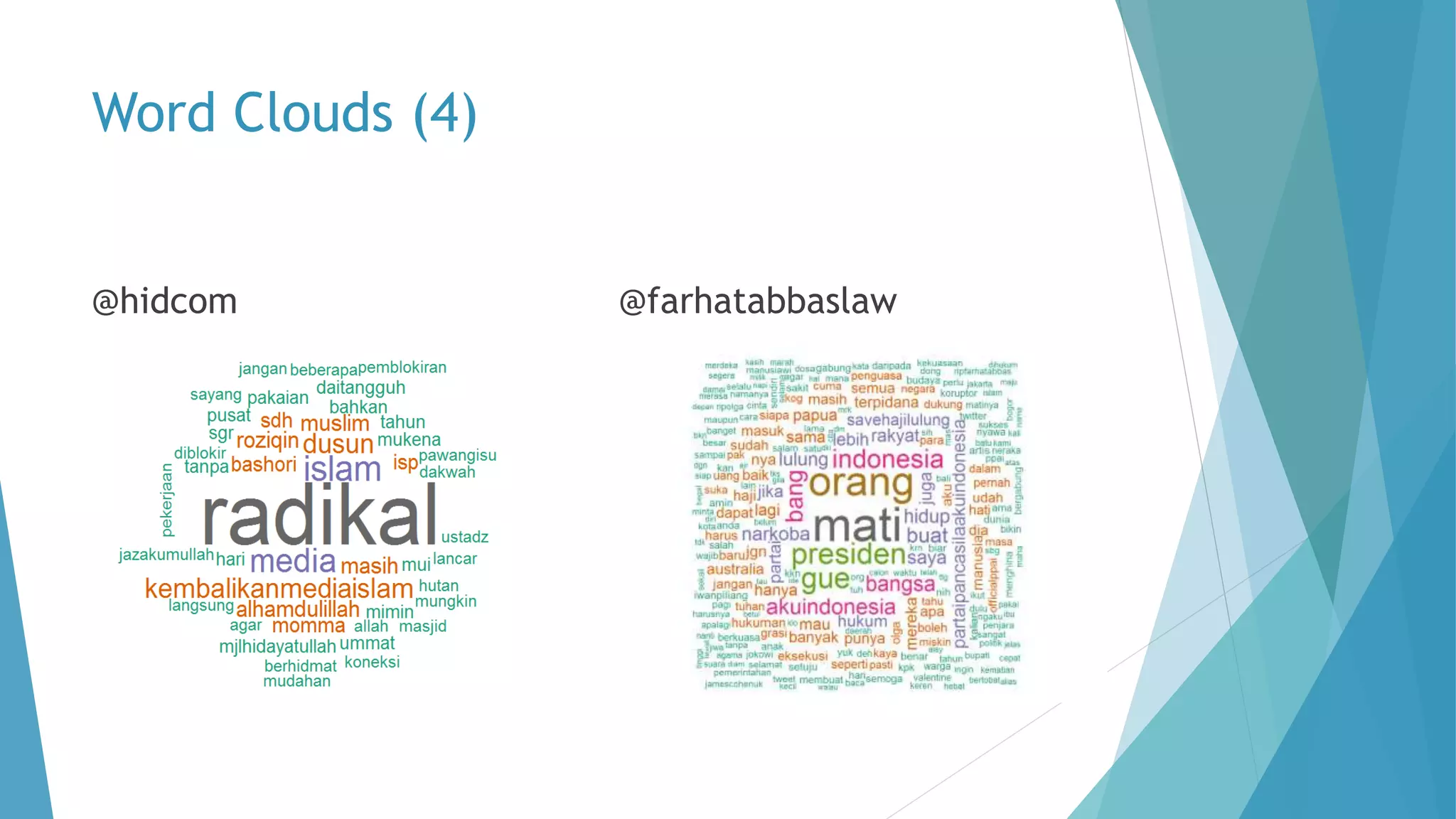
Word Clouds (4)
@hidcom @farhatabbaslaw
Java Implementation
 Natural Language Preprocessing
 Read tweets from CSV
 Lower case
 Remove http(s) links
 Remove punctuation symbols
 Remove numbers
 Canonicalize different word forms
 Remove stop words
 Train Bayesian Network
 Predict Tweet Author
 Initial experiments and dataset
validation available at:
http://ceefour.github.io/r-
tutorials/
 Java application source code (open
source) available on GitHub at:
https://github.com/lumenitb/nlu-
sentiment
1. Read Tweets from CSV
/**
* Read CSV file {@code f} and put its contents into {@link #rows},
* {@link #texts}, and {@link #origTexts}.
* @param f
*/
public void readCsv(File f) {
try (final CSVReader csv = new CSVReader(new FileReader(f))) {
headerNames = csv.readNext(); // header
rows = csv.readAll();
texts = rows.stream().map(it -> Maps.immutableEntry(it[0], it[1]))
.collect(Collectors.toMap(Map.Entry::getKey, Map.Entry::getValue));
origTexts = ImmutableMap.copyOf(texts);
} catch (Exception e) {
throw new RuntimeException("Cannot read " + f, e);
}
}
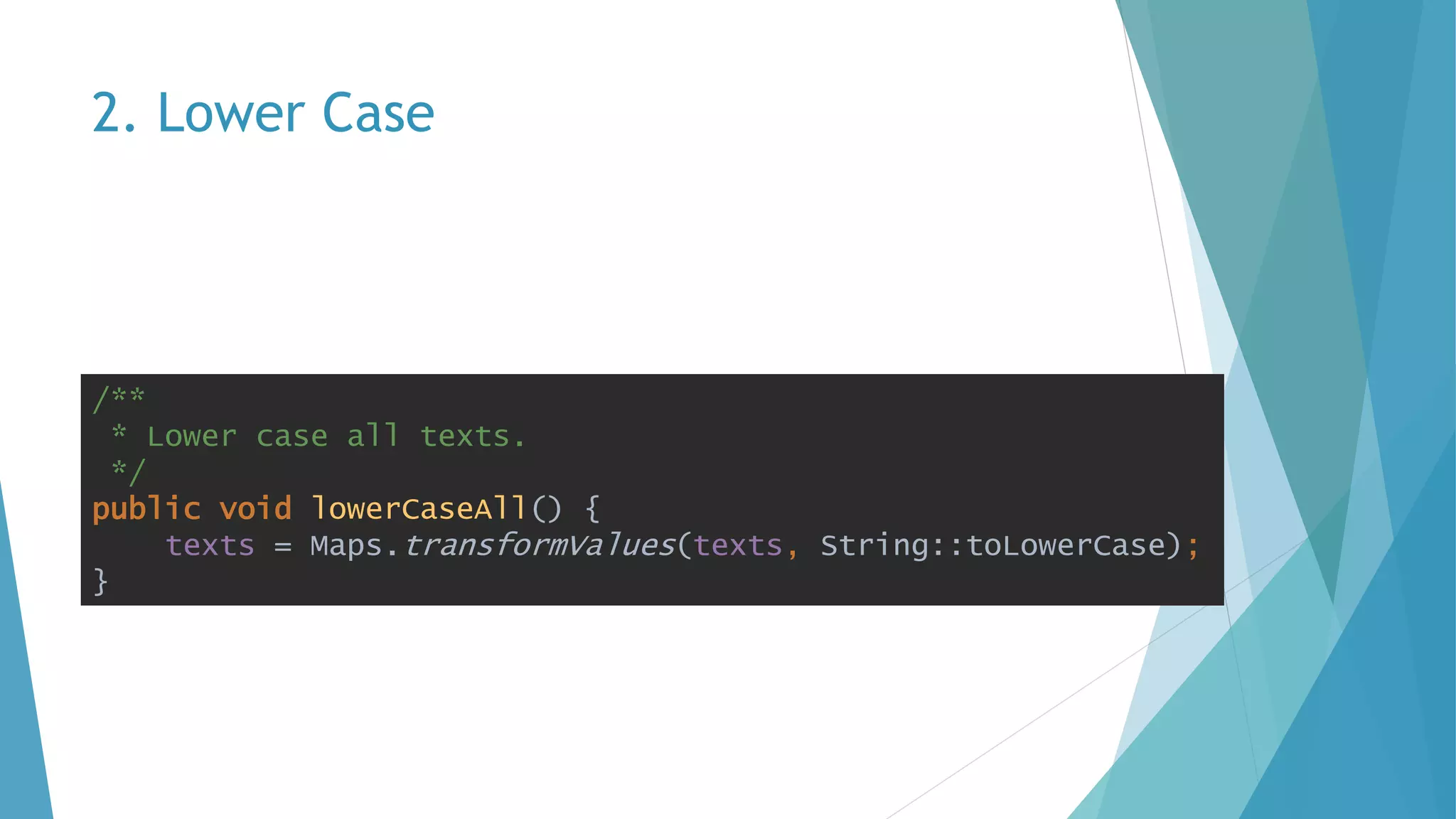
2. Lower Case
/**
* Lower case all texts.
*/
public void lowerCaseAll() {
texts = Maps.transformValues(texts, String::toLowerCase);
}
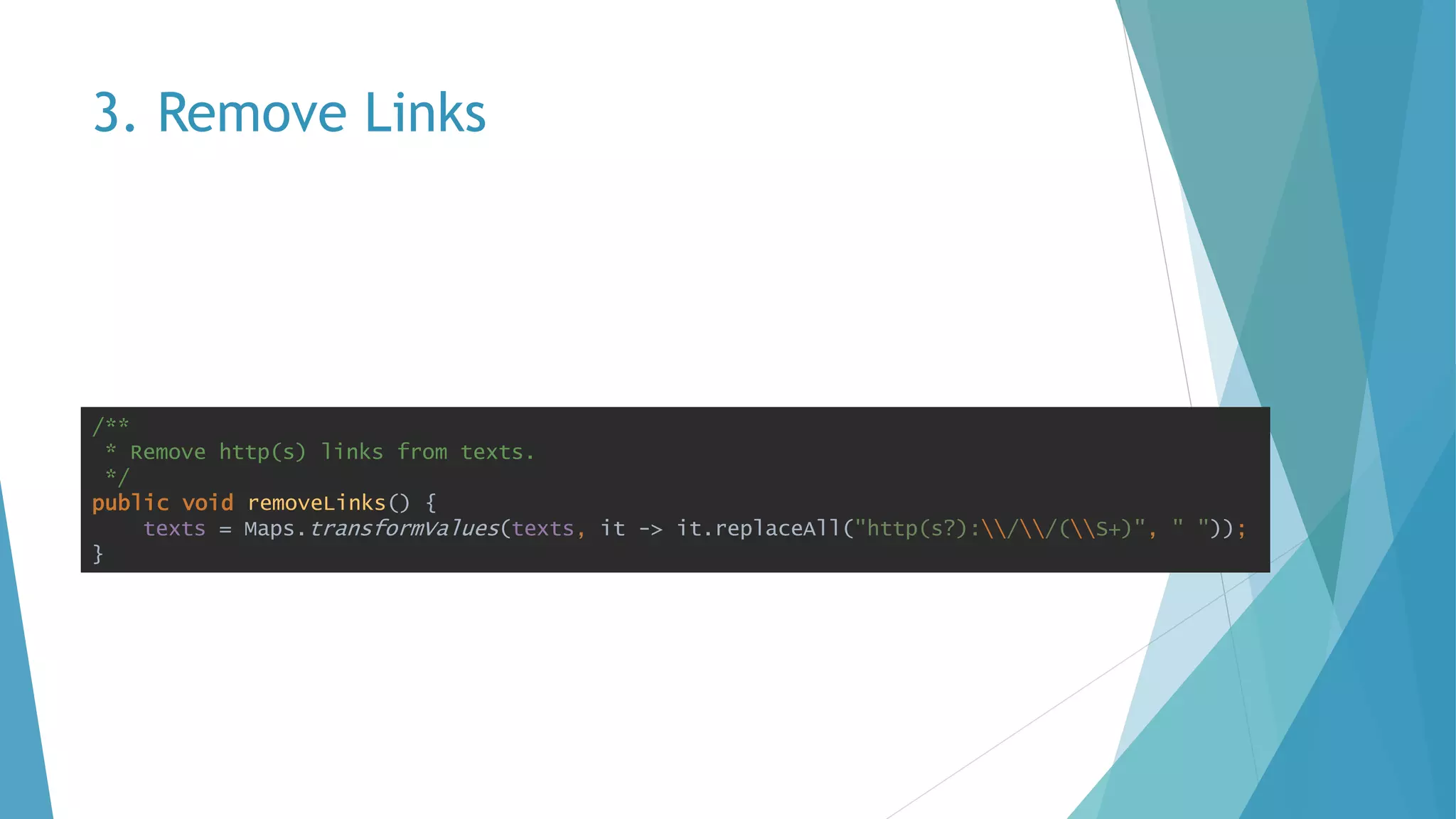
3. Remove Links
/**
* Remove http(s) links from texts.
*/
public void removeLinks() {
texts = Maps.transformValues(texts, it -> it.replaceAll("http(s?)://(S+)", " "));
}
4. Remove Punctuation Symbols
/**
* Remove punctuation symbols from texts.
*/
public void removePunctuation() {
texts = Maps.transformValues(texts, it -> it.replaceAll("[^a-zA-Z0-9]+", " "));
}
5. Remove Numbers
/**
* Remove numbers from texts.
*/
public void removeNumbers() {
texts = Maps.transformValues(texts, it -> it.replaceAll("[0-9]+", ""));
}
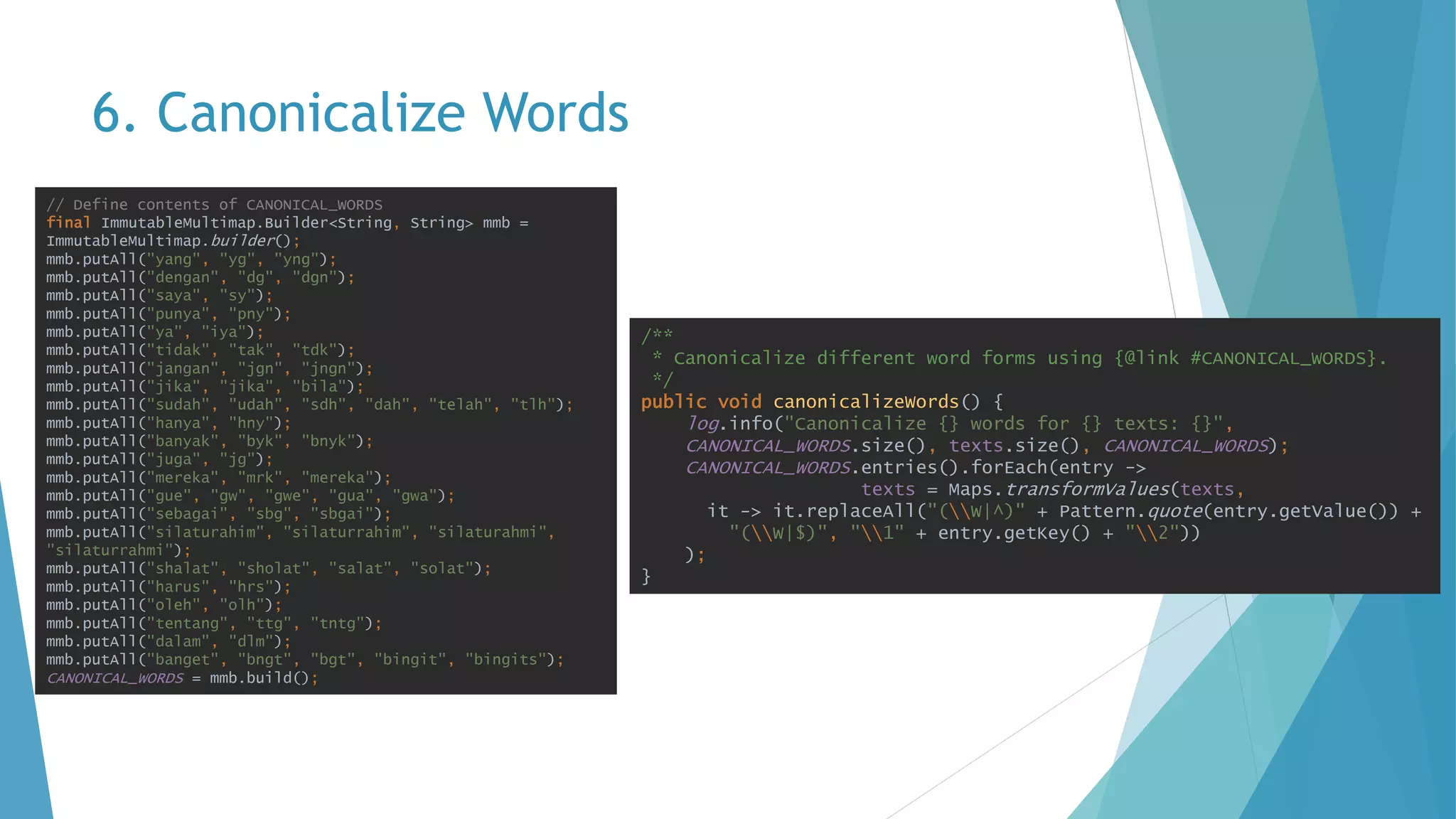
6. Canonicalize Words
/**
* Canonicalize different word forms using {@link #CANONICAL_WORDS}.
*/
public void canonicalizeWords() {
log.info("Canonicalize {} words for {} texts: {}",
CANONICAL_WORDS.size(), texts.size(), CANONICAL_WORDS);
CANONICAL_WORDS.entries().forEach(entry ->
texts = Maps.transformValues(texts,
it -> it.replaceAll("(W|^)" + Pattern.quote(entry.getValue()) +
"(W|$)", "1" + entry.getKey() + "2"))
);
}
// Define contents of CANONICAL_WORDS
final ImmutableMultimap.Builder<String, String> mmb =
ImmutableMultimap.builder();
mmb.putAll("yang", "yg", "yng");
mmb.putAll("dengan", "dg", "dgn");
mmb.putAll("saya", "sy");
mmb.putAll("punya", "pny");
mmb.putAll("ya", "iya");
mmb.putAll("tidak", "tak", "tdk");
mmb.putAll("jangan", "jgn", "jngn");
mmb.putAll("jika", "jika", "bila");
mmb.putAll("sudah", "udah", "sdh", "dah", "telah", "tlh");
mmb.putAll("hanya", "hny");
mmb.putAll("banyak", "byk", "bnyk");
mmb.putAll("juga", "jg");
mmb.putAll("mereka", "mrk", "mereka");
mmb.putAll("gue", "gw", "gwe", "gua", "gwa");
mmb.putAll("sebagai", "sbg", "sbgai");
mmb.putAll("silaturahim", "silaturrahim", "silaturahmi",
"silaturrahmi");
mmb.putAll("shalat", "sholat", "salat", "solat");
mmb.putAll("harus", "hrs");
mmb.putAll("oleh", "olh");
mmb.putAll("tentang", "ttg", "tntg");
mmb.putAll("dalam", "dlm");
mmb.putAll("banget", "bngt", "bgt", "bingit", "bingits");
CANONICAL_WORDS = mmb.build();
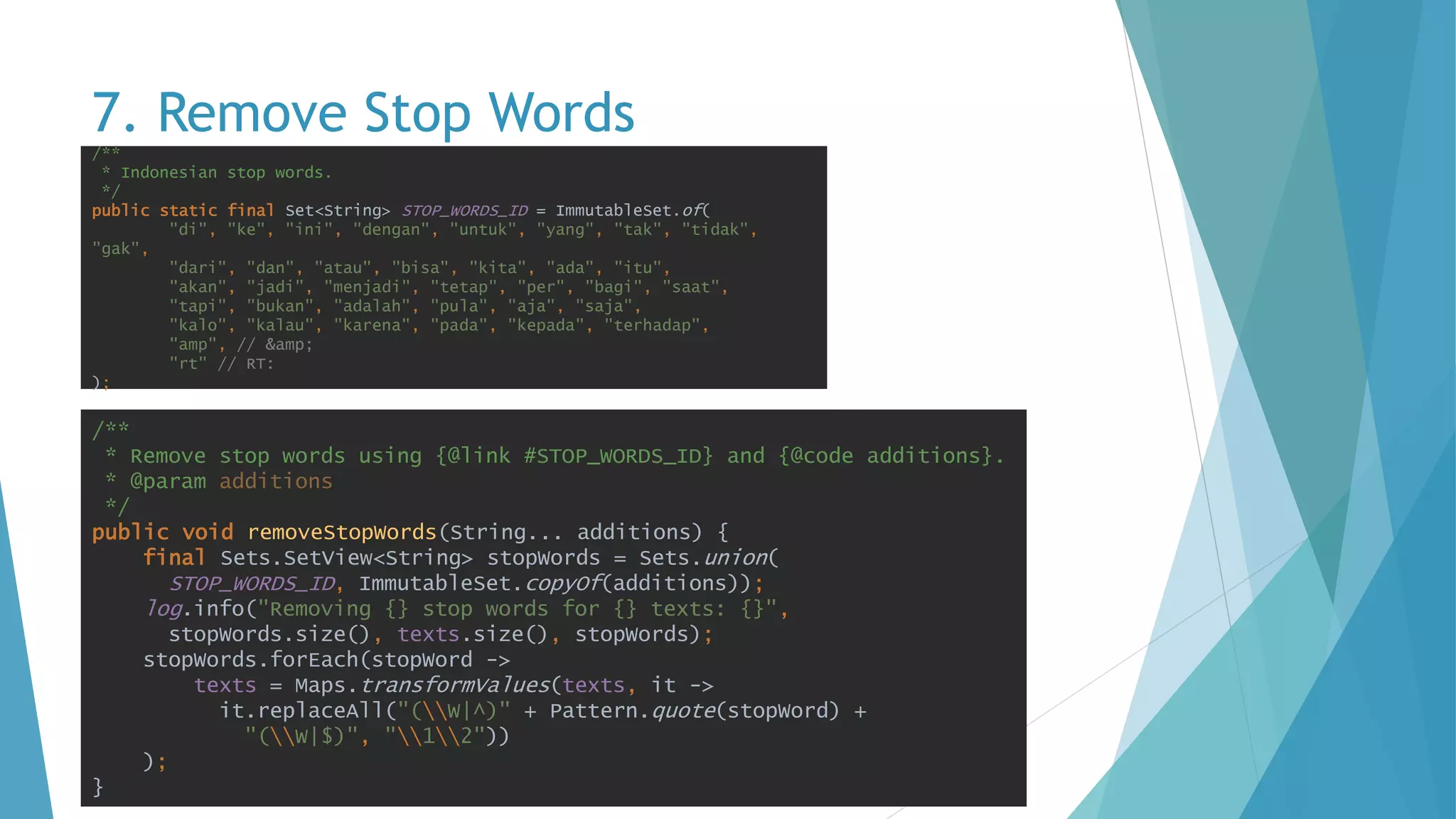
7. Remove Stop Words
/**
* Remove stop words using {@link #STOP_WORDS_ID} and {@code additions}.
* @param additions
*/
public void removeStopWords(String... additions) {
final Sets.SetView<String> stopWords = Sets.union(
STOP_WORDS_ID, ImmutableSet.copyOf(additions));
log.info("Removing {} stop words for {} texts: {}",
stopWords.size(), texts.size(), stopWords);
stopWords.forEach(stopWord ->
texts = Maps.transformValues(texts, it ->
it.replaceAll("(W|^)" + Pattern.quote(stopWord) +
"(W|$)", "12"))
);
}
/**
* Indonesian stop words.
*/
public static final Set<String> STOP_WORDS_ID = ImmutableSet.of(
"di", "ke", "ini", "dengan", "untuk", "yang", "tak", "tidak",
"gak",
"dari", "dan", "atau", "bisa", "kita", "ada", "itu",
"akan", "jadi", "menjadi", "tetap", "per", "bagi", "saat",
"tapi", "bukan", "adalah", "pula", "aja", "saja",
"kalo", "kalau", "karena", "pada", "kepada", "terhadap",
"amp", // &amp;
"rt" // RT:
);
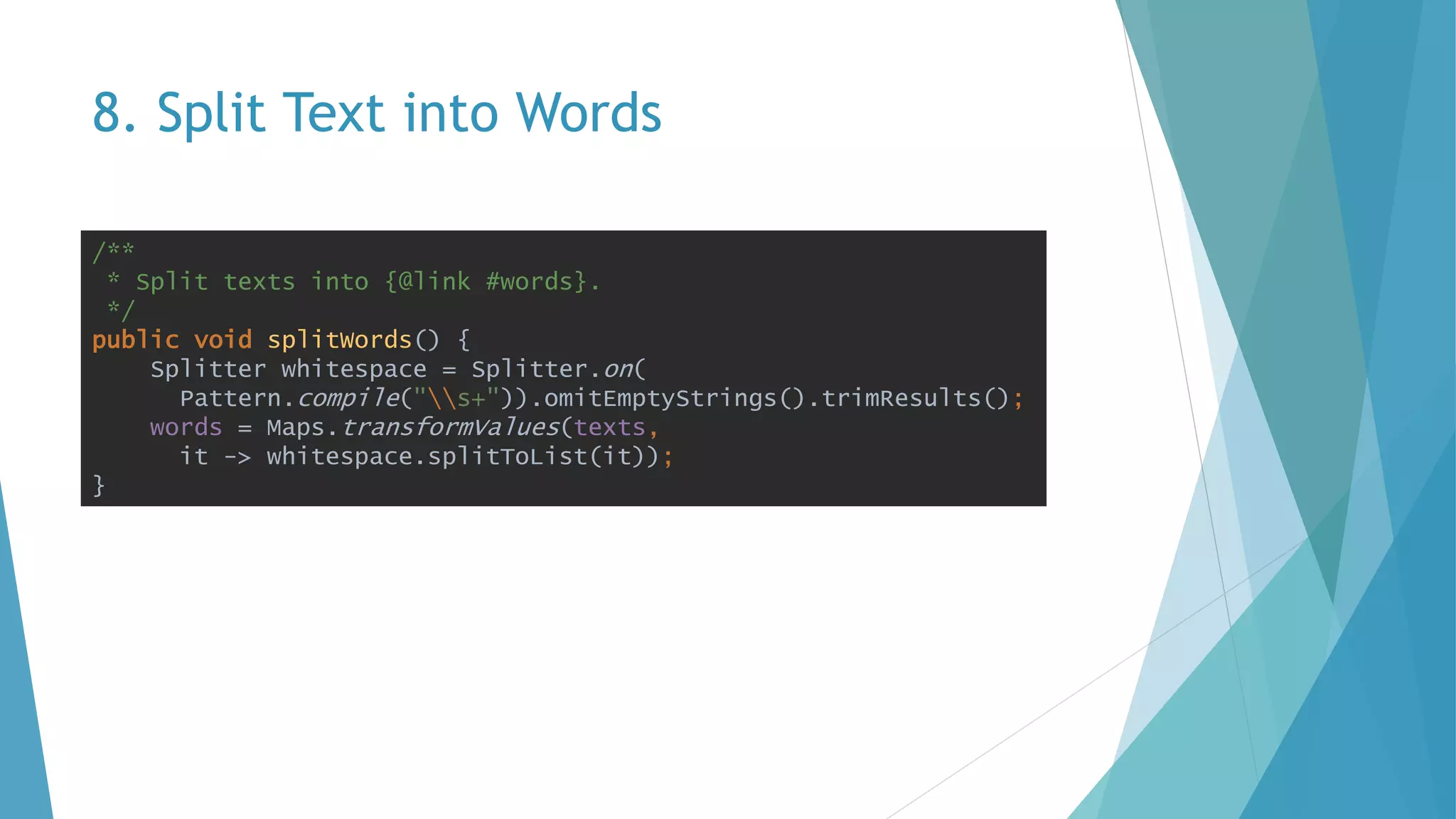
8. Split Text into Words
/**
* Split texts into {@link #words}.
*/
public void splitWords() {
Splitter whitespace = Splitter.on(
Pattern.compile("s+")).omitEmptyStrings().trimResults();
words = Maps.transformValues(texts,
it -> whitespace.splitToList(it));
}
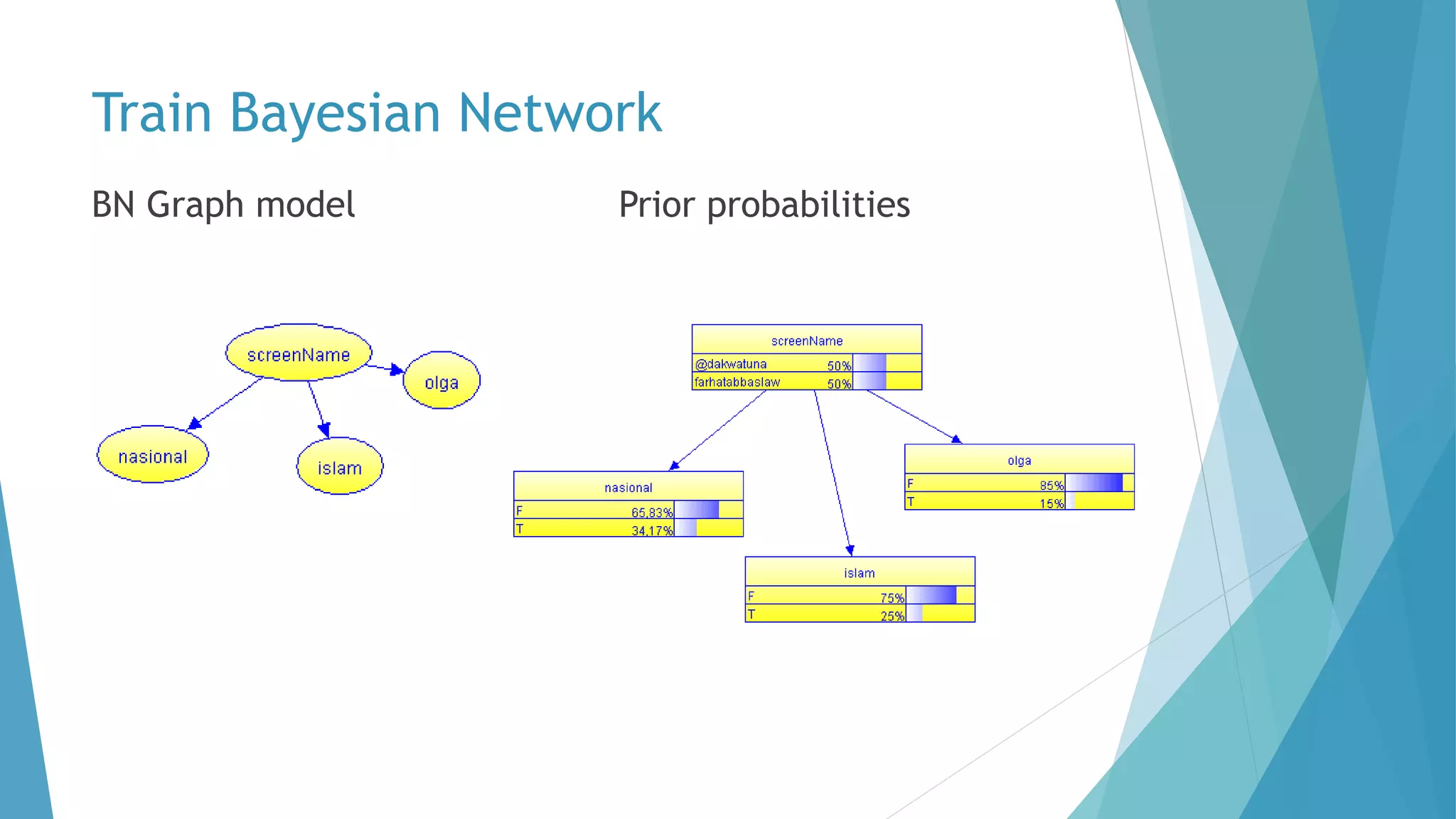
Train Bayesian Network
BN Graph model Prior probabilities
Train Bayesian Network: Java (1)
/**
* Creates a {@link SentimentAnalyzer} then analyzes the
file {@code f},
* with limiting words to {@code wordLimit} (based on top
word frequency),
* and additional stop words of {@code moreStopWords}
(base stop words
* are {@link SentimentAnalyzer#STOP_WORDS_ID}.
* @param f
* @param wordLimit
* @param moreStopWords
* @return
*/
protected SentimentAnalyzer analyze(File f, int wordLimit,
Set<String> moreStopWords) {
final SentimentAnalyzer sentimentAnalyzer = new
SentimentAnalyzer();
sentimentAnalyzer.readCsv(f);
sentimentAnalyzer.lowerCaseAll();
sentimentAnalyzer.removeLinks();
sentimentAnalyzer.removePunctuation();
sentimentAnalyzer.removeNumbers();
sentimentAnalyzer.canonicalizeWords();
sentimentAnalyzer.removeStopWords(moreStopWords.toArray(ne
w String[] {}));
log.info("Preprocessed text: {}",
sentimentAnalyzer.texts.entrySet().stream().limit(10)
.collect(Collectors.toMap(Map.Entry::getKey,
Map.Entry::getValue)));
sentimentAnalyzer.splitWords();
log.info("Words: {}",
sentimentAnalyzer.words.entrySet().stream().limit(10)
.collect(Collectors.toMap(Map.Entry::getKey,
Map.Entry::getValue)));
final ImmutableMultiset<String> wordMultiset =
Multisets.copyHighestCountFirst(HashMultiset.create(
sentimentAnalyzer.words.values().stream().flatMap(it
-> it.stream()).collect(Collectors.toList())) );
final Map<String, Integer> wordCounts = new
LinkedHashMap<>();
// only the N most used words
wordMultiset.elementSet().stream().limit(wordLimit).
forEach( it -> wordCounts.put(it,
wordMultiset.count(it)) );
log.info("Word counts (orig): {}", wordCounts);
// Normalize the twitterUser "vector" to length
1.0
// Note that this "vector" is actually user-
specific, i.e. it's not a user-independent vector
long origSumSqrs = 0;
for (final Integer it : wordCounts.values()) {
origSumSqrs += it * it;
}
double origLength = Math.sqrt(origSumSqrs);
final Map<String, Double> normWordCounts =
Maps.transformValues(wordCounts, it -> it /
origLength);
log.info("Word counts (normalized): {}",
normWordCounts);
sentimentAnalyzer.normWordCounts =
normWordCounts;
return sentimentAnalyzer;
}
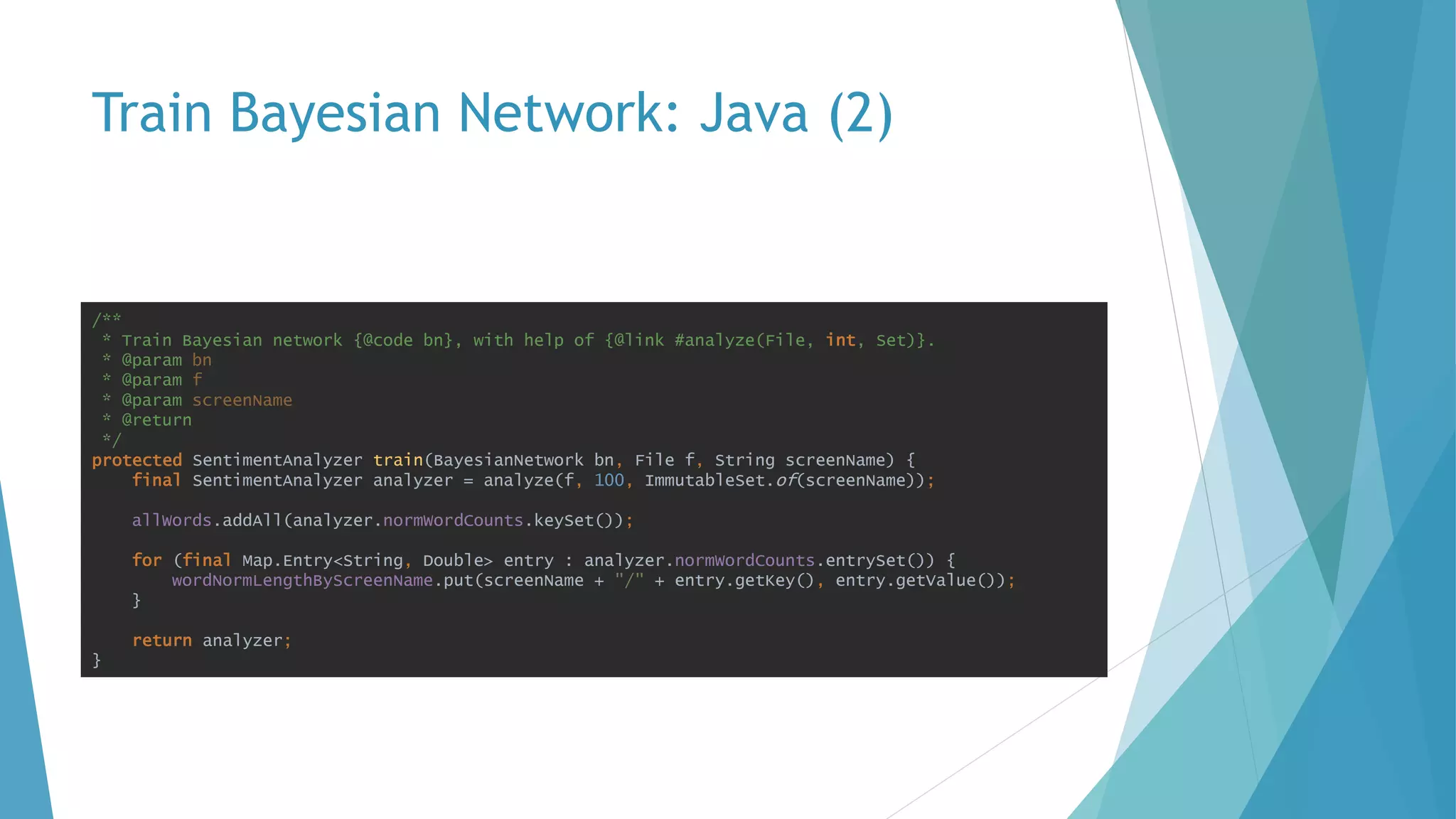
Train Bayesian Network: Java (2)
/**
* Train Bayesian network {@code bn}, with help of {@link #analyze(File, int, Set)}.
* @param bn
* @param f
* @param screenName
* @return
*/
protected SentimentAnalyzer train(BayesianNetwork bn, File f, String screenName) {
final SentimentAnalyzer analyzer = analyze(f, 100, ImmutableSet.of(screenName));
allWords.addAll(analyzer.normWordCounts.keySet());
for (final Map.Entry<String, Double> entry : analyzer.normWordCounts.entrySet()) {
wordNormLengthByScreenName.put(screenName + "/" + entry.getKey(), entry.getValue());
}
return analyzer;
}
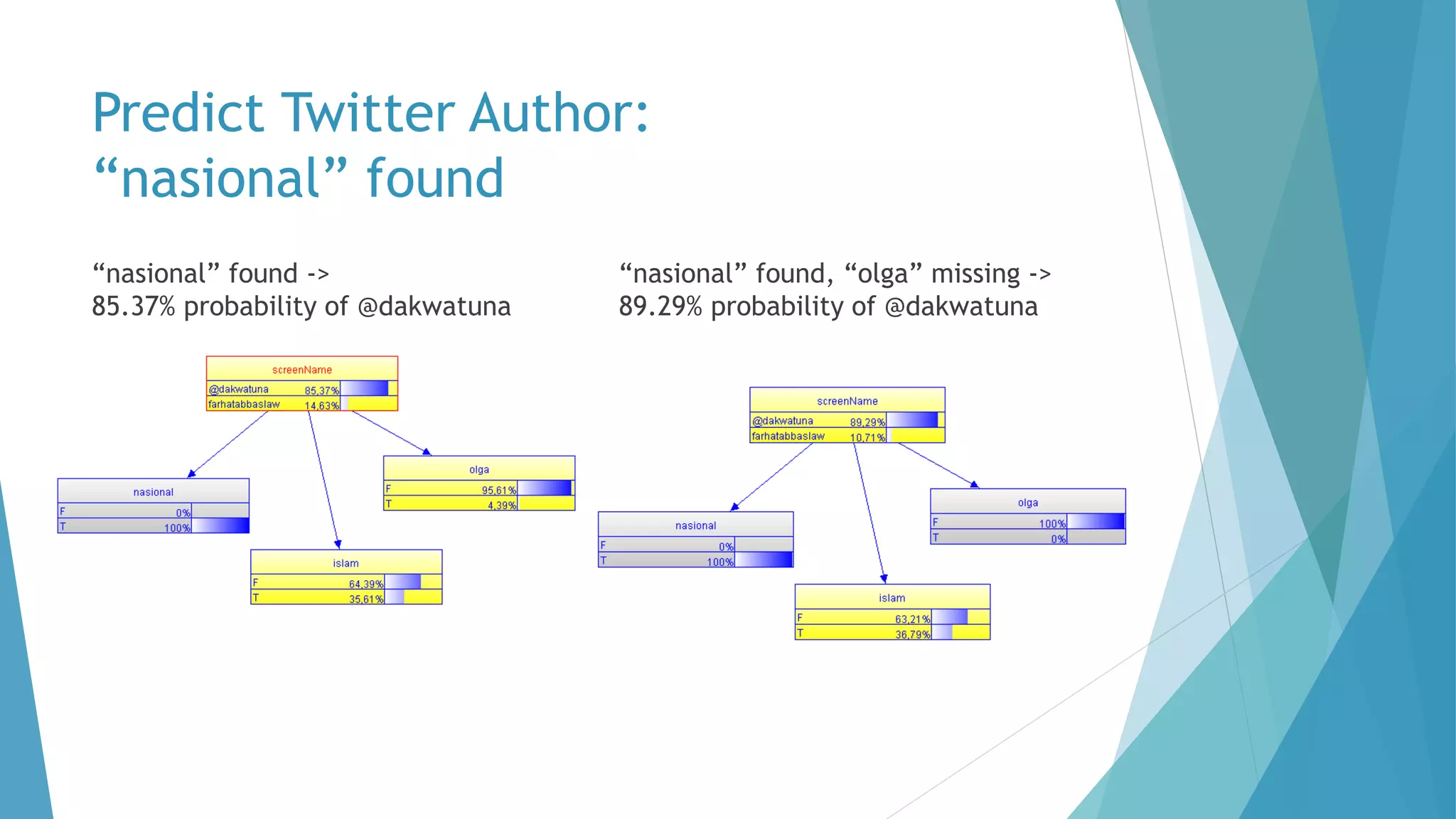
Predict Twitter Author:
“nasional” found
“nasional” found ->
85.37% probability of @dakwatuna
“nasional” found, “olga” missing ->
89.29% probability of @dakwatuna
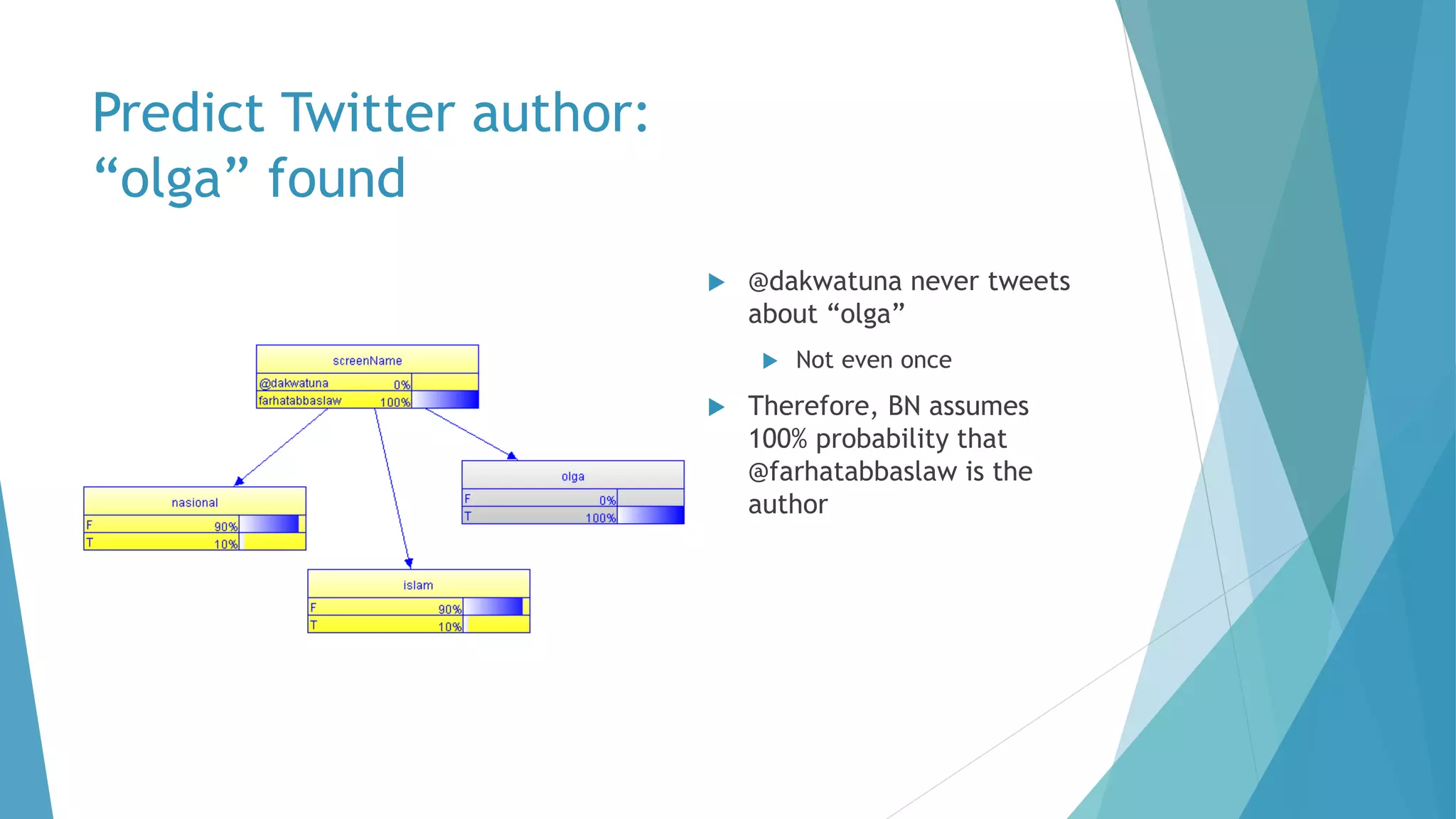
Predict Twitter author:
“olga” found
 @dakwatuna never tweets
about “olga”
 Not even once
 Therefore, BN assumes
100% probability that
@farhatabbaslaw is the
author
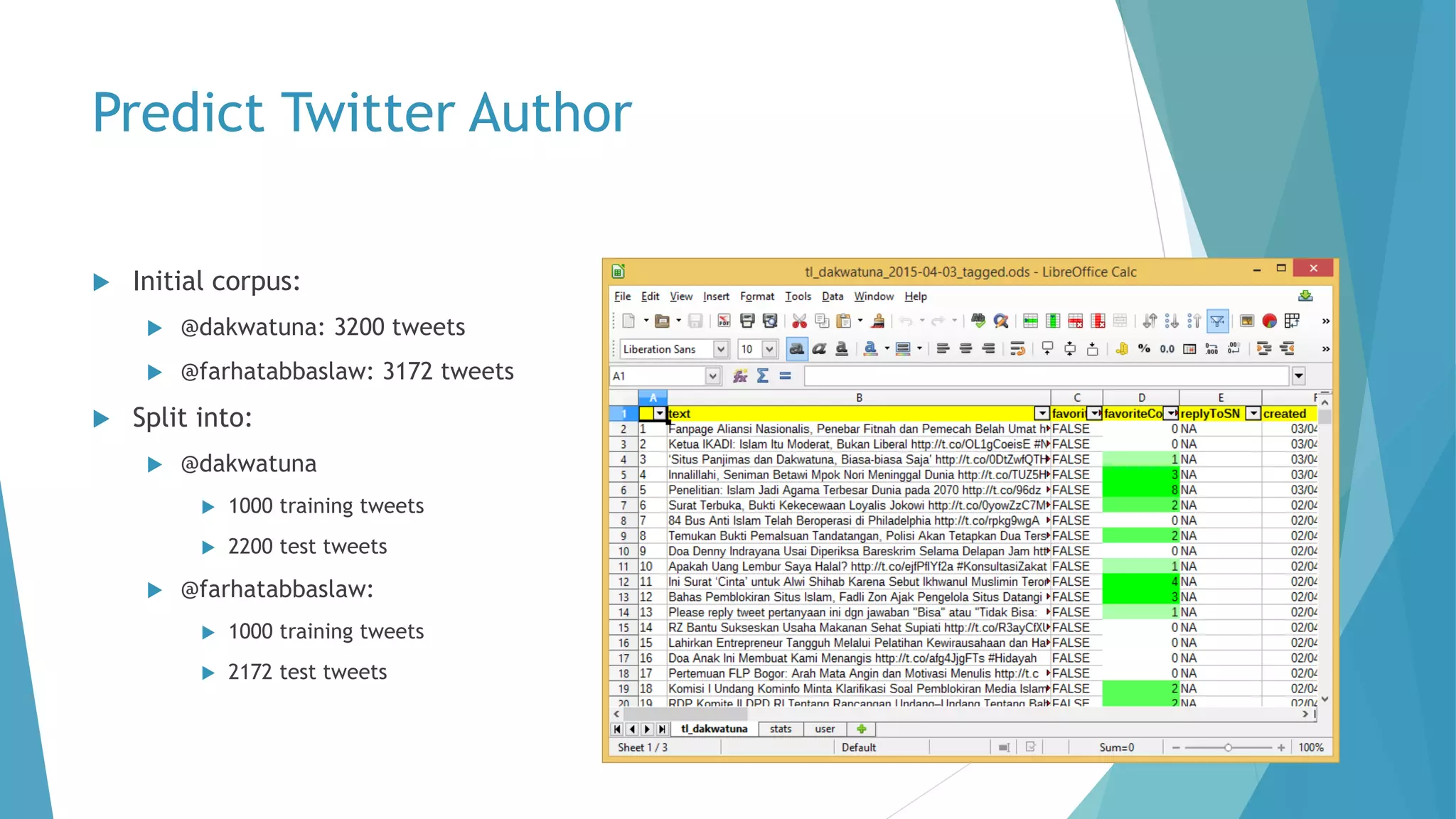
Predict Twitter Author
 Initial corpus:
 @dakwatuna: 3200 tweets
 @farhatabbaslaw: 3172 tweets
 Split into:
 @dakwatuna
 1000 training tweets
 2200 test tweets
 @farhatabbaslaw:
 1000 training tweets
 2172 test tweets
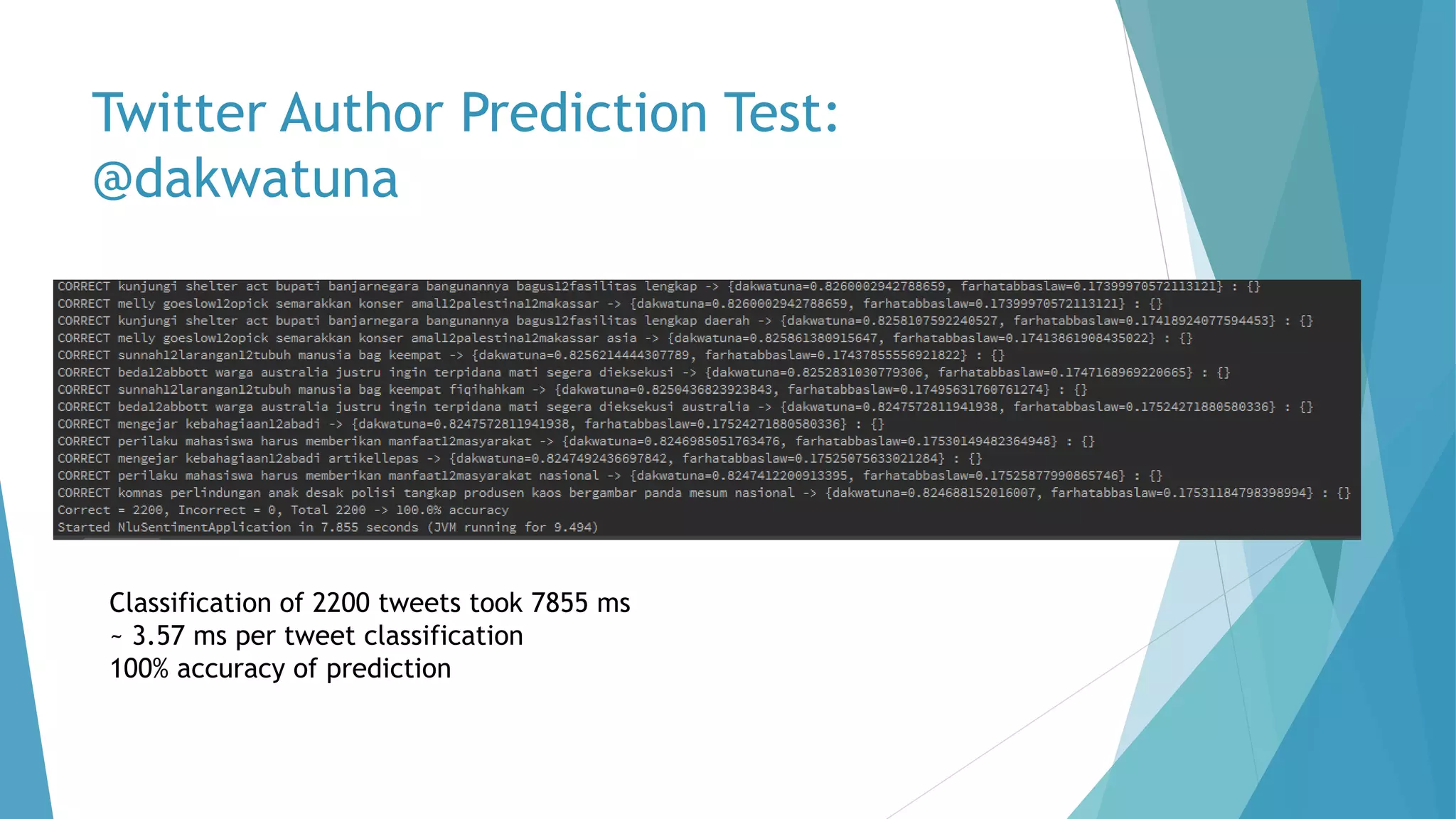
Twitter Author Prediction Test:
@dakwatuna
Classification of 2200 tweets took 7855 ms
~ 3.57 ms per tweet classification
100% accuracy of prediction
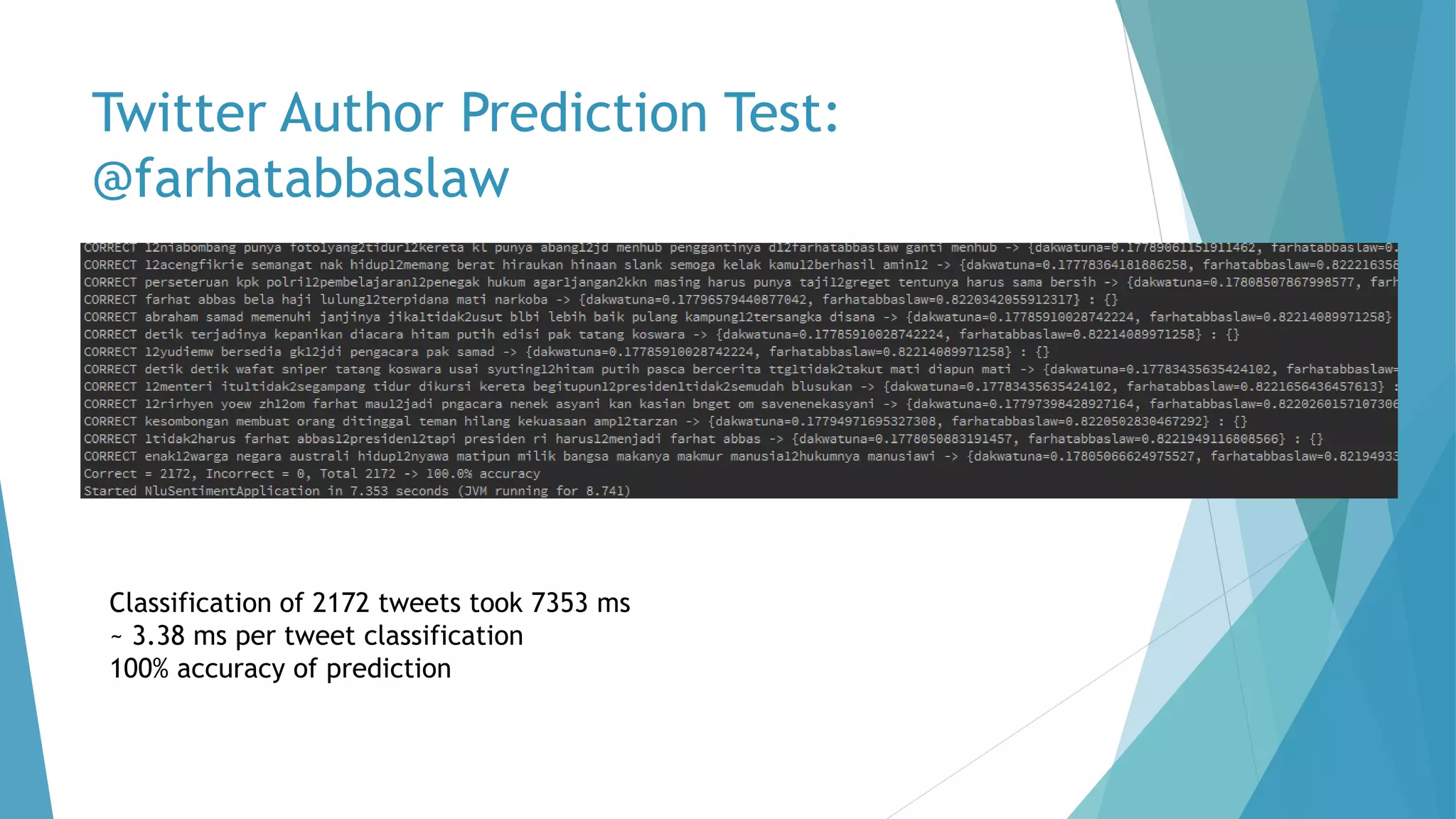
Twitter Author Prediction Test:
@farhatabbaslaw
Classification of 2172 tweets took 7353 ms
~ 3.38 ms per tweet classification
100% accuracy of prediction
Conclusion
 Initial results is promising
 Bayesian Networks is able to predict tweet author with “very good” accuracy
 Note that accuracy depends largely of:
 Twitter author’s writing style
 Twitter author’s topics of interest
 Twitter author’s distribution of words
 In other words, two different authors with similar writing style or topics will
have greater chance of “false positive” prediction

Twitter Author Prediction from Tweets using Bayesian Network

  • 1.
    Twitter Author Prediction fromTweets using Bayesian Network Hendy Irawan 23214344 TMDG 9 – Electrical Engineering - STEI ITB
  • 2.
    Can We Predictthe Author from a Tweet?  Most authors have a distinct writing style  ... And unique topics to talk about  ... And signature distribution of words used to tweet  Can we train Bayesian Network so that occurrence of words in a tweet can be used to infer the author of that tweet?  In summary: YES!  Disclaimer: Accuracy varies  In a test suite with @dakwatuna vs @farhatabbaslaw (very different tweet topics) – 100% prediction accuracy is achieved
  • 3.
    Analysis & ImplementationPlan  Visualize Word Distribution in Tweets with Word Clouds  Using R Statistical Language in RStudio  Implement in Java  Natural Language Preprocessing  Train Bayesian Network  Predict Tweet Author
  • 4.
    Visualize Word Distributionin Tweets with Word Clouds Using R Statistical Language in RStudio All documentation and sources (open source) available at: http://ceefour.github.io/r-tutorials/  Install R Packages  libcurl4-openssl-dev, TwitteR, httpuv, tm, wordcloud, RColorBrewer  Setup Twitter Oauth  Grab Data  Prepare Stop Words  Make A Corpus  Word Cloud
  • 5.
    1. Install RPackages
  • 6.
  • 7.
  • 8.
  • 9.
    5. Make ACorpus
  • 10.
    6. Visualize WordCloud: @dakwatuna
  • 11.
  • 12.
  • 13.
  • 14.
    Word Clouds (4) @hidcom@farhatabbaslaw
  • 15.
    Java Implementation  NaturalLanguage Preprocessing  Read tweets from CSV  Lower case  Remove http(s) links  Remove punctuation symbols  Remove numbers  Canonicalize different word forms  Remove stop words  Train Bayesian Network  Predict Tweet Author  Initial experiments and dataset validation available at: http://ceefour.github.io/r- tutorials/  Java application source code (open source) available on GitHub at: https://github.com/lumenitb/nlu- sentiment
  • 16.
    1. Read Tweetsfrom CSV /** * Read CSV file {@code f} and put its contents into {@link #rows}, * {@link #texts}, and {@link #origTexts}. * @param f */ public void readCsv(File f) { try (final CSVReader csv = new CSVReader(new FileReader(f))) { headerNames = csv.readNext(); // header rows = csv.readAll(); texts = rows.stream().map(it -> Maps.immutableEntry(it[0], it[1])) .collect(Collectors.toMap(Map.Entry::getKey, Map.Entry::getValue)); origTexts = ImmutableMap.copyOf(texts); } catch (Exception e) { throw new RuntimeException("Cannot read " + f, e); } }
  • 17.
    2. Lower Case /** *Lower case all texts. */ public void lowerCaseAll() { texts = Maps.transformValues(texts, String::toLowerCase); }
  • 18.
    3. Remove Links /** *Remove http(s) links from texts. */ public void removeLinks() { texts = Maps.transformValues(texts, it -> it.replaceAll("http(s?)://(S+)", " ")); }
  • 19.
    4. Remove PunctuationSymbols /** * Remove punctuation symbols from texts. */ public void removePunctuation() { texts = Maps.transformValues(texts, it -> it.replaceAll("[^a-zA-Z0-9]+", " ")); }
  • 20.
    5. Remove Numbers /** *Remove numbers from texts. */ public void removeNumbers() { texts = Maps.transformValues(texts, it -> it.replaceAll("[0-9]+", "")); }
  • 21.
    6. Canonicalize Words /** *Canonicalize different word forms using {@link #CANONICAL_WORDS}. */ public void canonicalizeWords() { log.info("Canonicalize {} words for {} texts: {}", CANONICAL_WORDS.size(), texts.size(), CANONICAL_WORDS); CANONICAL_WORDS.entries().forEach(entry -> texts = Maps.transformValues(texts, it -> it.replaceAll("(W|^)" + Pattern.quote(entry.getValue()) + "(W|$)", "1" + entry.getKey() + "2")) ); } // Define contents of CANONICAL_WORDS final ImmutableMultimap.Builder<String, String> mmb = ImmutableMultimap.builder(); mmb.putAll("yang", "yg", "yng"); mmb.putAll("dengan", "dg", "dgn"); mmb.putAll("saya", "sy"); mmb.putAll("punya", "pny"); mmb.putAll("ya", "iya"); mmb.putAll("tidak", "tak", "tdk"); mmb.putAll("jangan", "jgn", "jngn"); mmb.putAll("jika", "jika", "bila"); mmb.putAll("sudah", "udah", "sdh", "dah", "telah", "tlh"); mmb.putAll("hanya", "hny"); mmb.putAll("banyak", "byk", "bnyk"); mmb.putAll("juga", "jg"); mmb.putAll("mereka", "mrk", "mereka"); mmb.putAll("gue", "gw", "gwe", "gua", "gwa"); mmb.putAll("sebagai", "sbg", "sbgai"); mmb.putAll("silaturahim", "silaturrahim", "silaturahmi", "silaturrahmi"); mmb.putAll("shalat", "sholat", "salat", "solat"); mmb.putAll("harus", "hrs"); mmb.putAll("oleh", "olh"); mmb.putAll("tentang", "ttg", "tntg"); mmb.putAll("dalam", "dlm"); mmb.putAll("banget", "bngt", "bgt", "bingit", "bingits"); CANONICAL_WORDS = mmb.build();
  • 22.
    7. Remove StopWords /** * Remove stop words using {@link #STOP_WORDS_ID} and {@code additions}. * @param additions */ public void removeStopWords(String... additions) { final Sets.SetView<String> stopWords = Sets.union( STOP_WORDS_ID, ImmutableSet.copyOf(additions)); log.info("Removing {} stop words for {} texts: {}", stopWords.size(), texts.size(), stopWords); stopWords.forEach(stopWord -> texts = Maps.transformValues(texts, it -> it.replaceAll("(W|^)" + Pattern.quote(stopWord) + "(W|$)", "12")) ); } /** * Indonesian stop words. */ public static final Set<String> STOP_WORDS_ID = ImmutableSet.of( "di", "ke", "ini", "dengan", "untuk", "yang", "tak", "tidak", "gak", "dari", "dan", "atau", "bisa", "kita", "ada", "itu", "akan", "jadi", "menjadi", "tetap", "per", "bagi", "saat", "tapi", "bukan", "adalah", "pula", "aja", "saja", "kalo", "kalau", "karena", "pada", "kepada", "terhadap", "amp", // &amp; "rt" // RT: );
  • 23.
    8. Split Textinto Words /** * Split texts into {@link #words}. */ public void splitWords() { Splitter whitespace = Splitter.on( Pattern.compile("s+")).omitEmptyStrings().trimResults(); words = Maps.transformValues(texts, it -> whitespace.splitToList(it)); }
  • 24.
    Train Bayesian Network BNGraph model Prior probabilities
  • 25.
    Train Bayesian Network:Java (1) /** * Creates a {@link SentimentAnalyzer} then analyzes the file {@code f}, * with limiting words to {@code wordLimit} (based on top word frequency), * and additional stop words of {@code moreStopWords} (base stop words * are {@link SentimentAnalyzer#STOP_WORDS_ID}. * @param f * @param wordLimit * @param moreStopWords * @return */ protected SentimentAnalyzer analyze(File f, int wordLimit, Set<String> moreStopWords) { final SentimentAnalyzer sentimentAnalyzer = new SentimentAnalyzer(); sentimentAnalyzer.readCsv(f); sentimentAnalyzer.lowerCaseAll(); sentimentAnalyzer.removeLinks(); sentimentAnalyzer.removePunctuation(); sentimentAnalyzer.removeNumbers(); sentimentAnalyzer.canonicalizeWords(); sentimentAnalyzer.removeStopWords(moreStopWords.toArray(ne w String[] {})); log.info("Preprocessed text: {}", sentimentAnalyzer.texts.entrySet().stream().limit(10) .collect(Collectors.toMap(Map.Entry::getKey, Map.Entry::getValue))); sentimentAnalyzer.splitWords(); log.info("Words: {}", sentimentAnalyzer.words.entrySet().stream().limit(10) .collect(Collectors.toMap(Map.Entry::getKey, Map.Entry::getValue))); final ImmutableMultiset<String> wordMultiset = Multisets.copyHighestCountFirst(HashMultiset.create( sentimentAnalyzer.words.values().stream().flatMap(it -> it.stream()).collect(Collectors.toList())) ); final Map<String, Integer> wordCounts = new LinkedHashMap<>(); // only the N most used words wordMultiset.elementSet().stream().limit(wordLimit). forEach( it -> wordCounts.put(it, wordMultiset.count(it)) ); log.info("Word counts (orig): {}", wordCounts); // Normalize the twitterUser "vector" to length 1.0 // Note that this "vector" is actually user- specific, i.e. it's not a user-independent vector long origSumSqrs = 0; for (final Integer it : wordCounts.values()) { origSumSqrs += it * it; } double origLength = Math.sqrt(origSumSqrs); final Map<String, Double> normWordCounts = Maps.transformValues(wordCounts, it -> it / origLength); log.info("Word counts (normalized): {}", normWordCounts); sentimentAnalyzer.normWordCounts = normWordCounts; return sentimentAnalyzer; }
  • 26.
    Train Bayesian Network:Java (2) /** * Train Bayesian network {@code bn}, with help of {@link #analyze(File, int, Set)}. * @param bn * @param f * @param screenName * @return */ protected SentimentAnalyzer train(BayesianNetwork bn, File f, String screenName) { final SentimentAnalyzer analyzer = analyze(f, 100, ImmutableSet.of(screenName)); allWords.addAll(analyzer.normWordCounts.keySet()); for (final Map.Entry<String, Double> entry : analyzer.normWordCounts.entrySet()) { wordNormLengthByScreenName.put(screenName + "/" + entry.getKey(), entry.getValue()); } return analyzer; }
  • 27.
    Predict Twitter Author: “nasional”found “nasional” found -> 85.37% probability of @dakwatuna “nasional” found, “olga” missing -> 89.29% probability of @dakwatuna
  • 28.
    Predict Twitter author: “olga”found  @dakwatuna never tweets about “olga”  Not even once  Therefore, BN assumes 100% probability that @farhatabbaslaw is the author
  • 29.
    Predict Twitter Author Initial corpus:  @dakwatuna: 3200 tweets  @farhatabbaslaw: 3172 tweets  Split into:  @dakwatuna  1000 training tweets  2200 test tweets  @farhatabbaslaw:  1000 training tweets  2172 test tweets
  • 30.
    Twitter Author PredictionTest: @dakwatuna Classification of 2200 tweets took 7855 ms ~ 3.57 ms per tweet classification 100% accuracy of prediction
  • 31.
    Twitter Author PredictionTest: @farhatabbaslaw Classification of 2172 tweets took 7353 ms ~ 3.38 ms per tweet classification 100% accuracy of prediction
  • 32.
    Conclusion  Initial resultsis promising  Bayesian Networks is able to predict tweet author with “very good” accuracy  Note that accuracy depends largely of:  Twitter author’s writing style  Twitter author’s topics of interest  Twitter author’s distribution of words  In other words, two different authors with similar writing style or topics will have greater chance of “false positive” prediction