EBA Business Fieldwork
Pre-­‐workshop:	
  Introduc3on	
  
1	
  
2015/07/28	
  
©2015	
  SOI	
  Asia	
  
EBA	
  Business	
  Fieldwork	
  
2	
  
Objec3ves:	
  
•  For	
  students:	
  	
  
To	
  learn	
  about	
  the	
  technology-­‐oriented	
  
ongoing	
  project	
  and	
  get	
  hands-­‐on	
  experience	
  
•  For	
  companies:	
  	
  
To	
  promote	
  the	
  ongoing	
  Big	
  Data	
  Project	
  
driven	
  by	
  open	
  standard	
  technology	
  
3	
  
Focus	
  on	
  research	
  and	
  educaJon	
  on	
  BIG	
  DATA	
  	
  
(data	
  collecJon,	
  analysis,	
  and	
  visualizaJon)	
  	
CULTURAL
UNDERSTANDING
AND ACTIONS
IN THE FIELD
Deep knowledge and
problem finding ability in
[Energy and Environment]
[Health Environment]
[Disaster and Security]
Scientific analysis
with evidence
based approach.
Realizing the solution
in the society with
innovative way.
Discuss across
borders to find out
the solution
EXPERT
KNOWLEDGE
GLOBAL
COLLABORATION
SKILL
INFORMATION
TECHNOLOGY
SOCIAL
INNOVATION
Evidence	
  Based	
  Approach	
  
with	
  Resilience,	
  InnovaJon	
  and	
  Sustainability	
  
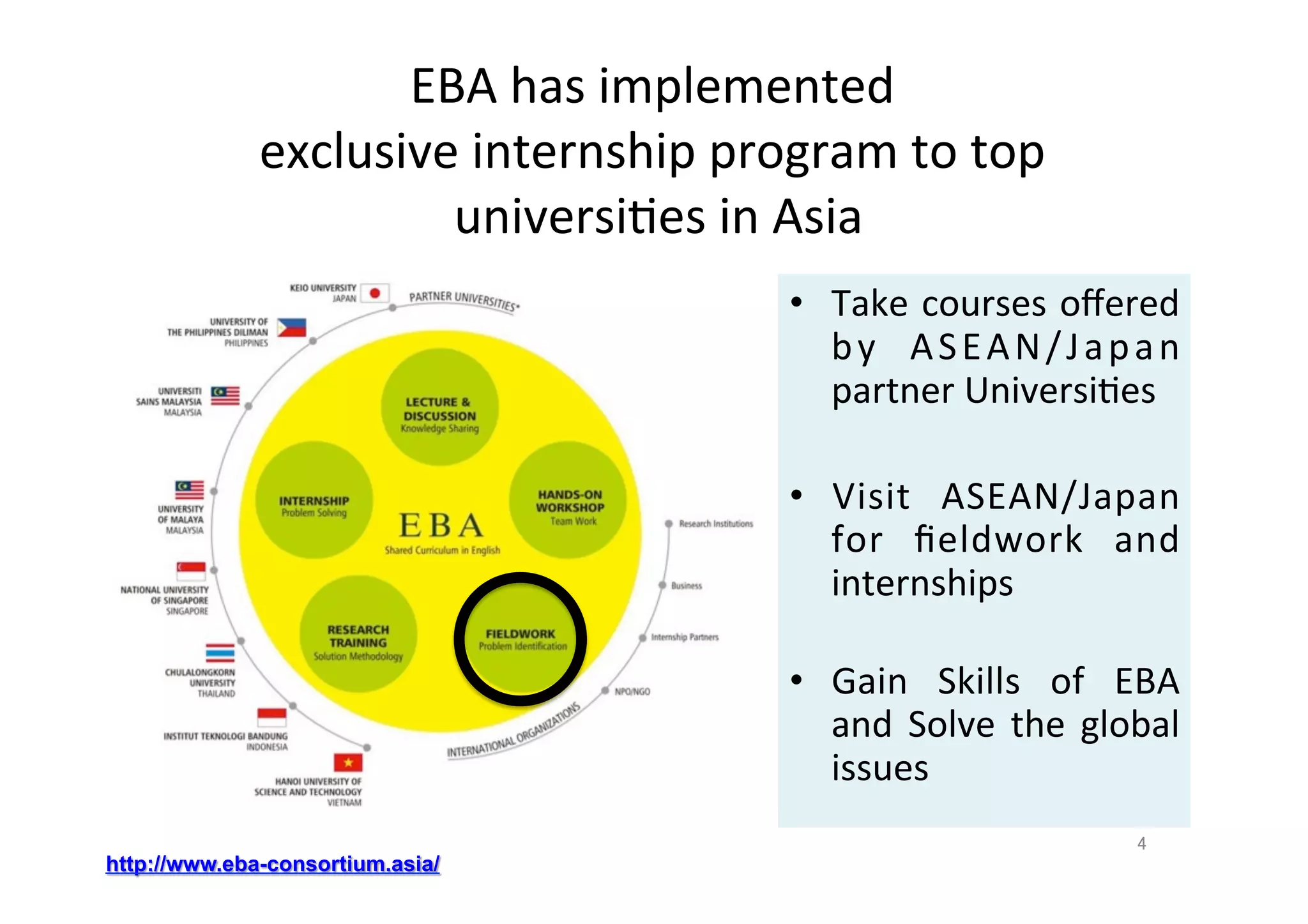
EBA	
  has	
  implemented	
  	
  
exclusive	
  internship	
  program	
  to	
  top	
  
universiJes	
  in	
  Asia	
•  Take	
  courses	
  offered	
  
by	
   ASEAN/Japan	
  
partner	
  UniversiJes	
  
•  Visit	
   ASEAN/Japan	
  
for	
   fieldwork	
   and	
  
internships	


•  Gain	
   Skills	
   of	
   EBA	
  
and	
  Solve	
  the	
  global	
  
issues	
  
http://www.eba-consortium.asia/
4
© Keio University 2008-2011. All rights reserved
SOI	
  Asia,	
  Asian	
  wide	
  university	
  network.	
  
5	
  
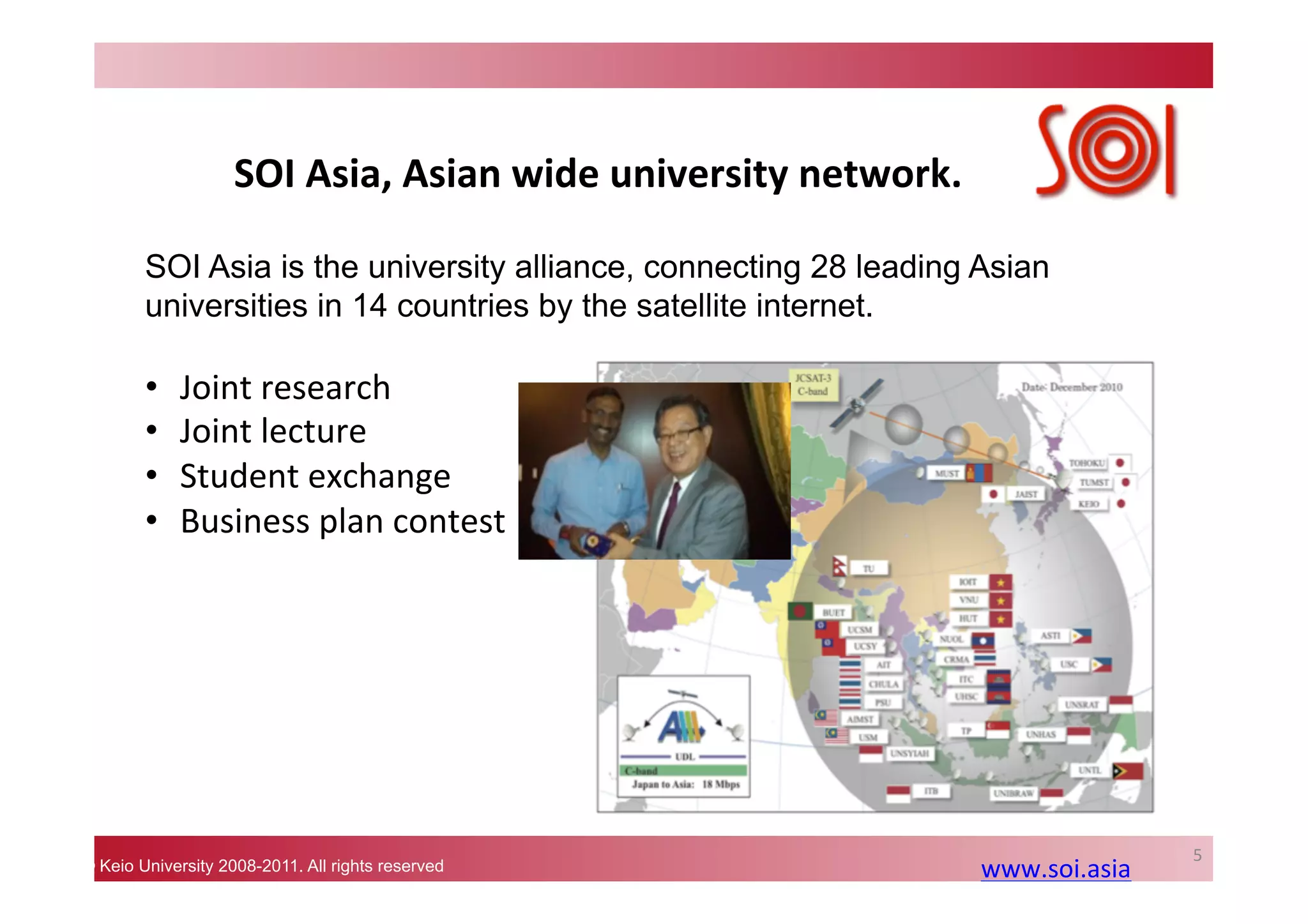
SOI Asia is the university alliance, connecting 28 leading Asian
universities in 14 countries by the satellite internet.	
www.soi.asia	
  	
  
•  Joint	
  research	
  
•  Joint	
  lecture	
  
•  Student	
  exchange	
  
•  Business	
  plan	
  contest	
  
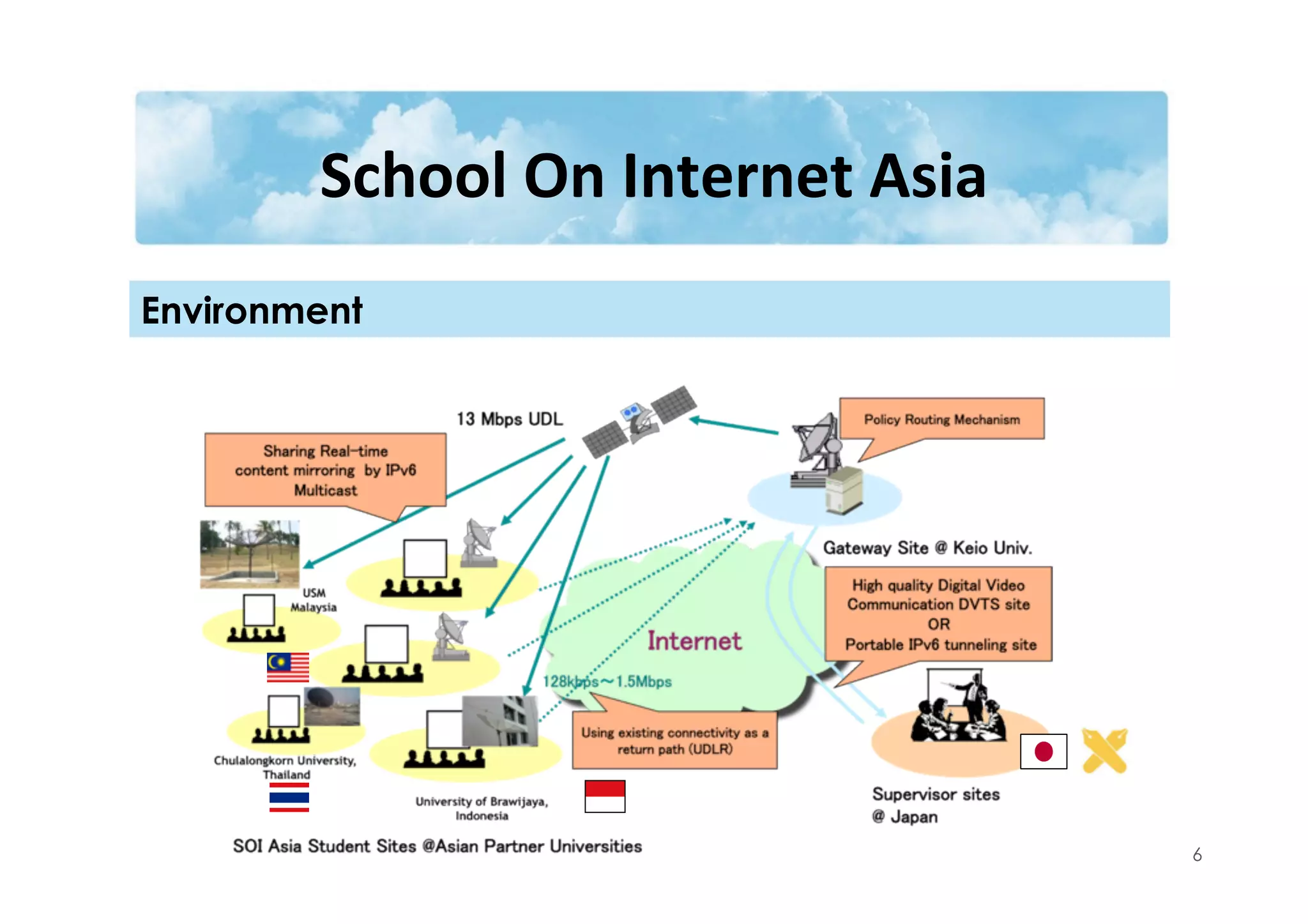
School	
  On	
  Internet	
  Asia	
  
6
Environment
©2015	
  SOI	
  Asia	
  
How	
  to	
  succeed	
  in	
  	
  
business	
  environment	
  
7	
  
©2015	
  SOI	
  Asia	
  
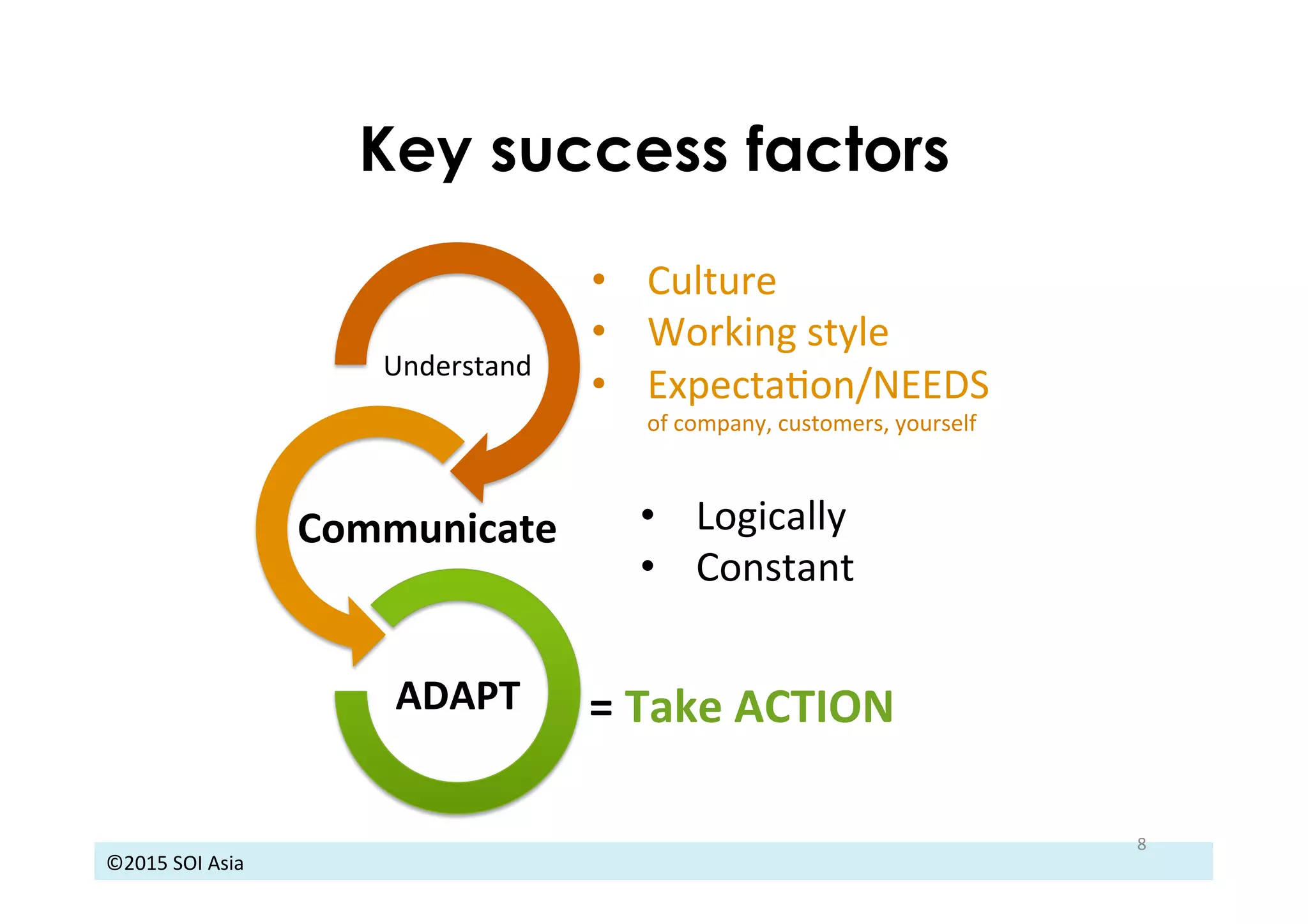
Key success factors
8	
  
Understand	
Communicate	
ADAPT	
 =	
  Take	
  ACTION	
  
•  Logically	
  
•  Constant	
  
•  Culture	
  
•  Working	
  style	
  
•  ExpectaJon/NEEDS	
  
of	
  company,	
  customers,	
  yourself	
  
©2015	
  SOI	
  Asia	
  
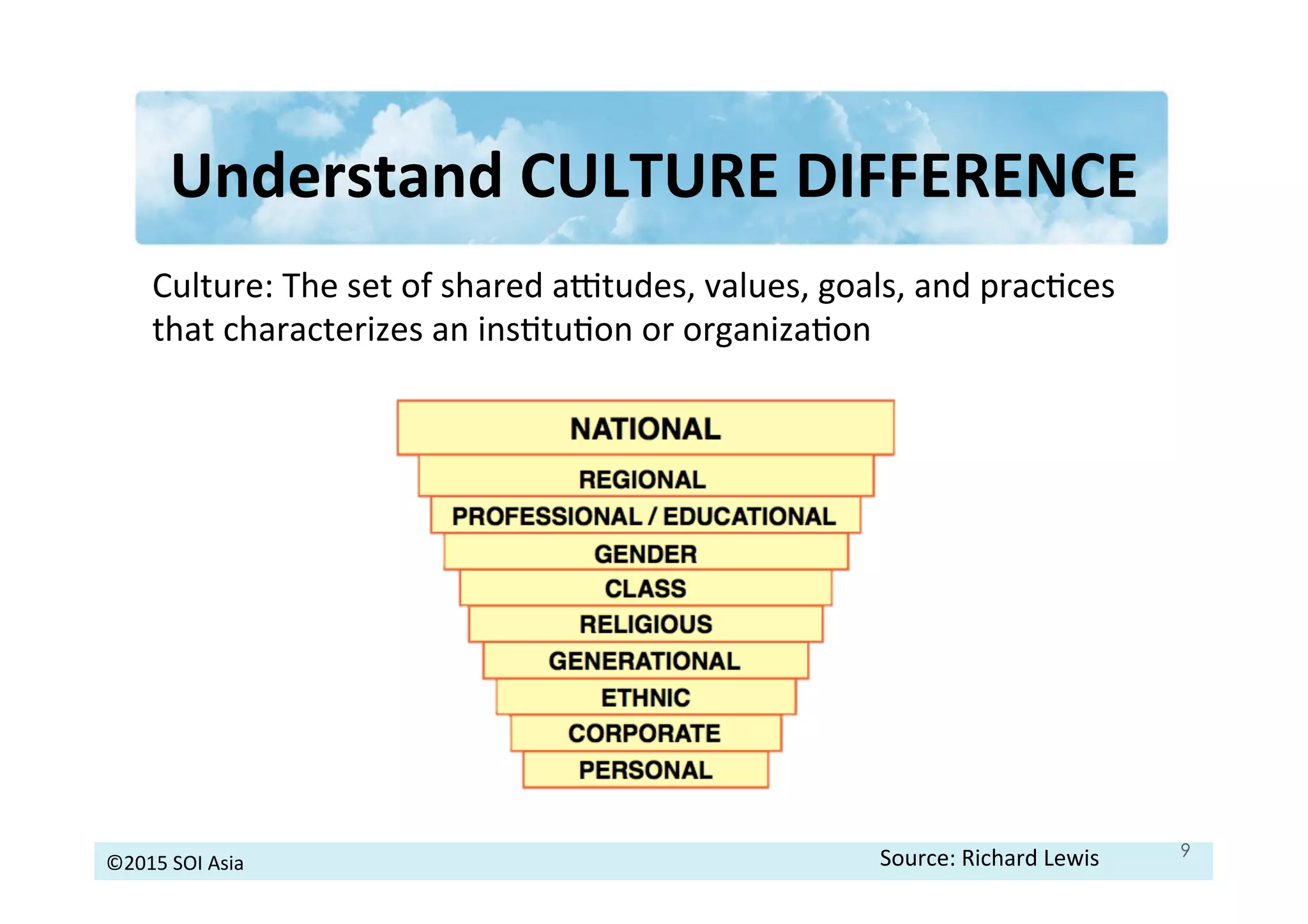
Understand	
  CULTURE	
  DIFFERENCE	
  
9Source:	
  Richard	
  Lewis	
  
Culture:	
  The	
  set	
  of	
  shared	
  a`tudes,	
  values,	
  goals,	
  and	
  pracJces	
  
that	
  characterizes	
  an	
  insJtuJon	
  or	
  organizaJon	
  
©2015	
  SOI	
  Asia	
  
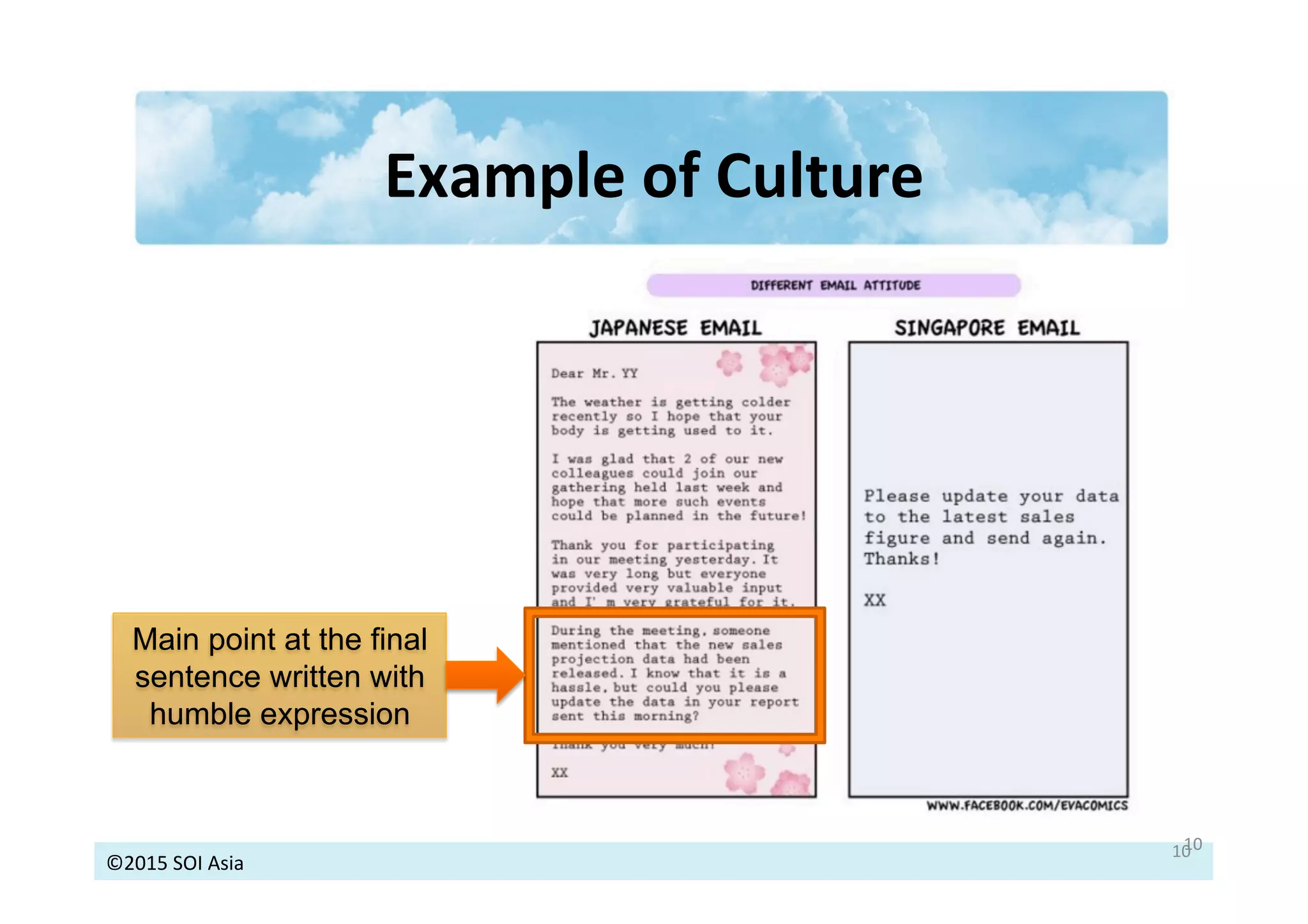
Example	
  of	
  Culture	
  
10	
  10	
  
Main point at the final
sentence written with
humble expression
©SOI	
  Asia,	
  Keio	
  University	
  2014.	
  All	
  Rights	
  Reserved.	
  
Business	
  phase:	
  	
  
Challenges	
  OR	
  Opportuni3es	
  
Some	
  companies:	
  
• Less	
  English	
  speaking	
  
• Consensus	
  
– Slow	
  decision	
  making	
  
– Typical	
  Japanese	
  e.g.	
  
Tokyo	
  Uni.	
  	
  
• Don’t	
  want	
  to	
  change	


11	
  
Miscommunica3on	
  
•  Japanese	
  language	
  
•  Way	
  of	
  thinking	
  
(Flexible/strict)	
  
Leadership	
  
•  Decision	
  making	
  
•  In	
  SFC	
  
2013	
  (1st	
  year)	
   2014	
  (2nd	
  year)	
  
Expecta3on	
  of	
  Japanese	
  companies	
  
•  NO.	
  1	
  preferred	
  skills	
  Communica3on	
  skills	
  
•  Be	
  first	
  penguin	
  
•  Not	
  giving	
  up	
  Challenging	
  spirits	
  
•  Do	
  by	
  yourself	
  
•  Bring	
  out	
  your	
  best	
  Independent	
  	
  
•  Sharing	
  idea/info	
  
•  Work	
  together	
  to	
  achieve	
  the	
  
common	
  goals	
  
Long-­‐term	
  
Collabora3on	
  
©2015	
  SOI	
  Asia	
  
Organiza3on	
  structure	
  	
  
affects	
  working	
  style	
  
13	
  
CEO	
  
Board	
  of	
  Directors	
  	
  
System	
  development	
  
Group	
  Leader	
  
Team	
  leader	
  
Staff	
  
Group	
  leader	
  
Team	
  leader	
  
Staff	
  
Group’s	
  CEO	
  
CEOs	
   Company’s	
  CEO	
  
Board	
  of	
  Director	
  
Management	
  
Strategy	
   MarkeJng	
   HR	
  
CTO	
  
General	
  
manager	
  
Deputy	
  
Manager	
  
Manager	
  
Assistant	
  
manager	
  
Senior	
  staff	
  
staff	
  
• 
• 
• 
• 
	
  FLAT 	


  HIERACHY	
  
©SOI	
  Asia,	
  Keio	
  University	
  2014.	
  All	
  Rights	
  Reserved.	
  
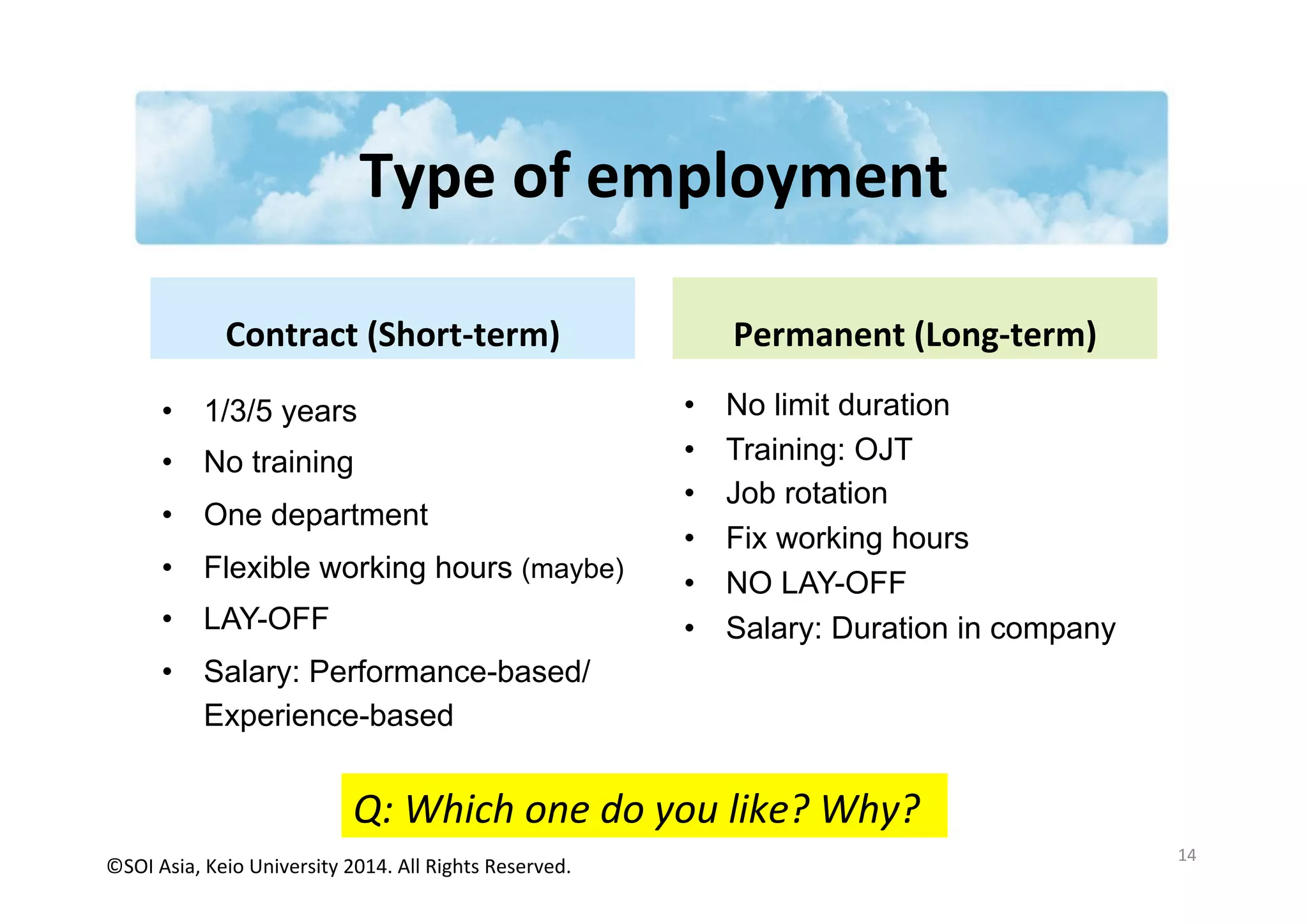
Type	
  of	
  employment	
  
•  1/3/5 years
•  No training
•  One department
•  Flexible working hours (maybe)
•  LAY-OFF
•  Salary: Performance-based/
Experience-based
14	
  
•  No limit duration
•  Training: OJT
•  Job rotation
•  Fix working hours
•  NO LAY-OFF
•  Salary: Duration in company
Contract	
  (Short-­‐term)	
   Permanent	
  (Long-­‐term)	
  
Q:	
  Which	
  one	
  do	
  you	
  like?	
  Why?	
  
©2015	
  SOI	
  Asia	
  
Adapta3on:	
  Case	
  study	
  
©2015	
  SOI	
  Asia	
  
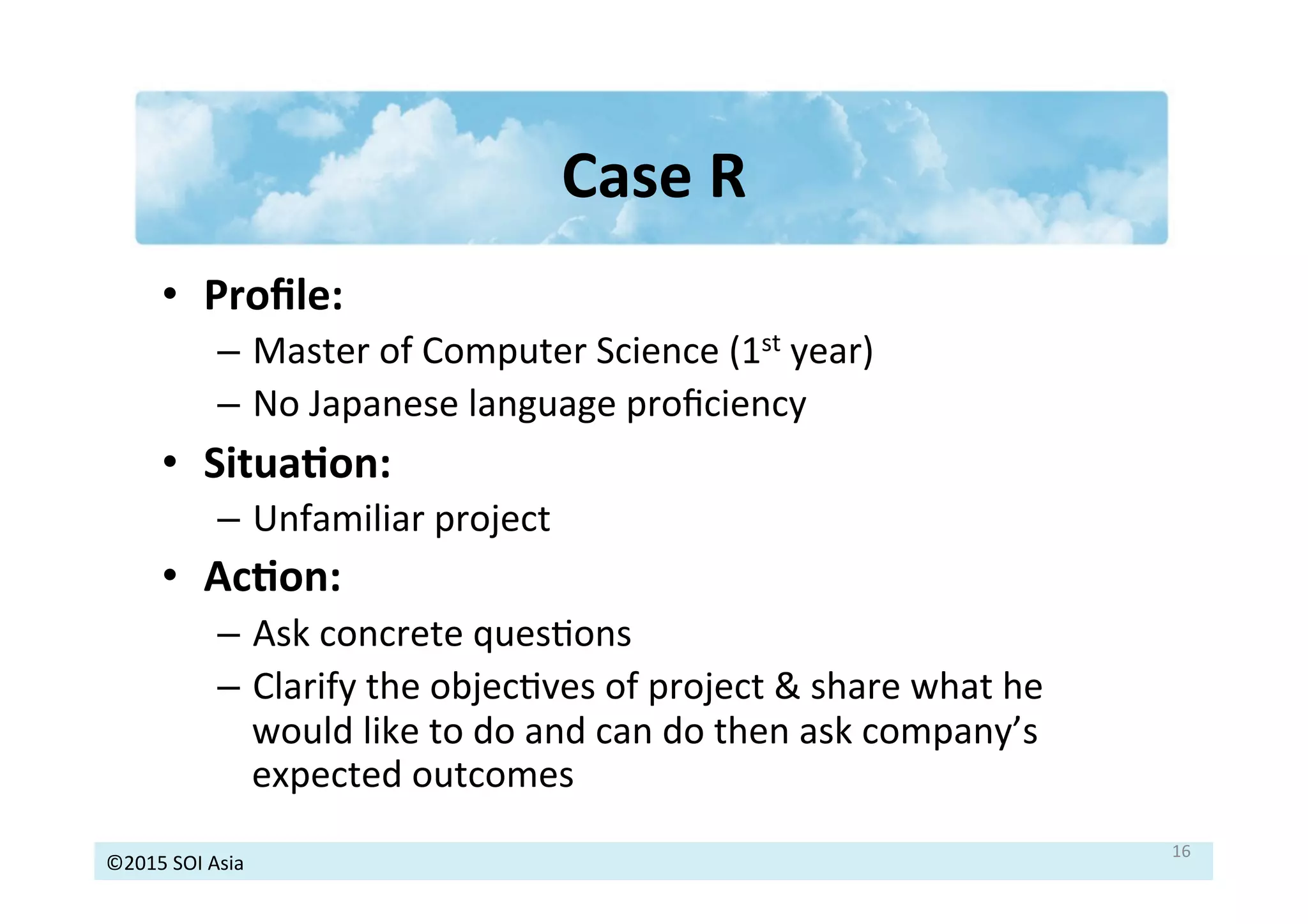
Case	
  R	
  
•  Profile:	
  
–  Master	
  of	
  Computer	
  Science	
  (1st	
  year)	
  
–  No	
  Japanese	
  language	
  proficiency	
  
•  Situa3on:	
  
–  Unfamiliar	
  project	
  
•  Ac3on:	
  
–  Ask	
  concrete	
  quesJons	
  
–  Clarify	
  the	
  objecJves	
  of	
  project	
  &	
  share	
  what	
  he	
  
would	
  like	
  to	
  do	
  and	
  can	
  do	
  then	
  ask	
  company’s	
  
expected	
  outcomes	
  
	
   16	
  
Communica3on	
  3ps	
  
	
  Ask	
  concrete	
  quesJons	
  
•  Specific	
  content	
  	
  
– Current	
  situaJon,	
  problem,	
  your	
  curious	
  points	
  	
  
– Reasons	
  why	
  you	
  ask	
  
•  Example:	
  	
  
1.	
  About requirement A, my understanding is …,I think I will do …
à Is it correct? (Ask for confirmation!!) à GOOD
2. Would you have any advice? [only this sentence is NOT GOOD]
17	
  
Source:	
  Nishi	
  san,	
  Meiseki	
  san	
  
©2015	
  SOI	
  Asia	
  
Career	
  planning	
  
18	
  
©2015	
  SOI	
  Asia	
  
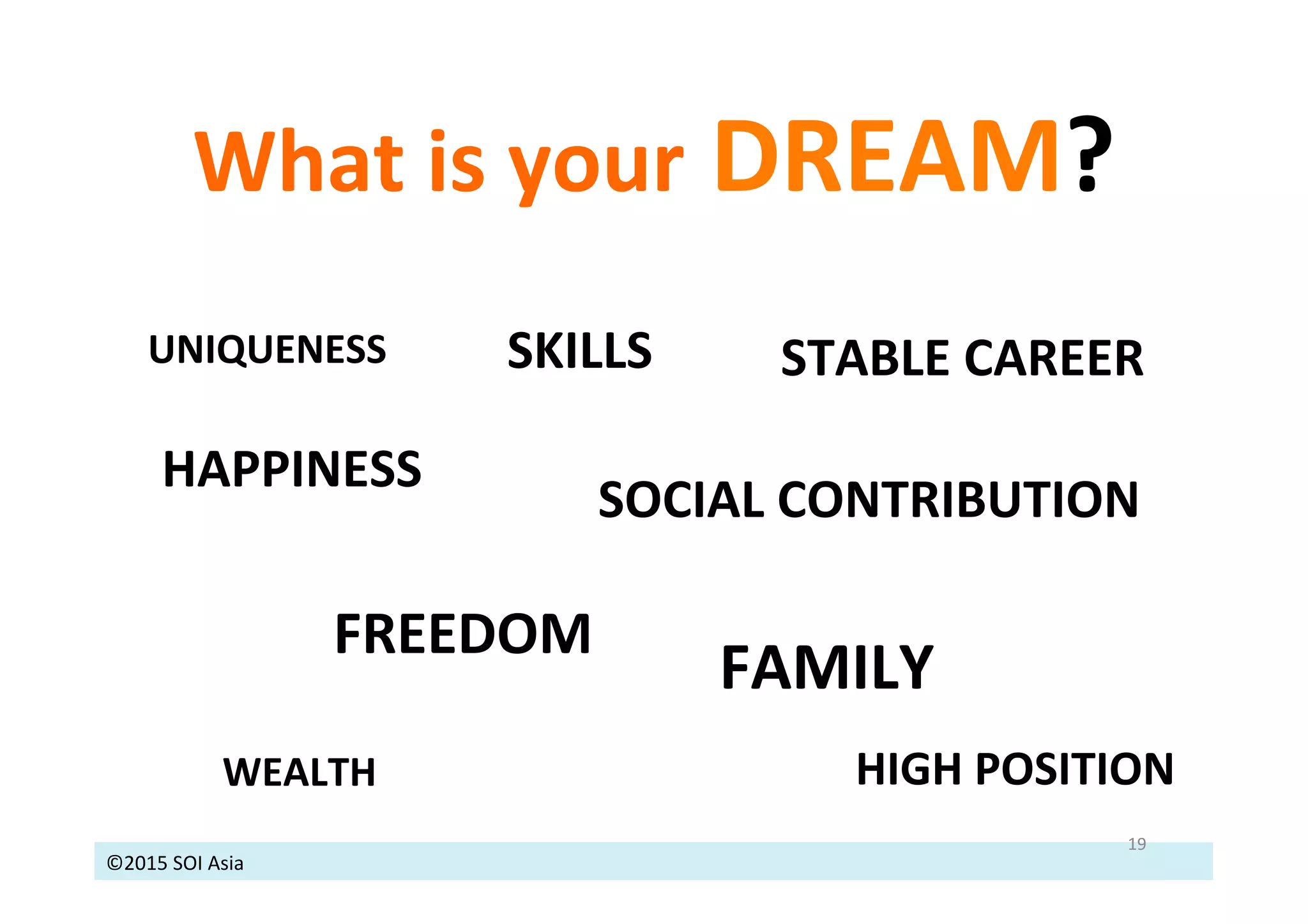
What	
  is	
  your	
  DREAM?	
  
19	
  
SKILLS	
  
WEALTH	
  
STABLE	
  CAREER	
  
FREEDOM	
  
FAMILY	
  
SOCIAL	
  CONTRIBUTION	
  
HIGH	
  POSITION	
  
HAPPINESS	
  
UNIQUENESS	
  
©2015	
  SOI	
  Asia	
  
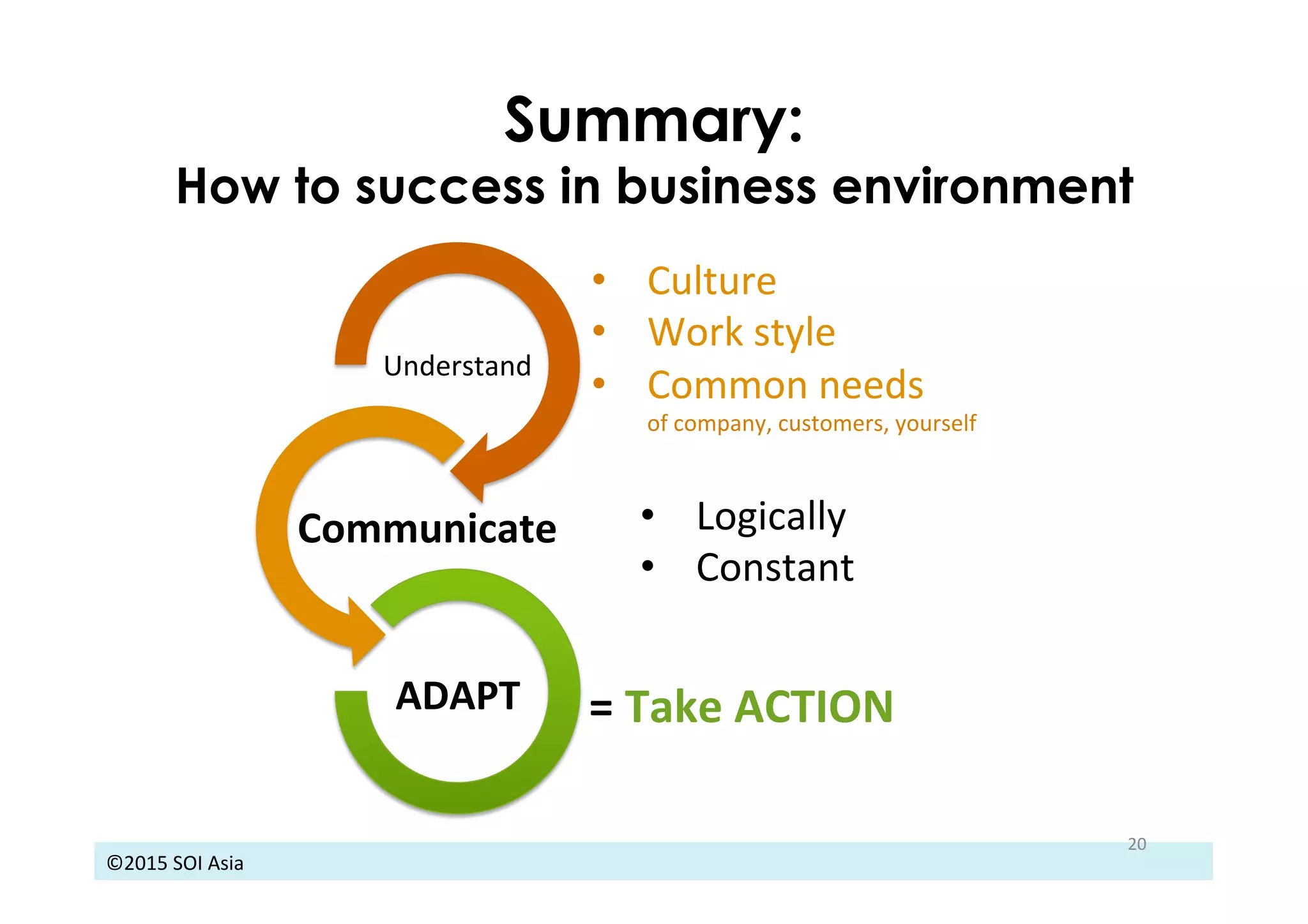
Summary:
How to success in business environment
20	
  
Understand	
Communicate	
ADAPT	
 =	
  Take	
  ACTION	
  
•  Logically	
  
•  Constant	
  
•  Culture	
  
•  Work	
  style	
  
•  Common	
  needs	
  
of	
  company,	
  customers,	
  yourself	
  
©2015	
  SOI	
  Asia	
  
Prof.	
  Masaki	
  session	
  
21
©2015	
  SOI	
  Asia	
  
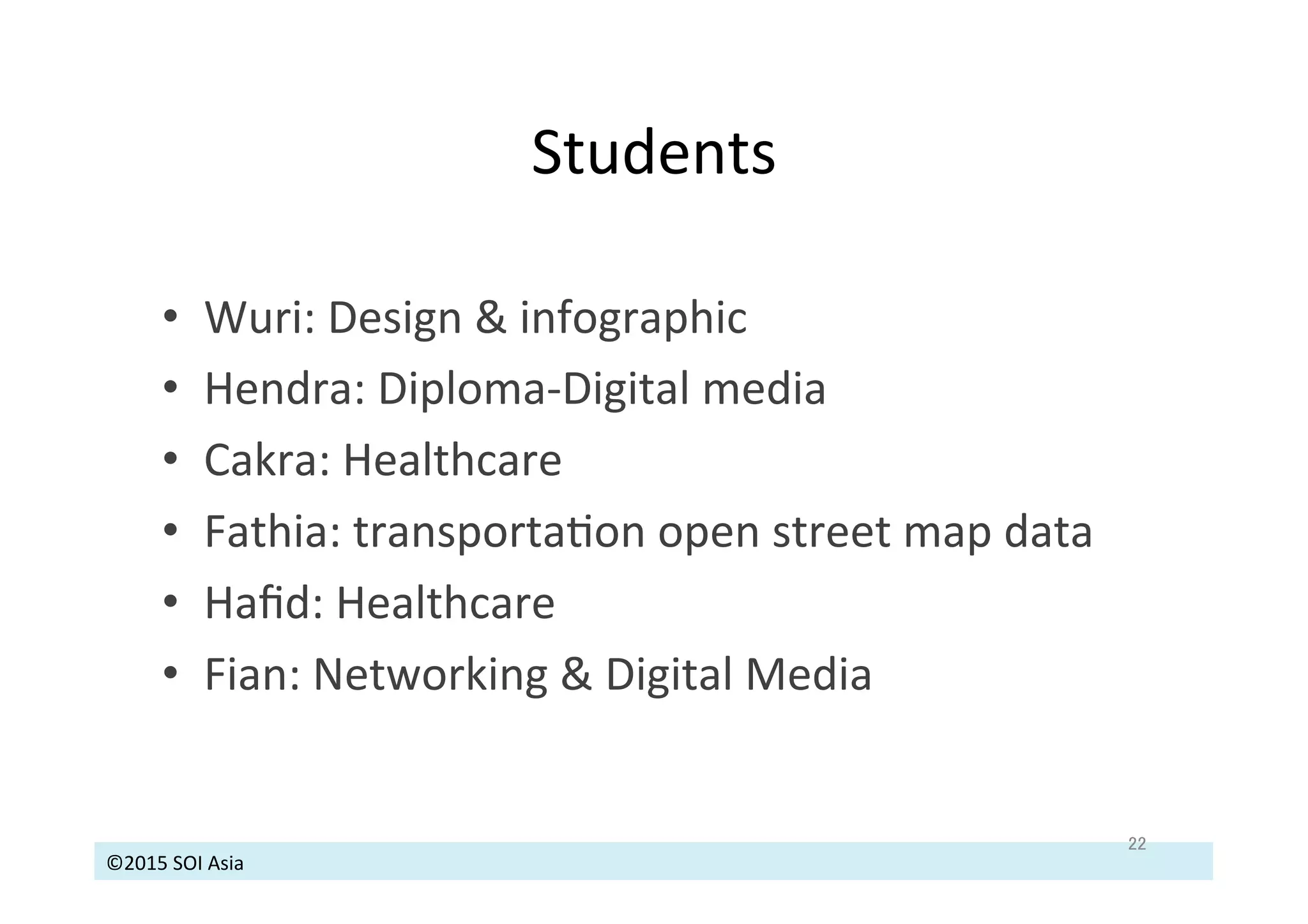
Students	
  
22	
•  Wuri:	
  Design	
  &	
  infographic	
  
•  Hendra:	
  Diploma-­‐Digital	
  media	
  	
  
•  Cakra:	
  Healthcare	
  
•  Fathia:	
  transportaJon	
  open	
  street	
  map	
  data	
  
•  Hafid:	
  Healthcare	
  
•  Fian:	
  Networking	
  &	
  Digital	
  Media	
  
©2015	
  SOI	
  Asia	
  
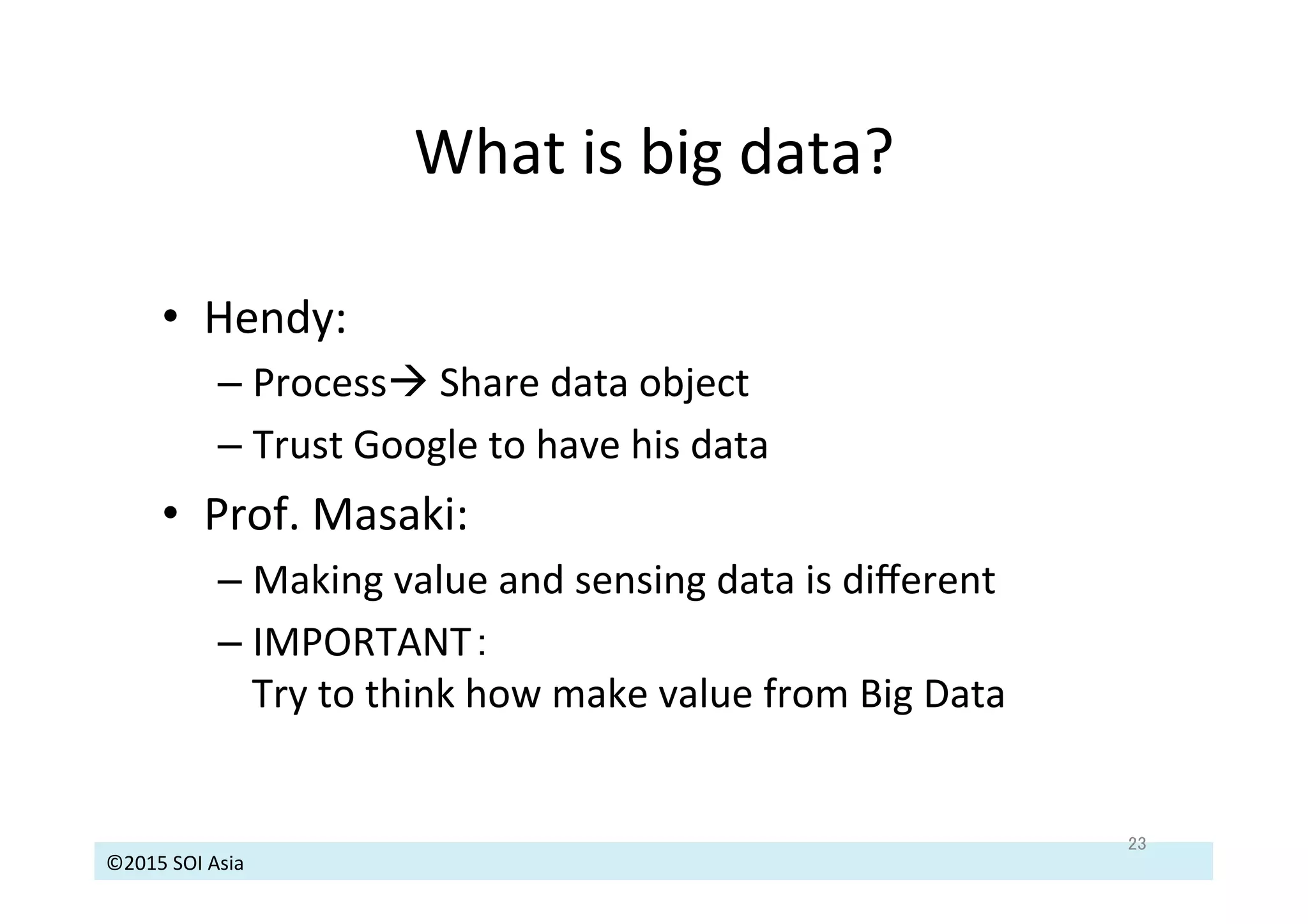
What	
  is	
  big	
  data?	
  
23	
•  Hendy:	
  	
  
– Processà	
  Share	
  data	
  object	
  
– Trust	
  Google	
  to	
  have	
  his	
  data	
  
•  Prof.	
  Masaki:	
  	
  
– Making	
  value	
  and	
  sensing	
  data	
  is	
  different	
  
– IMPORTANT: 	
  
Try	
  to	
  think	
  how	
  make	
  value	
  from	
  Big	
  Data	
  
©2015	
  SOI	
  Asia	
  
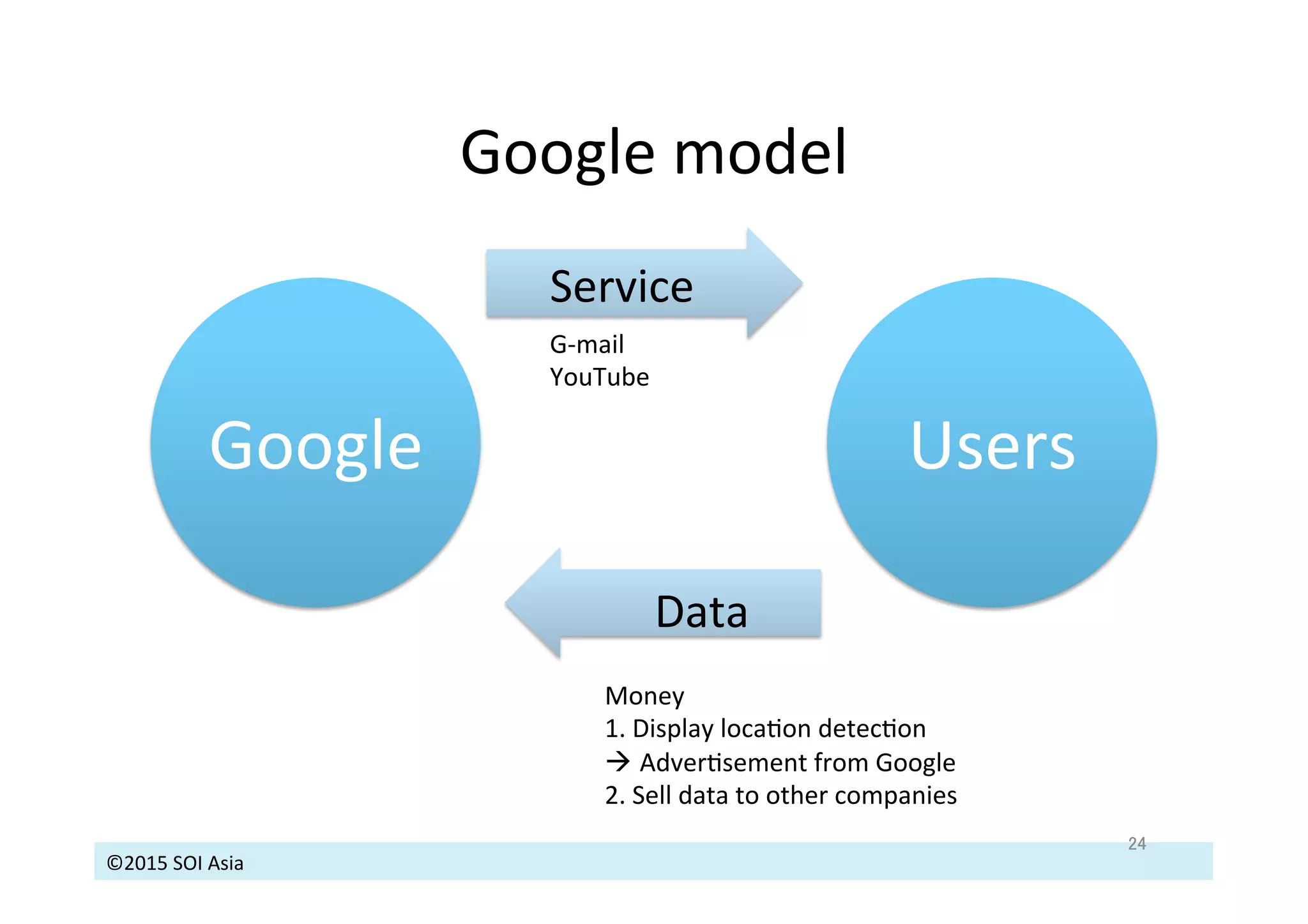
Google	
  model	
  
24	
Google	
  	
   Users	
  
Data	
  
Service	
  
Money	
  
1.	
  Display	
  locaJon	
  detecJon	
  
à AdverJsement	
  from	
  Google	
  
2.	
  Sell	
  data	
  to	
  other	
  companies	
  
G-­‐mail	
  
YouTube	
  
©2015	
  SOI	
  Asia	
  
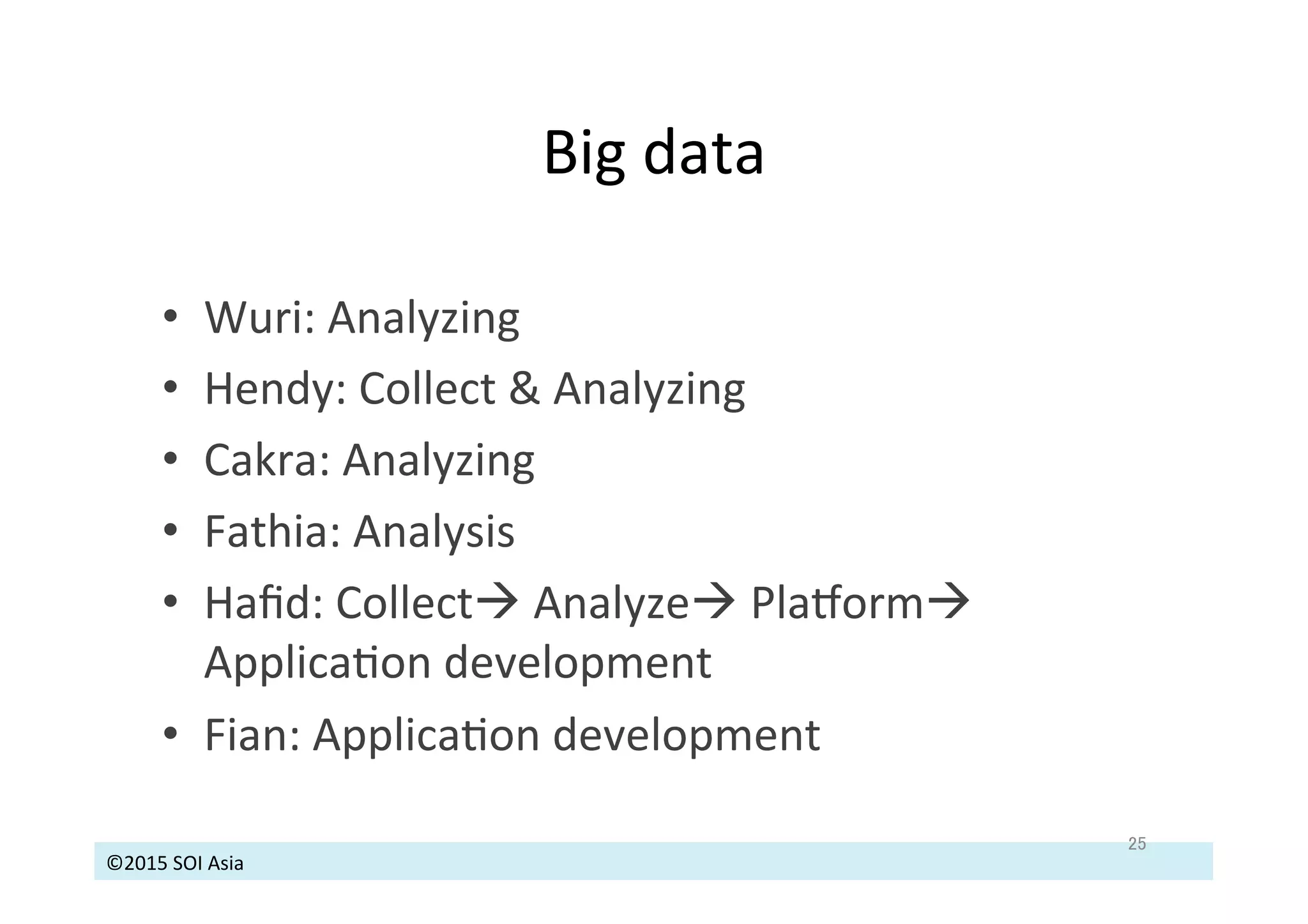
Big	
  data	
  
25	
•  Wuri:	
  Analyzing	
  
•  Hendy:	
  Collect	
  &	
  Analyzing	
  
•  Cakra:	
  Analyzing	
  
•  Fathia:	
  Analysis	
  
•  Hafid:	
  Collectà	
  Analyzeà	
  Planormà	
  
ApplicaJon	
  development	
  
•  Fian:	
  ApplicaJon	
  development	
  
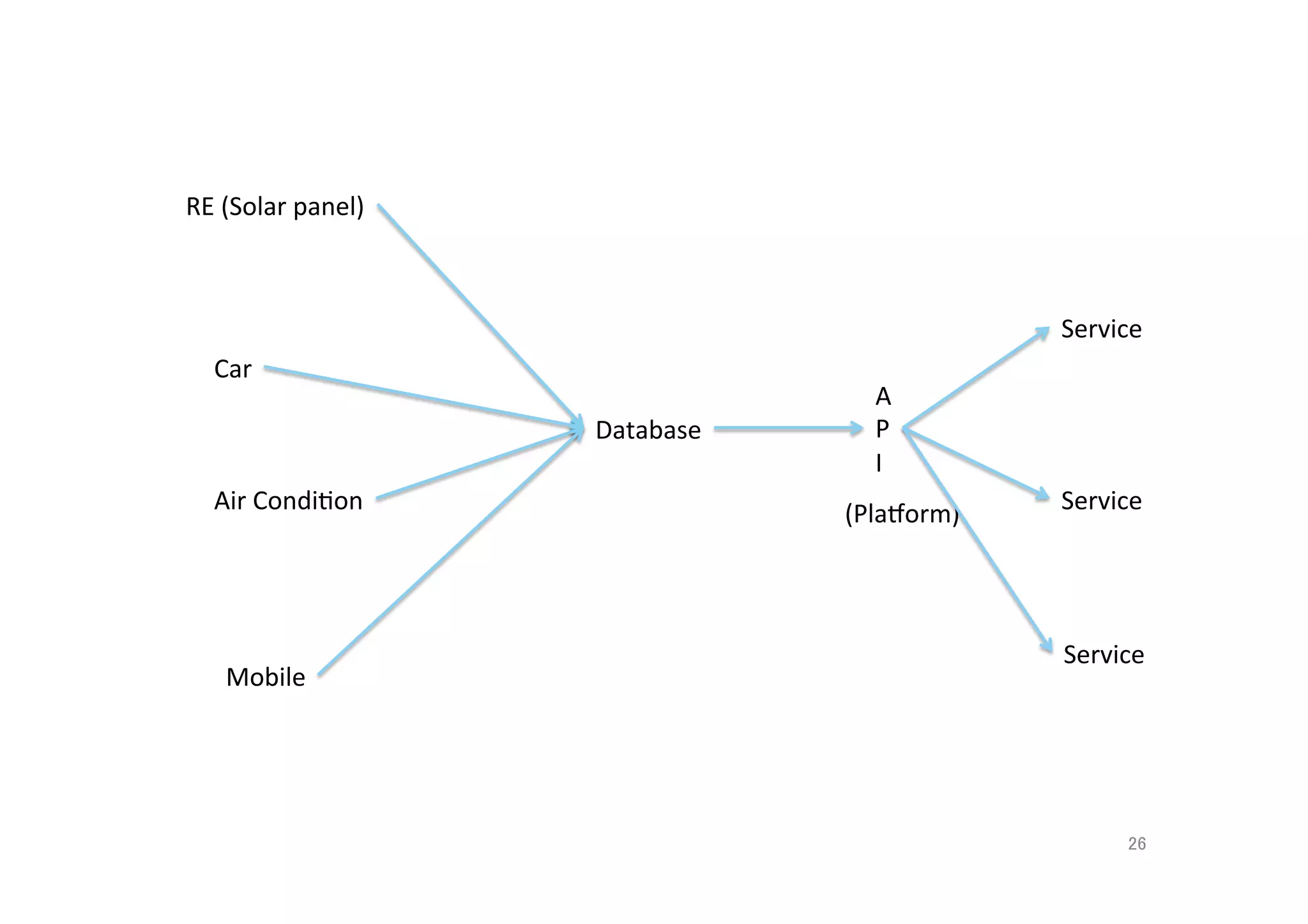
26	
RE	
  (Solar	
  panel)	
  
Car	
  
Air	
  CondiJon	
  
Mobile	
  
Database	
  
A	
  
P	
  
I	
  
Service	
  
Service	
  
Service	
  
(Planorm)	
  
©2015	
  SOI	
  Asia	
  
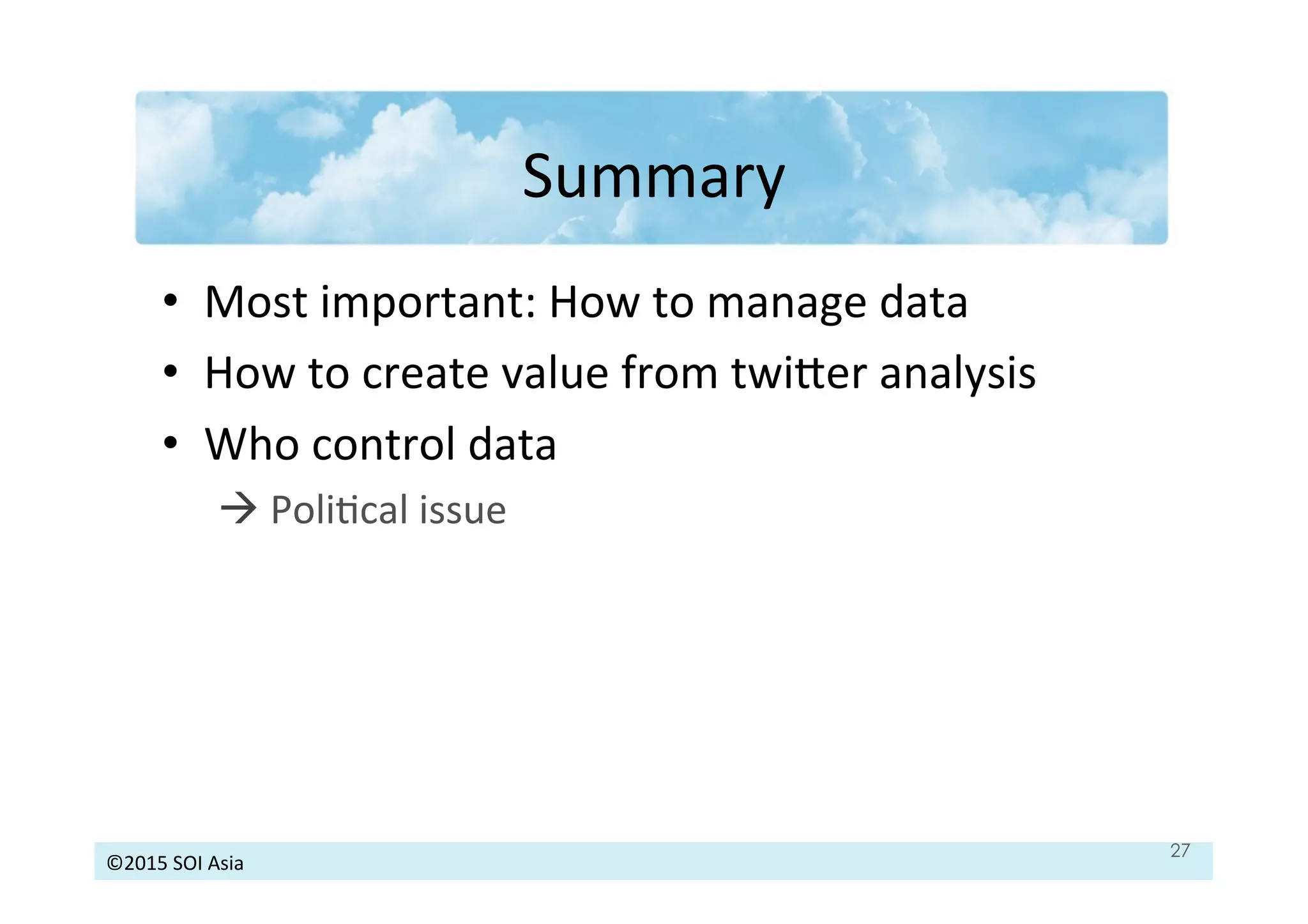
Summary	
  
•  Most	
  important:	
  How	
  to	
  manage	
  data	
  
•  How	
  to	
  create	
  value	
  from	
  twioer	
  analysis	
  
•  Who	
  control	
  data	
  
à	
  PoliJcal	
  issue	


27

EBA (Evidence-Based Approach) Culture

  • 1.
    EBA Business Fieldwork Pre-­‐workshop:  Introduc3on   1   2015/07/28  
  • 2.
    ©2015  SOI  Asia   EBA  Business  Fieldwork   2   Objec3ves:   •  For  students:     To  learn  about  the  technology-­‐oriented   ongoing  project  and  get  hands-­‐on  experience   •  For  companies:     To  promote  the  ongoing  Big  Data  Project   driven  by  open  standard  technology  
  • 3.
    3   Focus  on  research  and  educaJon  on  BIG  DATA     (data  collecJon,  analysis,  and  visualizaJon)   CULTURAL UNDERSTANDING AND ACTIONS IN THE FIELD Deep knowledge and problem finding ability in [Energy and Environment] [Health Environment] [Disaster and Security] Scientific analysis with evidence based approach. Realizing the solution in the society with innovative way. Discuss across borders to find out the solution EXPERT KNOWLEDGE GLOBAL COLLABORATION SKILL INFORMATION TECHNOLOGY SOCIAL INNOVATION Evidence  Based  Approach   with  Resilience,  InnovaJon  and  Sustainability  
  • 4.
    EBA  has  implemented     exclusive  internship  program  to  top   universiJes  in  Asia •  Take  courses  offered   by   ASEAN/Japan   partner  UniversiJes   •  Visit   ASEAN/Japan   for   fieldwork   and   internships     •  Gain   Skills   of   EBA   and  Solve  the  global   issues   http://www.eba-consortium.asia/ 4
  • 5.
    © Keio University2008-2011. All rights reserved SOI  Asia,  Asian  wide  university  network.   5   SOI Asia is the university alliance, connecting 28 leading Asian universities in 14 countries by the satellite internet. www.soi.asia     •  Joint  research   •  Joint  lecture   •  Student  exchange   •  Business  plan  contest  
  • 6.
    School  On  Internet  Asia   6 Environment
  • 7.
    ©2015  SOI  Asia   How  to  succeed  in     business  environment   7  
  • 8.
    ©2015  SOI  Asia   Key success factors 8   Understand Communicate ADAPT =  Take  ACTION   •  Logically   •  Constant   •  Culture   •  Working  style   •  ExpectaJon/NEEDS   of  company,  customers,  yourself  
  • 9.
    ©2015  SOI  Asia   Understand  CULTURE  DIFFERENCE   9Source:  Richard  Lewis   Culture:  The  set  of  shared  a`tudes,  values,  goals,  and  pracJces   that  characterizes  an  insJtuJon  or  organizaJon  
  • 10.
    ©2015  SOI  Asia   Example  of  Culture   10  10   Main point at the final sentence written with humble expression
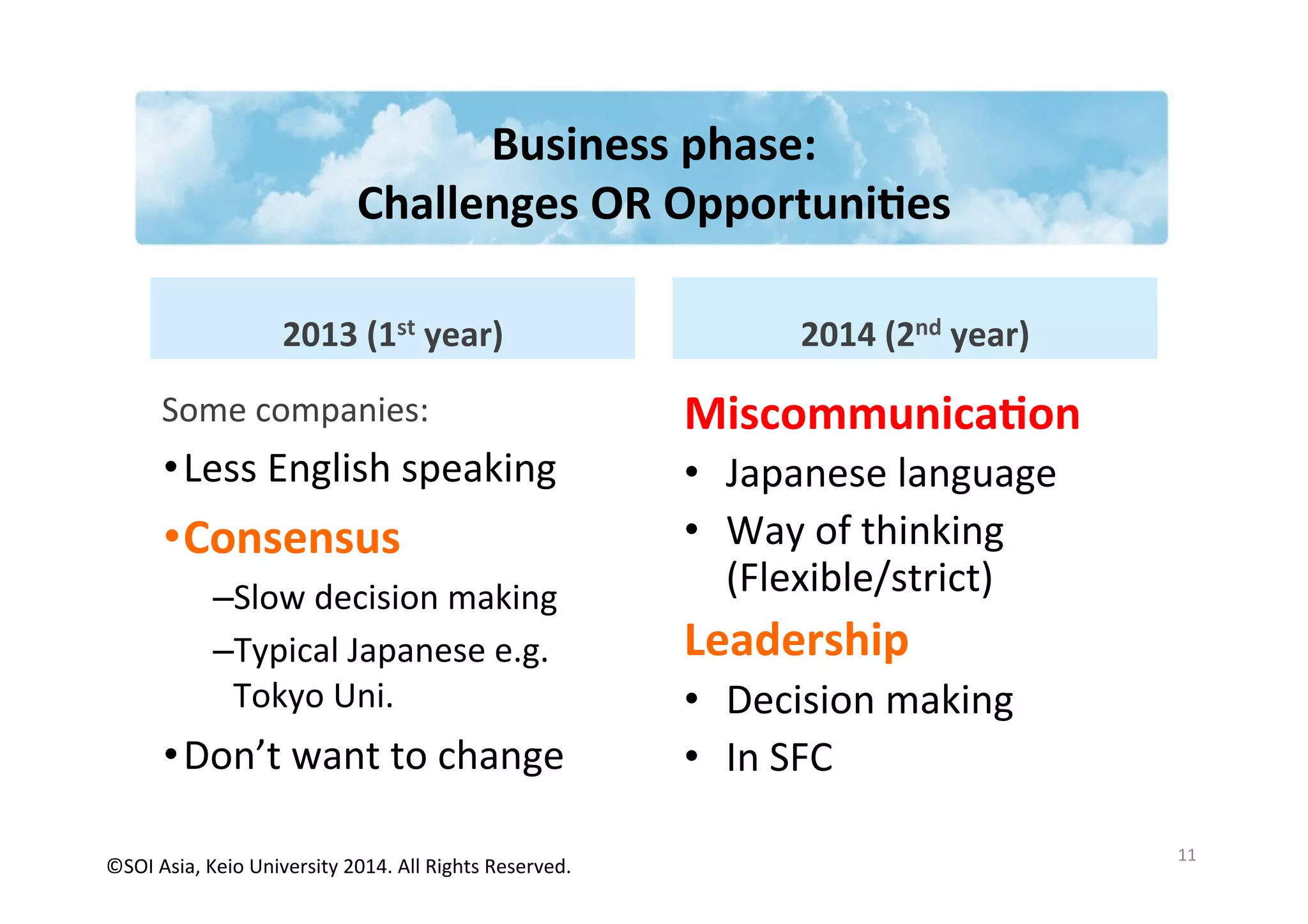
  • 11.
    ©SOI  Asia,  Keio  University  2014.  All  Rights  Reserved.   Business  phase:     Challenges  OR  Opportuni3es   Some  companies:   • Less  English  speaking   • Consensus   – Slow  decision  making   – Typical  Japanese  e.g.   Tokyo  Uni.     • Don’t  want  to  change     11   Miscommunica3on   •  Japanese  language   •  Way  of  thinking   (Flexible/strict)   Leadership   •  Decision  making   •  In  SFC   2013  (1st  year)   2014  (2nd  year)  
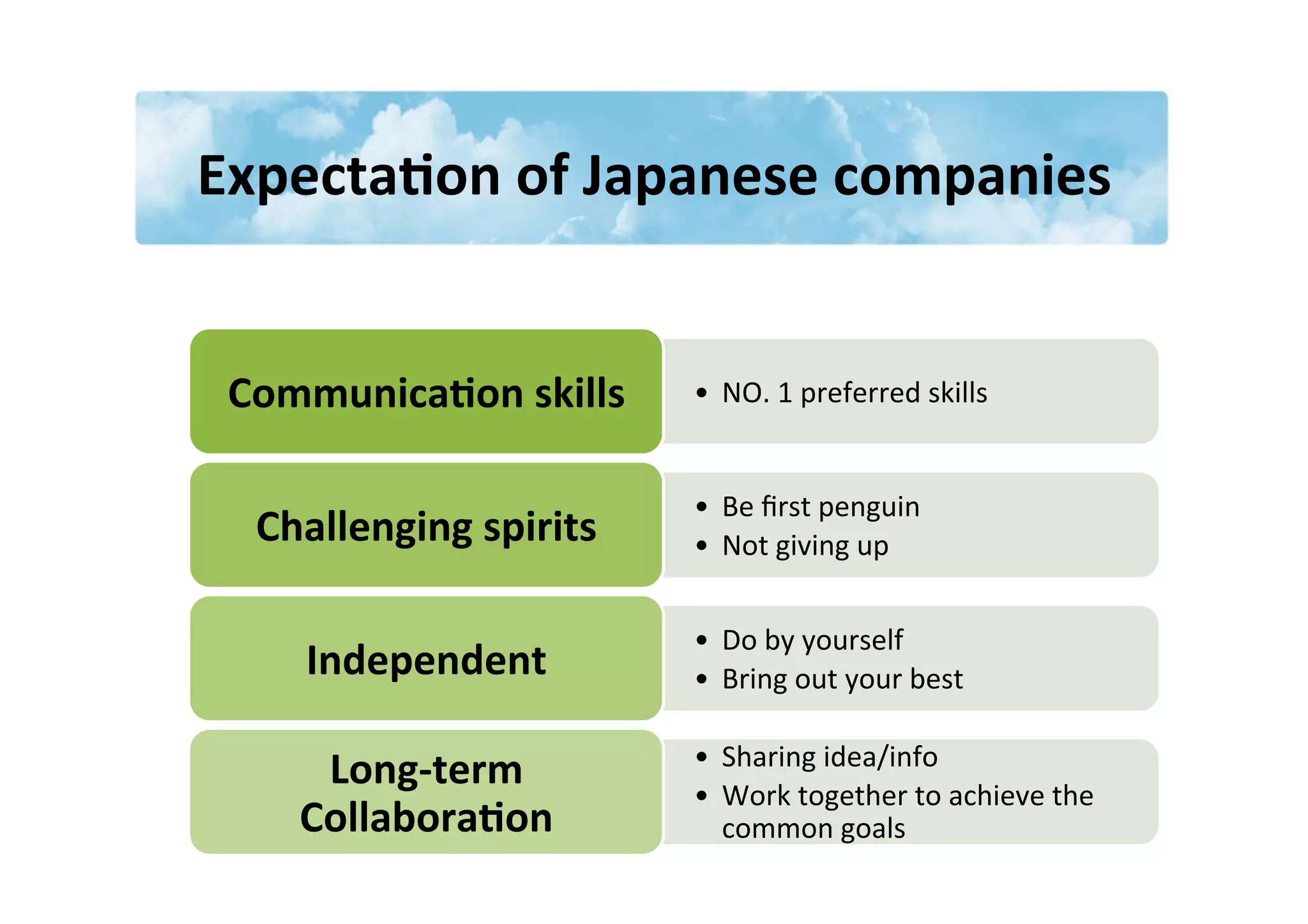
  • 12.
    Expecta3on  of  Japanese  companies   •  NO.  1  preferred  skills  Communica3on  skills   •  Be  first  penguin   •  Not  giving  up  Challenging  spirits   •  Do  by  yourself   •  Bring  out  your  best  Independent     •  Sharing  idea/info   •  Work  together  to  achieve  the   common  goals   Long-­‐term   Collabora3on  
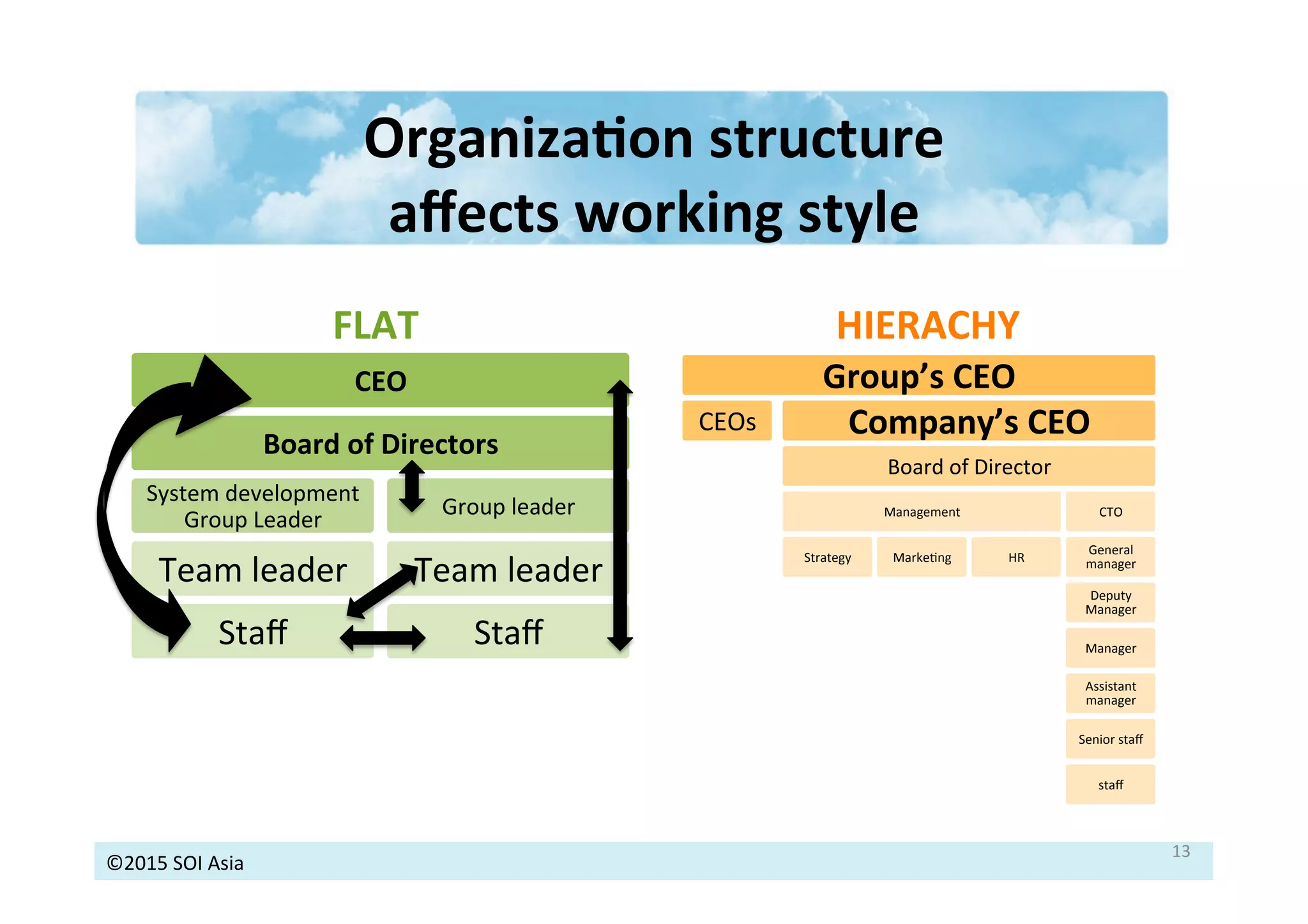
  • 13.
    ©2015  SOI  Asia   Organiza3on  structure     affects  working  style   13   CEO   Board  of  Directors     System  development   Group  Leader   Team  leader   Staff   Group  leader   Team  leader   Staff   Group’s  CEO   CEOs   Company’s  CEO   Board  of  Director   Management   Strategy   MarkeJng   HR   CTO   General   manager   Deputy   Manager   Manager   Assistant   manager   Senior  staff   staff   •  •  •  •   FLAT                HIERACHY  
  • 14.
    ©SOI  Asia,  Keio  University  2014.  All  Rights  Reserved.   Type  of  employment   •  1/3/5 years •  No training •  One department •  Flexible working hours (maybe) •  LAY-OFF •  Salary: Performance-based/ Experience-based 14   •  No limit duration •  Training: OJT •  Job rotation •  Fix working hours •  NO LAY-OFF •  Salary: Duration in company Contract  (Short-­‐term)   Permanent  (Long-­‐term)   Q:  Which  one  do  you  like?  Why?  
  • 15.
    ©2015  SOI  Asia   Adapta3on:  Case  study  
  • 16.
    ©2015  SOI  Asia   Case  R   •  Profile:   –  Master  of  Computer  Science  (1st  year)   –  No  Japanese  language  proficiency   •  Situa3on:   –  Unfamiliar  project   •  Ac3on:   –  Ask  concrete  quesJons   –  Clarify  the  objecJves  of  project  &  share  what  he   would  like  to  do  and  can  do  then  ask  company’s   expected  outcomes     16  
  • 17.
    Communica3on  3ps    Ask  concrete  quesJons   •  Specific  content     – Current  situaJon,  problem,  your  curious  points     – Reasons  why  you  ask   •  Example:     1.  About requirement A, my understanding is …,I think I will do … à Is it correct? (Ask for confirmation!!) à GOOD 2. Would you have any advice? [only this sentence is NOT GOOD] 17   Source:  Nishi  san,  Meiseki  san  
  • 18.
    ©2015  SOI  Asia   Career  planning   18  
  • 19.
    ©2015  SOI  Asia   What  is  your  DREAM?   19   SKILLS   WEALTH   STABLE  CAREER   FREEDOM   FAMILY   SOCIAL  CONTRIBUTION   HIGH  POSITION   HAPPINESS   UNIQUENESS  
  • 20.
    ©2015  SOI  Asia   Summary: How to success in business environment 20   Understand Communicate ADAPT =  Take  ACTION   •  Logically   •  Constant   •  Culture   •  Work  style   •  Common  needs   of  company,  customers,  yourself  
  • 21.
    ©2015  SOI  Asia   Prof.  Masaki  session   21
  • 22.
    ©2015  SOI  Asia   Students   22 •  Wuri:  Design  &  infographic   •  Hendra:  Diploma-­‐Digital  media     •  Cakra:  Healthcare   •  Fathia:  transportaJon  open  street  map  data   •  Hafid:  Healthcare   •  Fian:  Networking  &  Digital  Media  
  • 23.
    ©2015  SOI  Asia   What  is  big  data?   23 •  Hendy:     – Processà  Share  data  object   – Trust  Google  to  have  his  data   •  Prof.  Masaki:     – Making  value  and  sensing  data  is  different   – IMPORTANT:    Try  to  think  how  make  value  from  Big  Data  
  • 24.
    ©2015  SOI  Asia   Google  model   24 Google     Users   Data   Service   Money   1.  Display  locaJon  detecJon   à AdverJsement  from  Google   2.  Sell  data  to  other  companies   G-­‐mail   YouTube  
  • 25.
    ©2015  SOI  Asia   Big  data   25 •  Wuri:  Analyzing   •  Hendy:  Collect  &  Analyzing   •  Cakra:  Analyzing   •  Fathia:  Analysis   •  Hafid:  Collectà  Analyzeà  Planormà   ApplicaJon  development   •  Fian:  ApplicaJon  development  
  • 26.
    26 RE  (Solar  panel)   Car   Air  CondiJon   Mobile   Database   A   P   I   Service   Service   Service   (Planorm)  
  • 27.
    ©2015  SOI  Asia   Summary   •  Most  important:  How  to  manage  data   •  How  to  create  value  from  twioer  analysis   •  Who  control  data   à  PoliJcal  issue     27