SENTIMENT ANALYSIS:
USING MACHINE LEARNING
Group name: unidentified data
Devarshi
Devang
Kartik
Shivangi
TABLE OF CONTENTS:
 Natural Language Processing
 Sentiment analysis
 Need of sentiment analysis
 Machine learning methods
 Naïve Bayes
 Random forest
 Support vector machine
 KNN algorithm
 Objective
 Methodology
 Sentiment analysis of movie reviews
 Various algorithms used
 Results
NATURAL LANGUAGE PROCESSING:
 The natural language processing (NLP) is a discipline in artificial intelligence
and linguistics, that studies giving machines the capacity to understand a
language, like English for example.
 Inside the NLP there is the field of Sentiment Analysis that studies how to use
machines to process texts and give each one a kind of classification that we
can understand and use. This field uses language processing algorithms to
extract features, like frequency of words, and supervised machine learning
algorithms that learn from an initial set of data initially classified by a
human.
SENTIMENT ANALYSIS:
 Sentiment Analysis can be described as a problem that with a sentence or text
the machine gets capable to analyze and predict with the maximum precision
possible the sentiment that will be obtained by a person when reads it or the
contextual opinion related to something.
NEED OF SENTIMENT ANALYSIS:
 With the emergence of social media, the high availability of the information
on Internet and the users that have become prone to share on Internet their
feelings about products, movies or wherever they want to share, for example
on Twitter or Facebook, the ability to process this information has become
important.
 For example, we can introduce a new product to the market and then wait
for the feelings of the people on Internet, extract them in a useful form, and
decide the future viability of this new product.
 Most of this information isn’t classified or rated in any kind of classification
range that can be easy used and is hard to classify at a massive scale with
humans or normal tools. For this reason, the development of tools that can
learn to read texts and extract the feelings is important to the future.
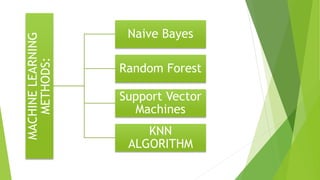
MACHINELEARNING
METHODS:
Naive Bayes
Random Forest
Support Vector
Machines
KNN
ALGORITHM
NAÏVE BAYES:
 Naive Bayes (NB) is a simple method based on the Bayes rule. The probability
each feature contributes independently to the final probability to be a class,
each one has its distribution. In a real problem, this independence is rare. To
avoid this, use Multinomial Naive Bayes, provided by SciKit-Learn, that models
the same probability but it uses a multinomial distribution.
RANDOM FOREST:
 Random Forest (RF) is a method that trains multiple decision trees. Each tree
is trained using a random subset of the vector features. The decisions of each
tree are combined using a voting algorithm that gives the result. The
sequence of features and the value of the feature generates the path to a
leaf that represents the decision. While training, the values of the
intermediate nodes are updated to minimize a cost function that evaluates
the performance of the trees. The objective is minimize a cost function that
evaluates the performance of the trees.
SUPPORT VECTOR MACHINE:
 Support vector machines (SVM) is a method that considers that each set of
features represents a position inside a hyperspace then the SVM tries to
divide it using a hyperplane maximizing the distance between this hyperplane
and each vector, minimizing the objective function. This space division is hard
to accomplish, and sometimes impossible, for this the SVM can use a margin
that allows to misclassify some examples but increases the overall
performance.
KNN ALGORITHM:
 KNN makes predictions using the training dataset directly.
 Predictions are made for a new instance (x) by searching through the entire
training set for the K most similar instances (the neighbors) and summarizing
the output variable for those K instances. For regression this might be the
mean output variable, in classification this might be the mode (or most
common) class value.
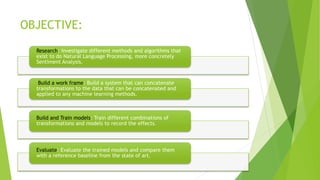
OBJECTIVE:
Research: Investigate different methods and algorithms that
exist to do Natural Language Processing, more concretely
Sentiment Analysis.
Build a work frame: Build a system that can concatenate
transformations to the data that can be concatenated and
applied to any machine learning methods.
Build and Train models: Train different combinations of
transformations and models to record the effects.
Evaluate: Evaluate the trained models and compare them
with a reference baseline from the state of art.
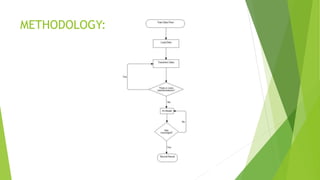
METHODOLOGY:
SENTIMENT ANALYSIS ON MOVIE REVIEWS:
 The dataset is comprised of tab-separated files with phrases from the Rotten
Tomatoes dataset. The train/test split has been preserved for the purposes of
benchmarking, but the sentences have been shuffled from their original order.
Each Sentence has been parsed into many phrases by the Stanford parser. Each
phrase has a PhraseId. Each sentence has a SentenceId. Phrases that are repeated
(such as short/common words) are only included once in the data.
 train.tsv contains the phrases and their associated sentiment labels. We have
additionally provided a SentenceId so that you can track which phrases belong to a
single sentence.
 test.tsv contains just phrases. You must assign a sentiment label to each phrase.
 The sentiment labels are:
0 - negative
1 - somewhat negative
2 - neutral
3 - somewhat positive
4 - positive
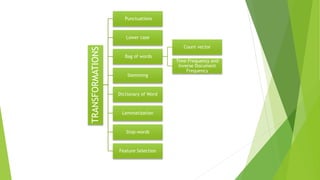
TRANSFORMATIONS
Punctuations
Lower case
Bag of words
Count vector
Time Frequency and
Inverse Document
Frequency
Stemming
Dictionary of Word
Lemmatization
Stop-words
Feature Selection
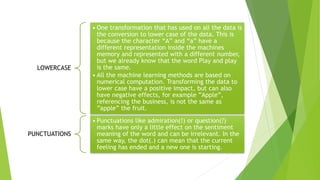
LOWERCASE
• One transformation that has used on all the data is
the conversion to lower case of the data. This is
because the character “A” and “a” have a
different representation inside the machines
memory and represented with a different number,
but we already know that the word Play and play
is the same.
• All the machine learning methods are based on
numerical computation. Transforming the data to
lower case have a positive impact, but can also
have negative effects, for example ”Apple”,
referencing the business, is not the same as
”apple” the fruit.
PUNCTUATIONS
• Punctuations like admiration(!) or question(?)
marks have only a little effect on the sentiment
meaning of the word and can be irrelevant. In the
same way, the dot(.) can mean that the current
feeling has ended and a new one is starting.
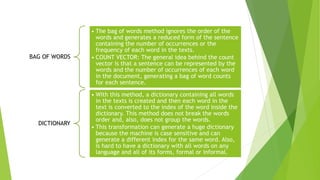
BAG OF WORDS
• The bag of words method ignores the order of the
words and generates a reduced form of the sentence
containing the number of occurrences or the
frequency of each word in the texts.
• COUNT VECTOR: The general idea behind the count
vector is that a sentence can be represented by the
words and the number of occurrences of each word
in the document, generating a bag of word counts
for each sentence.
DICTIONARY
• With this method, a dictionary containing all words
in the texts is created and then each word in the
text is converted to the index of the word inside the
dictionary. This method does not break the words
order and, also, does not group the words.
• This transformation can generate a huge dictionary
because the machine is case sensitive and can
generate a different index for the same word. Also,
is hard to have a dictionary with all words on any
language and all of its forms, formal or informal.
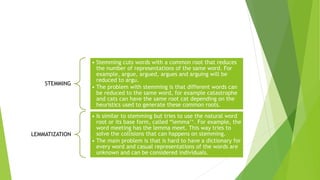
STEMMING
• Stemming cuts words with a common root that reduces
the number of representations of the same word. For
example, argue, argued, argues and arguing will be
reduced to argu.
• The problem with stemming is that different words can
be reduced to the same word, for example catastrophe
and cats can have the same root cat depending on the
heuristics used to generate these common roots.
LEMMATIZATION
• Is similar to stemming but tries to use the natural word
root or its base form, called “lemma’‘. For example, the
word meeting has the lemma meet. This way tries to
solve the collisions that can happens on stemming.
• The main problem is that is hard to have a dictionary for
every word and casual representations of the words are
unknown and can be considered individuals.
STOPWORDS
• In some problems, like search engines, removing
the words that do not have a special meaning by
itself, like connectors, can be helpful and reduce
the number of features of the final vector and
improve the performance.
• But keep in mind that removing these words can
lead to another expression that have another
meaning. For example, “not” is considered a stop
word but if we delete it in the sentence “Im not
happy” the meaning has changed to the inverse
“Im happy”.
FEATURE
SELECTION
• To reduce the vocabulary.
• This transformation has a high loss of information
and features but can have a high positive impact
on the final performance because the machine
learning method can learn only the words that are
important, like “‘happy”’ and skip other words.
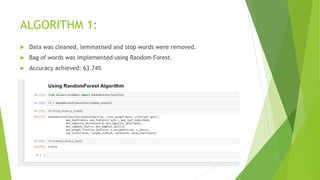
ALGORITHM 1:
 Data was cleaned, lemmatised and stop words were removed.
 Bag of words was implemented using Random Forest.
 Accuracy achieved: 63.74%
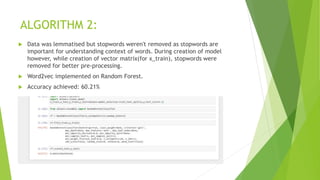
ALGORITHM 2:
 Data was lemmatised but stopwords weren't removed as stopwords are
important for understanding context of words. During creation of model
however, while creation of vector matrix(for x_train), stopwords were
removed for better pre-processing.
 Word2vec implemented on Random Forest.
 Accuracy achieved: 60.21%
WORKING ON RAW DATA:
 Just to compare the difference created by data cleaning, we applied the
following four algorithms on unclean, i.e, raw data.
 1. using random forest
 2.using KNN algorithm
 3. using SVM
USING RANDOM FOREST:
accuracy achieved: 54.2%
USING KNN ALGORITHM:
accuracy achieved: 50.6%
USING SVM ALGORITHM:
accuracy achieved: 56.6%
PREDICTING FOREST COVER TYPE:
 The study area includes four wilderness areas located in the Roosevelt
National Forest of northern Colorado. Each observation is a 30m x 30m patch.
You are asked to predict an integer classification for the forest cover type.
The seven types are:
 1 - Spruce/Fir
2 - Lodgepole Pine
3 - Ponderosa Pine
4 - Cottonwood/Willow
5 - Aspen
6 - Douglas-fir
7 - Krummholz
 The training set (15120 observations) contains both features and
the Cover_Type. The test set contains only the features.
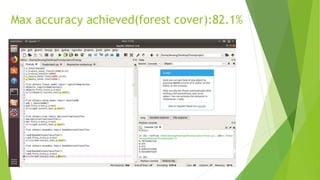
Max accuracy achieved(forest cover):82.1%
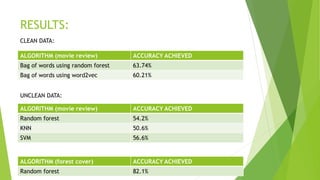
RESULTS:
ALGORITHM (movie review) ACCURACY ACHIEVED
Bag of words using random forest 63.74%
Bag of words using word2vec 60.21%
ALGORITHM (movie review) ACCURACY ACHIEVED
Random forest 54.2%
KNN 50.6%
SVM 56.6%
CLEAN DATA:
UNCLEAN DATA:
ALGORITHM (forest cover) ACCURACY ACHIEVED
Random forest 82.1%

sentiment analysis

  • 1.
    SENTIMENT ANALYSIS: USING MACHINELEARNING Group name: unidentified data Devarshi Devang Kartik Shivangi
  • 2.
    TABLE OF CONTENTS: Natural Language Processing  Sentiment analysis  Need of sentiment analysis  Machine learning methods  Naïve Bayes  Random forest  Support vector machine  KNN algorithm  Objective  Methodology  Sentiment analysis of movie reviews  Various algorithms used  Results
  • 3.
    NATURAL LANGUAGE PROCESSING: The natural language processing (NLP) is a discipline in artificial intelligence and linguistics, that studies giving machines the capacity to understand a language, like English for example.  Inside the NLP there is the field of Sentiment Analysis that studies how to use machines to process texts and give each one a kind of classification that we can understand and use. This field uses language processing algorithms to extract features, like frequency of words, and supervised machine learning algorithms that learn from an initial set of data initially classified by a human.
  • 4.
    SENTIMENT ANALYSIS:  SentimentAnalysis can be described as a problem that with a sentence or text the machine gets capable to analyze and predict with the maximum precision possible the sentiment that will be obtained by a person when reads it or the contextual opinion related to something.
  • 5.
    NEED OF SENTIMENTANALYSIS:  With the emergence of social media, the high availability of the information on Internet and the users that have become prone to share on Internet their feelings about products, movies or wherever they want to share, for example on Twitter or Facebook, the ability to process this information has become important.  For example, we can introduce a new product to the market and then wait for the feelings of the people on Internet, extract them in a useful form, and decide the future viability of this new product.  Most of this information isn’t classified or rated in any kind of classification range that can be easy used and is hard to classify at a massive scale with humans or normal tools. For this reason, the development of tools that can learn to read texts and extract the feelings is important to the future.
  • 6.
  • 7.
    NAÏVE BAYES:  NaiveBayes (NB) is a simple method based on the Bayes rule. The probability each feature contributes independently to the final probability to be a class, each one has its distribution. In a real problem, this independence is rare. To avoid this, use Multinomial Naive Bayes, provided by SciKit-Learn, that models the same probability but it uses a multinomial distribution.
  • 8.
    RANDOM FOREST:  RandomForest (RF) is a method that trains multiple decision trees. Each tree is trained using a random subset of the vector features. The decisions of each tree are combined using a voting algorithm that gives the result. The sequence of features and the value of the feature generates the path to a leaf that represents the decision. While training, the values of the intermediate nodes are updated to minimize a cost function that evaluates the performance of the trees. The objective is minimize a cost function that evaluates the performance of the trees.
  • 9.
    SUPPORT VECTOR MACHINE: Support vector machines (SVM) is a method that considers that each set of features represents a position inside a hyperspace then the SVM tries to divide it using a hyperplane maximizing the distance between this hyperplane and each vector, minimizing the objective function. This space division is hard to accomplish, and sometimes impossible, for this the SVM can use a margin that allows to misclassify some examples but increases the overall performance.
  • 10.
    KNN ALGORITHM:  KNNmakes predictions using the training dataset directly.  Predictions are made for a new instance (x) by searching through the entire training set for the K most similar instances (the neighbors) and summarizing the output variable for those K instances. For regression this might be the mean output variable, in classification this might be the mode (or most common) class value.
  • 11.
    OBJECTIVE: Research: Investigate differentmethods and algorithms that exist to do Natural Language Processing, more concretely Sentiment Analysis. Build a work frame: Build a system that can concatenate transformations to the data that can be concatenated and applied to any machine learning methods. Build and Train models: Train different combinations of transformations and models to record the effects. Evaluate: Evaluate the trained models and compare them with a reference baseline from the state of art.
  • 12.
  • 13.
    SENTIMENT ANALYSIS ONMOVIE REVIEWS:  The dataset is comprised of tab-separated files with phrases from the Rotten Tomatoes dataset. The train/test split has been preserved for the purposes of benchmarking, but the sentences have been shuffled from their original order. Each Sentence has been parsed into many phrases by the Stanford parser. Each phrase has a PhraseId. Each sentence has a SentenceId. Phrases that are repeated (such as short/common words) are only included once in the data.  train.tsv contains the phrases and their associated sentiment labels. We have additionally provided a SentenceId so that you can track which phrases belong to a single sentence.  test.tsv contains just phrases. You must assign a sentiment label to each phrase.  The sentiment labels are: 0 - negative 1 - somewhat negative 2 - neutral 3 - somewhat positive 4 - positive
  • 14.
    TRANSFORMATIONS Punctuations Lower case Bag ofwords Count vector Time Frequency and Inverse Document Frequency Stemming Dictionary of Word Lemmatization Stop-words Feature Selection
  • 15.
    LOWERCASE • One transformationthat has used on all the data is the conversion to lower case of the data. This is because the character “A” and “a” have a different representation inside the machines memory and represented with a different number, but we already know that the word Play and play is the same. • All the machine learning methods are based on numerical computation. Transforming the data to lower case have a positive impact, but can also have negative effects, for example ”Apple”, referencing the business, is not the same as ”apple” the fruit. PUNCTUATIONS • Punctuations like admiration(!) or question(?) marks have only a little effect on the sentiment meaning of the word and can be irrelevant. In the same way, the dot(.) can mean that the current feeling has ended and a new one is starting.
  • 16.
    BAG OF WORDS •The bag of words method ignores the order of the words and generates a reduced form of the sentence containing the number of occurrences or the frequency of each word in the texts. • COUNT VECTOR: The general idea behind the count vector is that a sentence can be represented by the words and the number of occurrences of each word in the document, generating a bag of word counts for each sentence. DICTIONARY • With this method, a dictionary containing all words in the texts is created and then each word in the text is converted to the index of the word inside the dictionary. This method does not break the words order and, also, does not group the words. • This transformation can generate a huge dictionary because the machine is case sensitive and can generate a different index for the same word. Also, is hard to have a dictionary with all words on any language and all of its forms, formal or informal.
  • 17.
    STEMMING • Stemming cutswords with a common root that reduces the number of representations of the same word. For example, argue, argued, argues and arguing will be reduced to argu. • The problem with stemming is that different words can be reduced to the same word, for example catastrophe and cats can have the same root cat depending on the heuristics used to generate these common roots. LEMMATIZATION • Is similar to stemming but tries to use the natural word root or its base form, called “lemma’‘. For example, the word meeting has the lemma meet. This way tries to solve the collisions that can happens on stemming. • The main problem is that is hard to have a dictionary for every word and casual representations of the words are unknown and can be considered individuals.
  • 18.
    STOPWORDS • In someproblems, like search engines, removing the words that do not have a special meaning by itself, like connectors, can be helpful and reduce the number of features of the final vector and improve the performance. • But keep in mind that removing these words can lead to another expression that have another meaning. For example, “not” is considered a stop word but if we delete it in the sentence “Im not happy” the meaning has changed to the inverse “Im happy”. FEATURE SELECTION • To reduce the vocabulary. • This transformation has a high loss of information and features but can have a high positive impact on the final performance because the machine learning method can learn only the words that are important, like “‘happy”’ and skip other words.
  • 19.
    ALGORITHM 1:  Datawas cleaned, lemmatised and stop words were removed.  Bag of words was implemented using Random Forest.  Accuracy achieved: 63.74%
  • 20.
    ALGORITHM 2:  Datawas lemmatised but stopwords weren't removed as stopwords are important for understanding context of words. During creation of model however, while creation of vector matrix(for x_train), stopwords were removed for better pre-processing.  Word2vec implemented on Random Forest.  Accuracy achieved: 60.21%
  • 21.
    WORKING ON RAWDATA:  Just to compare the difference created by data cleaning, we applied the following four algorithms on unclean, i.e, raw data.  1. using random forest  2.using KNN algorithm  3. using SVM
  • 22.
  • 23.
  • 24.
  • 25.
    PREDICTING FOREST COVERTYPE:  The study area includes four wilderness areas located in the Roosevelt National Forest of northern Colorado. Each observation is a 30m x 30m patch. You are asked to predict an integer classification for the forest cover type. The seven types are:  1 - Spruce/Fir 2 - Lodgepole Pine 3 - Ponderosa Pine 4 - Cottonwood/Willow 5 - Aspen 6 - Douglas-fir 7 - Krummholz  The training set (15120 observations) contains both features and the Cover_Type. The test set contains only the features.
  • 26.
  • 27.
    RESULTS: ALGORITHM (movie review)ACCURACY ACHIEVED Bag of words using random forest 63.74% Bag of words using word2vec 60.21% ALGORITHM (movie review) ACCURACY ACHIEVED Random forest 54.2% KNN 50.6% SVM 56.6% CLEAN DATA: UNCLEAN DATA: ALGORITHM (forest cover) ACCURACY ACHIEVED Random forest 82.1%