Anatoly Belikov
abelikov@singularitynet.io
Introduction to
OpenCog
2
$ https://github.com/singnet/
opencog-workshops
$
3
CogPrime
4
CogPrime
5
Use cases
• Chatbots
• Bioinformatics
• Unsupervised language learning
• Visual Question Answering VQA
• …
6
Atomspace - graph database
Hypergraph database designed to be primarily used as a
storage of explicit, declarative knowledge
Hypergraph defines programming language - Atomese
Has a number of associated mechanisms:
pattern matching, unified rule engine, moses
7
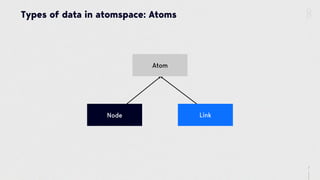
Types of data in atomspace: Atoms
Atom
LinkNode
8
Types of data in atomspace: Values
StringValue LinkValueFloatValue
TruthValue
9
Atomspace - API introduction
Python:
>> from opencog.atomspace import AtomSpace, types
>> atomspace = AtomSpace()
Scheme:
scheme> (use-modules (opencog))
scheme> (define atomspace (cog-new-atomspace))
10
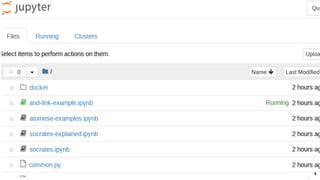
Pattern matcher examples
$ docker run -p8888:8888  -it demo-opencog
/home/relex/opencog-intro-master/
notebook.sh
$ http://localhost:8888/notebooks/and-
link-example.ipynb
11
Loading and storing
Load scheme file from scheme or python:
>> scheme_eval(atomspace, '(load-from-path “atomspace.scm")')
Indexed by atom type and name
Use PostgreSQL as backend storage
12
13
14
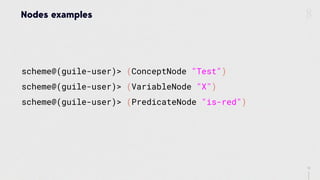
Nodes examples
scheme@(guile-user)> (ConceptNode "Test")
scheme@(guile-user)> (VariableNode "X")
scheme@(guile-user)> (PredicateNode "is-red")
15
Links examples: ListLink
>>> lst1 = ListLink(ConceptNode("red"),
VariableNode("$X"),
ConceptNode("blue"))
>>> print(str(lst1))
(ListLink
(ConceptNode "red")
(VariableNode "$X")
(ConceptNode "blue")
)
16
TruthValue
> from opencog.atomspace import TruthValue
> tv = TruthValue(0.5, 0.92)
P(Heads) = 0.5, .3
> ConceptNode(“Heads”).tv = tv
17
18
19
BindLink and pattern matcher
BindLink

<variables> - optional

  <pattern to match>

  <rewrite term>
Pattern example:
ListLink(ConceptNode("red"),
      VariableNode("$X"),
        ConceptNode("blue"))
20
21
22
23
24
25
26
Unified Rule Engine
Inference engine based on graph rewriting rules.
Allows to perform declarative inference.
Rules and data defined in the same language - atomese
Can do backward and forward chaining
27
Unified Rule Engine
Inference in first-order logic
Automatic differentiation
Graphical models
Probabilistic logic inference
Fuzzy logic inference
...
28
29
30
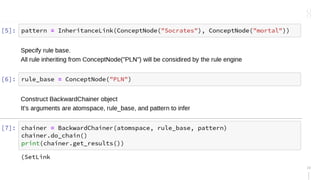
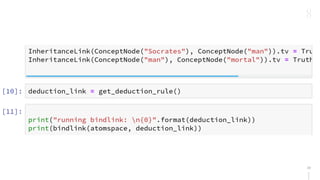
Running backward chainer
> request =
InheritanceLink(ConceptNode("Socrates"),
               ConceptNode("mortal"))
> tr = AtomSpace() # trace atomspace
> rule_base = ConceptNode("PLN") # rules to use
> chainer = BackwardChainer(atomspace, rule_base,
  request,
  trace_as=tr)
> chainer.do_chain()
> print(chainer.get_results())
31
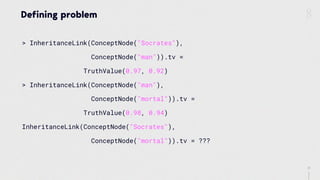
Defining problem
> InheritanceLink(ConceptNode("Socrates"),
ConceptNode("man")).tv =
TruthValue(0.97, 0.92)
> InheritanceLink(ConceptNode("man"),
ConceptNode("mortal")).tv =
TruthValue(0.98, 0.94)
InheritanceLink(ConceptNode("Socrates"),
ConceptNode("mortal")).tv = ???
32
Result
> (SetLink
(InheritanceLink (stv 0.9508 0.828)
(ConceptNode(“Socrates”),
(ConceptNode("mortal"))
33
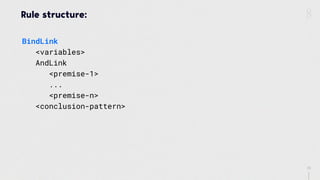
Rule structure:
BindLink

<variables>

AndLink

<premise-1>

...

<premise-n>

<conclusion-pattern>
34
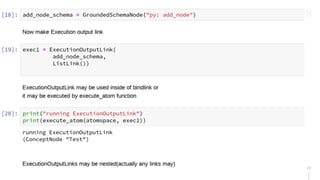
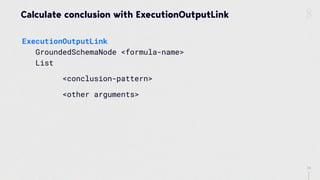
Calculate conclusion with ExecutionOutputLink
ExecutionOutputLink

GroundedSchemaNode <formula-name>

List
<conclusion-pattern>
<other arguments>
35
36
Deduction rule example
premise
A -> B
B -> C
Ergo: A -> C
condition = AndLink(BA, CB)
BA = InheritanceLink(var_b, var_a)
CB = InheritanceLink(var_c, var_b)
rewrite = ExecutionOutputLink(
GroundedSchemaNode("scm: deduction-formula"),
ListLink(CA, CB, BA))
deduction_link = BindLink(condition, rewrite)
37
38
39
40
41
42
BindLink the query was answered with
(ExecutionOutputLink
(GroundedSchemaNode "scm: deduction-formula")
(ListLink
(InheritanceLink (stv 0.9508 0.828)
(ConceptNode "Socrates")
(ConceptNode "mortal")
)
(InheritanceLink
(ConceptNode "Socrates")
(VariableNode "$B")
)
(InheritanceLink
(VariableNode "$B")
(ConceptNode "mortal")
)))
(AndLink
(InheritanceLink
(VariableNode "$B")
(ConceptNode "mortal")
)
(NotLink
(IdenticalLink
(ConceptNode "Socrates")
(ConceptNode "mortal")
)
)
(InheritanceLink
(ConceptNode "Socrates")
(VariableNode "$B")
))
43
Running VQA demo from the docker image
$ docker pull opencog/vqa
$ wget https://s3-us-west-2.amazonaws.com/
abelikov/data-small.tar.gz && tar -xvf data-
small.tar.gz
$ docker run  -v `pwd`/data:/home/relex/projects/
data -p 8889:8888 -it demo-opencog
44
45
46
47
Building VQA with OpenCog
Building blocks:
Atomspace for storing facts about world
Link-Grammar + RelEx for text processing
Faster-RCNN for bounding box and feature extraction
Our neural network models for classification
Unified rule engine and pattern matcher for computing answers
48
VQA pipeline overview
How many animals are there?
PatternMatcherVQA
(python)
atomspace
Relex + link-grammar
(java)
Pattern matcher
49
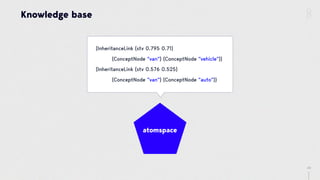
Knowledge base
atomspace
(InheritanceLink (stv 0.795 0.71)
(ConceptNode "van") (ConceptNode "vehicle"))
(InheritanceLink (stv 0.576 0.525)
(ConceptNode "van") (ConceptNode "auto"))
50
VQA pipeline: text processing
sentence => link-grammar => relex => template => query
51
Taking a look at link-grammar
linkparser> How many zebras are there?
Found 22 linkages (6 had no P.P. violations)
Linkage 1, cost vector = (UNUSED=0 DIS=
2.00 LEN=8)
+------------------Xp-----------------+
+----------->WV---------->+ |
+->Ws--+--H-+--Dmc-+--Spx-+--Pp--+ |
| | | | | | |
LEFT-WALL how many zebras.n are.v there.r ?
(S how many zebras.n
(VP are.v
(PP there.r))
?)
52
How link-grammar works?
Link-grammar has predefined dictionary or words associated with allowed link types.
(word: link types) pairs define what type of links can be attached to which word and
from which side.
Also number of global rules for example that links cannot cross each other.
Check the rules:
github.com/opencog/link-grammar/blob/master/data/en/4.0.dict
53
RelEx
Dependency parser that built on graph rewriting rules
Operates on graph built from link-grammar parse
Adds new semantic links between words
Relex parse for “How many zebras are there?”:
_predadj(zebra, there)
_quantity(zebra, _$qVar)
54
Vertices attributes of relex sentence graph
pos(be, verb)
penn-POS(be, VBP)
pos(there, adj)
tense(there, present)
penn-POS(there, JJ)
HYP(there, T)
QUERY-TYPE(_$qVar,
how_much)
penn-POS(_$qVar, CD)
pos(how, adv)
penn-POS(how, RB)
pos(?, punctuation)
noun_number(zebra, plural)
pos(zebra, noun)
penn-POS(zebra, NNS)
pos(_$qVar, adj)
55
Query example
Is the dog black?
_predadj(A, B)::_predadj(dog, black)
(conj-bc (AndLink

(InheritanceLink (VariableNode "$X") (ConceptNode "BoundingBox"))

(EvaluationLink (GroundedPredicateNode "py:runNeuralNetwork")
(ListLink (VariableNode "$X") (ConceptNode "dog")) )

(EvaluationLink (GroundedPredicateNode "py:runNeuralNetwork")
(ListLink (VariableNode "$X") (ConceptNode "black")) ))

)
56
Image processing
Bounding Boxes & features
Faster-RCNN
57
Bounding boxes => atomspace
ConceptNode("BoundingBox1")
ConceptNode("BoundingBox2")
ConceptNode("BoundingBox3")
Bounding Boxes & features
atomspace
58
Bounding boxes => atomspace
> (InheritanceLink
(ConceptNode("BoundingBox1")
(ConceptNode("BoundingBox"))
59
Use of URE and pattern matcher for queries
•URE allows to use declarative approach for computing answers
•We use fuzzy logic rules to compute truth value of queries
60
61
Integrating opencog with neural networks
Stay tuned!
Passing arbitrary python objects between ExecutionOutputLinks
Allows to express computation graph as pytorch expression
Allows to integrate and update ontologies
62
Resources
wiki.opencog.org/
github.com/opencog/
github.com/singnet/semantic-vision
blog.singularitynet.io
63

OpenCog Developer Workshop

  • 1.
  • 2.
  • 3.
  • 4.
  • 5.
    5 Use cases • Chatbots •Bioinformatics • Unsupervised language learning • Visual Question Answering VQA • …
  • 6.
    6 Atomspace - graphdatabase Hypergraph database designed to be primarily used as a storage of explicit, declarative knowledge Hypergraph defines programming language - Atomese Has a number of associated mechanisms: pattern matching, unified rule engine, moses
  • 7.
    7 Types of datain atomspace: Atoms Atom LinkNode
  • 8.
    8 Types of datain atomspace: Values StringValue LinkValueFloatValue TruthValue
  • 9.
    9 Atomspace - APIintroduction Python: >> from opencog.atomspace import AtomSpace, types >> atomspace = AtomSpace() Scheme: scheme> (use-modules (opencog)) scheme> (define atomspace (cog-new-atomspace))
  • 10.
    10 Pattern matcher examples $docker run -p8888:8888  -it demo-opencog /home/relex/opencog-intro-master/ notebook.sh $ http://localhost:8888/notebooks/and- link-example.ipynb
  • 11.
    11 Loading and storing Loadscheme file from scheme or python: >> scheme_eval(atomspace, '(load-from-path “atomspace.scm")') Indexed by atom type and name Use PostgreSQL as backend storage
  • 12.
  • 13.
  • 14.
    14 Nodes examples scheme@(guile-user)> (ConceptNode"Test") scheme@(guile-user)> (VariableNode "X") scheme@(guile-user)> (PredicateNode "is-red")
  • 15.
    15 Links examples: ListLink >>>lst1 = ListLink(ConceptNode("red"), VariableNode("$X"), ConceptNode("blue")) >>> print(str(lst1)) (ListLink (ConceptNode "red") (VariableNode "$X") (ConceptNode "blue") )
  • 16.
    16 TruthValue > from opencog.atomspaceimport TruthValue > tv = TruthValue(0.5, 0.92) P(Heads) = 0.5, .3 > ConceptNode(“Heads”).tv = tv
  • 17.
  • 18.
  • 19.
    19 BindLink and patternmatcher BindLink
 <variables> - optional
   <pattern to match>
   <rewrite term> Pattern example: ListLink(ConceptNode("red"),       VariableNode("$X"),         ConceptNode("blue"))
  • 20.
  • 21.
  • 22.
  • 23.
  • 24.
  • 25.
  • 26.
    26 Unified Rule Engine Inferenceengine based on graph rewriting rules. Allows to perform declarative inference. Rules and data defined in the same language - atomese Can do backward and forward chaining
  • 27.
    27 Unified Rule Engine Inferencein first-order logic Automatic differentiation Graphical models Probabilistic logic inference Fuzzy logic inference ...
  • 28.
  • 29.
  • 30.
    30 Running backward chainer >request = InheritanceLink(ConceptNode("Socrates"),                ConceptNode("mortal")) > tr = AtomSpace() # trace atomspace > rule_base = ConceptNode("PLN") # rules to use > chainer = BackwardChainer(atomspace, rule_base,   request,   trace_as=tr) > chainer.do_chain() > print(chainer.get_results())
  • 31.
    31 Defining problem > InheritanceLink(ConceptNode("Socrates"), ConceptNode("man")).tv= TruthValue(0.97, 0.92) > InheritanceLink(ConceptNode("man"), ConceptNode("mortal")).tv = TruthValue(0.98, 0.94) InheritanceLink(ConceptNode("Socrates"), ConceptNode("mortal")).tv = ???
  • 32.
    32 Result > (SetLink (InheritanceLink (stv0.9508 0.828) (ConceptNode(“Socrates”), (ConceptNode("mortal"))
  • 33.
  • 34.
    34 Calculate conclusion withExecutionOutputLink ExecutionOutputLink
 GroundedSchemaNode <formula-name>
 List <conclusion-pattern> <other arguments>
  • 35.
  • 36.
    36 Deduction rule example premise A-> B B -> C Ergo: A -> C condition = AndLink(BA, CB) BA = InheritanceLink(var_b, var_a) CB = InheritanceLink(var_c, var_b) rewrite = ExecutionOutputLink( GroundedSchemaNode("scm: deduction-formula"), ListLink(CA, CB, BA)) deduction_link = BindLink(condition, rewrite)
  • 37.
  • 38.
  • 39.
  • 40.
  • 41.
  • 42.
    42 BindLink the querywas answered with (ExecutionOutputLink (GroundedSchemaNode "scm: deduction-formula") (ListLink (InheritanceLink (stv 0.9508 0.828) (ConceptNode "Socrates") (ConceptNode "mortal") ) (InheritanceLink (ConceptNode "Socrates") (VariableNode "$B") ) (InheritanceLink (VariableNode "$B") (ConceptNode "mortal") ))) (AndLink (InheritanceLink (VariableNode "$B") (ConceptNode "mortal") ) (NotLink (IdenticalLink (ConceptNode "Socrates") (ConceptNode "mortal") ) ) (InheritanceLink (ConceptNode "Socrates") (VariableNode "$B") ))
  • 43.
    43 Running VQA demofrom the docker image $ docker pull opencog/vqa $ wget https://s3-us-west-2.amazonaws.com/ abelikov/data-small.tar.gz && tar -xvf data- small.tar.gz $ docker run  -v `pwd`/data:/home/relex/projects/ data -p 8889:8888 -it demo-opencog
  • 44.
  • 45.
  • 46.
  • 47.
    47 Building VQA withOpenCog Building blocks: Atomspace for storing facts about world Link-Grammar + RelEx for text processing Faster-RCNN for bounding box and feature extraction Our neural network models for classification Unified rule engine and pattern matcher for computing answers
  • 48.
    48 VQA pipeline overview Howmany animals are there? PatternMatcherVQA (python) atomspace Relex + link-grammar (java) Pattern matcher
  • 49.
    49 Knowledge base atomspace (InheritanceLink (stv0.795 0.71) (ConceptNode "van") (ConceptNode "vehicle")) (InheritanceLink (stv 0.576 0.525) (ConceptNode "van") (ConceptNode "auto"))
  • 50.
    50 VQA pipeline: textprocessing sentence => link-grammar => relex => template => query
  • 51.
    51 Taking a lookat link-grammar linkparser> How many zebras are there? Found 22 linkages (6 had no P.P. violations) Linkage 1, cost vector = (UNUSED=0 DIS= 2.00 LEN=8) +------------------Xp-----------------+ +----------->WV---------->+ | +->Ws--+--H-+--Dmc-+--Spx-+--Pp--+ | | | | | | | | LEFT-WALL how many zebras.n are.v there.r ? (S how many zebras.n (VP are.v (PP there.r)) ?)
  • 52.
    52 How link-grammar works? Link-grammarhas predefined dictionary or words associated with allowed link types. (word: link types) pairs define what type of links can be attached to which word and from which side. Also number of global rules for example that links cannot cross each other. Check the rules: github.com/opencog/link-grammar/blob/master/data/en/4.0.dict
  • 53.
    53 RelEx Dependency parser thatbuilt on graph rewriting rules Operates on graph built from link-grammar parse Adds new semantic links between words Relex parse for “How many zebras are there?”: _predadj(zebra, there) _quantity(zebra, _$qVar)
  • 54.
    54 Vertices attributes ofrelex sentence graph pos(be, verb) penn-POS(be, VBP) pos(there, adj) tense(there, present) penn-POS(there, JJ) HYP(there, T) QUERY-TYPE(_$qVar, how_much) penn-POS(_$qVar, CD) pos(how, adv) penn-POS(how, RB) pos(?, punctuation) noun_number(zebra, plural) pos(zebra, noun) penn-POS(zebra, NNS) pos(_$qVar, adj)
  • 55.
    55 Query example Is thedog black? _predadj(A, B)::_predadj(dog, black) (conj-bc (AndLink
 (InheritanceLink (VariableNode "$X") (ConceptNode "BoundingBox"))
 (EvaluationLink (GroundedPredicateNode "py:runNeuralNetwork") (ListLink (VariableNode "$X") (ConceptNode "dog")) )
 (EvaluationLink (GroundedPredicateNode "py:runNeuralNetwork") (ListLink (VariableNode "$X") (ConceptNode "black")) ))
 )
  • 56.
    56 Image processing Bounding Boxes& features Faster-RCNN
  • 57.
    57 Bounding boxes =>atomspace ConceptNode("BoundingBox1") ConceptNode("BoundingBox2") ConceptNode("BoundingBox3") Bounding Boxes & features atomspace
  • 58.
    58 Bounding boxes =>atomspace > (InheritanceLink (ConceptNode("BoundingBox1") (ConceptNode("BoundingBox"))
  • 59.
    59 Use of UREand pattern matcher for queries •URE allows to use declarative approach for computing answers •We use fuzzy logic rules to compute truth value of queries
  • 60.
  • 61.
    61 Integrating opencog withneural networks Stay tuned! Passing arbitrary python objects between ExecutionOutputLinks Allows to express computation graph as pytorch expression Allows to integrate and update ontologies
  • 62.
  • 63.