Tutoring in online and
distance education
D-TEL 2016, Kristiansand
Sven Åke Bjørke & Aleksandra Lazareva
Department of Global Development and Planning
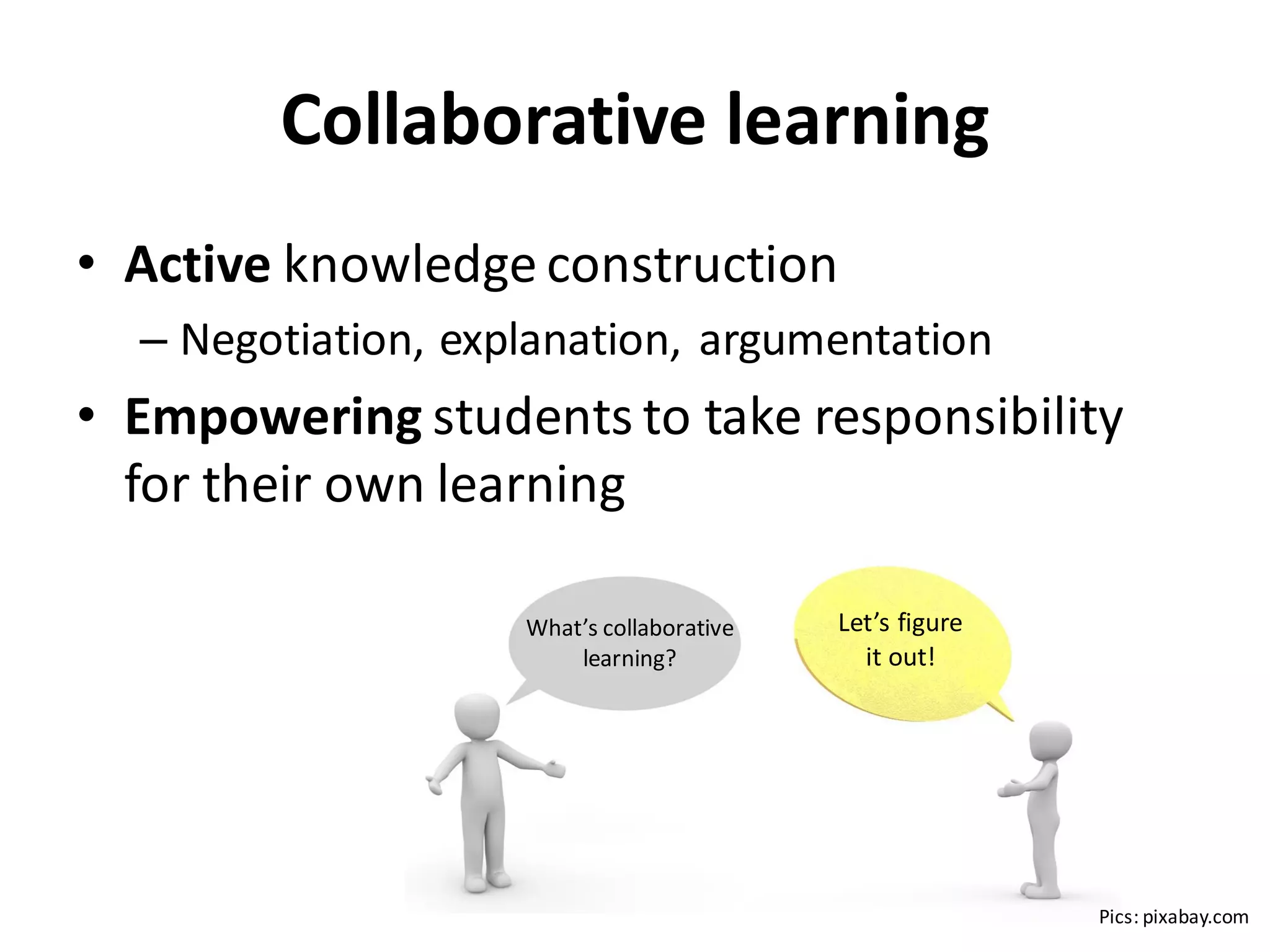
Collaborative learning
• Active knowledge construction
– Negotiation, explanation, argumentation
• Empowering students to take responsibility
for their own learning
What’s collaborative
learning?
Let’s figure
it out!
Pics: pixabay.com
The four Cs
Four key qualities for the Information Age
Creative,
efficient Communicator,
Critical thinker and
Collaborator
Asynchronous collaborative learning
• Backwards design
– Focus on what the students will have learned
when completing the course
– Learning activities rather than what the teacher
delivers
• Flipping the classroom
– Different levels of understanding (Bloom’s
taxonomy)
– Articles & videolectures  discussions
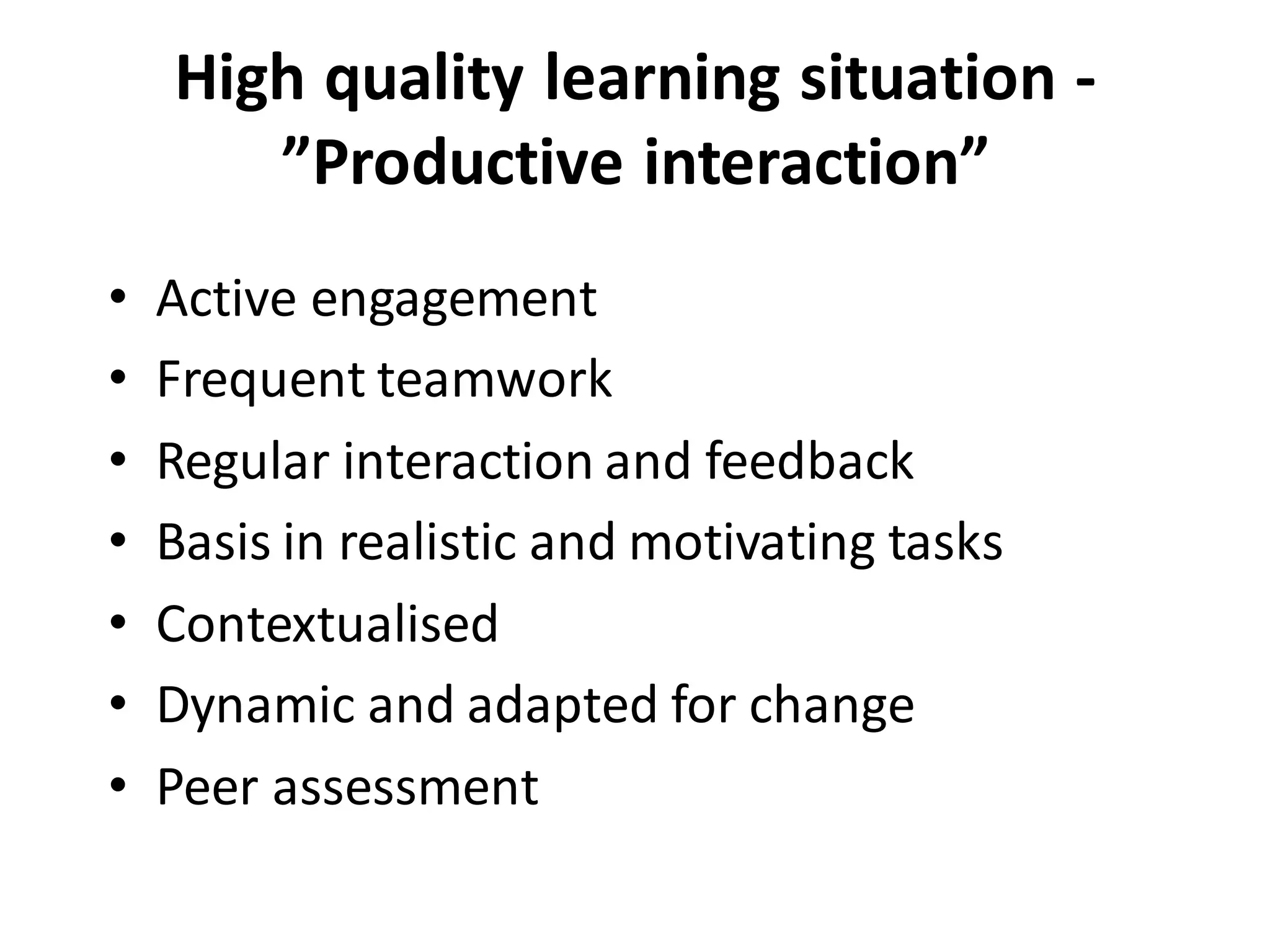
High quality learning situation -
”Productive interaction”
• Active engagement
• Frequent teamwork
• Regular interaction and feedback
• Basis in realistic and motivating tasks
• Contextualised
• Dynamic and adapted for change
• Peer assessment
Collaborative learning circle
Read
Discuss
Assess
Reflect
Do /
Make
Assess
Discuss
Major pitfall
• Taking for granted that collaboration will occur
simply because technology makes it possible
– Usually collaboration doesn’t happen
spontaneously
– Lack of experience in collaborative learning
– Insufficient training in the use of technology
Online collaborative learning
• Benefits
– Different backgrounds (cultural, institutional,
professional)
– Different prior knowledge
– Learning across time and space (e.g.,
asynchronous platforms)
– Presence
Pic: pixabay.com
Lack of social cues
Often based on expectations;
temporal organizationchallenge
Different behaviorsare considered relevant
Common ground challenge;
different need for support
Role of the teacher
• Guiding learners in the process of inquiry
• Monitoring learners’ understanding
• Addressing dysfunctionalgroup phenomena
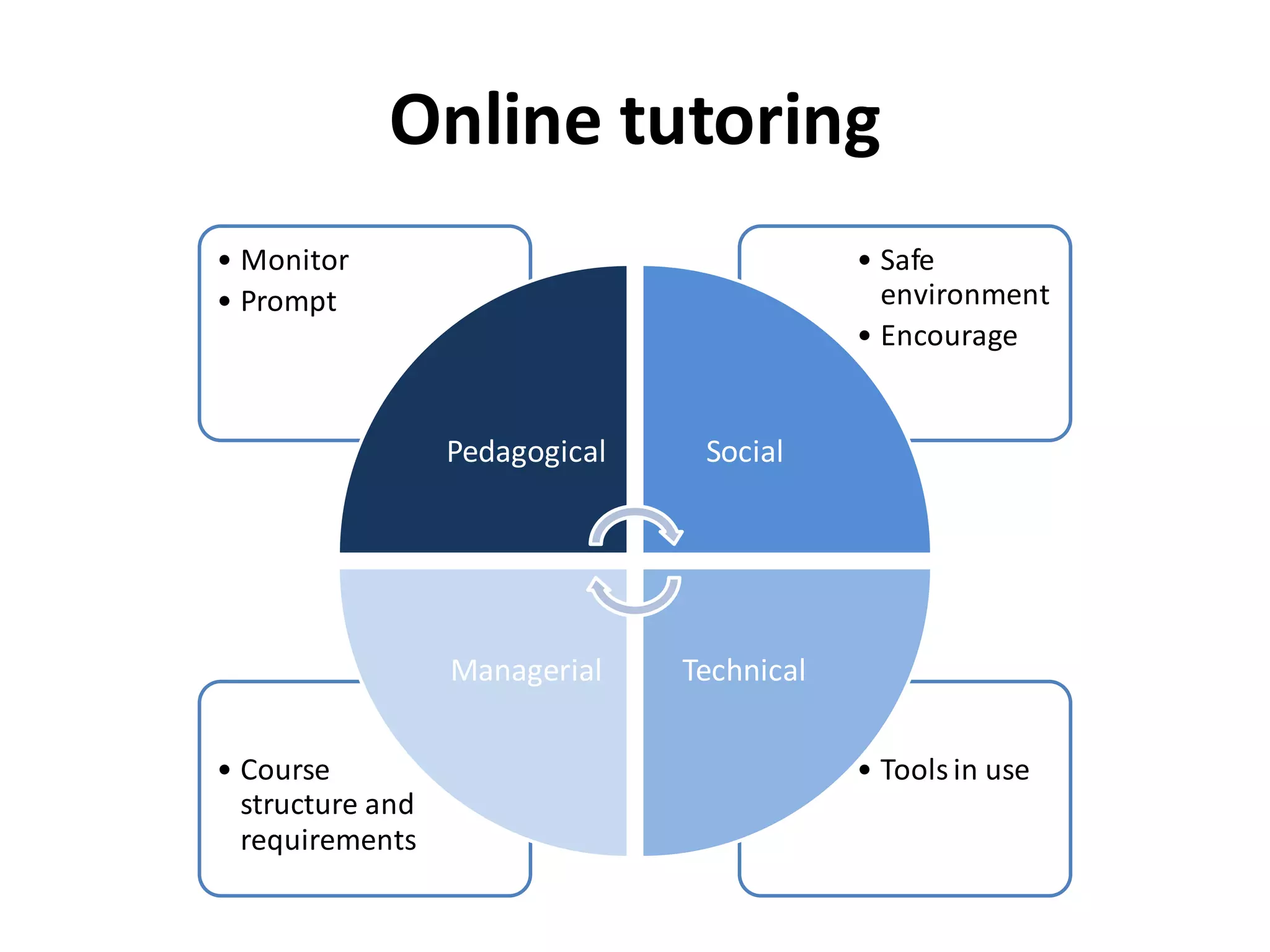
• Tools in use• Course
structure and
requirements
• Safe
environment
• Encourage
• Monitor
• Prompt
Pedagogical Social
TechnicalManagerial
Online tutoring
Assessment
Assessment is part of the learning process
Online credit giving course (example)
• 60% home exam
• 30% group hand-in
• 10% individual portfolio:
– Online quizzes
– Participation statistics
– Contributions in discussion forum & group hand-ins
– Individual blogs
Thank you!
sven.a.bjorke@uia.no
aleksandra.lazareva@uia.no
E-book: Team and onlinecollaborativework
http://grimstad.uia.no/puls/Groupwork/main.htm

Tutoring in online and distance education

  • 1.
    Tutoring in onlineand distance education D-TEL 2016, Kristiansand Sven Åke Bjørke & Aleksandra Lazareva Department of Global Development and Planning
  • 2.
    Collaborative learning • Activeknowledge construction – Negotiation, explanation, argumentation • Empowering students to take responsibility for their own learning What’s collaborative learning? Let’s figure it out! Pics: pixabay.com
  • 3.
    The four Cs Fourkey qualities for the Information Age Creative, efficient Communicator, Critical thinker and Collaborator
  • 4.
    Asynchronous collaborative learning •Backwards design – Focus on what the students will have learned when completing the course – Learning activities rather than what the teacher delivers • Flipping the classroom – Different levels of understanding (Bloom’s taxonomy) – Articles & videolectures  discussions
  • 5.
    High quality learningsituation - ”Productive interaction” • Active engagement • Frequent teamwork • Regular interaction and feedback • Basis in realistic and motivating tasks • Contextualised • Dynamic and adapted for change • Peer assessment
  • 6.
  • 7.
    Major pitfall • Takingfor granted that collaboration will occur simply because technology makes it possible – Usually collaboration doesn’t happen spontaneously – Lack of experience in collaborative learning – Insufficient training in the use of technology
  • 8.
    Online collaborative learning •Benefits – Different backgrounds (cultural, institutional, professional) – Different prior knowledge – Learning across time and space (e.g., asynchronous platforms) – Presence Pic: pixabay.com Lack of social cues Often based on expectations; temporal organizationchallenge Different behaviorsare considered relevant Common ground challenge; different need for support
  • 9.
    Role of theteacher • Guiding learners in the process of inquiry • Monitoring learners’ understanding • Addressing dysfunctionalgroup phenomena
  • 10.
    • Tools inuse• Course structure and requirements • Safe environment • Encourage • Monitor • Prompt Pedagogical Social TechnicalManagerial Online tutoring
  • 11.
    Assessment Assessment is partof the learning process Online credit giving course (example) • 60% home exam • 30% group hand-in • 10% individual portfolio: – Online quizzes – Participation statistics – Contributions in discussion forum & group hand-ins – Individual blogs
  • 12.
    Thank you! sven.a.bjorke@uia.no aleksandra.lazareva@uia.no E-book: Teamand onlinecollaborativework http://grimstad.uia.no/puls/Groupwork/main.htm