Inspiring the next
generation of
leaders, thinkers
and problem-solvers
derek@futuremakers.nz
@dwenmoth
www.futuremakers.nz
http://www.wenmoth.net
Lessons from Lockdown:
Preparing for a blended
future.
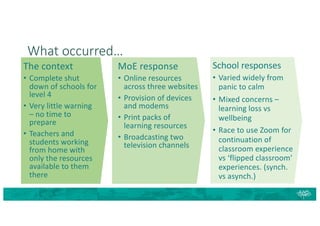
What occurred…
The context
• Complete shut
down of schools for
level 4
• Very little warning
– no time to
prepare
• Teachers and
students working
from home with
only the resources
available to them
there
MoE response
• Online resources
across three websites
• Provision of devices
and modems
• Print packs of
learning resources
• Broadcasting two
television channels
School responses
• Varied widely from
panic to calm
• Mixed concerns –
learning loss vs
wellbeing
• Race to use Zoom for
continuation of
classroom experience
vs ‘flipped classroom’
experiences. (synch.
vs asynch.)
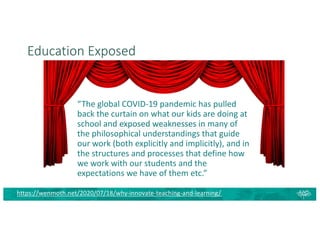
Education Exposed
https://wenmoth.net/2020/07/18/why-innovate-teaching-and-learning/
“The global COVID-19 pandemic has pulled
back the curtain on what our kids are doing at
school and exposed weaknesses in many of
the philosophical understandings that guide
our work (both explicitly and implicitly), and in
the structures and processes that define how
we work with our students and the
expectations we have of them etc.”
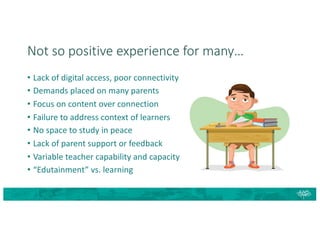
Not so positive experience for many…
• Lack of digital access, poor connectivity
• Demands placed on many parents
• Focus on content over connection
• Failure to address context of learners
• No space to study in peace
• Lack of parent support or feedback
• Variable teacher capability and capacity
• “Edutainment” vs. learning
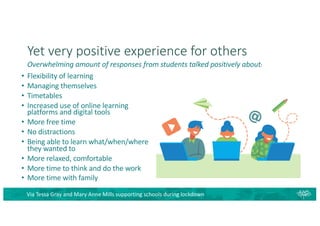
Yet very positive experience for others
• Flexibility of learning
• Managing themselves
• Timetables
• Increased use of online learning
platforms and digital tools
• More free time
• No distractions
• Being able to learn what/when/where
they wanted to
• More relaxed, comfortable
• More time to think and do the work
• More time with family
Via Tessa Gray and Mary Anne Mills supporting schools during lockdown
Overwhelming amount of responses from students talked positively about:
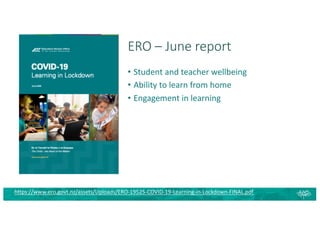
ERO – June report
• Student and teacher wellbeing
• Ability to learn from home
• Engagement in learning
https://www.ero.govt.nz/assets/Uploads/ERO-19525-COVID-19-Learning-in-Lockdown-FINAL.pdf
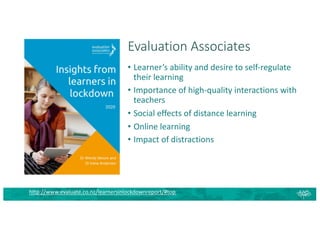
Evaluation Associates
• Learner’s ability and desire to self-regulate
their learning
• Importance of high-quality interactions with
teachers
• Social effects of distance learning
• Online learning
• Impact of distractions
http://www.evaluate.co.nz/learnersinlockdownreport/#top
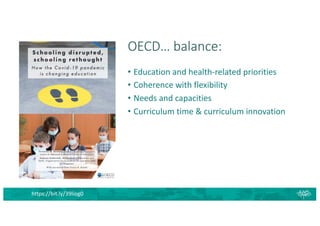
OECD… balance:
• Education and health-related priorities
• Coherence with flexibility
• Needs and capacities
• Curriculum time & curriculum innovation
https://bit.ly/39liog0
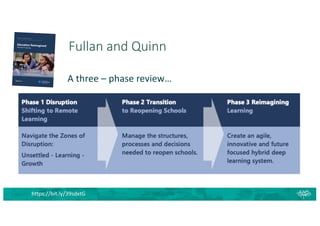
Fullan and Quinn
https://bit.ly/39sdxtG
A three – phase review…
A blended/hybrid future?
Need to consider…
• Technology – what to use (synchronous and asynchronous)
• Roles and responsibilities - teachers, parents/whanau,
community
• Structures and systems - Implications for timetables, resources
used, use of space
• Pedagogy - personalised pathways, tracking/monitoring progress,
new forms of assessment
• Curriculum – deep learning/competencies and wellbeing
Thank You
derek@futuremakers.nz
@dwenmoth
www.futuremakers.nz
http://www.wenmoth.net

Schoolbox pres. lessons from lockdown

  • 1.
    Inspiring the next generationof leaders, thinkers and problem-solvers derek@futuremakers.nz @dwenmoth www.futuremakers.nz http://www.wenmoth.net Lessons from Lockdown: Preparing for a blended future.
  • 2.
    What occurred… The context •Complete shut down of schools for level 4 • Very little warning – no time to prepare • Teachers and students working from home with only the resources available to them there MoE response • Online resources across three websites • Provision of devices and modems • Print packs of learning resources • Broadcasting two television channels School responses • Varied widely from panic to calm • Mixed concerns – learning loss vs wellbeing • Race to use Zoom for continuation of classroom experience vs ‘flipped classroom’ experiences. (synch. vs asynch.)
  • 3.
    Education Exposed https://wenmoth.net/2020/07/18/why-innovate-teaching-and-learning/ “The globalCOVID-19 pandemic has pulled back the curtain on what our kids are doing at school and exposed weaknesses in many of the philosophical understandings that guide our work (both explicitly and implicitly), and in the structures and processes that define how we work with our students and the expectations we have of them etc.”
  • 4.
    Not so positiveexperience for many… • Lack of digital access, poor connectivity • Demands placed on many parents • Focus on content over connection • Failure to address context of learners • No space to study in peace • Lack of parent support or feedback • Variable teacher capability and capacity • “Edutainment” vs. learning
  • 5.
    Yet very positiveexperience for others • Flexibility of learning • Managing themselves • Timetables • Increased use of online learning platforms and digital tools • More free time • No distractions • Being able to learn what/when/where they wanted to • More relaxed, comfortable • More time to think and do the work • More time with family Via Tessa Gray and Mary Anne Mills supporting schools during lockdown Overwhelming amount of responses from students talked positively about:
  • 6.
    ERO – Junereport • Student and teacher wellbeing • Ability to learn from home • Engagement in learning https://www.ero.govt.nz/assets/Uploads/ERO-19525-COVID-19-Learning-in-Lockdown-FINAL.pdf
  • 7.
    Evaluation Associates • Learner’sability and desire to self-regulate their learning • Importance of high-quality interactions with teachers • Social effects of distance learning • Online learning • Impact of distractions http://www.evaluate.co.nz/learnersinlockdownreport/#top
  • 8.
    OECD… balance: • Educationand health-related priorities • Coherence with flexibility • Needs and capacities • Curriculum time & curriculum innovation https://bit.ly/39liog0
  • 9.
  • 10.
    A blended/hybrid future? Needto consider… • Technology – what to use (synchronous and asynchronous) • Roles and responsibilities - teachers, parents/whanau, community • Structures and systems - Implications for timetables, resources used, use of space • Pedagogy - personalised pathways, tracking/monitoring progress, new forms of assessment • Curriculum – deep learning/competencies and wellbeing
  • 11.