Tutorial 
Calculation 
A) Circular Knitting 
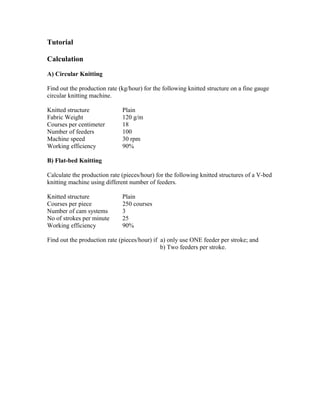
Find out the production rate (kg/hour) for the following knitted structure on a fine gauge 
circular knitting machine. 
Knitted structure Plain 
Fabric Weight 120 g/m 
Courses per centimeter 18 
Number of feeders 100 
Machine speed 30 rpm 
Working efficiency 90% 
B) Flat-bed Knitting 
Calculate the production rate (pieces/hour) for the following knitted structures of a V-bed 
knitting machine using different number of feeders. 
Knitted structure Plain 
Courses per piece 250 courses 
Number of cam systems 3 
No of strokes per minute 25 
Working efficiency 90% 
Find out the production rate (pieces/hour) if a) only use ONE feeder per stroke; and 
b) Two feeders per stroke.
Answer 
A) Circular Knitting 
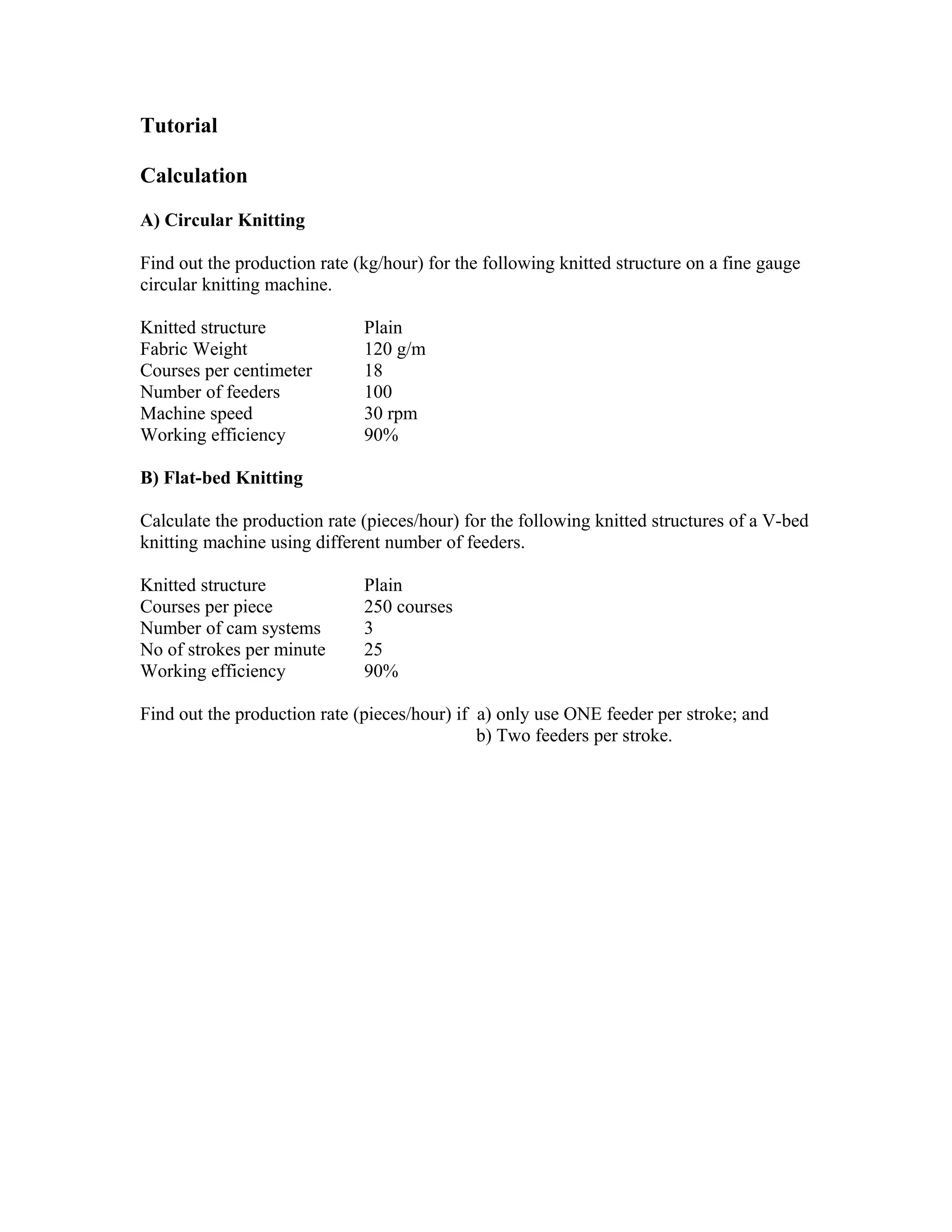
Production (courses/hour) = 100 x 30 x 60 x 0.9 =162,000 courses/hour 
Production (meters/hour) = 162,000 / (18 x 100) = 90 meters/hour 
Production (kg /hour) = 90 x 120 g/m /1000 = 10.8 kg/hour 
B) Flat Bed Knitting 
One feeder production: 
One stroke = TWO courses 
Production (courses/hour) = 25 x 2 x 60 x 0.9 = 2700 courses/hour 
Production (pieces /hour) = 2700/250 = 10.8 pieces/hour 
TWO feeder production 
Production (courses/hour) = 25 x 2 x2 x 60 x 0.9 = 5400 courses/hour 
Production (pieces/ hour) =5400/250 =21.6 pieces/hour
Knitting Instruction for Flat-bed Machine 
Apart from production calculation (pieces/hour) on V-bed machine, one of the key 
elements for the knitting factory (sweater factory) is to prepare knitting instruction. 
What is knitting instruction? 
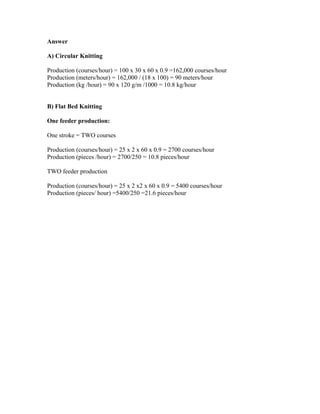
Knitting instruction is the statement used to knit the garment parts and expressed in terms 
of courses (fabric length), needles width (fabric width) and fashioning frequencies. 
In other words, if a fabric piece is given with how many inches in length and width, you 
need to find out the correct number of courses to produce the required length and correct 
number of needles width to produce the required fabric width. 
A swatch (a small piece of fabric) in correct knitting instruction and knitting tension is 
normally prepared before bulk production. One of the common methods used by industry 
to determine the stitch tension is to stretch the fabric course wise to its utmost limits 
manually and measure the dimension of 10 wales board. 
Example 
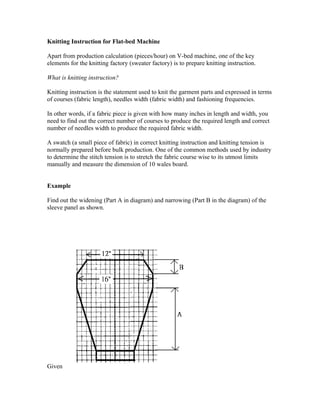
Find out the widening (Part A in diagram) and narrowing (Part B in the diagram) of the 
sleeve panel as shown. 
Given
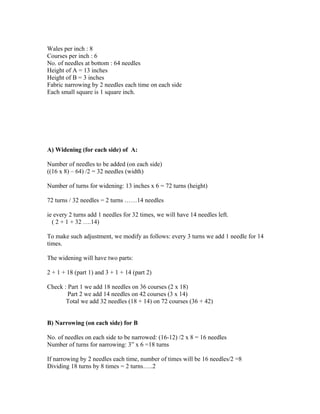
Wales per inch : 8 
Courses per inch : 6 
No. of needles at bottom : 64 needles 
Height of A = 13 inches 
Height of B = 3 inches 
Fabric narrowing by 2 needles each time on each side 
Each small square is 1 square inch. 
A) Widening (for each side) of A: 
Number of needles to be added (on each side) 
((16 x 8) – 64) /2 = 32 needles (width) 
Number of turns for widening: 13 inches x 6 = 72 turns (height) 
72 turns / 32 needles = 2 turns ……14 needles 
ie every 2 turns add 1 needles for 32 times, we will have 14 needles left. 
( 2 + 1 + 32 ….14) 
To make such adjustment, we modify as follows: every 3 turns we add 1 needle for 14 
times. 
The widening will have two parts: 
2 + 1 + 18 (part 1) and 3 + 1 + 14 (part 2) 
Check : Part 1 we add 18 needles on 36 courses (2 x 18) 
Part 2 we add 14 needles on 42 courses (3 x 14) 
Total we add 32 needles (18 + 14) on 72 courses (36 + 42) 
B) Narrowing (on each side) for B 
No. of needles on each side to be narrowed: (16-12) /2 x 8 = 16 needles 
Number of turns for narrowing: 3” x 6 =18 turns 
If narrowing by 2 needles each time, number of times will be 16 needles/2 =8 
Dividing 18 turns by 8 times = 2 turns…..2
which means 2 turns will be less if every 2 turns less 2 needles by 8 times ( 2-2-8). 
To make the adjustment, the last 2 turns will have 3 turns instead. The answer should be 
2-2-6 (Part 1) and 3-2-2 (part 2)
which means 2 turns will be less if every 2 turns less 2 needles by 8 times ( 2-2-8). 
To make the adjustment, the last 2 turns will have 3 turns instead. The answer should be 
2-2-6 (Part 1) and 3-2-2 (part 2)

Tutorial more calcuation

  • 1.
    Tutorial Calculation A)Circular Knitting Find out the production rate (kg/hour) for the following knitted structure on a fine gauge circular knitting machine. Knitted structure Plain Fabric Weight 120 g/m Courses per centimeter 18 Number of feeders 100 Machine speed 30 rpm Working efficiency 90% B) Flat-bed Knitting Calculate the production rate (pieces/hour) for the following knitted structures of a V-bed knitting machine using different number of feeders. Knitted structure Plain Courses per piece 250 courses Number of cam systems 3 No of strokes per minute 25 Working efficiency 90% Find out the production rate (pieces/hour) if a) only use ONE feeder per stroke; and b) Two feeders per stroke.
  • 2.
    Answer A) CircularKnitting Production (courses/hour) = 100 x 30 x 60 x 0.9 =162,000 courses/hour Production (meters/hour) = 162,000 / (18 x 100) = 90 meters/hour Production (kg /hour) = 90 x 120 g/m /1000 = 10.8 kg/hour B) Flat Bed Knitting One feeder production: One stroke = TWO courses Production (courses/hour) = 25 x 2 x 60 x 0.9 = 2700 courses/hour Production (pieces /hour) = 2700/250 = 10.8 pieces/hour TWO feeder production Production (courses/hour) = 25 x 2 x2 x 60 x 0.9 = 5400 courses/hour Production (pieces/ hour) =5400/250 =21.6 pieces/hour
  • 3.
    Knitting Instruction forFlat-bed Machine Apart from production calculation (pieces/hour) on V-bed machine, one of the key elements for the knitting factory (sweater factory) is to prepare knitting instruction. What is knitting instruction? Knitting instruction is the statement used to knit the garment parts and expressed in terms of courses (fabric length), needles width (fabric width) and fashioning frequencies. In other words, if a fabric piece is given with how many inches in length and width, you need to find out the correct number of courses to produce the required length and correct number of needles width to produce the required fabric width. A swatch (a small piece of fabric) in correct knitting instruction and knitting tension is normally prepared before bulk production. One of the common methods used by industry to determine the stitch tension is to stretch the fabric course wise to its utmost limits manually and measure the dimension of 10 wales board. Example Find out the widening (Part A in diagram) and narrowing (Part B in the diagram) of the sleeve panel as shown. Given
  • 4.
    Wales per inch: 8 Courses per inch : 6 No. of needles at bottom : 64 needles Height of A = 13 inches Height of B = 3 inches Fabric narrowing by 2 needles each time on each side Each small square is 1 square inch. A) Widening (for each side) of A: Number of needles to be added (on each side) ((16 x 8) – 64) /2 = 32 needles (width) Number of turns for widening: 13 inches x 6 = 72 turns (height) 72 turns / 32 needles = 2 turns ……14 needles ie every 2 turns add 1 needles for 32 times, we will have 14 needles left. ( 2 + 1 + 32 ….14) To make such adjustment, we modify as follows: every 3 turns we add 1 needle for 14 times. The widening will have two parts: 2 + 1 + 18 (part 1) and 3 + 1 + 14 (part 2) Check : Part 1 we add 18 needles on 36 courses (2 x 18) Part 2 we add 14 needles on 42 courses (3 x 14) Total we add 32 needles (18 + 14) on 72 courses (36 + 42) B) Narrowing (on each side) for B No. of needles on each side to be narrowed: (16-12) /2 x 8 = 16 needles Number of turns for narrowing: 3” x 6 =18 turns If narrowing by 2 needles each time, number of times will be 16 needles/2 =8 Dividing 18 turns by 8 times = 2 turns…..2
  • 5.
    which means 2turns will be less if every 2 turns less 2 needles by 8 times ( 2-2-8). To make the adjustment, the last 2 turns will have 3 turns instead. The answer should be 2-2-6 (Part 1) and 3-2-2 (part 2)
  • 6.
    which means 2turns will be less if every 2 turns less 2 needles by 8 times ( 2-2-8). To make the adjustment, the last 2 turns will have 3 turns instead. The answer should be 2-2-6 (Part 1) and 3-2-2 (part 2)