Hypothesis testing, MLE, language models
Kira Radinsky
Based on some slides of Ilan Gronau,
Ydo Wexler, Dan Geiger & Nir Fridman
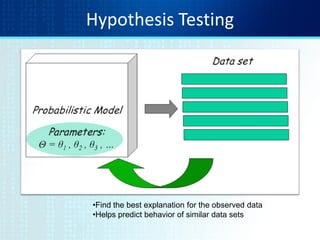
Hypothesis Testing
•Find the best explanation for the observed data
•Helps predict behavior of similar data sets
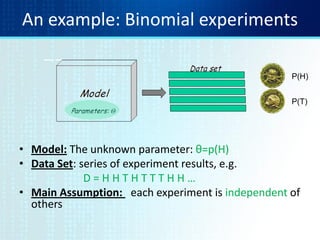
An example: Binomial experiments
• Model: The unknown parameter: θ=p(H)
• Data Set: series of experiment results, e.g.
D = H H T H T T T H H …
• Main Assumption: each experiment is independent of
others
P(H)
P(T)
Parameter Estimation
Using Likelihood Functions
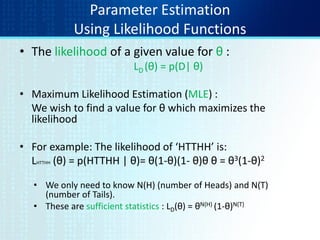
• The likelihood of a given value for θ :
LD (θ) = p(D| θ)
• Maximum Likelihood Estimation (MLE) :
We wish to find a value for θ which maximizes the
likelihood
• For example: The likelihood of ‘HTTHH’ is:
LHTTHH (θ) = p(HTTHH | θ)= θ(1-θ)(1- θ)θ θ = θ3(1-θ)2
• We only need to know N(H) (number of Heads) and N(T)
(number of Tails).
• These are sufficient statistics : LD(θ) = θN(H) (1-θ)N(T)
Sufficient Statistics
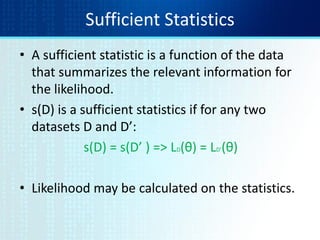
• A sufficient statistic is a function of the data
that summarizes the relevant information for
the likelihood.
• s(D) is a sufficient statistics if for any two
datasets D and D’:
s(D) = s(D’ ) => LD(θ) = LD’(θ)
• Likelihood may be calculated on the statistics.
Maximum Likelihood Estimation
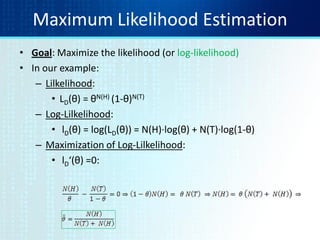
• Goal: Maximize the likelihood (or log-likelihood)
• In our example:
– Lilkelihood:
• LD(θ) = θN(H) (1-θ)N(T)
– Log-Lilkelihood:
• lD(θ) = log(LD(θ)) = N(H)·log(θ) + N(T)·log(1-θ)
– Maximization of Log-Lilkelihood:
• lD‘(θ) =0:
MLE with multiple parameters
• What if we have several parameters θ1, θ2,…, θK that we
wish to learn?
• Examples:
– die toss (K=6)
– Grades (K=100)
• Sufficient statistics [assumption: a series of independent experiments]:
– N1, N2, …, NK - the number of times each outcome was observed
• Likelihood:
• MLE:
From MLE to Bayesian Inference
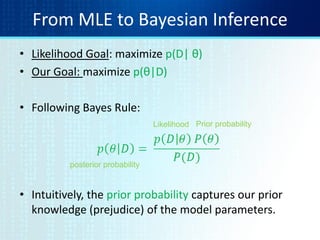
• Likelihood Goal: maximize p(D| θ)
• Our Goal: maximize p(θ|D)
• Following Bayes Rule:
• Intuitively, the prior probability captures our prior
knowledge (prejudice) of the model parameters.
posterior probability
Likelihood Prior probability
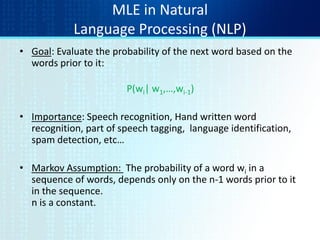
MLE in Natural
Language Processing (NLP)
• Goal: Evaluate the probability of the next word based on the
words prior to it:
P(wi| w1,…,wi-1)
• Importance: Speech recognition, Hand written word
recognition, part of speech tagging, language identification,
spam detection, etc…
• Markov Assumption: The probability of a word wi in a
sequence of words, depends only on the n-1 words prior to it
in the sequence.
n is a constant.
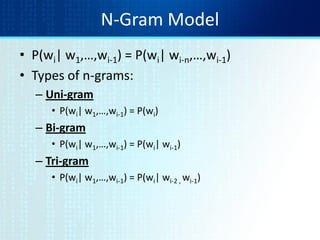
N-Gram Model
• P(wi| w1,…,wi-1) = P(wi| wi-n,…,wi-1)
• Types of n-grams:
– Uni-gram
• P(wi| w1,…,wi-1) = P(wi)
– Bi-gram
• P(wi| w1,…,wi-1) = P(wi| wi-1)
– Tri-gram
• P(wi| w1,…,wi-1) = P(wi| wi-2 , wi-1)
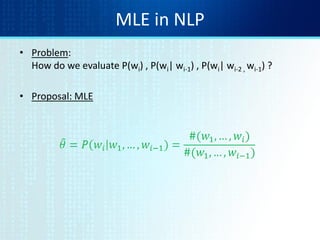
MLE in NLP
• Problem:
How do we evaluate P(wi) , P(wi| wi-1) , P(wi| wi-2 , wi-1) ?
• Proposal: MLE
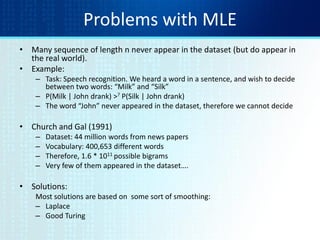
Problems with MLE
• Many sequence of length n never appear in the dataset (but do appear in
the real world).
• Example:
– Task: Speech recognition. We heard a word in a sentence, and wish to decide
between two words: “Milk” and “Silk”
– P(Milk | John drank) >? P(Silk | John drank)
– The word “John” never appeared in the dataset, therefore we cannot decide
• Church and Gal (1991)
– Dataset: 44 million words from news papers
– Vocabulary: 400,653 different words
– Therefore, 1.6 * 1011 possible bigrams
– Very few of them appeared in the dataset….
• Solutions:
Most solutions are based on some sort of smoothing:
– Laplace
– Good Turing
Evaluation
• The null hypothesis, denoted by H0
• The alternative hypothesis, denoted by H1.
• Should we reject the null hypothesis in favor of the alternative?
Input:
– a value from a certain distribution
– we don't know what the parameter of that distribution is.
Test:
– How likely it is that the value we were given could have come from the
distribution with this predicted parameter?
– If it's not very likely, we reject the null hypothesis in favor of the alternative.
• Critical Region
– But what exactly is "not very likely"?
– We choose a region known as the critical region. If the result of our
test lies in this region, then we reject the null hypothesis in favor of
the alternative.
Empirical Evolution methods
• Divide to train and test
– Leave one out
• Cross validation
– 10 fold cross validation
– 5x2 cross validation
• Never (never never!) perform evaluation on
the training data
Never!

Tutorial 2 (mle + language models)

  • 1.
    Hypothesis testing, MLE,language models Kira Radinsky Based on some slides of Ilan Gronau, Ydo Wexler, Dan Geiger & Nir Fridman
  • 2.
    Hypothesis Testing •Find thebest explanation for the observed data •Helps predict behavior of similar data sets
  • 3.
    An example: Binomialexperiments • Model: The unknown parameter: θ=p(H) • Data Set: series of experiment results, e.g. D = H H T H T T T H H … • Main Assumption: each experiment is independent of others P(H) P(T)
  • 4.
    Parameter Estimation Using LikelihoodFunctions • The likelihood of a given value for θ : LD (θ) = p(D| θ) • Maximum Likelihood Estimation (MLE) : We wish to find a value for θ which maximizes the likelihood • For example: The likelihood of ‘HTTHH’ is: LHTTHH (θ) = p(HTTHH | θ)= θ(1-θ)(1- θ)θ θ = θ3(1-θ)2 • We only need to know N(H) (number of Heads) and N(T) (number of Tails). • These are sufficient statistics : LD(θ) = θN(H) (1-θ)N(T)
  • 5.
    Sufficient Statistics • Asufficient statistic is a function of the data that summarizes the relevant information for the likelihood. • s(D) is a sufficient statistics if for any two datasets D and D’: s(D) = s(D’ ) => LD(θ) = LD’(θ) • Likelihood may be calculated on the statistics.
  • 6.
    Maximum Likelihood Estimation •Goal: Maximize the likelihood (or log-likelihood) • In our example: – Lilkelihood: • LD(θ) = θN(H) (1-θ)N(T) – Log-Lilkelihood: • lD(θ) = log(LD(θ)) = N(H)·log(θ) + N(T)·log(1-θ) – Maximization of Log-Lilkelihood: • lD‘(θ) =0:
  • 7.
    MLE with multipleparameters • What if we have several parameters θ1, θ2,…, θK that we wish to learn? • Examples: – die toss (K=6) – Grades (K=100) • Sufficient statistics [assumption: a series of independent experiments]: – N1, N2, …, NK - the number of times each outcome was observed • Likelihood: • MLE:
  • 8.
    From MLE toBayesian Inference • Likelihood Goal: maximize p(D| θ) • Our Goal: maximize p(θ|D) • Following Bayes Rule: • Intuitively, the prior probability captures our prior knowledge (prejudice) of the model parameters. posterior probability Likelihood Prior probability
  • 9.
    MLE in Natural LanguageProcessing (NLP) • Goal: Evaluate the probability of the next word based on the words prior to it: P(wi| w1,…,wi-1) • Importance: Speech recognition, Hand written word recognition, part of speech tagging, language identification, spam detection, etc… • Markov Assumption: The probability of a word wi in a sequence of words, depends only on the n-1 words prior to it in the sequence. n is a constant.
  • 10.
    N-Gram Model • P(wi|w1,…,wi-1) = P(wi| wi-n,…,wi-1) • Types of n-grams: – Uni-gram • P(wi| w1,…,wi-1) = P(wi) – Bi-gram • P(wi| w1,…,wi-1) = P(wi| wi-1) – Tri-gram • P(wi| w1,…,wi-1) = P(wi| wi-2 , wi-1)
  • 11.
    MLE in NLP •Problem: How do we evaluate P(wi) , P(wi| wi-1) , P(wi| wi-2 , wi-1) ? • Proposal: MLE
  • 12.
    Problems with MLE •Many sequence of length n never appear in the dataset (but do appear in the real world). • Example: – Task: Speech recognition. We heard a word in a sentence, and wish to decide between two words: “Milk” and “Silk” – P(Milk | John drank) >? P(Silk | John drank) – The word “John” never appeared in the dataset, therefore we cannot decide • Church and Gal (1991) – Dataset: 44 million words from news papers – Vocabulary: 400,653 different words – Therefore, 1.6 * 1011 possible bigrams – Very few of them appeared in the dataset…. • Solutions: Most solutions are based on some sort of smoothing: – Laplace – Good Turing
  • 13.
    Evaluation • The nullhypothesis, denoted by H0 • The alternative hypothesis, denoted by H1. • Should we reject the null hypothesis in favor of the alternative? Input: – a value from a certain distribution – we don't know what the parameter of that distribution is. Test: – How likely it is that the value we were given could have come from the distribution with this predicted parameter? – If it's not very likely, we reject the null hypothesis in favor of the alternative. • Critical Region – But what exactly is "not very likely"? – We choose a region known as the critical region. If the result of our test lies in this region, then we reject the null hypothesis in favor of the alternative.
  • 14.
    Empirical Evolution methods •Divide to train and test – Leave one out • Cross validation – 10 fold cross validation – 5x2 cross validation • Never (never never!) perform evaluation on the training data Never!