Propositional Logic and
predicate logic
Big Ideas
• Logic is a great knowledge representation
language for many AI problems
• Propositional logic is the simple
foundation and fine for some AI problems
• First order logic (FOL) is much more
expressive as a KR language and more
commonly used in AI
• There are many variations: horn logic,
higher order logic, three-valued logic,
probabilistic logics, etc.
Propositional logic (PL)
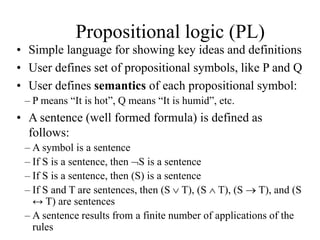
• Simple language for showing key ideas and definitions
• User defines set of propositional symbols, like P and Q
• User defines semantics of each propositional symbol:
– P means “It is hot”, Q means “It is humid”, etc.
• A sentence (well formed formula) is defined as
follows:
– A symbol is a sentence
– If S is a sentence, then S is a sentence
– If S is a sentence, then (S) is a sentence
– If S and T are sentences, then (S  T), (S  T), (S  T), and (S
↔ T) are sentences
– A sentence results from a finite number of applications of the
rules
Propositional logic
• Logical constants: true, false
• Propositional symbols: P, Q,... (atomic sentences)
• Wrapping parentheses: ( … )
• Sentences are combined by connectives:
 and [conjunction]
 or [disjunction]
implies [implication / conditional]
 is equivalent[biconditional]
 not [negation]
• Literal: atomic sentence or negated atomic sentence
P,  P
Examples of PL sentences
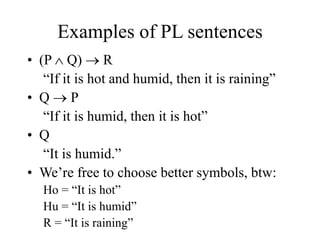
• (P  Q)  R
“If it is hot and humid, then it is raining”
• Q  P
“If it is humid, then it is hot”
• Q
“It is humid.”
• We’re free to choose better symbols, btw:
Ho = “It is hot”
Hu = “It is humid”
R = “It is raining”
Some terms
• The meaning or semantics of a sentence
determines its interpretation
• Given the truth values of all symbols in a
sentence, it can be “evaluated” to determine
its truth value (True or False)
• A model for a KB is a possible world – an
assignment of truth values to propositional
symbols that makes each sentence in the KB
True
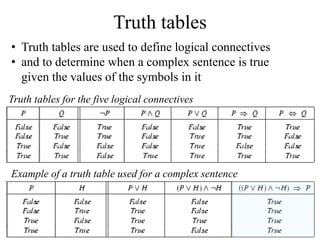
Truth tables
Truth tables for the five logical connectives
Example of a truth table used for a complex sentence
• Truth tables are used to define logical connectives
• and to determine when a complex sentence is true
given the values of the symbols in it
On the implies connective:
P  Q
• Note that  is a logical connective
• So PQ is a logical sentence and has a
truth value, i.e., is either true or false
• If we add this sentence to the KB, it can be
used by an inference rule, Modes Ponens, to
derive/infer/prove Q if P is also in the KB
• Given a KB where P=True and Q=True, we
can also derive/infer/prove that PQ is
True
Propositional Logic can’t say
• If X is married to Y, then Y is married to X.
• If X is west of Y, and Y is west of Z, then X
is west of Z.
• And a million other simple things.
• Fix:
– extend representation: add predicates
– Extend operator(resolution): add unification
Syntax
• See text for formal rules.
• All of propositional + quantifiers, predicates,
functions, and constants.
• Variables can take on values of constants or terms.
• Term = reference to object
• Variables not allowed to be predicates.
– E.G. What is the relationship between Bill and Hillary?
• Text Notation: variables lower case, constants upper
• Prolog Notation: variables are upper case, etc
Semantics
• Validity = true in every model and every
interpretation.
• Interpretation = mapping of constants,
predicates, functions into objects, relations,
and functions.
Advance Artificial
Intelligence
12
Predicate Calculus
So it is a better idea to use predicates instead of
propositions.
This leads us to predicate calculus.
Predicate calculus has symbols called
• object constants,
• relation constants, and
• function constants
These symbols will be used to refer to objects in the world
and to propositions about the word.
Advance Artificial
Intelligence
13
Quantification
Introducing the universal quantifier  and the existential
quantifier  facilitates the translation of world knowledge
into predicate calculus.
Examples:
Paul beats up all professors who fail him.
x(Professor(x)  Fails(x, Paul)  BeatsUp(Paul, x))
There is at least one intelligent UMB professor.
x(UMBProf(x)  Intelligent(x))
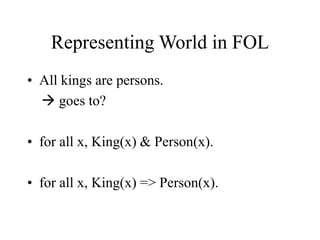
Representing World in FOL
• All kings are persons.
 goes to?
• for all x, King(x) & Person(x).
• for all x, King(x) => Person(x).
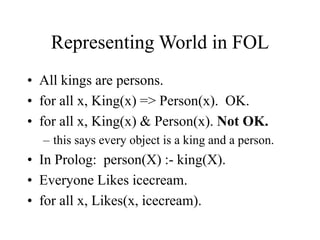
Representing World in FOL
• All kings are persons.
• for all x, King(x) => Person(x). OK.
• for all x, King(x) & Person(x). Not OK.
– this says every object is a king and a person.
• In Prolog: person(X) :- king(X).
• Everyone Likes icecream.
• for all x, Likes(x, icecream).
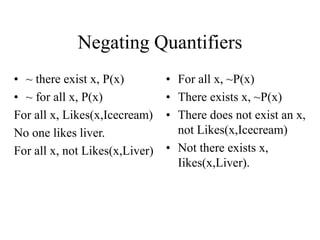
Negating Quantifiers
• ~ there exist x, P(x)
• ~ for all x, P(x)
For all x, Likes(x,Icecream)
No one likes liver.
For all x, not Likes(x,Liver)
• For all x, ~P(x)
• There exists x, ~P(x)
• There does not exist an x,
not Likes(x,Icecream)
• Not there exists x,
Iikes(x,Liver).
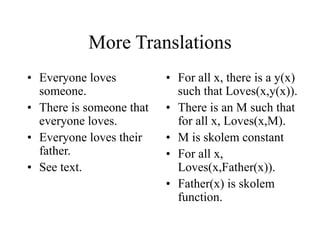
More Translations
• Everyone loves
someone.
• There is someone that
everyone loves.
• Everyone loves their
father.
• See text.
• For all x, there is a y(x)
such that Loves(x,y(x)).
• There is an M such that
for all x, Loves(x,M).
• M is skolem constant
• For all x,
Loves(x,Father(x)).
• Father(x) is skolem
function.
Occurs Checking
• When unifying a variable against a complex
term, the complex term should not contain
the same variable, else non-match.
• Prolog doesn’t check this.
• Ex. f(X,X) and f(Y,g(Y)) should not unify.
Modeling with Definite Clauses:
at most one positive literal
1. It is a crime for an american to sell weapons to a
hostile country.
1’. American(x)&Weapons(y)&Hostile(z) &
Sell(x,y,z) => Criminal (x).
2. The country Nono has some missiles.
There exists x Owns(Nono,x)&Missile(x).
2’. Missile(M1). … Skolem Constant introduction
2’’. Owns(Nono,M1).
Resolution gives forward chaining
• Enemy(x,America)
=>Hostile(x)
• Enemy(Nono,America)
• |- Hostile(Nono)
• Not Enemy(x,America)
or Hostile(x)
• Enemy(Nono,America)
• Resolve by {x/Nono}
• To Hostile(Nono)
FOL -> Conjuctive Normal Form
• Similar to process for propositional logic, but
• Use negations rules for quantifiers
• Standarize variables apart
• Universal quantification is implicit.
• Skolemization: introduction of constants and
functions to remove existential quantifiers.
Time
• Before (x,y) implies After(y,x)
• After(x,y) imples Before(y,x)
• Before(x,y) and Before(y,z) implies
Before(x,z) etc.
• When are you done?
• What about during?
Space and more
• In(x,y) and In(y,z) implies in(x,z).
• Infront, behind, etc
• Frame problem: you turn, some predicates
change and some don’t.
• etc.
And lots more: heat, wind, hitting, physical
objects versus thoughts, knowing,

predicateLogic.ppt

  • 1.
  • 2.
    Big Ideas • Logicis a great knowledge representation language for many AI problems • Propositional logic is the simple foundation and fine for some AI problems • First order logic (FOL) is much more expressive as a KR language and more commonly used in AI • There are many variations: horn logic, higher order logic, three-valued logic, probabilistic logics, etc.
  • 3.
    Propositional logic (PL) •Simple language for showing key ideas and definitions • User defines set of propositional symbols, like P and Q • User defines semantics of each propositional symbol: – P means “It is hot”, Q means “It is humid”, etc. • A sentence (well formed formula) is defined as follows: – A symbol is a sentence – If S is a sentence, then S is a sentence – If S is a sentence, then (S) is a sentence – If S and T are sentences, then (S  T), (S  T), (S  T), and (S ↔ T) are sentences – A sentence results from a finite number of applications of the rules
  • 4.
    Propositional logic • Logicalconstants: true, false • Propositional symbols: P, Q,... (atomic sentences) • Wrapping parentheses: ( … ) • Sentences are combined by connectives:  and [conjunction]  or [disjunction] implies [implication / conditional]  is equivalent[biconditional]  not [negation] • Literal: atomic sentence or negated atomic sentence P,  P
  • 5.
    Examples of PLsentences • (P  Q)  R “If it is hot and humid, then it is raining” • Q  P “If it is humid, then it is hot” • Q “It is humid.” • We’re free to choose better symbols, btw: Ho = “It is hot” Hu = “It is humid” R = “It is raining”
  • 6.
    Some terms • Themeaning or semantics of a sentence determines its interpretation • Given the truth values of all symbols in a sentence, it can be “evaluated” to determine its truth value (True or False) • A model for a KB is a possible world – an assignment of truth values to propositional symbols that makes each sentence in the KB True
  • 7.
    Truth tables Truth tablesfor the five logical connectives Example of a truth table used for a complex sentence • Truth tables are used to define logical connectives • and to determine when a complex sentence is true given the values of the symbols in it
  • 8.
    On the impliesconnective: P  Q • Note that  is a logical connective • So PQ is a logical sentence and has a truth value, i.e., is either true or false • If we add this sentence to the KB, it can be used by an inference rule, Modes Ponens, to derive/infer/prove Q if P is also in the KB • Given a KB where P=True and Q=True, we can also derive/infer/prove that PQ is True
  • 9.
    Propositional Logic can’tsay • If X is married to Y, then Y is married to X. • If X is west of Y, and Y is west of Z, then X is west of Z. • And a million other simple things. • Fix: – extend representation: add predicates – Extend operator(resolution): add unification
  • 10.
    Syntax • See textfor formal rules. • All of propositional + quantifiers, predicates, functions, and constants. • Variables can take on values of constants or terms. • Term = reference to object • Variables not allowed to be predicates. – E.G. What is the relationship between Bill and Hillary? • Text Notation: variables lower case, constants upper • Prolog Notation: variables are upper case, etc
  • 11.
    Semantics • Validity =true in every model and every interpretation. • Interpretation = mapping of constants, predicates, functions into objects, relations, and functions.
  • 12.
    Advance Artificial Intelligence 12 Predicate Calculus Soit is a better idea to use predicates instead of propositions. This leads us to predicate calculus. Predicate calculus has symbols called • object constants, • relation constants, and • function constants These symbols will be used to refer to objects in the world and to propositions about the word.
  • 13.
    Advance Artificial Intelligence 13 Quantification Introducing theuniversal quantifier  and the existential quantifier  facilitates the translation of world knowledge into predicate calculus. Examples: Paul beats up all professors who fail him. x(Professor(x)  Fails(x, Paul)  BeatsUp(Paul, x)) There is at least one intelligent UMB professor. x(UMBProf(x)  Intelligent(x))
  • 14.
    Representing World inFOL • All kings are persons.  goes to? • for all x, King(x) & Person(x). • for all x, King(x) => Person(x).
  • 15.
    Representing World inFOL • All kings are persons. • for all x, King(x) => Person(x). OK. • for all x, King(x) & Person(x). Not OK. – this says every object is a king and a person. • In Prolog: person(X) :- king(X). • Everyone Likes icecream. • for all x, Likes(x, icecream).
  • 16.
    Negating Quantifiers • ~there exist x, P(x) • ~ for all x, P(x) For all x, Likes(x,Icecream) No one likes liver. For all x, not Likes(x,Liver) • For all x, ~P(x) • There exists x, ~P(x) • There does not exist an x, not Likes(x,Icecream) • Not there exists x, Iikes(x,Liver).
  • 17.
    More Translations • Everyoneloves someone. • There is someone that everyone loves. • Everyone loves their father. • See text. • For all x, there is a y(x) such that Loves(x,y(x)). • There is an M such that for all x, Loves(x,M). • M is skolem constant • For all x, Loves(x,Father(x)). • Father(x) is skolem function.
  • 18.
    Occurs Checking • Whenunifying a variable against a complex term, the complex term should not contain the same variable, else non-match. • Prolog doesn’t check this. • Ex. f(X,X) and f(Y,g(Y)) should not unify.
  • 19.
    Modeling with DefiniteClauses: at most one positive literal 1. It is a crime for an american to sell weapons to a hostile country. 1’. American(x)&Weapons(y)&Hostile(z) & Sell(x,y,z) => Criminal (x). 2. The country Nono has some missiles. There exists x Owns(Nono,x)&Missile(x). 2’. Missile(M1). … Skolem Constant introduction 2’’. Owns(Nono,M1).
  • 20.
    Resolution gives forwardchaining • Enemy(x,America) =>Hostile(x) • Enemy(Nono,America) • |- Hostile(Nono) • Not Enemy(x,America) or Hostile(x) • Enemy(Nono,America) • Resolve by {x/Nono} • To Hostile(Nono)
  • 21.
    FOL -> ConjuctiveNormal Form • Similar to process for propositional logic, but • Use negations rules for quantifiers • Standarize variables apart • Universal quantification is implicit. • Skolemization: introduction of constants and functions to remove existential quantifiers.
  • 22.
    Time • Before (x,y)implies After(y,x) • After(x,y) imples Before(y,x) • Before(x,y) and Before(y,z) implies Before(x,z) etc. • When are you done? • What about during?
  • 23.
    Space and more •In(x,y) and In(y,z) implies in(x,z). • Infront, behind, etc • Frame problem: you turn, some predicates change and some don’t. • etc. And lots more: heat, wind, hitting, physical objects versus thoughts, knowing,