Naïve Bayes
Chapter 4, DDS
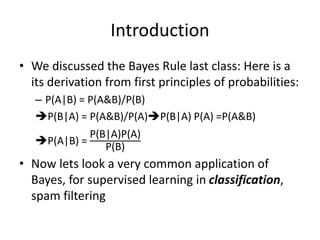
Introduction
• We discussed the Bayes Rule last class: Here is a
its derivation from first principles of probabilities:
– P(A|B) = P(A&B)/P(B)
P(B|A) = P(A&B)/P(A)P(B|A) P(A) =P(A&B)
P(A|B) =
P(B|A)P(A)
P(B)
• Now lets look a very common application of
Bayes, for supervised learning in classification,
spam filtering
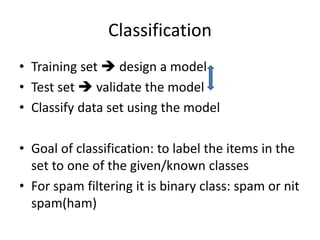
Classification
• Training set  design a model
• Test set  validate the model
• Classify data set using the model
• Goal of classification: to label the items in the
set to one of the given/known classes
• For spam filtering it is binary class: spam or nit
spam(ham)
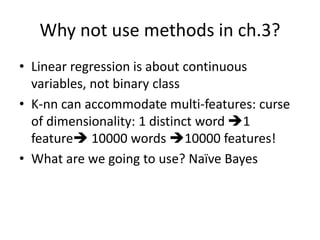
Why not use methods in ch.3?
• Linear regression is about continuous
variables, not binary class
• K-nn can accommodate multi-features: curse
of dimensionality: 1 distinct word 1
feature 10000 words 10000 features!
• What are we going to use? Naïve Bayes
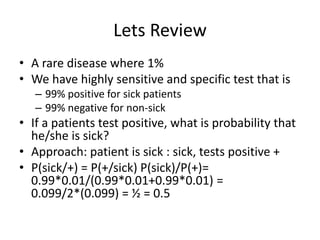
Lets Review
• A rare disease where 1%
• We have highly sensitive and specific test that is
– 99% positive for sick patients
– 99% negative for non-sick
• If a patients test positive, what is probability that
he/she is sick?
• Approach: patient is sick : sick, tests positive +
• P(sick/+) = P(+/sick) P(sick)/P(+)=
0.99*0.01/(0.99*0.01+0.99*0.01) =
0.099/2*(0.099) = ½ = 0.5
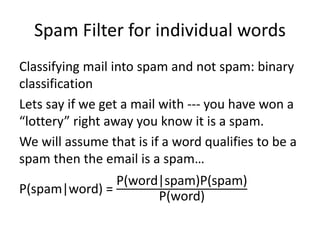
Spam Filter for individual words
Classifying mail into spam and not spam: binary
classification
Lets say if we get a mail with --- you have won a
“lottery” right away you know it is a spam.
We will assume that is if a word qualifies to be a
spam then the email is a spam…
P(spam|word) =
P(word|spam)P(spam)
P(word)
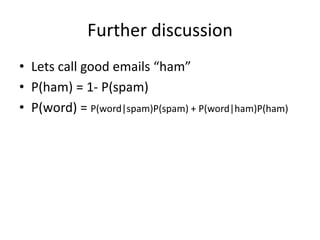
Further discussion
• Lets call good emails “ham”
• P(ham) = 1- P(spam)
• P(word) = P(word|spam)P(spam) + P(word|ham)P(ham)
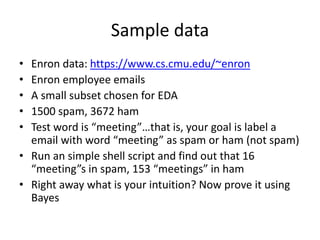
Sample data
• Enron data: https://www.cs.cmu.edu/~enron
• Enron employee emails
• A small subset chosen for EDA
• 1500 spam, 3672 ham
• Test word is “meeting”…that is, your goal is label a
email with word “meeting” as spam or ham (not spam)
• Run an simple shell script and find out that 16
“meeting”s in spam, 153 “meetings” in ham
• Right away what is your intuition? Now prove it using
Bayes
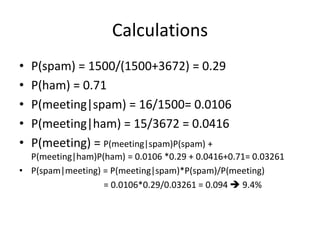
Calculations
• P(spam) = 1500/(1500+3672) = 0.29
• P(ham) = 0.71
• P(meeting|spam) = 16/1500= 0.0106
• P(meeting|ham) = 15/3672 = 0.0416
• P(meeting) = P(meeting|spam)P(spam) +
P(meeting|ham)P(ham) = 0.0106 *0.29 + 0.0416+0.71= 0.03261
• P(spam|meeting) = P(meeting|spam)*P(spam)/P(meeting)
= 0.0106*0.29/0.03261 = 0.094  9.4%
Simulation using bash shell script
• On to demo
• This code is available in pages 105-106 … good
luck with the typos… figure it out
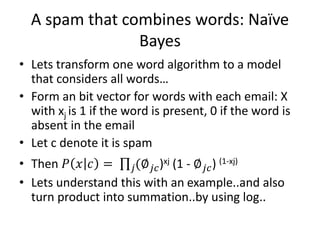
A spam that combines words: Naïve
Bayes
• Lets transform one word algorithm to a model
that considers all words…
• Form an bit vector for words with each email: X
with xj is 1 if the word is present, 0 if the word is
absent in the email
• Let c denote it is spam
• Then 𝑃 𝑥 𝑐 = 𝑗(∅ 𝑗𝑐)xj (1 - ∅ 𝑗𝑐) (1-xj)
• Lets understand this with an example..and also
turn product into summation..by using log..
Multi-word (contd.)
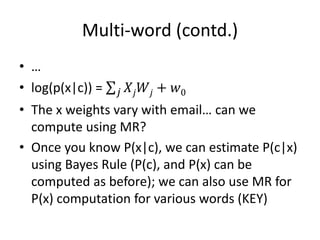
• …
• log(p(x|c)) = 𝑗 𝑋𝑗 𝑊𝑗 + 𝑤0
• The x weights vary with email… can we
compute using MR?
• Once you know P(x|c), we can estimate P(c|x)
using Bayes Rule (P(c), and P(x) can be
computed as before); we can also use MR for
P(x) computation for various words (KEY)
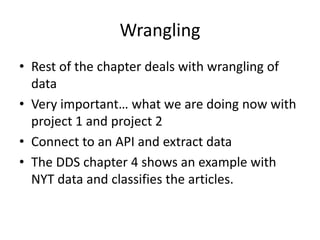
Wrangling
• Rest of the chapter deals with wrangling of
data
• Very important… what we are doing now with
project 1 and project 2
• Connect to an API and extract data
• The DDS chapter 4 shows an example with
NYT data and classifies the articles.
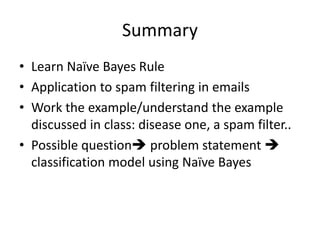
Summary
• Learn Naïve Bayes Rule
• Application to spam filtering in emails
• Work the example/understand the example
discussed in class: disease one, a spam filter..
• Possible question problem statement 
classification model using Naïve Bayes

Naïve bayes

  • 1.
  • 2.
    Introduction • We discussedthe Bayes Rule last class: Here is a its derivation from first principles of probabilities: – P(A|B) = P(A&B)/P(B) P(B|A) = P(A&B)/P(A)P(B|A) P(A) =P(A&B) P(A|B) = P(B|A)P(A) P(B) • Now lets look a very common application of Bayes, for supervised learning in classification, spam filtering
  • 3.
    Classification • Training set design a model • Test set  validate the model • Classify data set using the model • Goal of classification: to label the items in the set to one of the given/known classes • For spam filtering it is binary class: spam or nit spam(ham)
  • 4.
    Why not usemethods in ch.3? • Linear regression is about continuous variables, not binary class • K-nn can accommodate multi-features: curse of dimensionality: 1 distinct word 1 feature 10000 words 10000 features! • What are we going to use? Naïve Bayes
  • 5.
    Lets Review • Arare disease where 1% • We have highly sensitive and specific test that is – 99% positive for sick patients – 99% negative for non-sick • If a patients test positive, what is probability that he/she is sick? • Approach: patient is sick : sick, tests positive + • P(sick/+) = P(+/sick) P(sick)/P(+)= 0.99*0.01/(0.99*0.01+0.99*0.01) = 0.099/2*(0.099) = ½ = 0.5
  • 6.
    Spam Filter forindividual words Classifying mail into spam and not spam: binary classification Lets say if we get a mail with --- you have won a “lottery” right away you know it is a spam. We will assume that is if a word qualifies to be a spam then the email is a spam… P(spam|word) = P(word|spam)P(spam) P(word)
  • 7.
    Further discussion • Letscall good emails “ham” • P(ham) = 1- P(spam) • P(word) = P(word|spam)P(spam) + P(word|ham)P(ham)
  • 8.
    Sample data • Enrondata: https://www.cs.cmu.edu/~enron • Enron employee emails • A small subset chosen for EDA • 1500 spam, 3672 ham • Test word is “meeting”…that is, your goal is label a email with word “meeting” as spam or ham (not spam) • Run an simple shell script and find out that 16 “meeting”s in spam, 153 “meetings” in ham • Right away what is your intuition? Now prove it using Bayes
  • 9.
    Calculations • P(spam) =1500/(1500+3672) = 0.29 • P(ham) = 0.71 • P(meeting|spam) = 16/1500= 0.0106 • P(meeting|ham) = 15/3672 = 0.0416 • P(meeting) = P(meeting|spam)P(spam) + P(meeting|ham)P(ham) = 0.0106 *0.29 + 0.0416+0.71= 0.03261 • P(spam|meeting) = P(meeting|spam)*P(spam)/P(meeting) = 0.0106*0.29/0.03261 = 0.094  9.4%
  • 10.
    Simulation using bashshell script • On to demo • This code is available in pages 105-106 … good luck with the typos… figure it out
  • 11.
    A spam thatcombines words: Naïve Bayes • Lets transform one word algorithm to a model that considers all words… • Form an bit vector for words with each email: X with xj is 1 if the word is present, 0 if the word is absent in the email • Let c denote it is spam • Then 𝑃 𝑥 𝑐 = 𝑗(∅ 𝑗𝑐)xj (1 - ∅ 𝑗𝑐) (1-xj) • Lets understand this with an example..and also turn product into summation..by using log..
  • 12.
    Multi-word (contd.) • … •log(p(x|c)) = 𝑗 𝑋𝑗 𝑊𝑗 + 𝑤0 • The x weights vary with email… can we compute using MR? • Once you know P(x|c), we can estimate P(c|x) using Bayes Rule (P(c), and P(x) can be computed as before); we can also use MR for P(x) computation for various words (KEY)
  • 13.
    Wrangling • Rest ofthe chapter deals with wrangling of data • Very important… what we are doing now with project 1 and project 2 • Connect to an API and extract data • The DDS chapter 4 shows an example with NYT data and classifies the articles.
  • 14.
    Summary • Learn NaïveBayes Rule • Application to spam filtering in emails • Work the example/understand the example discussed in class: disease one, a spam filter.. • Possible question problem statement  classification model using Naïve Bayes