A
Presentation on
“Axial Flow Compressors and Fans”
Submitted By:
Uga Ram Prajapat
M. E. (Thermal Engineering)
1st Semester, 1st Year
1
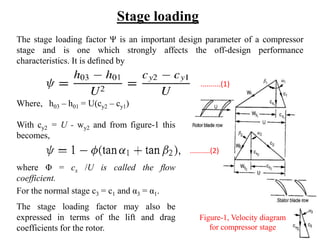
The stage loading factor Ψ is an important design parameter of a compressor
stage and is one which strongly affects the off-design performance
characteristics. It is defined by
Where, h03 – h01 = U(cy2 – cy1)
With cy2 = U - wy2 and from figure-1 this
becomes,
where Φ = cx /U is called the flow
coefficient.
The stage loading factor may also be
expressed in terms of the lift and drag
coefficients for the rotor.
Stage loading
For the normal stage c3 = c1 and α3 = α1.
Figure-1, Velocity diagram
for compressor stage
..........(1)
..........(2)
2
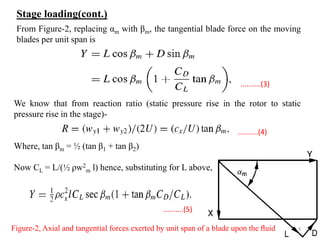
From Figure-2, replacing αm with βm, the tangential blade force on the moving
blades per unit span is
We know that from reaction ratio (static pressure rise in the rotor to static
pressure rise in the stage)-
Where, tan βm = ½ (tan β1 + tan β2)
Now CL = L/(½ ρw2
m l) hence, substituting for L above,
Figure-2, Axial and tangential forces exerted by unit span of a blade upon the fluid
..........(3)
..........(4)
..........(5)
Stage loading(cont.)
3
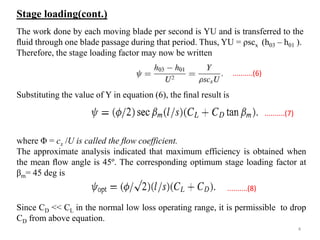
The work done by each moving blade per second is YU and is transferred to the
fluid through one blade passage during that period. Thus, YU = ρscx (h03 – h01 ).
Therefore, the stage loading factor may now be written
Substituting the value of Y in equation (6), the final result is
where Φ = cx /U is called the flow coefficient.
The approximate analysis indicated that maximum efficiency is obtained when
the mean flow angle is 45º. The corresponding optimum stage loading factor at
βm= 45 deg is
Since CD << CL in the normal low loss operating range, it is permissible to drop
CD from above equation.
..........(6)
..........(7)
..........(8)
Stage loading(cont.)
4
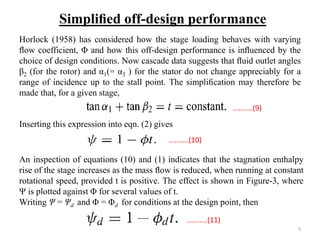
Horlock (1958) has considered how the stage loading behaves with varying
flow coefficient, Φ and how this off-design performance is influenced by the
choice of design conditions. Now cascade data suggests that fluid outlet angles
β2 (for the rotor) and α1(= α3 ) for the stator do not change appreciably for a
range of incidence up to the stall point. The simplification may therefore be
made that, for a given stage,
Inserting this expression into eqn. (2) gives
An inspection of equations (10) and (1) indicates that the stagnation enthalpy
rise of the stage increases as the mass flow is reduced, when running at constant
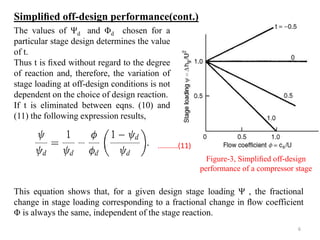
rotational speed, provided t is positive. The effect is shown in Figure-3, where
Ψ is plotted against Φ for several values of t.
Writing Ψ = Ψd and Φ = Φd for conditions at the design point, then
Simplified off-design performance
..........(9)
..........(10)
..........(11)
5
The values of Ψd and Φd chosen for a
particular stage design determines the value
of t.
Thus t is fixed without regard to the degree
of reaction and, therefore, the variation of
stage loading at off-design conditions is not
dependent on the choice of design reaction.
If t is eliminated between eqns. (10) and
(11) the following expression results,
..........(11)
Figure-3, Simplified off-design
performance of a compressor stage
This equation shows that, for a given design stage loading Ψ , the fractional
change in stage loading corresponding to a fractional change in flow coefficient
Φ is always the same, independent of the stage reaction.
Simplified off-design performance(cont.)
6
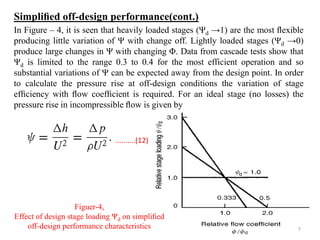
In Figure – 4, it is seen that heavily loaded stages (Ψd →1) are the most flexible
producing little variation of Ψ with change off. Lightly loaded stages (Ψd →0)
produce large changes in Ψ with changing Φ. Data from cascade tests show that
Ψd is limited to the range 0.3 to 0.4 for the most efficient operation and so
substantial variations of Ψ can be expected away from the design point. In order
to calculate the pressure rise at off-design conditions the variation of stage
efficiency with flow coefficient is required. For an ideal stage (no losses) the
pressure rise in incompressible flow is given by
..........(12)
Figuer-4,
Effect of design stage loading Ψd on simplified
off-design performance characteristics
Simplified off-design performance(cont.)
7
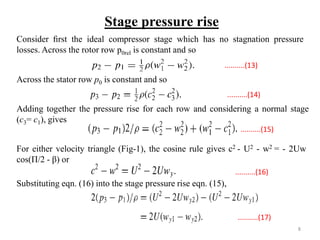
Consider first the ideal compressor stage which has no stagnation pressure
losses. Across the rotor row p0rel is constant and so
Across the stator row p0 is constant and so
Adding together the pressure rise for each row and considering a normal stage
(c3= c1), gives
For either velocity triangle (Fig-1), the cosine rule gives c2 - U2 - w2 = - 2Uw
cos(Π/2 - β) or
Substituting eqn. (16) into the stage pressure rise eqn. (15),
Stage pressure rise
..........(13)
..........(15)
..........(14)
..........(16)
..........(17)
8
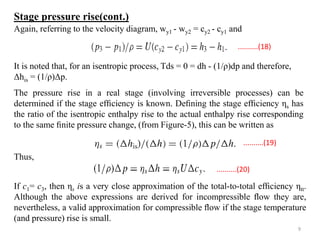
It is noted that, for an isentropic process, Tds = 0 = dh - (1/ρ)dp and therefore,
Δhis = (1/ρ)Δp.
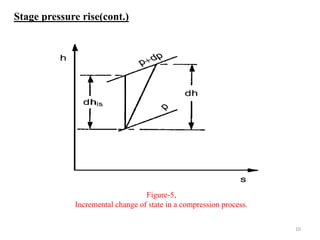
The pressure rise in a real stage (involving irreversible processes) can be
determined if the stage efficiency is known. Defining the stage efficiency ηs has
the ratio of the isentropic enthalpy rise to the actual enthalpy rise corresponding
to the same finite pressure change, (from Figure-5), this can be written as
Thus,
If c1= c3, then ηs is a very close approximation of the total-to-total efficiency ηtt.
Although the above expressions are derived for incompressible flow they are,
nevertheless, a valid approximation for compressible flow if the stage temperature
(and pressure) rise is small.
Again, referring to the velocity diagram, wy1 - wy2 = cy2 - cy1 and
..........(18)
..........(19)
..........(20)
Stage pressure rise(cont.)
9
Figure-5,
Incremental change of state in a compression process.
Stage pressure rise(cont.)
10
It is possible to apply the preceding analysis to the determination of multistage
compressor pressure ratios.
The procedure requires the calculation of pressure and temperature changes for a
single stage, the stage exit conditions enabling the density at entry to the following
stage to be found.
This calculation is repeated for each stage in turn until the required final conditions
are satisfied.
However, for compressors having identical stages it is more convenient to resort to
a simple compressible flow analysis.
Pressure ratio of a multistage compressor
11
Solution:-
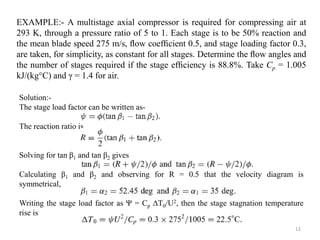
The stage load factor can be written as-
The reaction ratio is
Solving for tan β1 and tan β2 gives
Calculating β1 and β2 and observing for R = 0.5 that the velocity diagram is
symmetrical,
Writing the stage load factor as Ψ = Cp ΔT0/U2, then the stage stagnation temperature
rise is
EXAMPLE:- A multistage axial compressor is required for compressing air at
293 K, through a pressure ratio of 5 to 1. Each stage is to be 50% reaction and
the mean blade speed 275 m/s, flow coefficient 0.5, and stage loading factor 0.3,
are taken, for simplicity, as constant for all stages. Determine the flow angles and
the number of stages required if the stage efficiency is 88.8%. Take Cp = 1.005
kJ/(kg°C) and γ = 1.4 for air.
12
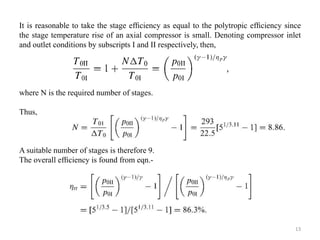
It is reasonable to take the stage efficiency as equal to the polytropic efficiency since
the stage temperature rise of an axial compressor is small. Denoting compressor inlet
and outlet conditions by subscripts I and II respectively, then,
where N is the required number of stages.
Thus,
A suitable number of stages is therefore 9.
The overall efficiency is found from eqn.-
13
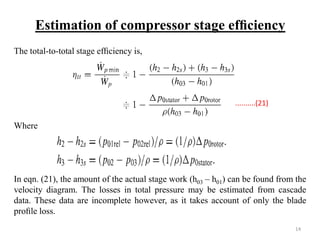
The total-to-total stage efficiency is,
Where
In eqn. (21), the amount of the actual stage work (h03 – h01) can be found from the
velocity diagram. The losses in total pressure may be estimated from cascade
data. These data are incomplete however, as it takes account of only the blade
profile loss.
Estimation of compressor stage efficiency
..........(21)
14
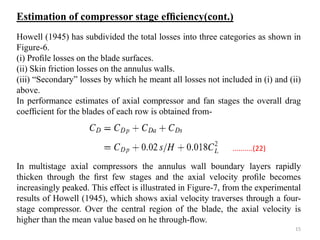
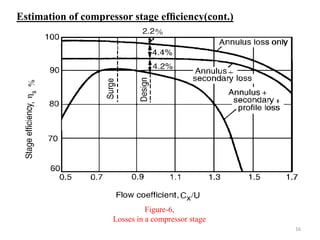
Howell (1945) has subdivided the total losses into three categories as shown in
Figure-6.
(i) Profile losses on the blade surfaces.
(ii) Skin friction losses on the annulus walls.
(iii) “Secondary” losses by which he meant all losses not included in (i) and (ii)
above.
In performance estimates of axial compressor and fan stages the overall drag
coefficient for the blades of each row is obtained from-
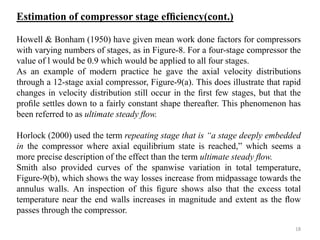
In multistage axial compressors the annulus wall boundary layers rapidly
thicken through the first few stages and the axial velocity profile becomes

increasingly peaked. This effect is illustrated in Figure-7, from the experimental
results of Howell (1945), which shows axial velocity traverses through a four-

stage compressor. Over the central region of the blade, the axial velocity is
higher than the mean value based on he through-flow.
..........(22)
Estimation of compressor stage efficiency(cont.)
15
Figure-6,
Losses in a compressor stage
Estimation of compressor stage efficiency(cont.)
16
The mean blade section (and most of the span) will, therefore, do less work than
is estimated from the velocity triangles based on the mean axial velocity.
In theory it would be expected that the tip and root sections would provide a
compensatory effect because of the low axial velocity in these regions. Due to
stalling of these sections (and tip leakage) no such work increase actually
occurs, and the net result is that the work done by the whole blade is below the
design figure.
Howell (1945) suggested that the stagnation enthalpy rise across a stage could
be expressed as
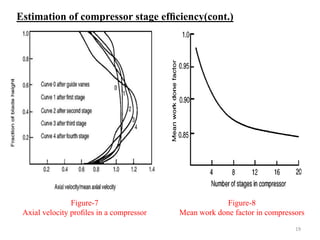
where l is a work done factor. For multistage compressors Howell recommended
for l a mean value of 0.86.
Other workers have suggested that l should be high at entry (0.96) where the
annulus wall boundary layers are thin, reducing progressively in the later stages
of the compressor (0.85).
..........(23)
Estimation of compressor stage efficiency(cont.)
17
Howell & Bonham (1950) have given mean work done factors for compressors
with varying numbers of stages, as in Figure-8. For a four-stage compressor the
value of l would be 0.9 which would be applied to all four stages.
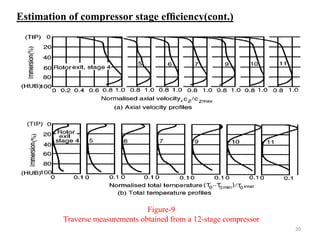
As an example of modern practice he gave the axial velocity distributions
through a 12-stage axial compressor, Figure-9(a). This does illustrate that rapid
changes in velocity distribution still occur in the first few stages, but that the
profile settles down to a fairly constant shape thereafter. This phenomenon has
been referred to as ultimate steady flow.
Horlock (2000) used the term repeating stage that is “a stage deeply embedded
in the compressor where axial equilibrium state is reached,” which seems a
more precise description of the effect than the term ultimate steady flow.
Smith also provided curves of the spanwise variation in total temperature,
Figure-9(b), which shows the way losses increase from midpassage towards the
annulus walls. An inspection of this figure shows also that the excess total
temperature near the end walls increases in magnitude and extent as the flow
passes through the compressor.
Estimation of compressor stage efficiency(cont.)
18
Figure-7
Axial velocity profiles in a compressor
Figure-8
Mean work done factor in compressors
Estimation of compressor stage efficiency(cont.)
19
Figure-9
Traverse measurements obtained from a 12-stage compressor
Estimation of compressor stage efficiency(cont.)
20
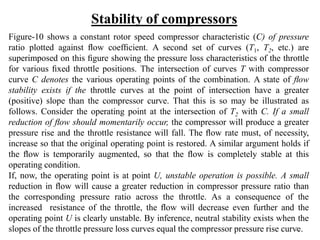
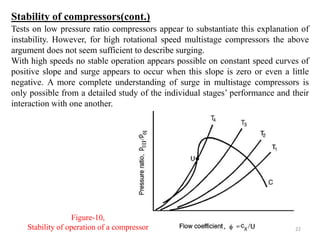
Figure-10 shows a constant rotor speed compressor characteristic (C) of pressure
ratio plotted against flow coefficient. A second set of curves (T1, T2, etc.) are
superimposed on this figure showing the pressure loss characteristics of the throttle
for various fixed throttle positions. The intersection of curves T with compressor
curve C denotes the various operating points of the combination. A state of flow
stability exists if the throttle curves at the point of intersection have a greater
(positive) slope than the compressor curve. That this is so may be illustrated as
follows. Consider the operating point at the intersection of T2 with C. If a small
reduction of flow should momentarily occur, the compressor will produce a greater
pressure rise and the throttle resistance will fall. The flow rate must, of necessity,
increase so that the original operating point is restored. A similar argument holds if
the flow is temporarily augmented, so that the flow is completely stable at this
operating condition.
If, now, the operating point is at point U, unstable operation is possible. A small
reduction in flow will cause a greater reduction in compressor pressure ratio than
the corresponding pressure ratio across the throttle. As a consequence of the
increased resistance of the throttle, the flow will decrease even further and the
operating point U is clearly unstable. By inference, neutral stability exists when the
slopes of the throttle pressure loss curves equal the compressor pressure rise curve.
Stability of compressors
21
Tests on low pressure ratio compressors appear to substantiate this explanation of
instability. However, for high rotational speed multistage compressors the above
argument does not seem sufficient to describe surging.
With high speeds no stable operation appears possible on constant speed curves of
positive slope and surge appears to occur when this slope is zero or even a little
negative. A more complete understanding of surge in multistage compressors is
only possible from a detailed study of the individual stages’ performance and their
interaction with one another.
Figure-10,
Stability of operation of a compressor
Stability of compressors(cont.)
22
An axial-flow fan is simply a single-stage compressor of low-pressure (and
temperature) rise, so that much of the foregoing theory of this chapter is valid for
this class of machine.
However, because of the high space–chord ratio used in many axial fans, a
simplified theoretical approach based on isolated aerofoil theory is often used.
This method can be of use in the design of ventilating fans (usually of high
space–chord ratio) in which aerodynamic interference between adjacent blades
can be assumed negligible.
Attempts have been made to extend the scope of isolated aerofoil theory to less
widely spaced blades by the introduction of an interference factor; for instance,
the ratio k of the lift force of a single blade in a cascade to the lift force of a
single isolated blade.
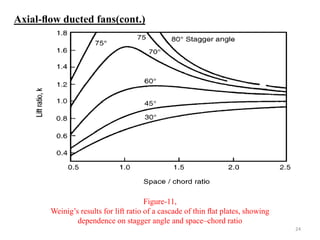
As a guide to the degree of this interference, the exact solution obtained by
Weinig (1935) and used by Wislicenus (1947) for a row of thin flat plates is of
value and is shown in Figure-11.
Axial-flow ducted fans
23
Figure-11,
Weinig’s results for lift ratio of a cascade of thin flat plates, showing
dependence on stagger angle and space–chord ratio
Axial-flow ducted fans(cont.)
24
This illustrates the dependence of k on space–chord ratio for several stagger
angles.
The rather pronounced effect of stagger for moderate space–chord ratios should
be noted as well as the asymptotic convergence of k towards unity for higher
space–chord ratios.
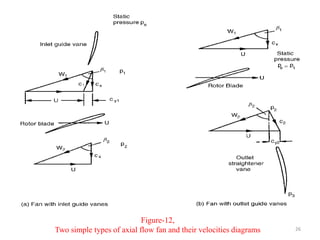
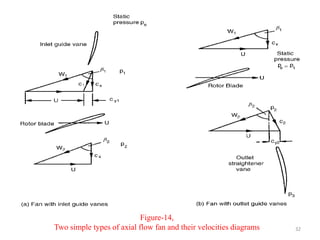
Two simple types of axial-flow fan are shown in Figure-12 in which the inlet and
outlet flow are entirely axial.
In the first type 12(a), a set of guide vanes provides a contra swirl and the flow is
restored to the axial direction by the rotor.
In the second type 12(b), the rotor imparts swirl in the direction of blade motion
and the flow is restored to the axial direction by the action of outlet straighteners
(or outlet guide vanes).
The theory and design of both the above types of fan have been investigated by
Van Niekerk (1958) who was able to formulate expressions for calculating the
optimum sizes and fan speeds using blade element theory.
Axial-flow ducted fans(cont.)
25
Figure-12,
Two simple types of axial flow fan and their velocities diagrams 26
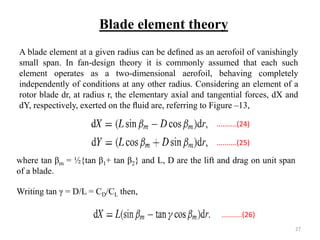
A blade element at a given radius can be defined as an aerofoil of vanishingly
small span. In fan-design theory it is commonly assumed that each such
element operates as a two-dimensional aerofoil, behaving completely
independently of conditions at any other radius. Considering an element of a
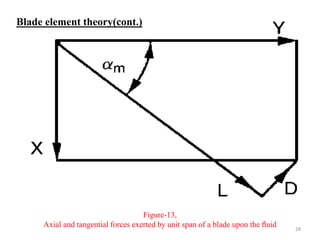
rotor blade dr, at radius r, the elementary axial and tangential forces, dX and
dY, respectively, exerted on the fluid are, referring to Figure –13,
where tan βm = ½{tan β1+ tan β2} and L, D are the lift and drag on unit span
of a blade.
Blade element theory
Writing tan γ = D/L = CD/CL then,
..........(24)
..........(25)
..........(26)
27
Figure-13,
Axial and tangential forces exerted by unit span of a blade upon the fluid
Blade element theory(cont.)
28
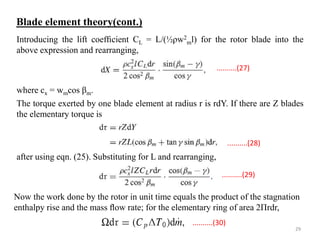
Introducing the lift coefficient CL = L/(½ρw2
ml) for the rotor blade into the
above expression and rearranging,
where cx = wmcos βm.
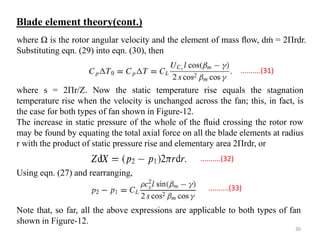
The torque exerted by one blade element at radius r is rdY. If there are Z blades
the elementary torque is
after using eqn. (25). Substituting for L and rearranging,
Now the work done by the rotor in unit time equals the product of the stagnation
enthalpy rise and the mass flow rate; for the elementary ring of area 2Πrdr,
..........(29)
..........(30)
..........(28)
..........(27)
Blade element theory(cont.)
29
where Ω is the rotor angular velocity and the element of mass flow, dṁ = 2Πrdr.
Substituting eqn. (29) into eqn. (30), then
where s = 2Πr/Z. Now the static temperature rise equals the stagnation
temperature rise when the velocity is unchanged across the fan; this, in fact, is
the case for both types of fan shown in Figure-12.
The increase in static pressure of the whole of the fluid crossing the rotor row
may be found by equating the total axial force on all the blade elements at radius
r with the product of static pressure rise and elementary area 2Πrdr, or
Using eqn. (27) and rearranging,
Note that, so far, all the above expressions are applicable to both types of fan
shown in Figure-12.
..........(33)
..........(32)
..........(31)
Blade element theory(cont.)
30
Consider the fan type fitted with guide vanes at inlet shown in figure-14(a).
The pressure rise across this fan is equal to the rotor pressure rise ( p2 – p1) minus
the drop in pressure across the guide vanes ( pe – p1).
The ideal pressure rise across the fan is given by the product of ρ and Cp ΔT0.
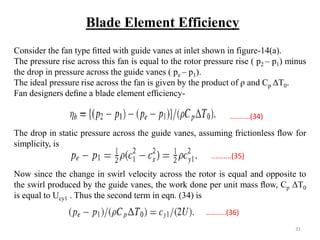
Fan designers define a blade element efficiency-
The drop in static pressure across the guide vanes, assuming frictionless flow for
simplicity, is
Now since the change in swirl velocity across the rotor is equal and opposite to
the swirl produced by the guide vanes, the work done per unit mass flow, Cp ΔT0
is equal to Ucy1 . Thus the second term in eqn. (34) is
Blade Element Efficiency
..........(34)
..........(35)
..........(36)
31
Figure-14,
Two simple types of axial flow fan and their velocities diagrams 32
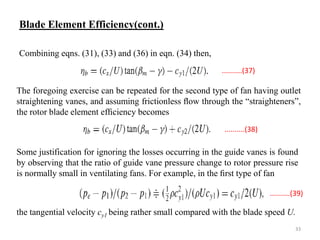
The foregoing exercise can be repeated for the second type of fan having outlet
straightening vanes, and assuming frictionless flow through the “straighteners”,
the rotor blade element efficiency becomes
Some justification for ignoring the losses occurring in the guide vanes is found
by observing that the ratio of guide vane pressure change to rotor pressure rise
is normally small in ventilating fans. For example, in the first type of fan
the tangential velocity cy1 being rather small compared with the blade speed U.
Combining eqns. (31), (33) and (36) in eqn. (34) then,
Blade Element Efficiency(cont.)
..........(37)
..........(38)
..........(39)
33
Lift Coefficient of a fan aerofoil
where α is the angle between the
flow direction and line of zero lift of
the aerofoil.
For an isolated, the zero lift line may
be defined by joining the trailing
edge point with the point of
maximum camber in figure-15(a).
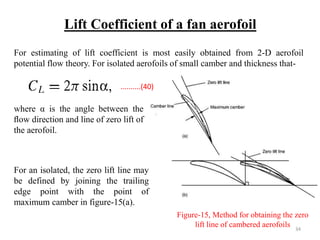
For estimating of lift coefficient is most easily obtained from 2-D aerofoil
potential flow theory. For isolated aerofoils of small camber and thickness that-
Figure-15, Method for obtaining the zero
lift line of cambered aerofoils
..........(40)
34
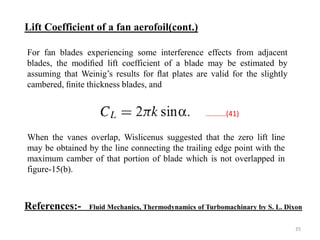
For fan blades experiencing some interference effects from adjacent
blades, the modified lift coefficient of a blade may be estimated by
assuming that Weinig’s results for flat plates are valid for the slightly
cambered, finite thickness blades, and
When the vanes overlap, Wislicenus suggested that the zero lift line
may be obtained by the line connecting the trailing edge point with the
maximum camber of that portion of blade which is not overlapped in
figure-15(b).
Lift Coefficient of a fan aerofoil(cont.)
..........(41)
References:- Fluid Mechanics, Thermodynamics of Turbomachinary by S. L. Dixon
35
36
37

Turbomachinary: Axial flow compressor and fans

  • 1.
    A Presentation on “Axial FlowCompressors and Fans” Submitted By: Uga Ram Prajapat M. E. (Thermal Engineering) 1st Semester, 1st Year 1
  • 2.
    The stage loadingfactor Ψ is an important design parameter of a compressor stage and is one which strongly affects the off-design performance characteristics. It is defined by Where, h03 – h01 = U(cy2 – cy1) With cy2 = U - wy2 and from figure-1 this becomes, where Φ = cx /U is called the flow coefficient. The stage loading factor may also be expressed in terms of the lift and drag coefficients for the rotor. Stage loading For the normal stage c3 = c1 and α3 = α1. Figure-1, Velocity diagram for compressor stage ..........(1) ..........(2) 2
  • 3.
    From Figure-2, replacingαm with βm, the tangential blade force on the moving blades per unit span is We know that from reaction ratio (static pressure rise in the rotor to static pressure rise in the stage)- Where, tan βm = ½ (tan β1 + tan β2) Now CL = L/(½ ρw2 m l) hence, substituting for L above, Figure-2, Axial and tangential forces exerted by unit span of a blade upon the fluid ..........(3) ..........(4) ..........(5) Stage loading(cont.) 3
  • 4.
    The work doneby each moving blade per second is YU and is transferred to the fluid through one blade passage during that period. Thus, YU = ρscx (h03 – h01 ). Therefore, the stage loading factor may now be written Substituting the value of Y in equation (6), the final result is where Φ = cx /U is called the flow coefficient. The approximate analysis indicated that maximum efficiency is obtained when the mean flow angle is 45º. The corresponding optimum stage loading factor at βm= 45 deg is Since CD << CL in the normal low loss operating range, it is permissible to drop CD from above equation. ..........(6) ..........(7) ..........(8) Stage loading(cont.) 4
  • 5.
    Horlock (1958) hasconsidered how the stage loading behaves with varying flow coefficient, Φ and how this off-design performance is influenced by the choice of design conditions. Now cascade data suggests that fluid outlet angles β2 (for the rotor) and α1(= α3 ) for the stator do not change appreciably for a range of incidence up to the stall point. The simplification may therefore be made that, for a given stage, Inserting this expression into eqn. (2) gives An inspection of equations (10) and (1) indicates that the stagnation enthalpy rise of the stage increases as the mass flow is reduced, when running at constant rotational speed, provided t is positive. The effect is shown in Figure-3, where Ψ is plotted against Φ for several values of t. Writing Ψ = Ψd and Φ = Φd for conditions at the design point, then Simplified off-design performance ..........(9) ..........(10) ..........(11) 5
  • 6.
    The values ofΨd and Φd chosen for a particular stage design determines the value of t. Thus t is fixed without regard to the degree of reaction and, therefore, the variation of stage loading at off-design conditions is not dependent on the choice of design reaction. If t is eliminated between eqns. (10) and (11) the following expression results, ..........(11) Figure-3, Simplified off-design performance of a compressor stage This equation shows that, for a given design stage loading Ψ , the fractional change in stage loading corresponding to a fractional change in flow coefficient Φ is always the same, independent of the stage reaction. Simplified off-design performance(cont.) 6
  • 7.
    In Figure –4, it is seen that heavily loaded stages (Ψd →1) are the most flexible producing little variation of Ψ with change off. Lightly loaded stages (Ψd →0) produce large changes in Ψ with changing Φ. Data from cascade tests show that Ψd is limited to the range 0.3 to 0.4 for the most efficient operation and so substantial variations of Ψ can be expected away from the design point. In order to calculate the pressure rise at off-design conditions the variation of stage efficiency with flow coefficient is required. For an ideal stage (no losses) the pressure rise in incompressible flow is given by ..........(12) Figuer-4, Effect of design stage loading Ψd on simplified off-design performance characteristics Simplified off-design performance(cont.) 7
  • 8.
    Consider first theideal compressor stage which has no stagnation pressure losses. Across the rotor row p0rel is constant and so Across the stator row p0 is constant and so Adding together the pressure rise for each row and considering a normal stage (c3= c1), gives For either velocity triangle (Fig-1), the cosine rule gives c2 - U2 - w2 = - 2Uw cos(Π/2 - β) or Substituting eqn. (16) into the stage pressure rise eqn. (15), Stage pressure rise ..........(13) ..........(15) ..........(14) ..........(16) ..........(17) 8
  • 9.
    It is notedthat, for an isentropic process, Tds = 0 = dh - (1/ρ)dp and therefore, Δhis = (1/ρ)Δp. The pressure rise in a real stage (involving irreversible processes) can be determined if the stage efficiency is known. Defining the stage efficiency ηs has the ratio of the isentropic enthalpy rise to the actual enthalpy rise corresponding to the same finite pressure change, (from Figure-5), this can be written as Thus, If c1= c3, then ηs is a very close approximation of the total-to-total efficiency ηtt. Although the above expressions are derived for incompressible flow they are, nevertheless, a valid approximation for compressible flow if the stage temperature (and pressure) rise is small. Again, referring to the velocity diagram, wy1 - wy2 = cy2 - cy1 and ..........(18) ..........(19) ..........(20) Stage pressure rise(cont.) 9
  • 10.
    Figure-5, Incremental change ofstate in a compression process. Stage pressure rise(cont.) 10
  • 11.
    It is possibleto apply the preceding analysis to the determination of multistage compressor pressure ratios. The procedure requires the calculation of pressure and temperature changes for a single stage, the stage exit conditions enabling the density at entry to the following stage to be found. This calculation is repeated for each stage in turn until the required final conditions are satisfied. However, for compressors having identical stages it is more convenient to resort to a simple compressible flow analysis. Pressure ratio of a multistage compressor 11
  • 12.
    Solution:- The stage loadfactor can be written as- The reaction ratio is Solving for tan β1 and tan β2 gives Calculating β1 and β2 and observing for R = 0.5 that the velocity diagram is symmetrical, Writing the stage load factor as Ψ = Cp ΔT0/U2, then the stage stagnation temperature rise is EXAMPLE:- A multistage axial compressor is required for compressing air at 293 K, through a pressure ratio of 5 to 1. Each stage is to be 50% reaction and the mean blade speed 275 m/s, flow coefficient 0.5, and stage loading factor 0.3, are taken, for simplicity, as constant for all stages. Determine the flow angles and the number of stages required if the stage efficiency is 88.8%. Take Cp = 1.005 kJ/(kg°C) and γ = 1.4 for air. 12
  • 13.
    It is reasonableto take the stage efficiency as equal to the polytropic efficiency since the stage temperature rise of an axial compressor is small. Denoting compressor inlet and outlet conditions by subscripts I and II respectively, then, where N is the required number of stages. Thus, A suitable number of stages is therefore 9. The overall efficiency is found from eqn.- 13
  • 14.
    The total-to-total stageefficiency is, Where In eqn. (21), the amount of the actual stage work (h03 – h01) can be found from the velocity diagram. The losses in total pressure may be estimated from cascade data. These data are incomplete however, as it takes account of only the blade profile loss. Estimation of compressor stage efficiency ..........(21) 14
  • 15.
    Howell (1945) hassubdivided the total losses into three categories as shown in Figure-6. (i) Profile losses on the blade surfaces. (ii) Skin friction losses on the annulus walls. (iii) “Secondary” losses by which he meant all losses not included in (i) and (ii) above. In performance estimates of axial compressor and fan stages the overall drag coefficient for the blades of each row is obtained from- In multistage axial compressors the annulus wall boundary layers rapidly thicken through the first few stages and the axial velocity profile becomes increasingly peaked. This effect is illustrated in Figure-7, from the experimental results of Howell (1945), which shows axial velocity traverses through a four- stage compressor. Over the central region of the blade, the axial velocity is higher than the mean value based on he through-flow. ..........(22) Estimation of compressor stage efficiency(cont.) 15
  • 16.
    Figure-6, Losses in acompressor stage Estimation of compressor stage efficiency(cont.) 16
  • 17.
    The mean bladesection (and most of the span) will, therefore, do less work than is estimated from the velocity triangles based on the mean axial velocity. In theory it would be expected that the tip and root sections would provide a compensatory effect because of the low axial velocity in these regions. Due to stalling of these sections (and tip leakage) no such work increase actually occurs, and the net result is that the work done by the whole blade is below the design figure. Howell (1945) suggested that the stagnation enthalpy rise across a stage could be expressed as where l is a work done factor. For multistage compressors Howell recommended for l a mean value of 0.86. Other workers have suggested that l should be high at entry (0.96) where the annulus wall boundary layers are thin, reducing progressively in the later stages of the compressor (0.85). ..........(23) Estimation of compressor stage efficiency(cont.) 17
  • 18.
    Howell & Bonham(1950) have given mean work done factors for compressors with varying numbers of stages, as in Figure-8. For a four-stage compressor the value of l would be 0.9 which would be applied to all four stages. As an example of modern practice he gave the axial velocity distributions through a 12-stage axial compressor, Figure-9(a). This does illustrate that rapid changes in velocity distribution still occur in the first few stages, but that the profile settles down to a fairly constant shape thereafter. This phenomenon has been referred to as ultimate steady flow. Horlock (2000) used the term repeating stage that is “a stage deeply embedded in the compressor where axial equilibrium state is reached,” which seems a more precise description of the effect than the term ultimate steady flow. Smith also provided curves of the spanwise variation in total temperature, Figure-9(b), which shows the way losses increase from midpassage towards the annulus walls. An inspection of this figure shows also that the excess total temperature near the end walls increases in magnitude and extent as the flow passes through the compressor. Estimation of compressor stage efficiency(cont.) 18
  • 19.
    Figure-7 Axial velocity profilesin a compressor Figure-8 Mean work done factor in compressors Estimation of compressor stage efficiency(cont.) 19
  • 20.
    Figure-9 Traverse measurements obtainedfrom a 12-stage compressor Estimation of compressor stage efficiency(cont.) 20
  • 21.
    Figure-10 shows aconstant rotor speed compressor characteristic (C) of pressure ratio plotted against flow coefficient. A second set of curves (T1, T2, etc.) are superimposed on this figure showing the pressure loss characteristics of the throttle for various fixed throttle positions. The intersection of curves T with compressor curve C denotes the various operating points of the combination. A state of flow stability exists if the throttle curves at the point of intersection have a greater (positive) slope than the compressor curve. That this is so may be illustrated as follows. Consider the operating point at the intersection of T2 with C. If a small reduction of flow should momentarily occur, the compressor will produce a greater pressure rise and the throttle resistance will fall. The flow rate must, of necessity, increase so that the original operating point is restored. A similar argument holds if the flow is temporarily augmented, so that the flow is completely stable at this operating condition. If, now, the operating point is at point U, unstable operation is possible. A small reduction in flow will cause a greater reduction in compressor pressure ratio than the corresponding pressure ratio across the throttle. As a consequence of the increased resistance of the throttle, the flow will decrease even further and the operating point U is clearly unstable. By inference, neutral stability exists when the slopes of the throttle pressure loss curves equal the compressor pressure rise curve. Stability of compressors 21
  • 22.
    Tests on lowpressure ratio compressors appear to substantiate this explanation of instability. However, for high rotational speed multistage compressors the above argument does not seem sufficient to describe surging. With high speeds no stable operation appears possible on constant speed curves of positive slope and surge appears to occur when this slope is zero or even a little negative. A more complete understanding of surge in multistage compressors is only possible from a detailed study of the individual stages’ performance and their interaction with one another. Figure-10, Stability of operation of a compressor Stability of compressors(cont.) 22
  • 23.
    An axial-flow fanis simply a single-stage compressor of low-pressure (and temperature) rise, so that much of the foregoing theory of this chapter is valid for this class of machine. However, because of the high space–chord ratio used in many axial fans, a simplified theoretical approach based on isolated aerofoil theory is often used. This method can be of use in the design of ventilating fans (usually of high space–chord ratio) in which aerodynamic interference between adjacent blades can be assumed negligible. Attempts have been made to extend the scope of isolated aerofoil theory to less widely spaced blades by the introduction of an interference factor; for instance, the ratio k of the lift force of a single blade in a cascade to the lift force of a single isolated blade. As a guide to the degree of this interference, the exact solution obtained by Weinig (1935) and used by Wislicenus (1947) for a row of thin flat plates is of value and is shown in Figure-11. Axial-flow ducted fans 23
  • 24.
    Figure-11, Weinig’s results forlift ratio of a cascade of thin flat plates, showing dependence on stagger angle and space–chord ratio Axial-flow ducted fans(cont.) 24
  • 25.
    This illustrates thedependence of k on space–chord ratio for several stagger angles. The rather pronounced effect of stagger for moderate space–chord ratios should be noted as well as the asymptotic convergence of k towards unity for higher space–chord ratios. Two simple types of axial-flow fan are shown in Figure-12 in which the inlet and outlet flow are entirely axial. In the first type 12(a), a set of guide vanes provides a contra swirl and the flow is restored to the axial direction by the rotor. In the second type 12(b), the rotor imparts swirl in the direction of blade motion and the flow is restored to the axial direction by the action of outlet straighteners (or outlet guide vanes). The theory and design of both the above types of fan have been investigated by Van Niekerk (1958) who was able to formulate expressions for calculating the optimum sizes and fan speeds using blade element theory. Axial-flow ducted fans(cont.) 25
  • 26.
    Figure-12, Two simple typesof axial flow fan and their velocities diagrams 26
  • 27.
    A blade elementat a given radius can be defined as an aerofoil of vanishingly small span. In fan-design theory it is commonly assumed that each such element operates as a two-dimensional aerofoil, behaving completely independently of conditions at any other radius. Considering an element of a rotor blade dr, at radius r, the elementary axial and tangential forces, dX and dY, respectively, exerted on the fluid are, referring to Figure –13, where tan βm = ½{tan β1+ tan β2} and L, D are the lift and drag on unit span of a blade. Blade element theory Writing tan γ = D/L = CD/CL then, ..........(24) ..........(25) ..........(26) 27
  • 28.
    Figure-13, Axial and tangentialforces exerted by unit span of a blade upon the fluid Blade element theory(cont.) 28
  • 29.
    Introducing the liftcoefficient CL = L/(½ρw2 ml) for the rotor blade into the above expression and rearranging, where cx = wmcos βm. The torque exerted by one blade element at radius r is rdY. If there are Z blades the elementary torque is after using eqn. (25). Substituting for L and rearranging, Now the work done by the rotor in unit time equals the product of the stagnation enthalpy rise and the mass flow rate; for the elementary ring of area 2Πrdr, ..........(29) ..........(30) ..........(28) ..........(27) Blade element theory(cont.) 29
  • 30.
    where Ω isthe rotor angular velocity and the element of mass flow, dṁ = 2Πrdr. Substituting eqn. (29) into eqn. (30), then where s = 2Πr/Z. Now the static temperature rise equals the stagnation temperature rise when the velocity is unchanged across the fan; this, in fact, is the case for both types of fan shown in Figure-12. The increase in static pressure of the whole of the fluid crossing the rotor row may be found by equating the total axial force on all the blade elements at radius r with the product of static pressure rise and elementary area 2Πrdr, or Using eqn. (27) and rearranging, Note that, so far, all the above expressions are applicable to both types of fan shown in Figure-12. ..........(33) ..........(32) ..........(31) Blade element theory(cont.) 30
  • 31.
    Consider the fantype fitted with guide vanes at inlet shown in figure-14(a). The pressure rise across this fan is equal to the rotor pressure rise ( p2 – p1) minus the drop in pressure across the guide vanes ( pe – p1). The ideal pressure rise across the fan is given by the product of ρ and Cp ΔT0. Fan designers define a blade element efficiency- The drop in static pressure across the guide vanes, assuming frictionless flow for simplicity, is Now since the change in swirl velocity across the rotor is equal and opposite to the swirl produced by the guide vanes, the work done per unit mass flow, Cp ΔT0 is equal to Ucy1 . Thus the second term in eqn. (34) is Blade Element Efficiency ..........(34) ..........(35) ..........(36) 31
  • 32.
    Figure-14, Two simple typesof axial flow fan and their velocities diagrams 32
  • 33.
    The foregoing exercisecan be repeated for the second type of fan having outlet straightening vanes, and assuming frictionless flow through the “straighteners”, the rotor blade element efficiency becomes Some justification for ignoring the losses occurring in the guide vanes is found by observing that the ratio of guide vane pressure change to rotor pressure rise is normally small in ventilating fans. For example, in the first type of fan the tangential velocity cy1 being rather small compared with the blade speed U. Combining eqns. (31), (33) and (36) in eqn. (34) then, Blade Element Efficiency(cont.) ..........(37) ..........(38) ..........(39) 33
  • 34.
    Lift Coefficient ofa fan aerofoil where α is the angle between the flow direction and line of zero lift of the aerofoil. For an isolated, the zero lift line may be defined by joining the trailing edge point with the point of maximum camber in figure-15(a). For estimating of lift coefficient is most easily obtained from 2-D aerofoil potential flow theory. For isolated aerofoils of small camber and thickness that- Figure-15, Method for obtaining the zero lift line of cambered aerofoils ..........(40) 34
  • 35.
    For fan bladesexperiencing some interference effects from adjacent blades, the modified lift coefficient of a blade may be estimated by assuming that Weinig’s results for flat plates are valid for the slightly cambered, finite thickness blades, and When the vanes overlap, Wislicenus suggested that the zero lift line may be obtained by the line connecting the trailing edge point with the maximum camber of that portion of blade which is not overlapped in figure-15(b). Lift Coefficient of a fan aerofoil(cont.) ..........(41) References:- Fluid Mechanics, Thermodynamics of Turbomachinary by S. L. Dixon 35
  • 36.
  • 37.