BRANCH :- MECH(5th)
SUBJECT:-FLUID POWER ENGINEERING
GUIDED BY :- V.N.KALOLA
NAME ENROLLMENT NO. ROLL NO.
CHAUDHARI BRIJAL 170433119004 2097
CHAVDA MAYUR 170433119006 2098
DOSHI PARAS 170433119008 2099
HINGU RAVI 170433119009 2100
SHANTILAL SHAH ENGG.
COLLEGE
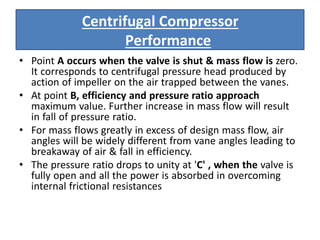
• Lets analyze what will
occur when a valve
placed in the delivery
line of a compressor
running at constant
speed is slowly
opened
• The variation in
pressure ratio is
shown above
Centrifugal Compressor
Performance
• Point A occurs when the valve is shut & mass flow is zero.
It corresponds to centrifugal pressure head produced by
action of impeller on the air trapped between the vanes.
• At point B, efficiency and pressure ratio approach
maximum value. Further increase in mass flow will result
in fall of pressure ratio.
• For mass flows greatly in excess of design mass flow, air
angles will be widely different from vane angles leading to
breakaway of air & fall in efficiency.
• The pressure ratio drops to unity at 'C' , when the valve is
fully open and all the power is absorbed in overcoming
internal frictional resistances
Centrifugal Compressor
Performance
Surging
• The operating point 'A' could be obtained but a
part of the curve between 'A' and 'B' could not
be obtained due to Surging.
• Surging is associated with sudden drop in
delivery pressure & with violent aerodynamic
pulsation which is transmitted throughout the
machine
• For any operating point D on the part of
characteristics curve having a positive slope, a
decrease in mass flow will be accompanied by a
fall in delivery pressure.
• If the pressure of the air downstream of the
compressor does not fall quickly enough, the
air will tend to reverse its direction and will
flow back in the direction of the resulting
pressure gradient.
• When this occurs, the pressure ratio drops
rapidly causing a further drop in mass flow
until the point 'A' is reached, where the
mass flow is zero.
Surging
• Surging starts to occur in the diffuser
passages where flow is retarded by frictional
forces near the vanes
• Tendency to surge increases with number of
diffuser vanes
• Several diffuser channels to every impeller
channel – tendency for air to flow up one
channel & down another
Surging
• Only in one pair of channels the delivery
pressure will fall & increase likelihood of
surging
• Thus number of diffuser vanes is less than
no.
of impeller vanes
• Surging is then not likely to occur
Surging
Choking
• At some point say 'E', the position is reached
where no further increase in mass flow can
be obtained no matter how wide open the
control valve is ‐ CHOKING
• This point represents the maximum delivery
obtainable at the particular rotational speed
for which the curve is drawn.
Losses in Compressor
1. Frictional Losses
2. Incidence Losses
3. Clearance and leakage losses
Frictional Losses
• Major portion of the losses is due to fluid
friction in stationary and rotating blade
passages
• Flow in impeller and diffuser is decelerating
in
nature
• Frictional losses are due to both skin friction
and boundary layer separation
• Depend on the friction factor, length of the
flow passage and square of the fluid velocity
Incidence Losses
• During the off‐design conditions, the direction
of relative velocity of fluid at inlet does not
match with the inlet blade angle
• Hence, fluid cannot enter the blade passage
smoothly by gliding along the blade surface
• The loss in energy that takes place because of
this is known as incidence loss
• This is sometimes referred to as shock losses.
• However, the word shock in this context
should not be confused with the
aerodynamic sense of shock
Incidence Losses
Clearance and leakage losses
• Certain minimum clearances are necessary between
the impeller shaft and the casing and between the
outlet periphery of the impeller eye and the casing
• The leakage of gas through the shaft clearance is
minimized by employing glands.
• The clearance losses depend upon the impeller
diameter and the static pressure at the impeller tip.
• A larger diameter of impeller is necessary for a higher
peripheral speed and it is very difficult in the situation
to provide sealing between the casing and the
impeller eye tip.
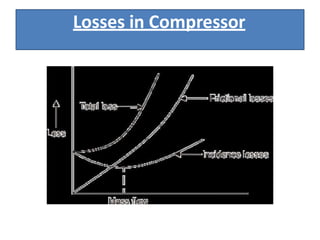
Losses in Compressor
• The leakage losses comprise a small fraction
of
the total loss.
• The incidence losses attain the minimum
value at the designed mass flow rate.
• The shock losses are zero at the designed flow
rate.
Losses in Compressor
• However, Incidence losses comprise both shock
losses and impeller entry loss due to a change in
the direction of fluid flow from axial to radial
direction in the vane less space before entering
the impeller blades.
• The impeller entry loss is very small compared
to
other losses.
• This is why the incidence losses show a non
zero minimum value at the designed flow rate.
Losses in Compressor


Surging and choking

  • 1.
    BRANCH :- MECH(5th) SUBJECT:-FLUIDPOWER ENGINEERING GUIDED BY :- V.N.KALOLA NAME ENROLLMENT NO. ROLL NO. CHAUDHARI BRIJAL 170433119004 2097 CHAVDA MAYUR 170433119006 2098 DOSHI PARAS 170433119008 2099 HINGU RAVI 170433119009 2100 SHANTILAL SHAH ENGG. COLLEGE
  • 2.
    • Lets analyzewhat will occur when a valve placed in the delivery line of a compressor running at constant speed is slowly opened • The variation in pressure ratio is shown above Centrifugal Compressor Performance
  • 3.
    • Point Aoccurs when the valve is shut & mass flow is zero. It corresponds to centrifugal pressure head produced by action of impeller on the air trapped between the vanes. • At point B, efficiency and pressure ratio approach maximum value. Further increase in mass flow will result in fall of pressure ratio. • For mass flows greatly in excess of design mass flow, air angles will be widely different from vane angles leading to breakaway of air & fall in efficiency. • The pressure ratio drops to unity at 'C' , when the valve is fully open and all the power is absorbed in overcoming internal frictional resistances Centrifugal Compressor Performance
  • 4.
    Surging • The operatingpoint 'A' could be obtained but a part of the curve between 'A' and 'B' could not be obtained due to Surging. • Surging is associated with sudden drop in delivery pressure & with violent aerodynamic pulsation which is transmitted throughout the machine • For any operating point D on the part of characteristics curve having a positive slope, a decrease in mass flow will be accompanied by a fall in delivery pressure.
  • 5.
    • If thepressure of the air downstream of the compressor does not fall quickly enough, the air will tend to reverse its direction and will flow back in the direction of the resulting pressure gradient. • When this occurs, the pressure ratio drops rapidly causing a further drop in mass flow until the point 'A' is reached, where the mass flow is zero. Surging
  • 6.
    • Surging startsto occur in the diffuser passages where flow is retarded by frictional forces near the vanes • Tendency to surge increases with number of diffuser vanes • Several diffuser channels to every impeller channel – tendency for air to flow up one channel & down another Surging
  • 7.
    • Only inone pair of channels the delivery pressure will fall & increase likelihood of surging • Thus number of diffuser vanes is less than no. of impeller vanes • Surging is then not likely to occur Surging
  • 8.
    Choking • At somepoint say 'E', the position is reached where no further increase in mass flow can be obtained no matter how wide open the control valve is ‐ CHOKING • This point represents the maximum delivery obtainable at the particular rotational speed for which the curve is drawn.
  • 9.
    Losses in Compressor 1.Frictional Losses 2. Incidence Losses 3. Clearance and leakage losses
  • 10.
    Frictional Losses • Majorportion of the losses is due to fluid friction in stationary and rotating blade passages • Flow in impeller and diffuser is decelerating in nature • Frictional losses are due to both skin friction and boundary layer separation • Depend on the friction factor, length of the flow passage and square of the fluid velocity
  • 11.
    Incidence Losses • Duringthe off‐design conditions, the direction of relative velocity of fluid at inlet does not match with the inlet blade angle • Hence, fluid cannot enter the blade passage smoothly by gliding along the blade surface • The loss in energy that takes place because of this is known as incidence loss
  • 12.
    • This issometimes referred to as shock losses. • However, the word shock in this context should not be confused with the aerodynamic sense of shock Incidence Losses
  • 13.
    Clearance and leakagelosses • Certain minimum clearances are necessary between the impeller shaft and the casing and between the outlet periphery of the impeller eye and the casing • The leakage of gas through the shaft clearance is minimized by employing glands. • The clearance losses depend upon the impeller diameter and the static pressure at the impeller tip. • A larger diameter of impeller is necessary for a higher peripheral speed and it is very difficult in the situation to provide sealing between the casing and the impeller eye tip.
  • 14.
  • 15.
    • The leakagelosses comprise a small fraction of the total loss. • The incidence losses attain the minimum value at the designed mass flow rate. • The shock losses are zero at the designed flow rate. Losses in Compressor
  • 16.
    • However, Incidencelosses comprise both shock losses and impeller entry loss due to a change in the direction of fluid flow from axial to radial direction in the vane less space before entering the impeller blades. • The impeller entry loss is very small compared to other losses. • This is why the incidence losses show a non zero minimum value at the designed flow rate. Losses in Compressor
  • 17.