TUMOR
IMMUNITY
BY – Deepak Sakhuja
M.Sc. Biotechnology
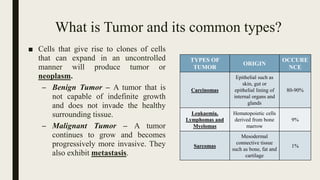
What is Tumor and its common types?
■ Cells that give rise to clones of cells
that can expand in an uncontrolled
manner will produce tumor or
neoplasm.
– Benign Tumor – A tumor that is
not capable of indefinite growth
and does not invade the healthy
surrounding tissue.
– Malignant Tumor – A tumor
continues to grow and becomes
progressively more invasive. They
also exhibit metastasis.
TYPES OF
TUMOR
ORIGIN
OCCURE
NCE
Carcinomas
Epithelial such as
skin, gut or
epithelial lining of
internal organs and
glands
80-90%
Leukaemia,
Lymphomas and
Myelomas
Hematopoietic cells
derived from bone
marrow
9%
Sarcomas
Mesodermal
connective tissue
such as bone, fat and
cartilage
1%
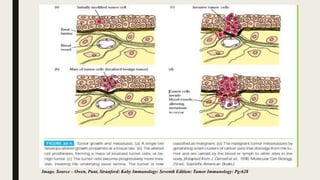
Image. Source – Owen, Punt, Stranford: Kuby Immunology: Seventh Edition: Tumor Immunology: Pg:628
CAUSES OF TUMOR
■ DNA alterations due to chemical agents (such as DDT,
EtBr, Formaldehyde, etc.), physical agents (such as
asbestos) and ionizing radiation (such as UV light, X rays
etc.). They collectively called CARCINOGENS
■ Infection of certain viruses which has the ability to
integrated in the host genome.
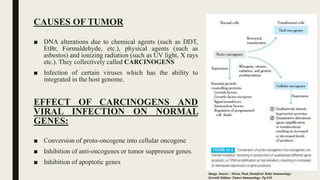
EFFECT OF CARCINOGENS AND
VIRAL INFECTION ON NORMAL
GENES:
■ Conversion of proto-oncogene into cellular oncogene
■ Inhibition of anti-oncogenes or tumor suppressor genes.
■ Inhibition of apoptotic genes
Image. Source – Owen, Punt, Stranford: Kuby Immunology:
Seventh Edition: Tumor Immunology: Pg:630
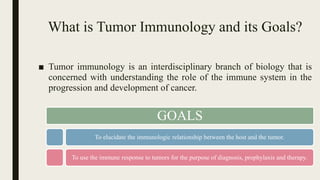
What is Tumor Immunology and its Goals?
■ Tumor immunology is an interdisciplinary branch of biology that is
concerned with understanding the role of the immune system in the
progression and development of cancer.
GOALS
To elucidate the immunologic relationship between the host and the tumor.
To use the immune response to tumors for the purpose of diagnosis, prophylaxis and therapy.
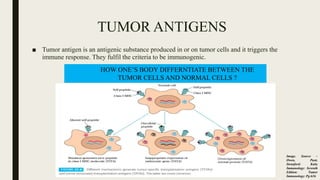
TUMOR ANTIGENS
■ Tumor antigen is an antigenic substance produced in or on tumor cells and it triggers the
immune response. They fulfil the criteria to be immunogenic.
HOW ONE’S BODY DIFFERNTIATE BETWEEN THE
TUMOR CELLS AND NORMAL CELLS ?
Image. Source –
Owen, Punt,
Stranford: Kuby
Immunology: Seventh
Edition: Tumor
Immunology: Pg:636
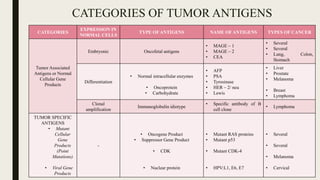
CATEGORIES OF TUMOR ANTIGENS
CATEGORIES
EXPRESSION IN
NORMAL CELLS
TYPE OFANTIGENS NAME OFANTIGENS TYPES OF CANCER
Tumor Associated
Antigens or Normal
Cellular Gene
Products
Embryonic Oncofetal antigens
• MAGE – 1
• MAGE – 2
• CEA
• Several
• Several
• Lung, Colon,
Stomach
Differentiation
• Normal intracellular enzymes
• Oncoprotein
• Carbohydrate
• AFP
• PSA
• Tyrosinase
• HER – 2/ neu
• Lewis
• Liver
• Prostate
• Melanoma
• Breast
• Lymphoma
Clonal
amplification
Immunoglobulin idiotype
• Specific antibody of B
cell clone
• Lymphoma
TUMOR SPECIFIC
ANTIGENS
• Mutant
Cellular
Gene
Products
(Point
Mutations)
• Viral Gene
Products
-
• Oncogene Product
• Suppressor Gene Product
• CDK
• Nuclear protein
• Mutant RAS proteins
• Mutant p53
• Mutant CDK-4
• HPV:L1, E6, E7
• Several
• Several
• Melanoma
• Cervical
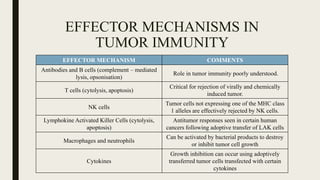
EFFECTOR MECHANISMS IN
TUMOR IMMUNITY
EFFECTOR MECHANISM COMMENTS
Antibodies and B cells (complement – mediated
lysis, opsonisation)
Role in tumor immunity poorly understood.
T cells (cytolysis, apoptosis)
Critical for rejection of virally and chemically
induced tumor.
NK cells
Tumor cells not expressing one of the MHC class
1 alleles are effectively rejected by NK cells.
Lymphokine Activated Killer Cells (cytolysis,
apoptosis)
Antitumor responses seen in certain human
cancers following adoptive transfer of LAK cells
Macrophages and neutrophils
Can be activated by bacterial products to destroy
or inhibit tumor cell growth
Cytokines
Growth inhibition can occur using adoptively
transferred tumor cells transfected with certain
cytokines
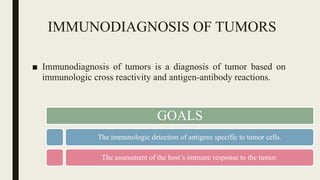
IMMUNODIAGNOSIS OF TUMORS
■ Immunodiagnosis of tumors is a diagnosis of tumor based on
immunologic cross reactivity and antigen-antibody reactions.
GOALS
The immunologic detection of antigens specific to tumor cells.
The assessment of the host’s immune response to the tumor.
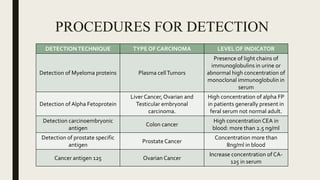
PROCEDURES FOR DETECTION
DETECTIONTECHNIQUE TYPE OF CARCINOMA LEVEL OF INDICATOR
Detection of Myeloma proteins Plasma cellTumors
Presence of light chains of
immunoglobulins in urine or
abnormal high concentration of
monoclonal immunoglobulin in
serum
Detection of Alpha Fetoprotein
Liver Cancer, Ovarian and
Testicular embryonal
carcinoma.
High concentration of alpha FP
in patients generally present in
feral serum not normal adult.
Detection carcinoembryonic
antigen
Colon cancer
High concentration CEA in
blood: more than 2.5 ng/ml
Detection of prostate specific
antigen
Prostate Cancer
Concentration more than
8ng/ml in blood
Cancer antigen 125 Ovarian Cancer
Increase concentration of CA-
125 in serum
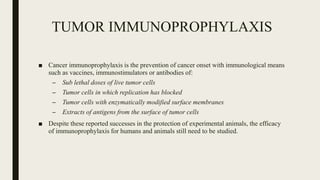
TUMOR IMMUNOPROPHYLAXIS
■ Cancer immunoprophylaxis is the prevention of cancer onset with immunological means
such as vaccines, immunostimulators or antibodies of:
– Sub lethal doses of live tumor cells
– Tumor cells in which replication has blocked
– Tumor cells with enzymatically modified surface membranes
– Extracts of antigens from the surface of tumor cells
■ Despite these reported successes in the protection of experimental animals, the efficacy
of immunoprophylaxis for humans and animals still need to be studied.
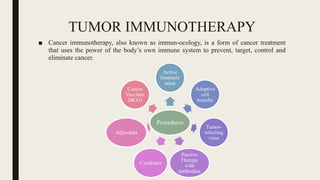
TUMOR IMMUNOTHERAPY
■ Cancer immunotherapy, also known as immun-ocology, is a form of cancer treatment
that uses the power of the body’s own immune system to prevent, target, control and
eliminate cancer.
Procedures
Active
Immuniz
ation
Adoptive
cell
transfer
Tumor-
infecting
virus
Passive
Therapy
with
antibodies
Cytokines
Adjuvants
Cancer
Vaccines
(BCG)
REFERNCES
■ Owen, Punt, Stranford: Kuby Immunology: Seventh Edition: Tumor Immunology:
Pg; 627-648
■ Richard Coico, Geoffrey Sunshine Eli Benjamini: Immunology- A Short Course:
Fifth Edition: Tumor Immunity: Pg;273-285
■ www.Wikipedia.com/Tumorantigens
■ American Journal of Pathology
■ www.sciencedirect.com
■ www.ncbi.nlm.nih.gov
■ www.cancerresearch.org
THANKYOU…….

Tumor Immunity

  • 1.
    TUMOR IMMUNITY BY – DeepakSakhuja M.Sc. Biotechnology
  • 2.
    What is Tumorand its common types? ■ Cells that give rise to clones of cells that can expand in an uncontrolled manner will produce tumor or neoplasm. – Benign Tumor – A tumor that is not capable of indefinite growth and does not invade the healthy surrounding tissue. – Malignant Tumor – A tumor continues to grow and becomes progressively more invasive. They also exhibit metastasis. TYPES OF TUMOR ORIGIN OCCURE NCE Carcinomas Epithelial such as skin, gut or epithelial lining of internal organs and glands 80-90% Leukaemia, Lymphomas and Myelomas Hematopoietic cells derived from bone marrow 9% Sarcomas Mesodermal connective tissue such as bone, fat and cartilage 1%
  • 3.
    Image. Source –Owen, Punt, Stranford: Kuby Immunology: Seventh Edition: Tumor Immunology: Pg:628
  • 4.
    CAUSES OF TUMOR ■DNA alterations due to chemical agents (such as DDT, EtBr, Formaldehyde, etc.), physical agents (such as asbestos) and ionizing radiation (such as UV light, X rays etc.). They collectively called CARCINOGENS ■ Infection of certain viruses which has the ability to integrated in the host genome. EFFECT OF CARCINOGENS AND VIRAL INFECTION ON NORMAL GENES: ■ Conversion of proto-oncogene into cellular oncogene ■ Inhibition of anti-oncogenes or tumor suppressor genes. ■ Inhibition of apoptotic genes Image. Source – Owen, Punt, Stranford: Kuby Immunology: Seventh Edition: Tumor Immunology: Pg:630
  • 5.
    What is TumorImmunology and its Goals? ■ Tumor immunology is an interdisciplinary branch of biology that is concerned with understanding the role of the immune system in the progression and development of cancer. GOALS To elucidate the immunologic relationship between the host and the tumor. To use the immune response to tumors for the purpose of diagnosis, prophylaxis and therapy.
  • 6.
    TUMOR ANTIGENS ■ Tumorantigen is an antigenic substance produced in or on tumor cells and it triggers the immune response. They fulfil the criteria to be immunogenic. HOW ONE’S BODY DIFFERNTIATE BETWEEN THE TUMOR CELLS AND NORMAL CELLS ? Image. Source – Owen, Punt, Stranford: Kuby Immunology: Seventh Edition: Tumor Immunology: Pg:636
  • 7.
    CATEGORIES OF TUMORANTIGENS CATEGORIES EXPRESSION IN NORMAL CELLS TYPE OFANTIGENS NAME OFANTIGENS TYPES OF CANCER Tumor Associated Antigens or Normal Cellular Gene Products Embryonic Oncofetal antigens • MAGE – 1 • MAGE – 2 • CEA • Several • Several • Lung, Colon, Stomach Differentiation • Normal intracellular enzymes • Oncoprotein • Carbohydrate • AFP • PSA • Tyrosinase • HER – 2/ neu • Lewis • Liver • Prostate • Melanoma • Breast • Lymphoma Clonal amplification Immunoglobulin idiotype • Specific antibody of B cell clone • Lymphoma TUMOR SPECIFIC ANTIGENS • Mutant Cellular Gene Products (Point Mutations) • Viral Gene Products - • Oncogene Product • Suppressor Gene Product • CDK • Nuclear protein • Mutant RAS proteins • Mutant p53 • Mutant CDK-4 • HPV:L1, E6, E7 • Several • Several • Melanoma • Cervical
  • 8.
    EFFECTOR MECHANISMS IN TUMORIMMUNITY EFFECTOR MECHANISM COMMENTS Antibodies and B cells (complement – mediated lysis, opsonisation) Role in tumor immunity poorly understood. T cells (cytolysis, apoptosis) Critical for rejection of virally and chemically induced tumor. NK cells Tumor cells not expressing one of the MHC class 1 alleles are effectively rejected by NK cells. Lymphokine Activated Killer Cells (cytolysis, apoptosis) Antitumor responses seen in certain human cancers following adoptive transfer of LAK cells Macrophages and neutrophils Can be activated by bacterial products to destroy or inhibit tumor cell growth Cytokines Growth inhibition can occur using adoptively transferred tumor cells transfected with certain cytokines
  • 9.
    IMMUNODIAGNOSIS OF TUMORS ■Immunodiagnosis of tumors is a diagnosis of tumor based on immunologic cross reactivity and antigen-antibody reactions. GOALS The immunologic detection of antigens specific to tumor cells. The assessment of the host’s immune response to the tumor.
  • 10.
    PROCEDURES FOR DETECTION DETECTIONTECHNIQUETYPE OF CARCINOMA LEVEL OF INDICATOR Detection of Myeloma proteins Plasma cellTumors Presence of light chains of immunoglobulins in urine or abnormal high concentration of monoclonal immunoglobulin in serum Detection of Alpha Fetoprotein Liver Cancer, Ovarian and Testicular embryonal carcinoma. High concentration of alpha FP in patients generally present in feral serum not normal adult. Detection carcinoembryonic antigen Colon cancer High concentration CEA in blood: more than 2.5 ng/ml Detection of prostate specific antigen Prostate Cancer Concentration more than 8ng/ml in blood Cancer antigen 125 Ovarian Cancer Increase concentration of CA- 125 in serum
  • 11.
    TUMOR IMMUNOPROPHYLAXIS ■ Cancerimmunoprophylaxis is the prevention of cancer onset with immunological means such as vaccines, immunostimulators or antibodies of: – Sub lethal doses of live tumor cells – Tumor cells in which replication has blocked – Tumor cells with enzymatically modified surface membranes – Extracts of antigens from the surface of tumor cells ■ Despite these reported successes in the protection of experimental animals, the efficacy of immunoprophylaxis for humans and animals still need to be studied.
  • 12.
    TUMOR IMMUNOTHERAPY ■ Cancerimmunotherapy, also known as immun-ocology, is a form of cancer treatment that uses the power of the body’s own immune system to prevent, target, control and eliminate cancer. Procedures Active Immuniz ation Adoptive cell transfer Tumor- infecting virus Passive Therapy with antibodies Cytokines Adjuvants Cancer Vaccines (BCG)
  • 13.
    REFERNCES ■ Owen, Punt,Stranford: Kuby Immunology: Seventh Edition: Tumor Immunology: Pg; 627-648 ■ Richard Coico, Geoffrey Sunshine Eli Benjamini: Immunology- A Short Course: Fifth Edition: Tumor Immunity: Pg;273-285 ■ www.Wikipedia.com/Tumorantigens ■ American Journal of Pathology ■ www.sciencedirect.com ■ www.ncbi.nlm.nih.gov ■ www.cancerresearch.org
  • 14.