Tumor Immunology
Tumors
• Arise from uncontrolled proliferation and
spread of clones of transformed cells.
• Growth of malignant tumors is determined, in
large part, by the proliferative capacity of the
tumor cells and the ability of these cells to
invade host tissues and metastasize to distant
sites.
• The concept of immune surveillance, proposed
by Macfarlane Burnet in the 1950s, states that
a physiologic function of the immune system is
to recognize and destroy clones of transformed
cells before they grow into tumors and to kill
tumors after they are formed.
• One of the factors in the growth of malignant
tumors is the ability of these cancers to evade
or overcome the mechanisms of host defense.
General Features of Tumor immunity
• Tumors express antigens that are recognized as foreign
by the immune system of the tumor-bearing host
- Experiments have shown this is true
• Immune responses often fail to prevent the growth of
tumors
- Only a few antigens may be recognized as nonself
- Rapid growth and spread of tumors may overwhelm the
system
- Many tumors have specialized ways of evading host
immune responses
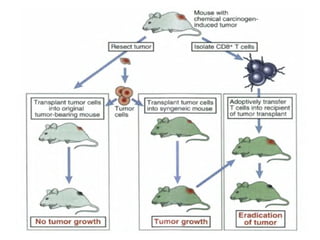
• The immune system can be activated by
external stimuli to effectively kill tumor cells
and eradicate tumors
Tumor Antigens
• Two groups of tumor antigens:
- Tumor specific antigens – expressed on tumor
cells but not on normal cells.
- Tumor associated antigens – expressed on
tumor cells and also on normal cells
• Tumor antigens recognized by T cells are likely
the major inducers of tumor immunity and the
most promising candidates for tumor vaccines
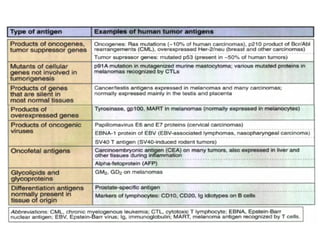
Types of Tumor Antigens
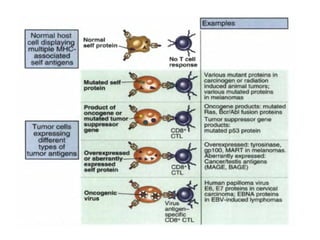
- Products of mutated genes
- Abnormally expressed cellular proteins
- Antigens of oncogenic viruses
- Oncofetal antigens
- Altered glycolipids and glycoprotein antigens
- Tissue specific differentiation antigens
Products of Mutated Genes
• Some tumor antigens are produced by
oncogenic mutants of normal cellular genes.
- Come from point mutations, deletions,
chromosomal translocations, or viral gene
insertions affecting cellular proto-oncogenes or
tumor suppressor genes
• Tumor antigens may be produced by randomly
mutated genes whose products are not related
to the transformed phenotype
Abnormally Expressed Cellular Proteins
• Tumor antigens may be normal cellular proteins that
are abnormally expressed in tumor cells and elicit
immune responses
- Under normal circumstances, they may be expressed at
very low concentrations that do not elicit tolerance.
• Cancer/testis antigens are proteins expressed in
gametes and trophoblasts, and in many types of
cancers, but not in normal somatic tissues.
- Functions of most of them are unknown. In general,
they are not required for the malignant phenotype of
the cells and their sequences are not mutated.
Antigens of Oncogenic Viruses
• Products of oncogenic viruses function as
tumor antigens and elicit specific T cell
responses that may serve to eradicate the
tumors
Oncofetal Antigens
• Proteins that are expressed at high levels in
cancer cells and in normal developing fetal but
not adult tissues
- It is believed that the genes encoding these
proteins are silenced during development and
are derepressed with malignant
transformations.
Altered Glycolipid and Glycoprotein Antigens
• Most human and experimental tumors express
higher than normal levels or abnormal forms
of surface glycoproteins and glycolipids, which
may be diagnostic markers and targets for
therapy.
Tissue-Specific Differentiation Antigens
• Tumors express molecules that are normally
present on the cells of origin.
- They are specific for particular lineages or
differentiation stages of various cell types.
Immune Responses to Tumors
• Effector mechanisms of both innate and
adaptive immunity have been shown to kill
tumor cells in vitro.
• The challenge is to determine which of these
mechanisms will contribute to protective
immune responses against tumors in vivo, and
to enhance these mechanisms in ways that are
tumor specific.
Innate Immune Responses to Tumors
• NK cells kill many types of tumor cells, especially those
that have reduced class I MHC expression but do not
express ligands for NK cell activating receptors
- Some tumor cells lose expression of class I MHC
molecules perhaps as a result of selection against class
I MHC-expressing cells by CTLs
- Inhibitory signals to NK cells from recognition of class I
MHC molecules
- Some tumors express MICA, MICB, and ULB, which are
ligands for NKG2D activating receptor on NK cells
- IL-2 and IL-12 increase tumoricidal capacity of NK cells
• Macrophages can kill tumor cells
- Through several mechanisms like release of
lysosomal enzymes, reactive oxygen species,
and nitric oxide.
- Activated macrophages also produce the
cytokine TNF which was first characterized as
an agent that can kill tumors mainly by
inducing thrombosis in tumor blood vessels.
Adaptive Immune Responses to Tumors
• Evidence suggests that T cell responses play
protective role against tumors
• The principal mechanism of tumor immunity is
killing of tumor cells by CD8+ CTLs
• CD8+ T cell responses specific for tumor
antigens may require cross-presentation of
the tumor antigens by professional APCs, such
as dendritic cells
- The importance of CD4+ helper T cells in tumor
immunity is less clear. They may provide cytokines for
effective CTL development. They may also secrete
cytokines such as TNF and IFN-γ that can increase tumor
cell class I MHC expression and sensitivity to lysis by
CTLs. IFN-γ may also activate macrophages to kill tumor
cells
• Tumor bearing hosts may produce antibodies against
various tumor antigens which can kill tumor cells by
activating complement or ADCC in which macrophages
or NK cells mediate the killing. However this has been
shown mainly in vitro.
Evasion of Immune Responses by Tumors
• Many malignant tumors posses mechanisms
that enable them to evade or resist host
immune responses
• Experimental evidence in mouse models
indicates that immune responses to tumor
cells impart selective pressures that result in
the survival and outgrowth of variant tumor
cells with reduced immunogenicity, a process
that has been called “tumor editing”
• Tumor editing is thought to underlie the emergence
of tumors that “escape” immunosurveillance.
• Tumor editing and escape may be a result of several
mechanisms:
Tumor antigens may induce specific immunological
tolerance either because tumor antigens are self
antigens encountered by the developing immune
system or because the tumor cells present their
antigens in a tolerogenic form to mature
lymphocytes.
Regulatory T cells may suppress T cell
responses to tumors. Evidence shows these
cell types increase in tumor bearing
individuals, and can be found in cellular
infiltrates in certain tumors. Depletion of
these cell types in tumor bearing mice
enhances antitumor immunity and reduces
tumor growth
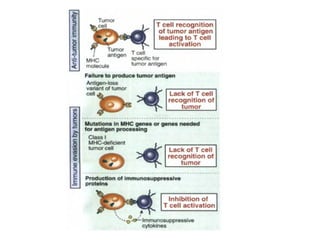
Tumors lose expression of antigens that elicit
immune responses. Such “tumor loss variants”
are common in rapidly growing tumors and
can readily be induced in tumor cell lines by
culture with tumor specific antibodies or CTLs.
Tumors may fail to induce CTLs because most
tumor cells do not expressed costimulators or
class II MHC molecules
The products of tumor cells (e.g. tumor
growth factor-β) may suppress anti-tumor
immune responses. Some other examples
include expression of Fas ligand which
recognize death receptors on leukocytes
leading to apoptotic death
The cell surface antigens of tumors may be
hidden from the immune system by glycocalyx
molecules, such as sialic acid-containing
mucopolysaccharides. This process is called
antigen masking and may be a consequence of
the fact that tumor cells often express more of
these glycocalyx molecules than normal cells
do.
Immunotherapy for Tumors
• Aims at augmenting the weak host immune
response to the tumors (active immunity) or
to administer tumor specific antibodies or T
cells, a form of passive immunity.
Stimulation of Active Host Immune
Responses to Tumors
• Early attempts relied on nonspecific immune
stimulation.
• More recently, vaccines composed of killed tumor
cells or tumor antigens have been administered to
patients, and strategies for enhancing immune
responses against the tumor are being developed.
• Immunization of tumor-bearing individuals with
killed tumor cells or tumor antigens may result in
enhancement of immune responses against the
tumor.
• Cell-mediated immunity to tumors may be
enhanced by expressing costimulators and
cytokines in tumor cells and by treating
tumor-bearing individuals with cytokines that
stimulate the proliferation and differentiation
of T lymphocytes and NK cells.
• Blocking inhibitory pathways to promote
tumor immunity
• Nonspecific stimulation of the immune system
- Immune responses to tumors may be
stimulated by the local administration of
inflammatory substance or by systemic
treatment with agents that function as
polyclonal activators of lymphocytes e.g.
administration of BCG activates and promotes
macrophage-mediated killing of tumor cells
Passive Immunotherapy for Tumors with T
Cells and Antibodies
• Adoptive Cellular Therapy
- It’s the transfer of cellular immune cells that have
anti-tumor reactivity into a tumor-bearing host.
The cells to be transferred are expanded from the
lymphocytes of patients with tumors.
• Graft-versus-Leukemia effect
- In leukemia patients, administration of alloreactive
T cells together with hematopoietic stem cell
transplants can contribute to eradication of the
tumor.
- The graft-versus-leukemia effect is directed at the
allogeneic MHC molecules present on the recipient’s
hematopoietic cells, including the leukemia cells. the
downside is development of graft-versus-host disease.
• Therapy with anti-tumor Antibodies
- Tumor-specific monoclonal antibodies may be useful
for specific immunotherapy for tumors.
- The potential of using antibodies as “magic bullets”
has been alluring to investigators for many years and
is still an active area of research.
The Role of the Immune System in Promoting
Tumor Growth
• In addition to protection against cancer, the
immune system may contribute to the
development of some tumors.
• Chronic inflammation as a result of infections
has been associated with some cancers.
Examples include the gastric cancer in the
setting of chronic Helicobacter pylori infection
and hepatocellular carcinomas associated with
chronic hepatitis B and C virus infections.
• Cells of the innate immune system are considered
the most direct tumor promoting culprits among
immune cells. chronic activation of macrophages is
characterized by angiogenesis and tissue
remodeling, both of which favor tumor formation.
Innate immune cells also generate free radicals that
cause DNA damage and lead to mutations in tumor
suppressor genes and oncogenes. Some data
suggest that innate immune cells secrete molecules
that promote cell cycle progression and survival of
tumor cells.

Immunopathology Lecture 4.pptx presentation

  • 1.
  • 2.
    Tumors • Arise fromuncontrolled proliferation and spread of clones of transformed cells. • Growth of malignant tumors is determined, in large part, by the proliferative capacity of the tumor cells and the ability of these cells to invade host tissues and metastasize to distant sites.
  • 3.
    • The conceptof immune surveillance, proposed by Macfarlane Burnet in the 1950s, states that a physiologic function of the immune system is to recognize and destroy clones of transformed cells before they grow into tumors and to kill tumors after they are formed. • One of the factors in the growth of malignant tumors is the ability of these cancers to evade or overcome the mechanisms of host defense.
  • 4.
    General Features ofTumor immunity • Tumors express antigens that are recognized as foreign by the immune system of the tumor-bearing host - Experiments have shown this is true • Immune responses often fail to prevent the growth of tumors - Only a few antigens may be recognized as nonself - Rapid growth and spread of tumors may overwhelm the system - Many tumors have specialized ways of evading host immune responses
  • 6.
    • The immunesystem can be activated by external stimuli to effectively kill tumor cells and eradicate tumors
  • 7.
    Tumor Antigens • Twogroups of tumor antigens: - Tumor specific antigens – expressed on tumor cells but not on normal cells. - Tumor associated antigens – expressed on tumor cells and also on normal cells • Tumor antigens recognized by T cells are likely the major inducers of tumor immunity and the most promising candidates for tumor vaccines
  • 8.
    Types of TumorAntigens - Products of mutated genes - Abnormally expressed cellular proteins - Antigens of oncogenic viruses - Oncofetal antigens - Altered glycolipids and glycoprotein antigens - Tissue specific differentiation antigens
  • 9.
    Products of MutatedGenes • Some tumor antigens are produced by oncogenic mutants of normal cellular genes. - Come from point mutations, deletions, chromosomal translocations, or viral gene insertions affecting cellular proto-oncogenes or tumor suppressor genes • Tumor antigens may be produced by randomly mutated genes whose products are not related to the transformed phenotype
  • 11.
    Abnormally Expressed CellularProteins • Tumor antigens may be normal cellular proteins that are abnormally expressed in tumor cells and elicit immune responses - Under normal circumstances, they may be expressed at very low concentrations that do not elicit tolerance. • Cancer/testis antigens are proteins expressed in gametes and trophoblasts, and in many types of cancers, but not in normal somatic tissues. - Functions of most of them are unknown. In general, they are not required for the malignant phenotype of the cells and their sequences are not mutated.
  • 12.
    Antigens of OncogenicViruses • Products of oncogenic viruses function as tumor antigens and elicit specific T cell responses that may serve to eradicate the tumors
  • 13.
    Oncofetal Antigens • Proteinsthat are expressed at high levels in cancer cells and in normal developing fetal but not adult tissues - It is believed that the genes encoding these proteins are silenced during development and are derepressed with malignant transformations.
  • 14.
    Altered Glycolipid andGlycoprotein Antigens • Most human and experimental tumors express higher than normal levels or abnormal forms of surface glycoproteins and glycolipids, which may be diagnostic markers and targets for therapy.
  • 15.
    Tissue-Specific Differentiation Antigens •Tumors express molecules that are normally present on the cells of origin. - They are specific for particular lineages or differentiation stages of various cell types.
  • 17.
    Immune Responses toTumors • Effector mechanisms of both innate and adaptive immunity have been shown to kill tumor cells in vitro. • The challenge is to determine which of these mechanisms will contribute to protective immune responses against tumors in vivo, and to enhance these mechanisms in ways that are tumor specific.
  • 18.
    Innate Immune Responsesto Tumors • NK cells kill many types of tumor cells, especially those that have reduced class I MHC expression but do not express ligands for NK cell activating receptors - Some tumor cells lose expression of class I MHC molecules perhaps as a result of selection against class I MHC-expressing cells by CTLs - Inhibitory signals to NK cells from recognition of class I MHC molecules - Some tumors express MICA, MICB, and ULB, which are ligands for NKG2D activating receptor on NK cells - IL-2 and IL-12 increase tumoricidal capacity of NK cells
  • 19.
    • Macrophages cankill tumor cells - Through several mechanisms like release of lysosomal enzymes, reactive oxygen species, and nitric oxide. - Activated macrophages also produce the cytokine TNF which was first characterized as an agent that can kill tumors mainly by inducing thrombosis in tumor blood vessels.
  • 20.
    Adaptive Immune Responsesto Tumors • Evidence suggests that T cell responses play protective role against tumors • The principal mechanism of tumor immunity is killing of tumor cells by CD8+ CTLs • CD8+ T cell responses specific for tumor antigens may require cross-presentation of the tumor antigens by professional APCs, such as dendritic cells
  • 21.
    - The importanceof CD4+ helper T cells in tumor immunity is less clear. They may provide cytokines for effective CTL development. They may also secrete cytokines such as TNF and IFN-γ that can increase tumor cell class I MHC expression and sensitivity to lysis by CTLs. IFN-γ may also activate macrophages to kill tumor cells • Tumor bearing hosts may produce antibodies against various tumor antigens which can kill tumor cells by activating complement or ADCC in which macrophages or NK cells mediate the killing. However this has been shown mainly in vitro.
  • 22.
    Evasion of ImmuneResponses by Tumors • Many malignant tumors posses mechanisms that enable them to evade or resist host immune responses • Experimental evidence in mouse models indicates that immune responses to tumor cells impart selective pressures that result in the survival and outgrowth of variant tumor cells with reduced immunogenicity, a process that has been called “tumor editing”
  • 23.
    • Tumor editingis thought to underlie the emergence of tumors that “escape” immunosurveillance. • Tumor editing and escape may be a result of several mechanisms: Tumor antigens may induce specific immunological tolerance either because tumor antigens are self antigens encountered by the developing immune system or because the tumor cells present their antigens in a tolerogenic form to mature lymphocytes.
  • 24.
    Regulatory T cellsmay suppress T cell responses to tumors. Evidence shows these cell types increase in tumor bearing individuals, and can be found in cellular infiltrates in certain tumors. Depletion of these cell types in tumor bearing mice enhances antitumor immunity and reduces tumor growth
  • 25.
    Tumors lose expressionof antigens that elicit immune responses. Such “tumor loss variants” are common in rapidly growing tumors and can readily be induced in tumor cell lines by culture with tumor specific antibodies or CTLs. Tumors may fail to induce CTLs because most tumor cells do not expressed costimulators or class II MHC molecules
  • 26.
    The products oftumor cells (e.g. tumor growth factor-β) may suppress anti-tumor immune responses. Some other examples include expression of Fas ligand which recognize death receptors on leukocytes leading to apoptotic death
  • 27.
    The cell surfaceantigens of tumors may be hidden from the immune system by glycocalyx molecules, such as sialic acid-containing mucopolysaccharides. This process is called antigen masking and may be a consequence of the fact that tumor cells often express more of these glycocalyx molecules than normal cells do.
  • 29.
    Immunotherapy for Tumors •Aims at augmenting the weak host immune response to the tumors (active immunity) or to administer tumor specific antibodies or T cells, a form of passive immunity.
  • 30.
    Stimulation of ActiveHost Immune Responses to Tumors • Early attempts relied on nonspecific immune stimulation. • More recently, vaccines composed of killed tumor cells or tumor antigens have been administered to patients, and strategies for enhancing immune responses against the tumor are being developed. • Immunization of tumor-bearing individuals with killed tumor cells or tumor antigens may result in enhancement of immune responses against the tumor.
  • 31.
    • Cell-mediated immunityto tumors may be enhanced by expressing costimulators and cytokines in tumor cells and by treating tumor-bearing individuals with cytokines that stimulate the proliferation and differentiation of T lymphocytes and NK cells. • Blocking inhibitory pathways to promote tumor immunity
  • 32.
    • Nonspecific stimulationof the immune system - Immune responses to tumors may be stimulated by the local administration of inflammatory substance or by systemic treatment with agents that function as polyclonal activators of lymphocytes e.g. administration of BCG activates and promotes macrophage-mediated killing of tumor cells
  • 33.
    Passive Immunotherapy forTumors with T Cells and Antibodies • Adoptive Cellular Therapy - It’s the transfer of cellular immune cells that have anti-tumor reactivity into a tumor-bearing host. The cells to be transferred are expanded from the lymphocytes of patients with tumors. • Graft-versus-Leukemia effect - In leukemia patients, administration of alloreactive T cells together with hematopoietic stem cell transplants can contribute to eradication of the tumor.
  • 34.
    - The graft-versus-leukemiaeffect is directed at the allogeneic MHC molecules present on the recipient’s hematopoietic cells, including the leukemia cells. the downside is development of graft-versus-host disease. • Therapy with anti-tumor Antibodies - Tumor-specific monoclonal antibodies may be useful for specific immunotherapy for tumors. - The potential of using antibodies as “magic bullets” has been alluring to investigators for many years and is still an active area of research.
  • 35.
    The Role ofthe Immune System in Promoting Tumor Growth • In addition to protection against cancer, the immune system may contribute to the development of some tumors. • Chronic inflammation as a result of infections has been associated with some cancers. Examples include the gastric cancer in the setting of chronic Helicobacter pylori infection and hepatocellular carcinomas associated with chronic hepatitis B and C virus infections.
  • 36.
    • Cells ofthe innate immune system are considered the most direct tumor promoting culprits among immune cells. chronic activation of macrophages is characterized by angiogenesis and tissue remodeling, both of which favor tumor formation. Innate immune cells also generate free radicals that cause DNA damage and lead to mutations in tumor suppressor genes and oncogenes. Some data suggest that innate immune cells secrete molecules that promote cell cycle progression and survival of tumor cells.