VCE Psychology Units 3 & 4


              Lesson 4


   Organisation of long-
          term memory
   Explain the organisation of long-term memory
    including declarative and episodic memory,
    and semantic network theory

   Identify types of long-term memories

   Explain and evaluate the semantic network
    theory
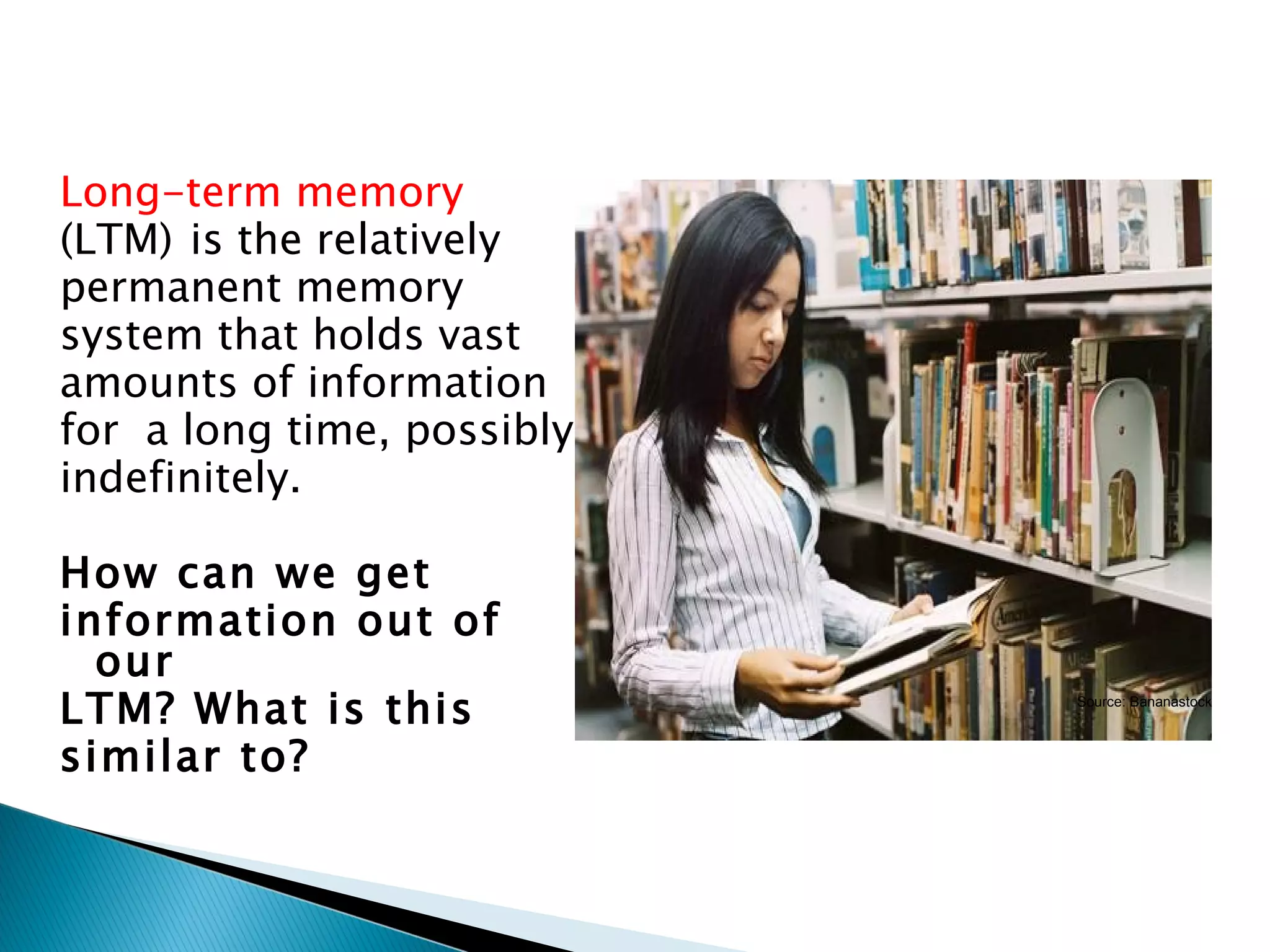
Long-term memory
(LTM) is the relatively
permanent memory
system that holds vast
amounts of information
for a long time, possibly
indefinitely.

How can we get
information out of
  our
LTM? What is this           Source: Bananastock


similar to?
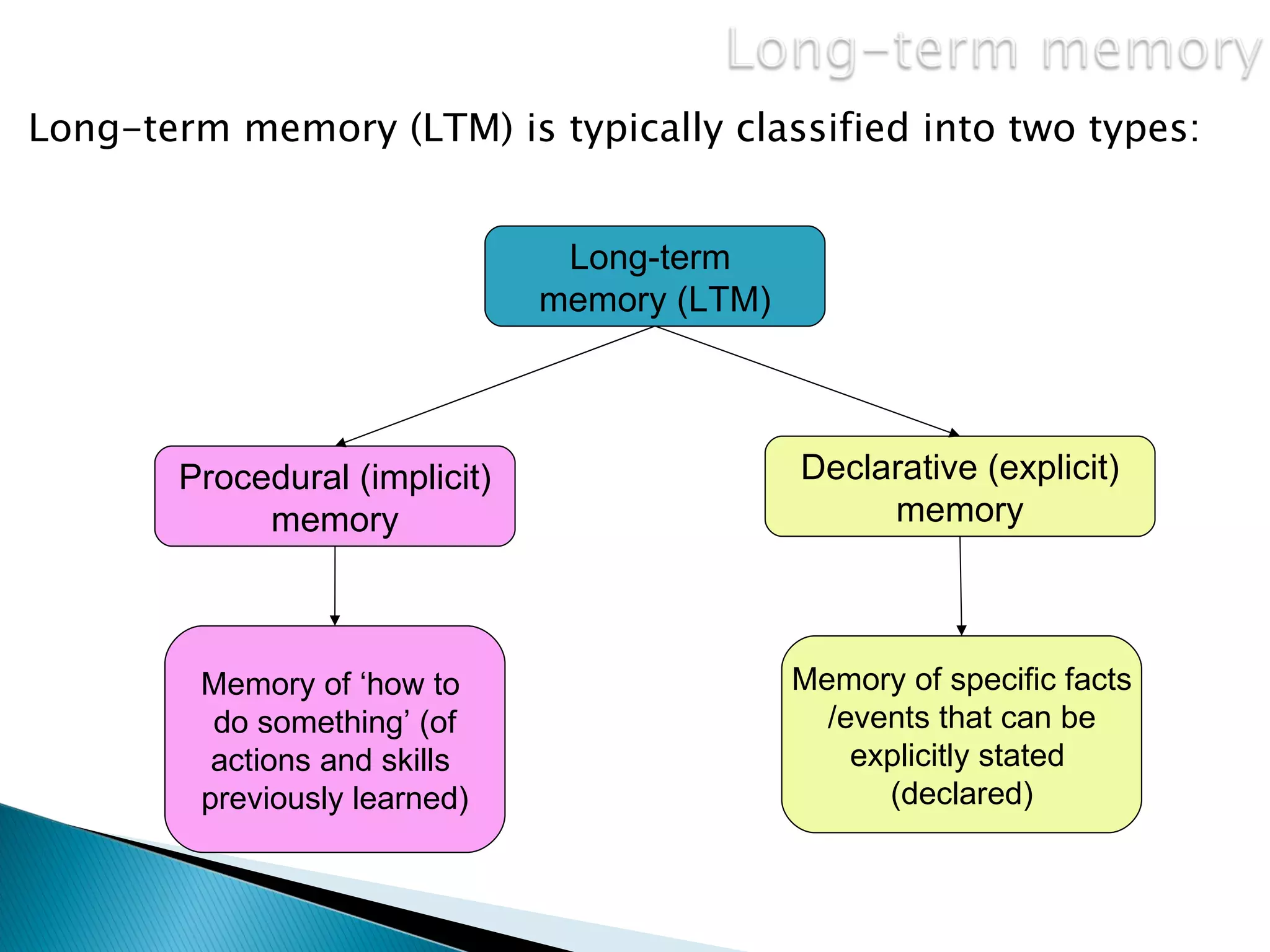
Long-term memory (LTM) is typically classified into two types:


                                Long-term
                               memory (LTM)


       Procedural (implicit)                  Declarative (explicit)
            memory                                 memory


         Memory of ‘how to                    Memory of specific facts
          do something’ (of                     /events that can be
          actions and skills                      explicitly stated
         previously learned)                        (declared)
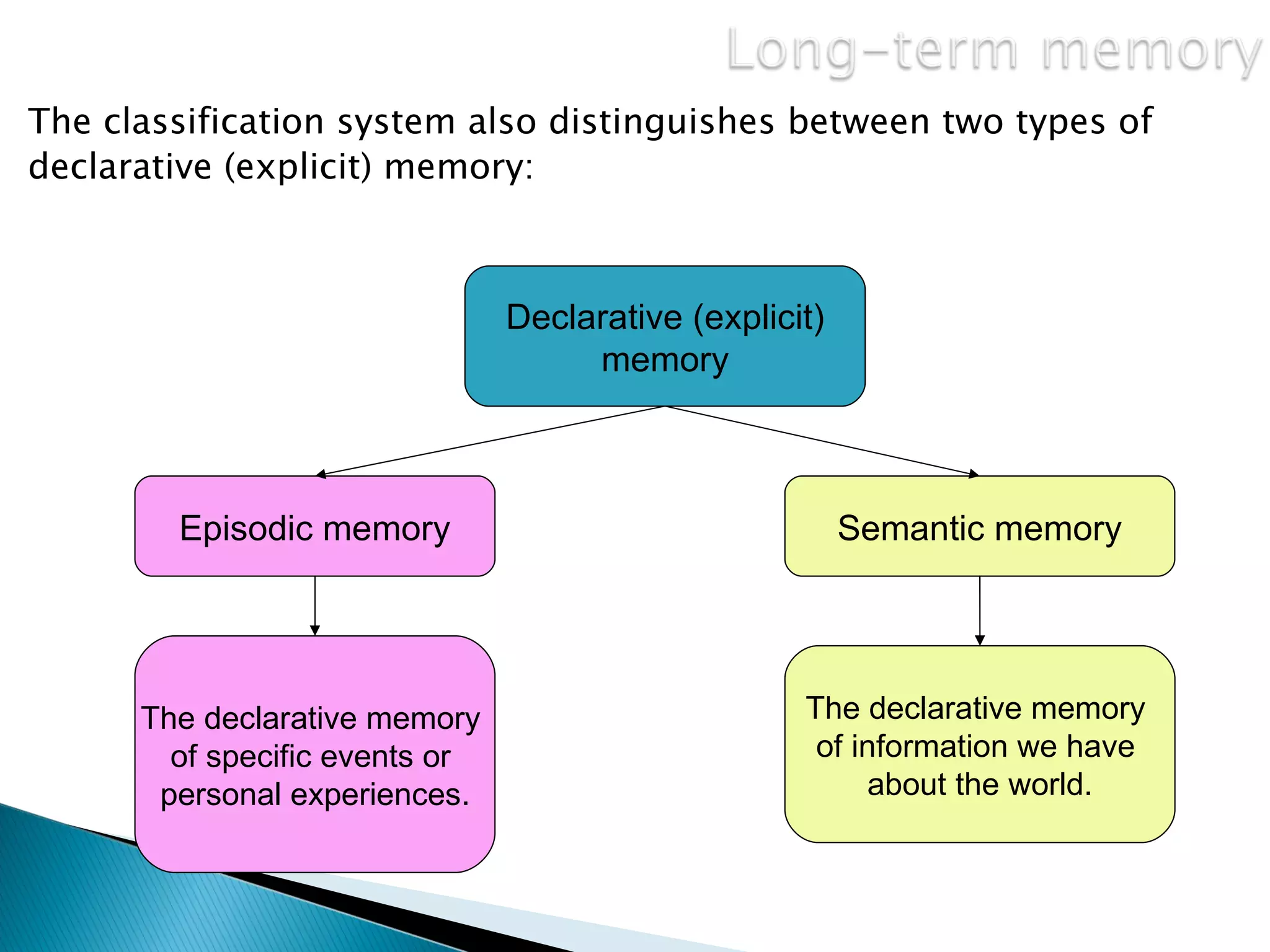
The classification system also distinguishes between two types of
declarative (explicit) memory:


                                Declarative (explicit)
                                     memory


        Episodic memory                                  Semantic memory


      The declarative memory                        The declarative memory
        of specific events or                        of information we have
       personal experiences.                              about the world.
Declarative memory
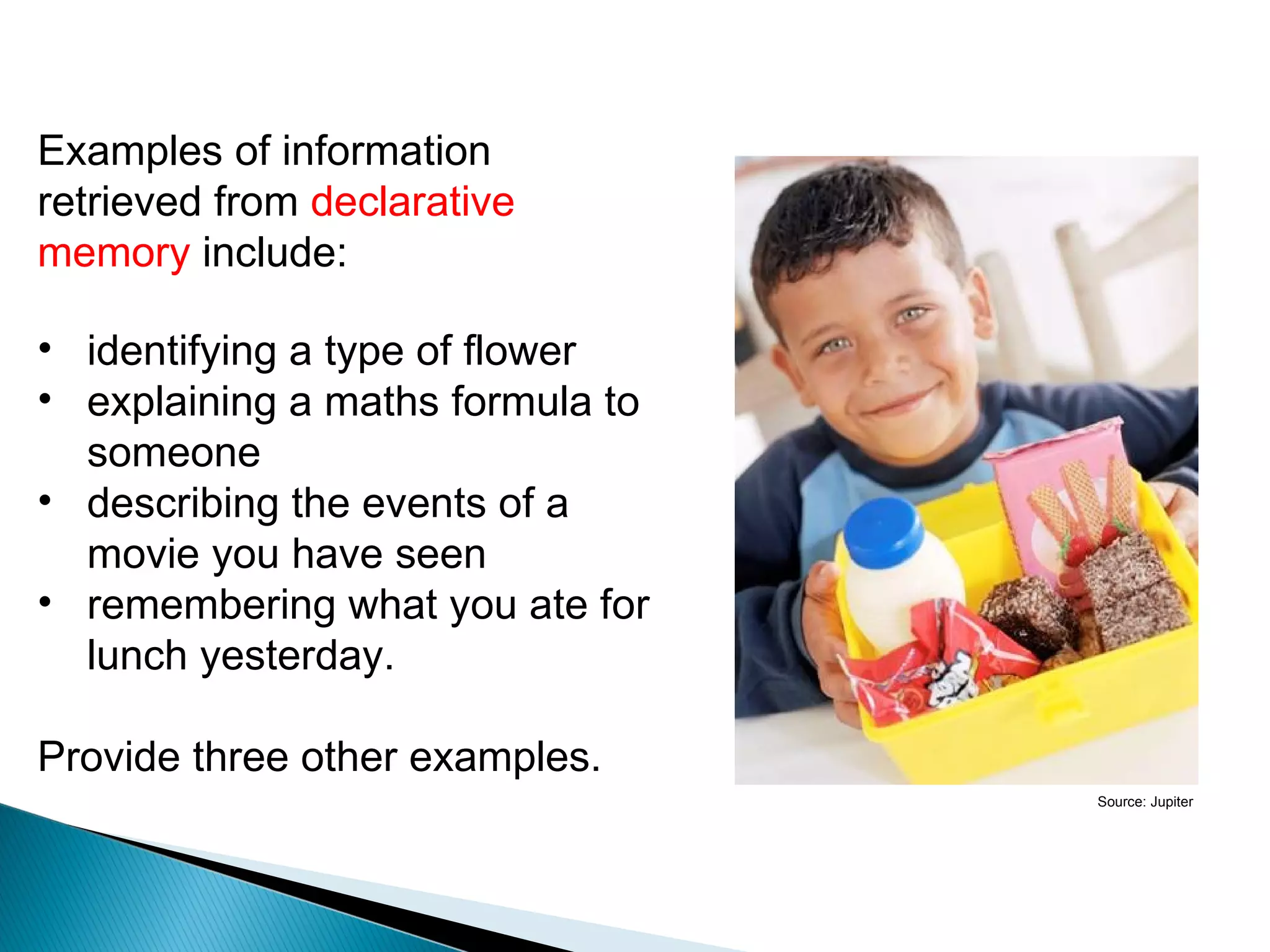
Examples of information
retrieved from declarative
memory include:

• identifying a type of flower
• explaining a maths formula to
  someone
• describing the events of a
  movie you have seen
• remembering what you ate for
  lunch yesterday.

Provide three other examples.
                                              Source: Jupiter
Episodic memory

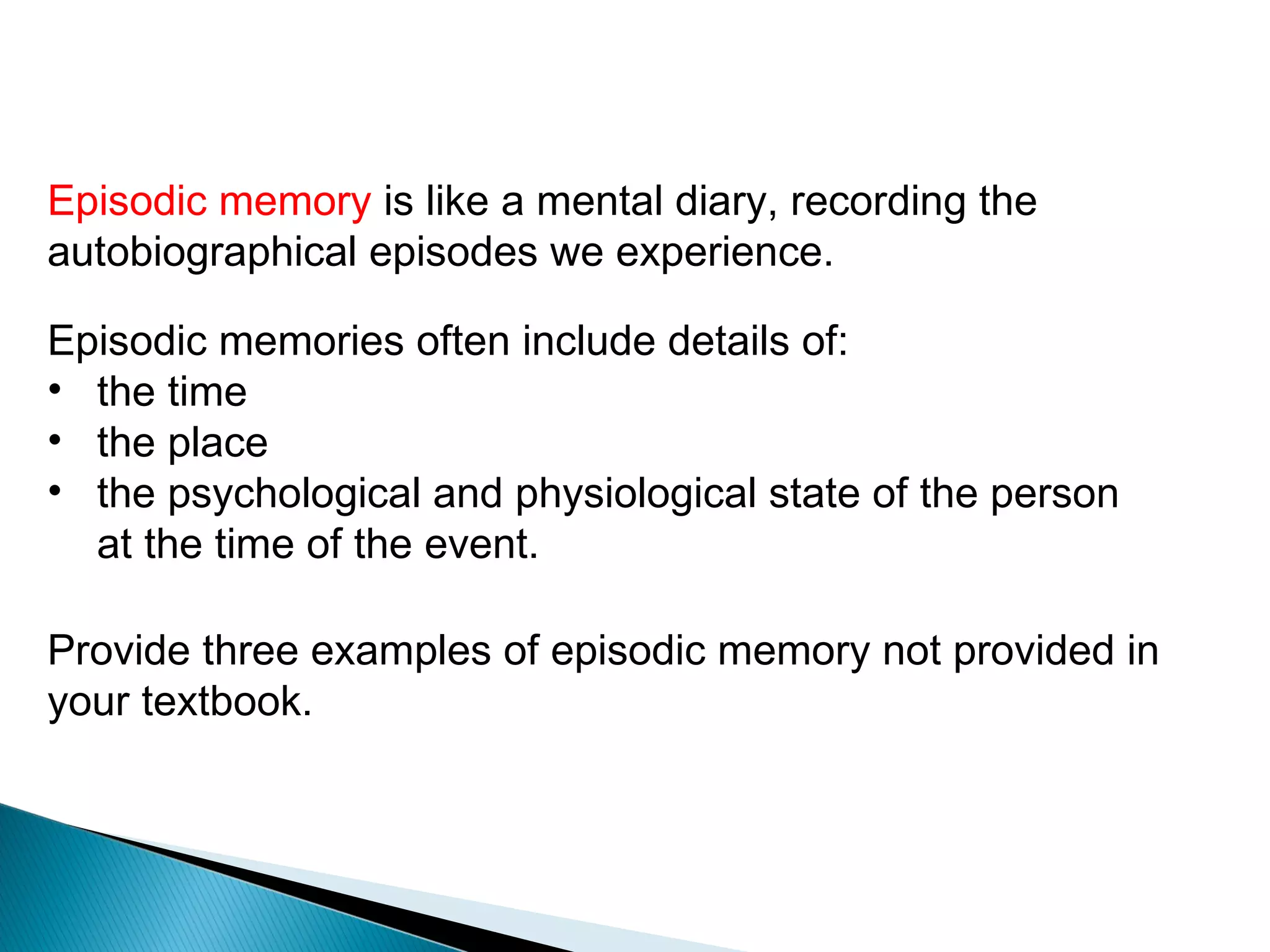
Episodic memory is like a mental diary, recording the
autobiographical episodes we experience.

Episodic memories often include details of:
• the time
• the place
• the psychological and physiological state of the person
  at the time of the event.

Provide three examples of episodic memory not provided in
your textbook.
Episodic memory


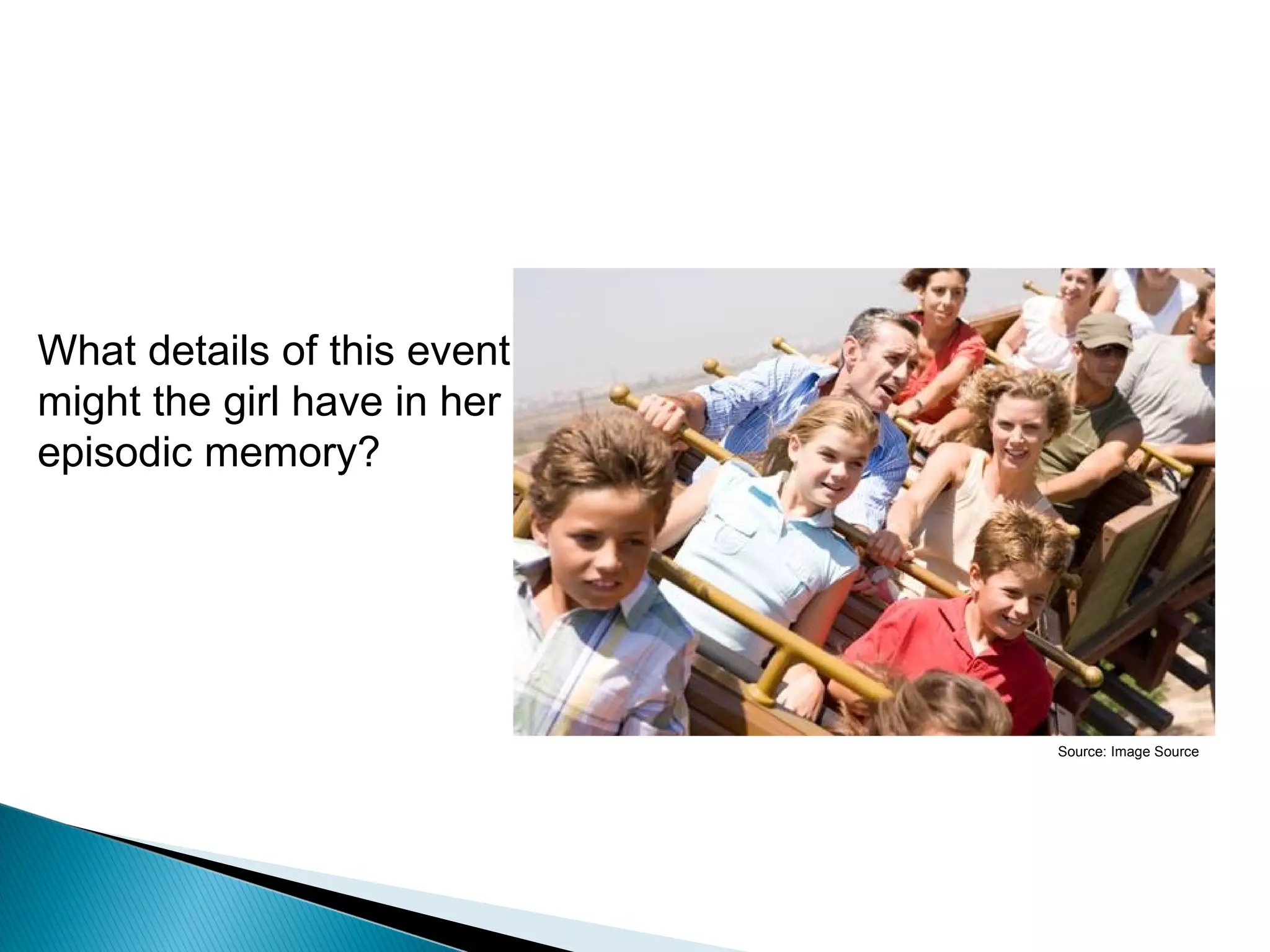
What details of this event
might the girl have in her
episodic memory?


                                    Source: Image Source
Semantic memory
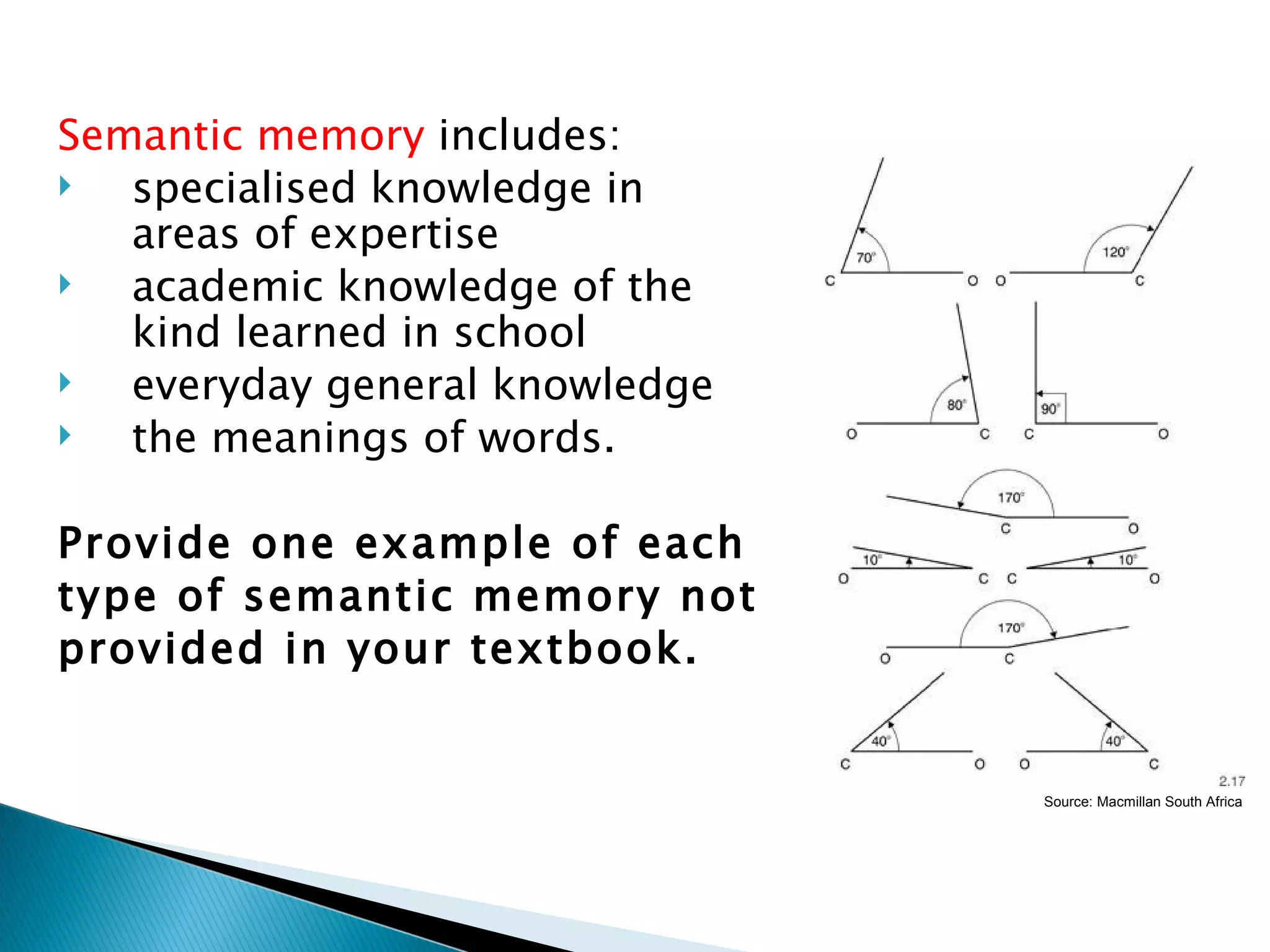
Semantic memory includes:
  specialised knowledge in
   areas of expertise
  academic knowledge of the
   kind learned in school
  everyday general knowledge
  the meanings of words.

Provide one example of each
type of semantic memory not
provided in your textbook.


                                       Source: Macmillan South Africa
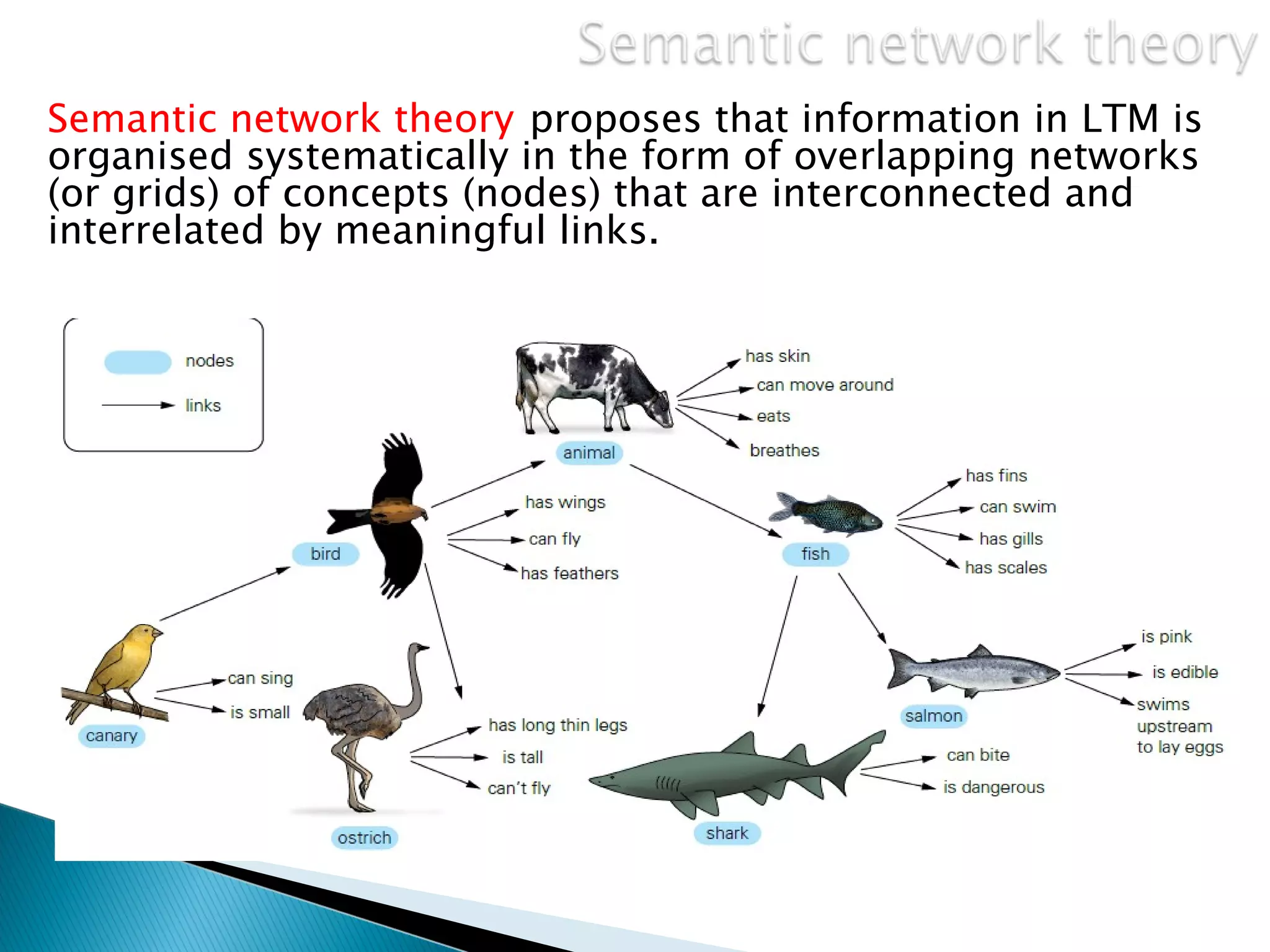
Semantic network theory proposes that information in LTM is
organised systematically in the form of overlapping networks
(or grids) of concepts (nodes) that are interconnected and
interrelated by meaningful links.
   Each node is linked with a number of other
    nodes.

   When we retrieve information, the activation of
    one node causes other related nodes to be
    activated also.

   The retrieval of information from LTM therefore
    begins with someone searching a particular
    ‘region’ of memory and then tracing associations
    for links among memories (concepts) in that
    region, rather than randomly searching the vast
    information stores in LTM.

How is this similar to using Google?
   A shorter link between two concepts in a
    semantic network indicates a strong
    association between concepts. While a longer
    link between two concepts illustrates a more
    distant association.

   It is thought that when ideas are further apart
    in meaning , they are further apart in in
    distance (within the network). This means
    that when memories are similar in their
    meaning it takes shorter time to retrieve
    them.
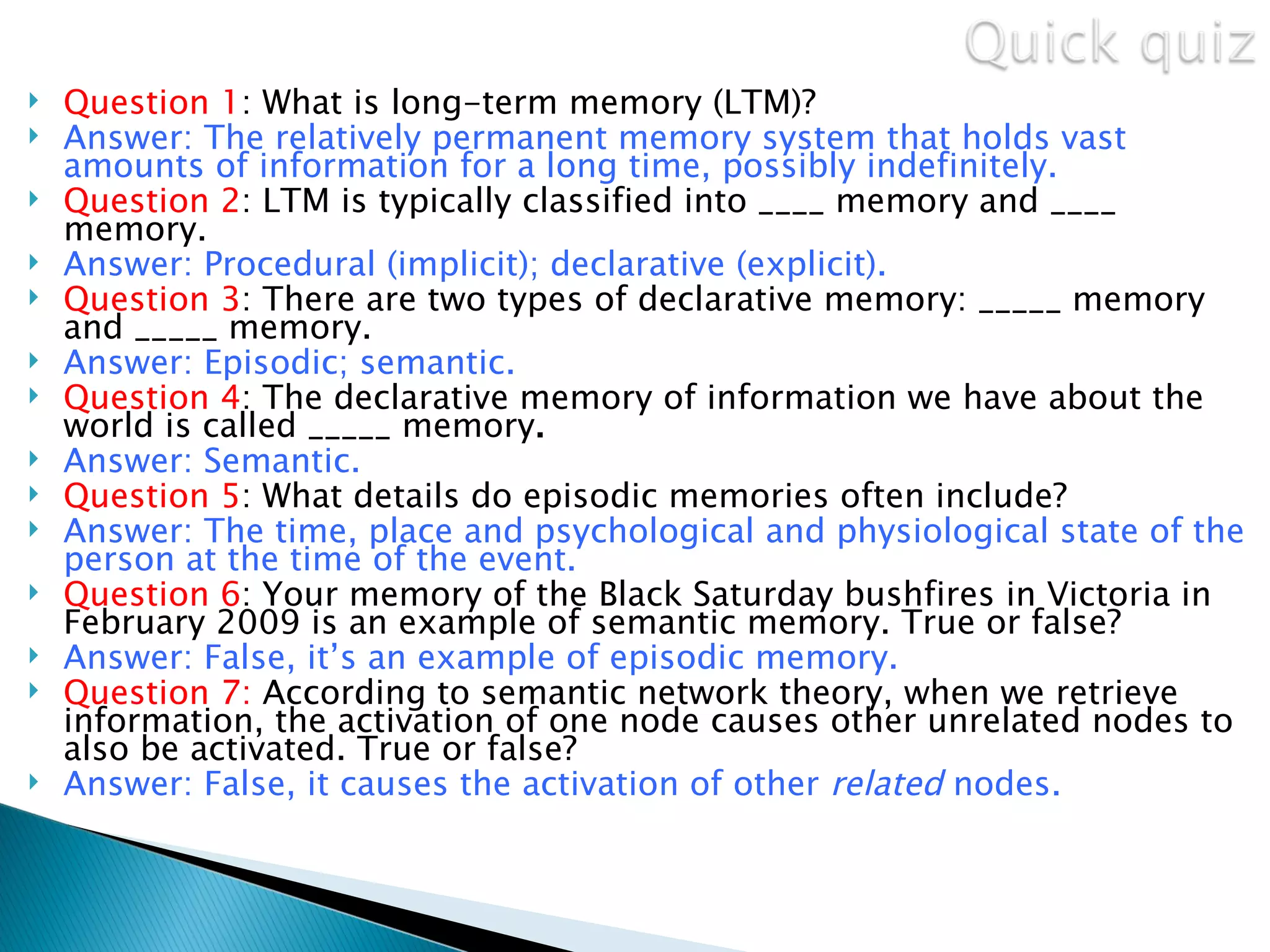
   Question 1: What is long-term memory (LTM)?
   Answer: The relatively permanent memory system that holds vast
    amounts of information for a long time, possibly indefinitely.
   Question 2: LTM is typically classified into ____ memory and ____
    memory.
   Answer: Procedural (implicit); declarative (explicit).
   Question 3: There are two types of declarative memory: _____ memory
    and _____ memory.
   Answer: Episodic; semantic.
   Question 4: The declarative memory of information we have about the
    world is called _____ memory.
   Answer: Semantic.
   Question 5: What details do episodic memories often include?
   Answer: The time, place and psychological and physiological state of the
    person at the time of the event.
   Question 6: Your memory of the Black Saturday bushfires in Victoria in
    February 2009 is an example of semantic memory. True or false?
   Answer: False, it’s an example of episodic memory.
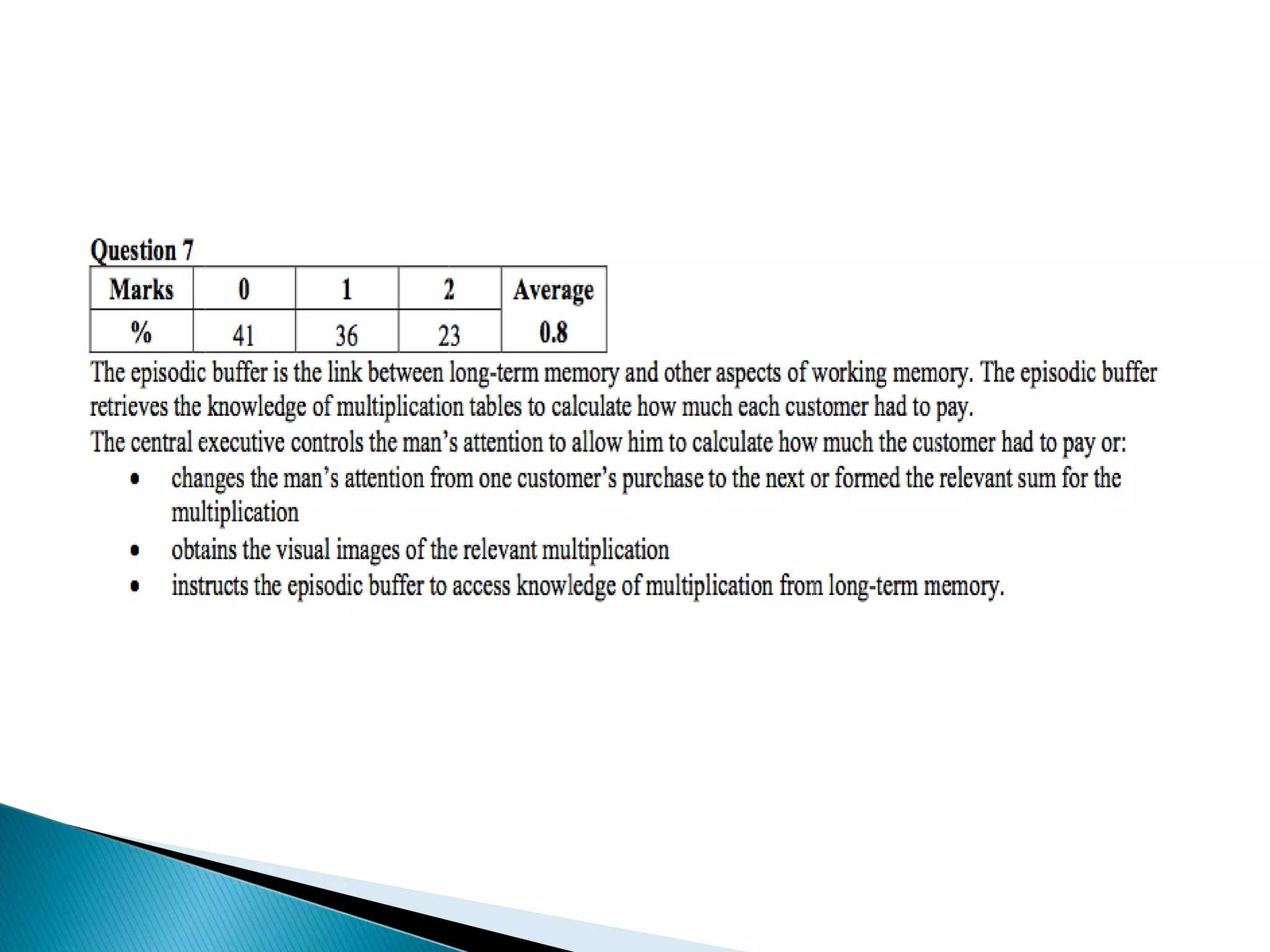
   Question 7: According to semantic network theory, when we retrieve
    information, the activation of one node causes other unrelated nodes to
    also be activated. True or false?
   Answer: False, it causes the activation of other related nodes.

Lesson 4 organisation of ltm 2012

  • 1.
    VCE Psychology Units3 & 4 Lesson 4 Organisation of long- term memory
  • 4.
    Explain the organisation of long-term memory including declarative and episodic memory, and semantic network theory  Identify types of long-term memories  Explain and evaluate the semantic network theory
  • 5.
    Long-term memory (LTM) isthe relatively permanent memory system that holds vast amounts of information for a long time, possibly indefinitely. How can we get information out of our LTM? What is this Source: Bananastock similar to?
  • 6.
    Long-term memory (LTM)is typically classified into two types: Long-term memory (LTM) Procedural (implicit) Declarative (explicit) memory memory Memory of ‘how to Memory of specific facts do something’ (of /events that can be actions and skills explicitly stated previously learned) (declared)
  • 7.
    The classification systemalso distinguishes between two types of declarative (explicit) memory: Declarative (explicit) memory Episodic memory Semantic memory The declarative memory The declarative memory of specific events or of information we have personal experiences. about the world.
  • 8.
    Declarative memory Examples ofinformation retrieved from declarative memory include: • identifying a type of flower • explaining a maths formula to someone • describing the events of a movie you have seen • remembering what you ate for lunch yesterday. Provide three other examples. Source: Jupiter
  • 9.
    Episodic memory Episodic memoryis like a mental diary, recording the autobiographical episodes we experience. Episodic memories often include details of: • the time • the place • the psychological and physiological state of the person at the time of the event. Provide three examples of episodic memory not provided in your textbook.
  • 10.
    Episodic memory What detailsof this event might the girl have in her episodic memory? Source: Image Source
  • 11.
    Semantic memory Semantic memoryincludes:  specialised knowledge in areas of expertise  academic knowledge of the kind learned in school  everyday general knowledge  the meanings of words. Provide one example of each type of semantic memory not provided in your textbook. Source: Macmillan South Africa
  • 12.
    Semantic network theoryproposes that information in LTM is organised systematically in the form of overlapping networks (or grids) of concepts (nodes) that are interconnected and interrelated by meaningful links.
  • 13.
    Each node is linked with a number of other nodes.  When we retrieve information, the activation of one node causes other related nodes to be activated also.  The retrieval of information from LTM therefore begins with someone searching a particular ‘region’ of memory and then tracing associations for links among memories (concepts) in that region, rather than randomly searching the vast information stores in LTM. How is this similar to using Google?
  • 14.
    A shorter link between two concepts in a semantic network indicates a strong association between concepts. While a longer link between two concepts illustrates a more distant association.  It is thought that when ideas are further apart in meaning , they are further apart in in distance (within the network). This means that when memories are similar in their meaning it takes shorter time to retrieve them.
  • 15.
    Question 1: What is long-term memory (LTM)?  Answer: The relatively permanent memory system that holds vast amounts of information for a long time, possibly indefinitely.  Question 2: LTM is typically classified into ____ memory and ____ memory.  Answer: Procedural (implicit); declarative (explicit).  Question 3: There are two types of declarative memory: _____ memory and _____ memory.  Answer: Episodic; semantic.  Question 4: The declarative memory of information we have about the world is called _____ memory.  Answer: Semantic.  Question 5: What details do episodic memories often include?  Answer: The time, place and psychological and physiological state of the person at the time of the event.  Question 6: Your memory of the Black Saturday bushfires in Victoria in February 2009 is an example of semantic memory. True or false?  Answer: False, it’s an example of episodic memory.  Question 7: According to semantic network theory, when we retrieve information, the activation of one node causes other unrelated nodes to also be activated. True or false?  Answer: False, it causes the activation of other related nodes.

Editor's Notes

  • #6 As explained on pp 320-21: we can get (‘retrieve’) information from LTM using retrieval cues . This is similar to the way we use a call number to locate a book in the library or the ‘Find’ function in computer software. The retrieval of information from LTM can be intentional, such as when you try to recall the name of your Year 7 English teacher, or unintentional, such as when hearing a particular song brings back memories of a special time in your life. In either case, only the specific information relevant to the cue is retrieved, rather than the entire contents of LTM. Most of the time, the retrieval of information from LTM is very efficient. Remarkably, it takes only a few seconds to search through this huge storehouse of information to find the information required.
  • #9 The birth of a sibling Describing a recent holiday What you did in a class yesterday Your memory of the Victorian bushfires in 2009 Etc.
  • #10 Further examples could include: where you were when you first went on a rollercoaster (and how you felt) your first day of school your first kiss attending a friend's birthday party attending a grandparents funeral.
  • #11 She might remember: that it was the morning (or afternoon) that it was a really hot day that it was at Luna Park, or while on holiday in Queensland that she was really excited and loved it that she sat next to her brother and that their parents sat behind them.
  • #12 Specialised knowledge in areas of expertise, e.g. what tools you would need to build a wooden fence. Academic knowledge of the kind learned in school, e.g. Pythagoras' theorem. Everyday general knowledge, e.g. that 1300 hrs means the same as 1 pm. The meanings of words, e.g. that hinder means to cause delay, interruption, or difficulty.
  • #14 When you use Google, you type in keywords and Google then systematically locates websites that have your keywords in them. This significantly narrows down your search and you then only have to search through those websites with your keywords in them, as opposed to every website on the internet.