Contents
What is Tuberculosis
?
Whatis the difference between TB infection and TB disease
?
How is TB transmitted
?
What are the symptoms of the disease
?
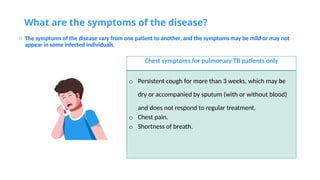
When should you see a doctor
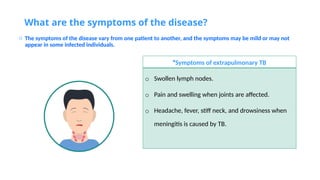
?
What are the causes of TB infection
?
When should a TB test be performed
?
How is TB diagnosed
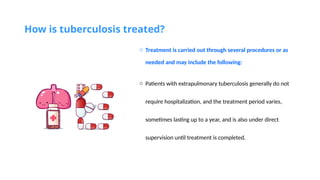
?
How is TB treated
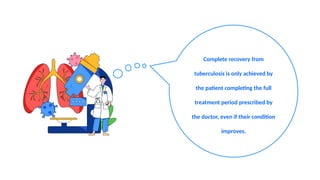
?
What are the complications of TB infection
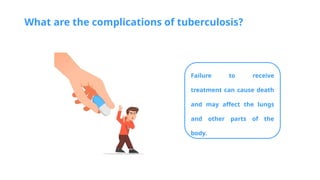
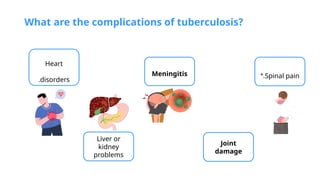
?
What you should know about TB medications
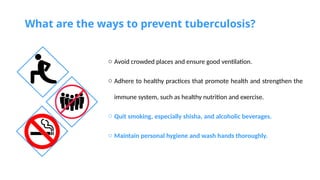
.
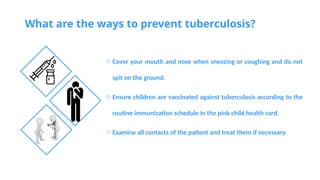
What are the ways to prevent TB infection
?
4.
What is Tuberculosis
?
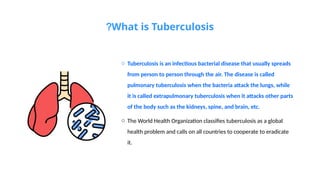
oTuberculosis is an infectious bacterial disease that usually spreads
from person to person through the air. The disease is called
pulmonary tuberculosis when the bacteria attack the lungs, while
it is called extrapulmonary tuberculosis when it attacks other parts
of the body such as the kidneys, spine, and brain, etc.
o The World Health Organization classifies tuberculosis as a global
health problem and calls on all countries to cooperate to eradicate
it.
5.
What is thedifference between TB infection and
TB disease?
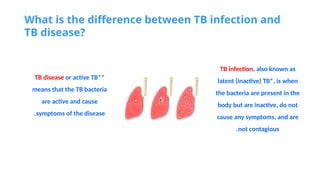
TB infection, also known as
latent (inactive) TB*, is when
the bacteria are present in the
body but are inactive, do not
cause any symptoms, and are
not contagious
.
TB disease or active TB**
means that the TB bacteria
are active and cause
symptoms of the disease
.
6.
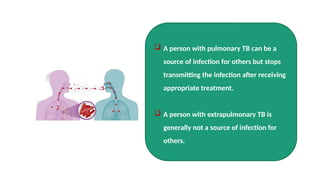
A personwith pulmonary TB can be a
source of infection for others but stops
transmitting the infection after receiving
appropriate treatment.
A person with extrapulmonary TB is
generally not a source of infection for
others.
7.
How is TBtransmitted?
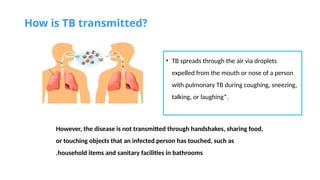
• TB spreads through the air via droplets
expelled from the mouth or nose of a person
with pulmonary TB during coughing, sneezing,
talking, or laughing*.
However, the disease is not transmitted through handshakes, sharing food,
or touching objects that an infected person has touched, such as
household items and sanitary facilities in bathrooms
.
8.
What are thesymptoms of the disease?
o The symptoms of the disease vary from one patient to another, and the symptoms may be mild or may not
appear in some infected individuals.
General Symptoms
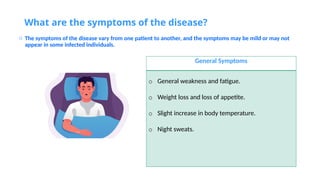
o General weakness and fatigue.
o Weight loss and loss of appetite.
o Slight increase in body temperature.
o Night sweats.
9.
What are thesymptoms of the disease?
o The symptoms of the disease vary from one patient to another, and the symptoms may be mild or may not
appear in some infected individuals.
Chest symptoms for pulmonary TB patients only
o Persistent cough for more than 3 weeks, which may be
dry or accompanied by sputum (with or without blood)
and does not respond to regular treatment.
o Chest pain.
o Shortness of breath.
10.
What are thesymptoms of the disease?
o The symptoms of the disease vary from one patient to another, and the symptoms may be mild or may not
appear in some infected individuals.
Symptoms of extrapulmonary TB
*
o Swollen lymph nodes.
o Pain and swelling when joints are affected.
o Headache, fever, stiff neck, and drowsiness when
meningitis is caused by TB.
11.
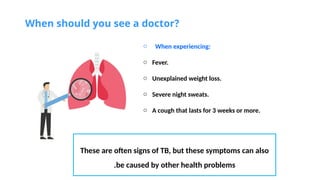
When should yousee a doctor?
o When experiencing:
o Fever.
o Unexplained weight loss.
o Severe night sweats.
o A cough that lasts for 3 weeks or more.
These are often signs of TB, but these symptoms can also
be caused by other health problems
.
12.
What are thecauses of TB infection?
o Anyone can be at risk of developing TB, but some people are more at risk, including:
o Those living in countries with a high incidence of TB.
o Those who have close and prolonged contact with an infected person.
o People with Human Immunodeficiency Virus / AIDS.
o Those with health problems that weaken the immune system.
o Those receiving treatments that weaken the immune system, such as chemotherapy.
o Young children or the elderly.
o Drug and alcohol addicts.
13.
When should aTB test be performed?
o For people who have been in contact with a TB patient or someone suspected of having TB.
o For people receiving treatments that weaken the immune system (cancer patients), such as
chemotherapy.
o If TB symptoms appear and the doctor requests tests.
o If the workplace requires tests, such as for healthcare workers and others.
o Applicants for new residency visas and their renewal for expatriates as part of medical fitness
examinations.
14.
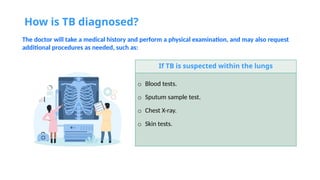
How is TBdiagnosed?
The doctor will take a medical history and perform a physical examination, and may also request
additional procedures as needed, such as:
If TB is suspected within the lungs
o Blood tests.
o Sputum sample test.
o Chest X-ray.
o Skin tests.
15.
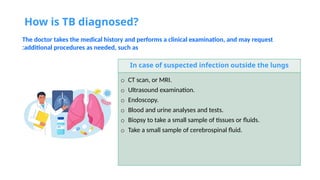
How is TBdiagnosed?
The doctor takes the medical history and performs a clinical examination, and may request
additional procedures as needed, such as
:
In case of suspected infection outside the lungs
o CT scan, or MRI.
o Ultrasound examination.
o Endoscopy.
o Blood and urine analyses and tests.
o Biopsy to take a small sample of tissues or fluids.
o Take a small sample of cerebrospinal fluid.
16.
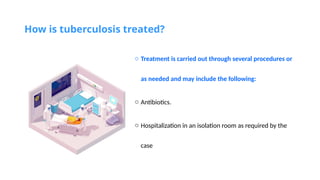
How is tuberculosistreated?
o Treatment is carried out through several procedures or
as needed and may include the following:
o Antibiotics.
o Hospitalization in an isolation room as required by the
case
17.
How is tuberculosistreated?
o Treatment is carried out through several procedures or as
needed and may include the following:
o Patients with extrapulmonary tuberculosis generally do not
require hospitalization, and the treatment period varies,
sometimes lasting up to a year, and is also under direct
supervision until treatment is completed.
18.
Complete recovery from
tuberculosisis only achieved by
the patient completing the full
treatment period prescribed by
the doctor, even if their condition
improves.
19.
What should beknown about tuberculosis
medications?
Tuberculosis medications are usually
safe, but some people experience side
effects that require consulting a doctor
.
20.
What are thecomplications of tuberculosis?
Failure to receive
treatment can cause death
and may affect the lungs
and other parts of the
body.
21.
What are thecomplications of tuberculosis?
Joint
damage
Liver or
kidney
problems
Spinal pain
*.
Meningitis
Heart
disorders
.
22.
What are theways to prevent tuberculosis?
o Avoid crowded places and ensure good ventilation.
o Adhere to healthy practices that promote health and strengthen the
immune system, such as healthy nutrition and exercise.
o Quit smoking, especially shisha, and alcoholic beverages.
o Maintain personal hygiene and wash hands thoroughly.
23.
What are theways to prevent tuberculosis?
o Cover your mouth and nose when sneezing or coughing and do not
spit on the ground.
o Ensure children are vaccinated against tuberculosis according to the
routine immunization schedule in the pink child health card.
o Examine all contacts of the patient and treat them if necessary.
#5 *ويتوجب على المصاب بالعدوى أخذ العلاج المناسب للتخلص من وجود البكتيريا ويمنع تحولها الى السل النشط ويصاب بالمرض.
**وقد يكون هذا بسبب تقدم السن أوالإصابة بأمراض تضعف المناعة كالسرطان والأمراض المزمنة كالسكري وأمراض الكلى، وزيادة ضغوطات الحياة ، وتعاطي المخدرات والمشروبات الكحولية، أوالإصابة بفيروس نقص المناعة البشري ( الأيدز ) و سوء التغذية.
#7 * يصاب الأشخاص الذين يمضون وقتا طويلا مع الشخص المصاب مثل أفراد العائلة أو الأصدقاء أو زملاء العمل بالعدوى عند إستنشاقهم للهواء الملوث بالجراثيم
#12 * مثل جنوب أفريقيا, الهند, الصين, المكسيك, وبعض دول شرق آسيا.
** مثل مصابين السكري وأمراض الكلي والسرطان.
*مرضى السرطان .
***حيث أن الجهاز المناعي عند كبار السن والصغار يعتبر أقل من الجهاز المناعي لدى الأشخاص الأصحاء.
#14
* يتم بحقن بروتين منقى ومشتق من بكتيريا السل داخل الجلد وتقاس الإستجابة المتكونة في مكان الحقن بعد 48 إلى 72 ساعة وبمقاييس معينة . لمعرفة ما إذا كان الشخص مصاب بعدوى السل
** للتأكد من عدم إصابة الدماغ والحبل الشوكي بالسّل، ويتم هذا الإجراء عن طريق إبرة في آخر الظهر يتم فيها سحب عيّنة من السائل النخاعي.
#15 خزعة لأخذ عيّنة صغيرة من الأنسجة،أو السوائل من المنطقة المصابة لفحصها
* يتم بحقن بروتين منقى ومشتق من بكتيريا السل داخل الجلد وتقاس الإستجابة المتكونة في مكان الحقن بعد 48 إلى 72 ساعة وبمقاييس معينة . لمعرفة ما إذا كان الشخص مصاب بعدوى السل
** للتأكد من عدم إصابة الدماغ والحبل الشوكي بالسّل، ويتم هذا الإجراء عن طريق إبرة في آخر الظهر يتم فيها سحب عيّنة من السائل النخاعي.
#16 * يتم العلاج بتناول مجموعة من المضادات الحيوية يوميا وبانتظام تحت الإشراف المباشر من المختصين وتبلغ فترة العلاج ستة أشهر و قد تزيد في بعض الحالات .
**قد يتطلب علاج المريض المصاب بالسل الرئوي التنويم بالمستشفى في غرفة معزولة حسب ما تستدعيه الحالة لتلقي العلاج تحت الإشراف المباشر بعدها يستطيع المريض العودة إلى حياته العادية بعد خروجه من المستشفى على أن تتم متابعة العلاج الى المدة المحددة من قبل الطبيب حسب المواعيد المسجلة.
#17 * يتم العلاج بتناول مجموعة من المضادات الحيوية يوميا وبانتظام تحت الإشراف المباشر من المختصين وتبلغ فترة العلاج ستة أشهر و قد تزيد في بعض الحالات .
**قد يتطلب علاج المريض المصاب بالسل الرئوي التنويم بالمستشفى في غرفة معزولة حسب ما تستدعيه الحالة لتلقي العلاج تحت الإشراف المباشر بعدها يستطيع المريض العودة إلى حياته العادية بعد خروجه من المستشفى على أن تتم متابعة العلاج الى المدة المحددة من قبل الطبيب حسب المواعيد المسجلة.
#21 * تعد آلام الظهر وتيبسها من المضاعفات الشائعة لمرضى السّل
**وهذا يعتبر من الحالات النادرة حيث قد يصيب مرض السّل الأنسجة المحيطة بالقلب، مما يتسبب في حدوث التهاب واحتباس السوائل التي قد تتداخل مع قدرة القلب على ضخ الدم للجسم بشكل فعال.



![PERI-PROSTHETIC FRACTURE NAIL-PLATE CONSTRUCT [NPC].pptx](https://cdn.slidesharecdn.com/ss_thumbnails/drarunkumardrmohamedashrafperiprostheticfrasturenail-plateconstructnpc-260209164459-7e9d15a1-thumbnail.jpg?width=640&height=640&fit=bounds)


![CTEV [ clubfoot] DR ARUN LAL ,DR MOHAMED ASHRAF travancore medical college k...](https://cdn.slidesharecdn.com/ss_thumbnails/ctevclubfootdrarunlaldrmohamedashraftravancoremedicalcollegekollamkeralaindia-260208063247-18fc466c-thumbnail.jpg?width=640&height=640&fit=bounds)


![ONFH[AVN HIP] -TRIPLE REGIME -A NOVAL SURGICAL CONCEPT .pptx](https://cdn.slidesharecdn.com/ss_thumbnails/onfhavnhip2026koaconcalicutdrgokuldevdrmashraf-260210064517-213ec005-thumbnail.jpg?width=640&height=640&fit=bounds)


