Microorganisms and Human diseases:
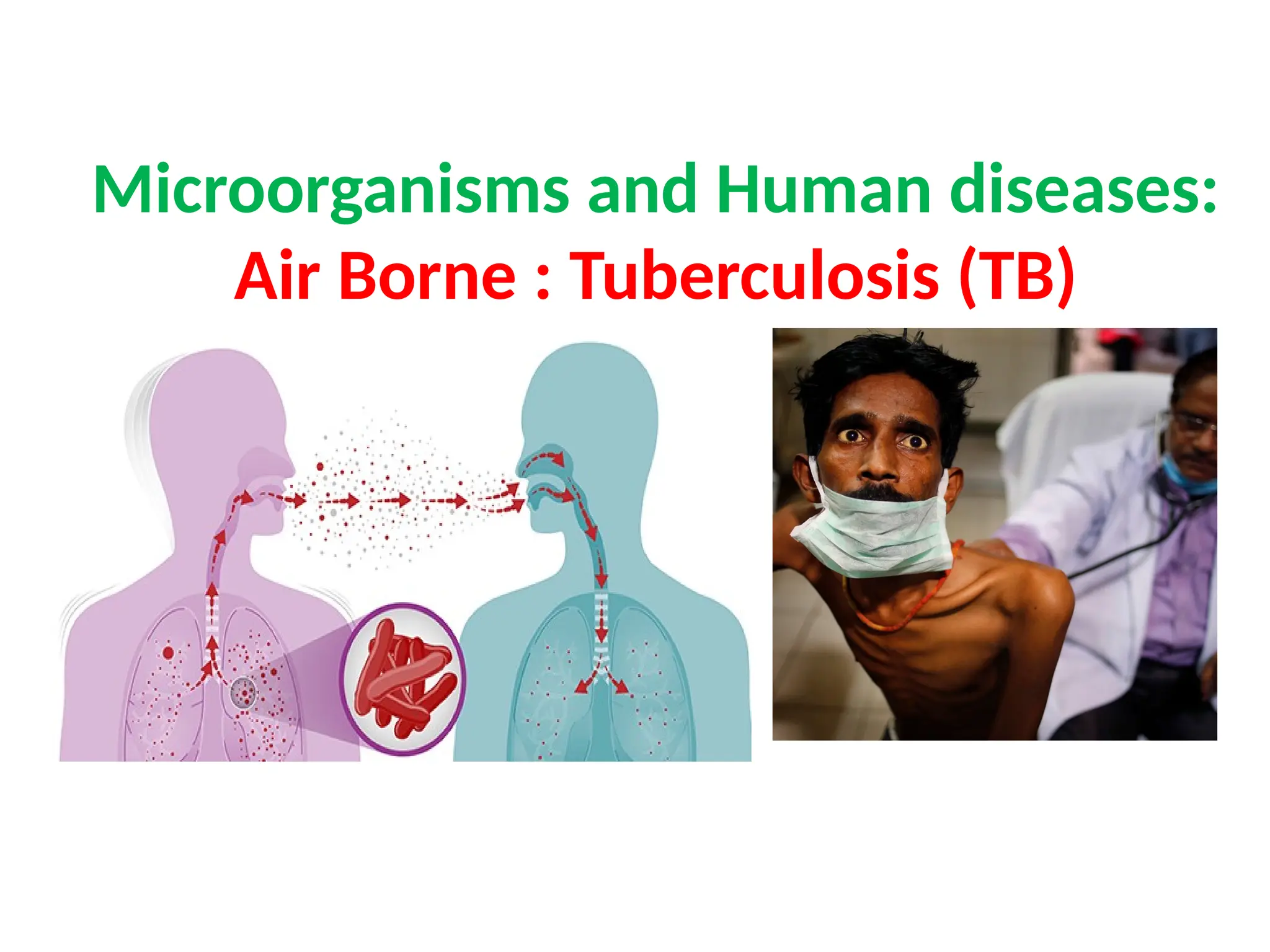
Air Borne : Tuberculosis (TB)
What is tuberculosis?
‱ A person may develop TB after
inhaling Mycobacterium tuberculosis (M.
tuberculosis) bacteria.
‱ When TB affects the lungs, the disease is the
most contagious, but a person will usually only
become sick after close contact with someone
who has this type of TB.
Causes
‱ M. tuberculosis bacteria cause TB.
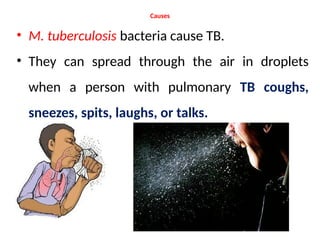
‱ They can spread through the air in droplets
when a person with pulmonary TB coughs,
sneezes, spits, laughs, or talks.
‱ Only people with active TB can transmit the
infection.
‱ However, most people with the disease can no
longer transmit the bacteria after they have
received appropriate treatment for at least 2 weeks
.
Early warning signs
.
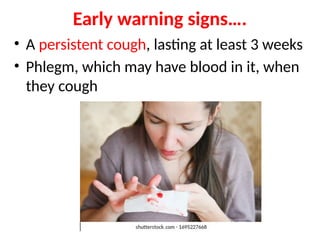
‱ A persistent cough, lasting at least 3 weeks
‱ Phlegm, which may have blood in it, when
they cough
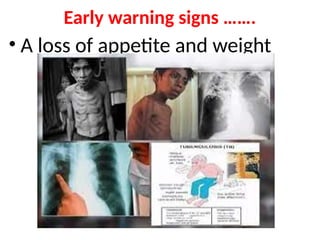
‱ A loss of appetite and weight
Early warning signs 

.
Early warning signs
.
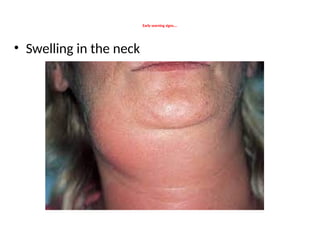
‱ Swelling in the neck
‱ A general feeling of fatigue
and being unwell
‱ A fever
‱ Chest pain
Symptoms
Latent TB:
‱ A person with latent TB will have no
symptoms, and no damage will show on a
chest X-ray.
‱ However, a blood test or skin prick test
will indicate that they have TB infection.
Active TB:
‱ A person with TB disease may experience a
cough that produces phlegm, fatigue, a fever,
chills, and a loss of appetite and weight.
‱ Symptoms typically worsen over time, but
they can also spontaneously go away and
return.
Beyond the lungs
‱ TB usually affects the lungs, though symptoms can
develop in other parts of the body.
‱ This is more common in people with weakened
immune systems.
TB can cause:
‱ Persistently swollen lymph nodes, or “swollen glands”
‱ Abdominal pain
‱ Joint or bone pain
‱ Confusion
‱ A persistent headache
‱ Seizures
Diagnosis
‱ A person with latent TB will have no
symptoms, but the infection can show up on
tests. People should ask for a TB test if they:
‱ have spent time with a person who has or is at
risk of TB
‱ have spent time in a country with high rates of
TB
‱ work in an environment where TB may be
present
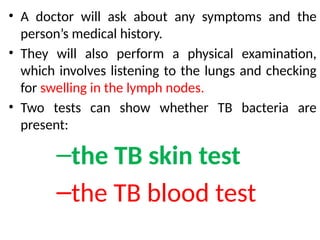
‱ A doctor will ask about any symptoms and the
person’s medical history.
‱ They will also perform a physical examination,
which involves listening to the lungs and checking
for swelling in the lymph nodes.
‱ Two tests can show whether TB bacteria are
present:
–the TB skin test
–the TB blood test
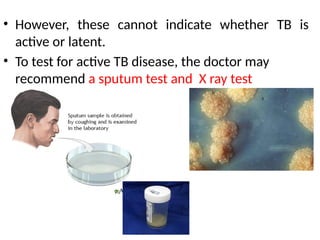
‱ However, these cannot indicate whether TB is
active or latent.
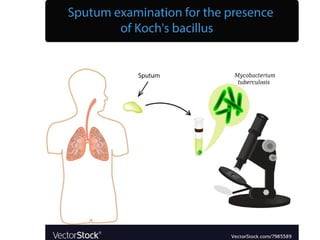
‱ To test for active TB disease, the doctor may
recommend a sputum test and X ray test
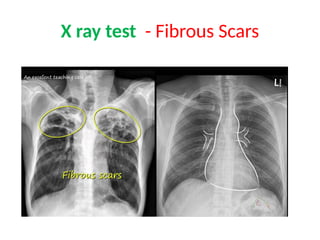
X ray test - Fibrous Scars
Treatment
‱ With early detection and appropriate antibiotics,
TB is treatable.
‱ The right type of antibiotic and length of
treatment will depend on:
the person’s age and overall health
whether they have latent or active TB
the location of the infection
‱ Treatment for latent TB can vary.
‱ It may involve taking an antibiotic once a week for 12
weeks or every day for 9 months.
‱ Treatment for active TB may involve taking several
drugs for 6–9 months
‱ When a person has a drug resistant strain of TB, the
treatment will be more complex.
‱ It is essential to complete the full course of
treatment, even if symptoms go away.
‱ If a person stops taking their medication early, some
bacteria can survive and become resistant to
antibiotics. In this case, the person may go on to
develop drug resistant TB
Vaccination
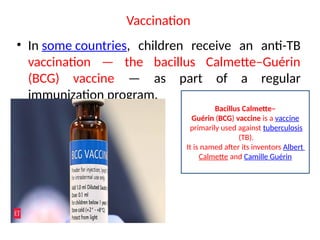
‱ In some countries, children receive an anti-TB
vaccination — the bacillus Calmette–GuĂ©rin
(BCG) vaccine — as part of a regular
immunization program.
Bacillus Calmette–
Guérin (BCG) vaccine is a vaccine
primarily used against tuberculosis
(TB).
It is named after its inventors Albert
Calmette and Camille Guérin

TB Microorganisms and Human diseases.pptx

  • 1.
    Microorganisms and Humandiseases: Air Borne : Tuberculosis (TB)
  • 2.
    What is tuberculosis? ‱A person may develop TB after inhaling Mycobacterium tuberculosis (M. tuberculosis) bacteria. ‱ When TB affects the lungs, the disease is the most contagious, but a person will usually only become sick after close contact with someone who has this type of TB.
  • 3.
    Causes ‱ M. tuberculosisbacteria cause TB. ‱ They can spread through the air in droplets when a person with pulmonary TB coughs, sneezes, spits, laughs, or talks.
  • 4.
    ‱ Only peoplewith active TB can transmit the infection. ‱ However, most people with the disease can no longer transmit the bacteria after they have received appropriate treatment for at least 2 weeks .
  • 5.
    Early warning signs
. ‱A persistent cough, lasting at least 3 weeks ‱ Phlegm, which may have blood in it, when they cough
  • 6.
    ‱ A lossof appetite and weight Early warning signs 

.
  • 7.
  • 8.
    ‱ A generalfeeling of fatigue and being unwell ‱ A fever ‱ Chest pain
  • 9.
    Symptoms Latent TB: ‱ Aperson with latent TB will have no symptoms, and no damage will show on a chest X-ray. ‱ However, a blood test or skin prick test will indicate that they have TB infection.
  • 10.
    Active TB: ‱ Aperson with TB disease may experience a cough that produces phlegm, fatigue, a fever, chills, and a loss of appetite and weight. ‱ Symptoms typically worsen over time, but they can also spontaneously go away and return.
  • 11.
    Beyond the lungs ‱TB usually affects the lungs, though symptoms can develop in other parts of the body. ‱ This is more common in people with weakened immune systems. TB can cause: ‱ Persistently swollen lymph nodes, or “swollen glands” ‱ Abdominal pain ‱ Joint or bone pain ‱ Confusion ‱ A persistent headache ‱ Seizures
  • 12.
    Diagnosis ‱ A personwith latent TB will have no symptoms, but the infection can show up on tests. People should ask for a TB test if they: ‱ have spent time with a person who has or is at risk of TB ‱ have spent time in a country with high rates of TB ‱ work in an environment where TB may be present
  • 13.
    ‱ A doctorwill ask about any symptoms and the person’s medical history. ‱ They will also perform a physical examination, which involves listening to the lungs and checking for swelling in the lymph nodes. ‱ Two tests can show whether TB bacteria are present: –the TB skin test –the TB blood test
  • 14.
    ‱ However, thesecannot indicate whether TB is active or latent. ‱ To test for active TB disease, the doctor may recommend a sputum test and X ray test
  • 16.
    X ray test- Fibrous Scars
  • 17.
    Treatment ‱ With earlydetection and appropriate antibiotics, TB is treatable. ‱ The right type of antibiotic and length of treatment will depend on: the person’s age and overall health whether they have latent or active TB the location of the infection
  • 18.
    ‱ Treatment forlatent TB can vary. ‱ It may involve taking an antibiotic once a week for 12 weeks or every day for 9 months. ‱ Treatment for active TB may involve taking several drugs for 6–9 months ‱ When a person has a drug resistant strain of TB, the treatment will be more complex. ‱ It is essential to complete the full course of treatment, even if symptoms go away. ‱ If a person stops taking their medication early, some bacteria can survive and become resistant to antibiotics. In this case, the person may go on to develop drug resistant TB
  • 19.
    Vaccination ‱ In somecountries, children receive an anti-TB vaccination — the bacillus Calmette–GuĂ©rin (BCG) vaccine — as part of a regular immunization program. Bacillus Calmette– GuĂ©rin (BCG) vaccine is a vaccine primarily used against tuberculosis (TB). It is named after its inventors Albert Calmette and Camille GuĂ©rin