IC Design of
Power Management Circuits (III)
Wing-Hung Ki
Integrated Power Electronics Laboratory
ECE Dept., HKUST
Clear Water Bay, Hong Kong
www.ee.ust.hk/~eeki
International Symposium on Integrated Circuits
Singapore, Dec. 14, 2009
Part III
Switching Converters:
Stability and Compensation

Ki

2
Content
Stability and Compensation
Nyquist criteria
System loop gain
Phase margin vs transient response
Type I, II, III compensators
Compensation for voltage mode control
Compensation for current mode control

Ki

3
Feedback Systems
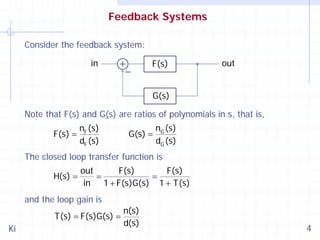
Consider the feedback system:

in

F(s)

out

G(s)
Note that F(s) and G(s) are ratios of polynomials in s, that is,
F(s) =

nF (s)
dF (s)

G(s) =

nG (s)
dG (s)

The closed loop transfer function is
H(s) =

out
F(s)
F(s)
=
=
in 1 + F(s)G(s) 1 + T(s)

and the loop gain is
T(s) = F(s)G(s) =
Ki

n(s)
d(s)

4
Stability Criteria
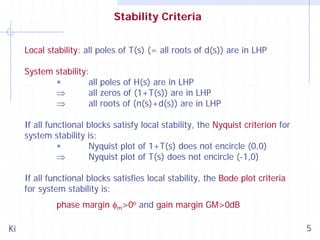
Local stability: all poles of T(s) (= all roots of d(s)) are in LHP
System stability:
∗
all poles of H(s) are in LHP
⇒
all zeros of (1+T(s)) are in LHP
⇒
all roots of (n(s)+d(s)) are in LHP
If all functional blocks satisfy local stability, the Nyquist criterion for
system stability is:
∗
Nyquist plot of 1+T(s) does not encircle (0,0)
⇒
Nyquist plot of T(s) does not encircle (-1,0)
If all functional blocks satisfies local stability, the Bode plot criteria
for system stability is:
phase margin φm>0o and gain margin GM>0dB
Ki

5
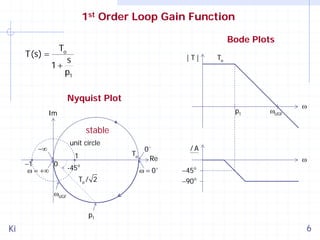
1st Order Loop Gain Function
T(s) =

Bode Plots

To

|T|

s
1+
p1

To

Nyquist Plot
p1

Im

ωUGF

ω

stable
unit circle

−∞
0
−1
ω = +∞

To

1
-45

o

0−
Re
ω = 0+

To / 2

/A

ω
−45o
−90 o

ωUGF
p1

Ki

6
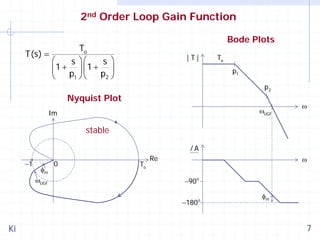
2nd Order Loop Gain Function
T(s) =

Bode Plots

To
⎛
s ⎞⎛
s ⎞
⎜1 + p ⎟ ⎜1 + p ⎟
⎝
1 ⎠⎝
2 ⎠

|T|

To
p1
p2

Nyquist Plot

ωUGF

Im

ω

stable
/A

−1

φm
ωUGF

0

To

Re

ω
−90 o
−180

Ki

o

φm

7
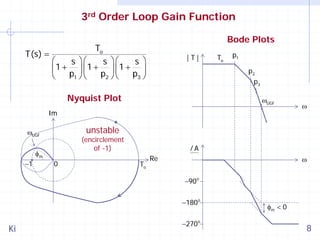
3rd Order Loop Gain Function
T(s) =

Bode Plots

To

|T|

⎛
s ⎞⎛
s ⎞⎛
s ⎞
⎜1 + p ⎟ ⎜1 + p ⎟ ⎜1 + p ⎟
⎝
1 ⎠⎝
2 ⎠⎝
3 ⎠

To

p1
p2
p3

Nyquist Plot

ωUGF

Im

unstable

ωUGF

(encirclement
of -1)

φm

−1

ω

0

/A
To

Re

ω
−90 o
−180o

Ki

−270o

φm < 0

8
Observations on Loop Gain Function
•

1st order systems are unconditional stable.

•

2nd order systems are stable, but a high damping factor would
cause large overshoot and excessive ringing before settling to
the steady state.

•

For 3rd order systems, if the 3rd pole p3 is less than 10X of the
unity gain frequency ωUGF, the system is unstable.

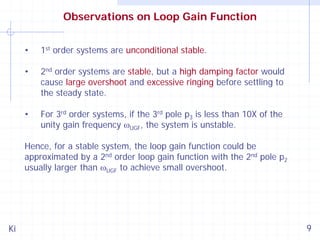
Hence, for a stable system, the loop gain function could be
approximated by a 2nd order loop gain function with the 2nd pole p2
usually larger than ωUGF to achieve small overshoot.

Ki

9
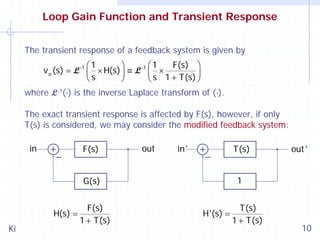
Loop Gain Function and Transient Response
The transient response of a feedback system is given by
F(s) ⎞
⎛1
⎛1
⎞
v o (s) = L−1 ⎜ × H(s) ⎟ = L−1 ⎜ ×
⎟
⎝s
⎠
⎝ s 1 + T(s) ⎠
where L-1(⋅) is the inverse Laplace transform of (⋅).
The exact transient response is affected by F(s), however, if only
T(s) is considered, we may consider the modified feedback system:
in

F(s)

out

in'

T(s)
1

G(s)
H(s) =
Ki

F(s)
1 + T(s)

out '

H'(s) =

T(s)
1 + T(s)

10
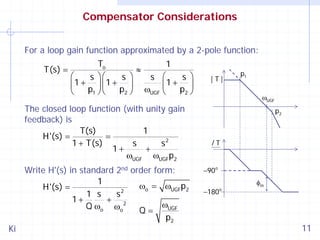
Compensator Considerations
For a loop gain function approximated by a 2-pole function:
T(s) =

To
1
≈
⎛
s ⎞⎛
s ⎞
s ⎛
s ⎞
1 + ⎟ ⎜1 + ⎟
1+ ⎟
⎜
p1 ⎠ ⎝
p2 ⎠ ωUGF ⎜
p2 ⎠
⎝
⎝

The closed loop function (with unity gain
feedback) is
T(s)
1
H'(s) =
=
1 + T(s)
s
s2
1+
+
ωUGF ωUGFp2

Ki

Write H'(s) in standard 2nd order form:
1
ωo = ωUGFp2
H'(s) =
2
1 s
s
1+
+ 2
ωUGF
Q ωo ωo
Q=
p2

|T|

p1

ωUGF
p2

/T

−90 o
−180

o

φm

11
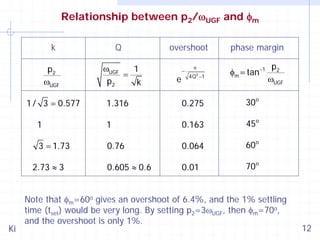
Relationship between p2/ωUGF and φm
k

p2
ωUGF

Q

ωUGF
1
=
p2
k

overshoot
e

−

π
2

4Q −1

phase margin

φm = tan−1

1.316

0.275

30 o

1

1

0.163

45o

3 = 1.73

0.76

0.064

60 o

0.605 ≈ 0.6

0.01

70 o

1 / 3 = 0.577

2.73 ≈ 3

Ki

p2
ωUGF

Note that φm=60o gives an overshoot of 6.4%, and the 1% settling
time (tset) would be very long. By setting p2=3ωUGF, then φm=70o,
and the overshoot is only 1%.

12
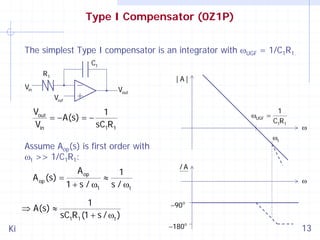
Type I Compensator (0Z1P)
The simplest Type I compensator is an integrator with ωUGF = 1/C1R1.
C1
R1

|A|

Vin

Vout

Vref

Vout
1
= − A(s) = −
Vin
sC1R1
Assume Aop(s) is first order with
ωt >> 1/C1R1:

A op

1
≈
A op (s) =
1 + s / ω1 s / ωt
1
⇒ A(s) ≈
sC1R1 (1 + s / ωt )
Ki

ωUGF =

1
C1R1

ω

ωt

/A

ω
−90 o
−180o

13
Type I Compensator (0Z1P)
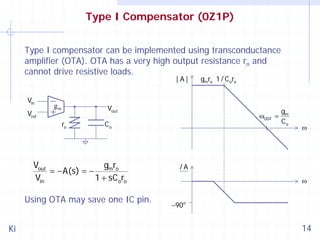
Type I compensator can be implemented using transconductance
amplifier (OTA). OTA has a very high output resistance ro and
cannot drive resistive loads.
|A|

Vin
Vref

gm

Vout
ro

Using OTA may save one IC pin.
Ki

ωUGF =

Co

Vout
gmro
= − A(s) = −
Vin
1 + sC oro

gmro 1 / C oro

gm
Co

ω

/A

ω
−90 o

14
Type II Compensator (1Z2P)
Type II compensator consists of a pole-zero pair with ωz<ωp, and a
maximum phase boosting of 90o is possible.
R2

|A|

C2

1
C2R 2

C1

ωUGF =
1 / C1R1

R1
Vin
Vref

Vout

Vout
1 + sC2R 2
=−
Vin
s(C1 + C 2 )R1 [1 + s(C1 || C 2 )R 2 ]
A(s) ≈

Ki

(1 + sC2R 2 )
sC2R1 (1 + sC1R 2 )

1
C1R 2

(C1 << C2 )

1 / C2R1

ω

/A

ω
90 o phase
boosting
−90 o

15
Type II Compensator (1Z1P)
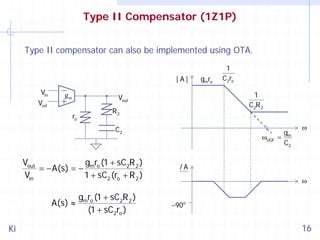
Type II compensator can also be implemented using OTA.
|A|
Vin
Vref

gm

1
C2R 2

Vout
ro

R2
C2

Vout
g r (1 + sC2R 2 )
= − A(s) = − m o
Vin
1 + sC2 (ro + R 2 )
A(s) ≈
Ki

gmro (1 + sC2R 2 )
(1 + sC2ro )

gmro

1
C2ro

ωUGF

g
= m
C2

ω

/A

ω
−90 o

16
Type III Compensator (2Z3P)
Type III compensator consists of two pole-zero pairs, and phase
boosting of 180o is possible to compensate for complex poles.
R2
R3

Vin

C3

R1

Vref

|A|

C2

1
C2R 2

C1

Vout

1
C2R1

/A
Vout
(1 + sC 2R 2 )[1 + sC3 (R1 + R 3 )]
=−
+90 o
Vin
s(C1 + C2 )R1 (1 + sC1 || C2R 2 )(1 + sC3R 3 )

(1 + sC2R 2 )(1 + sC 3R1 )
A(s) ≈
sC2R1 (1 + sC1R 2 )(1 + sC 3R 3 )
Ki

(C1 <<C2 , R1>>R 3 )

1
C3R1

1
1
C1R 2 C3R 3

ωUGF
1
=
C1R 3

180o
boosting

ω

ω

−90 o

17
PWM Voltage Mode Control
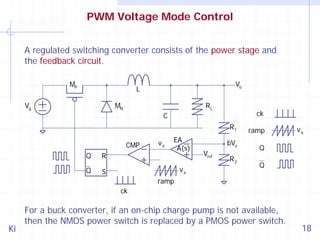
A regulated switching converter consists of the power stage and
the feedback circuit.
MP

Vo

L

Vg

MN

RL

ck

C
R1
CMP
Q

R

Q

va

EA
A(s)

S

va

bVo
Vref

ramp
Q

R2

va

Q

ramp
ck

Ki

For a buck converter, if an on-chip charge pump is not available,
then the NMOS power switch is replaced by a PMOS power switch.

18
Loop Gains of Voltage Mode CCM Converters
The system loop gain is T(s) = A(s)×H(s), where A(s) is the frequency
response of the EA (compensator). Loop gains of voltage mode PWM
CCM converters with trailing-edge modulation are compiled. Parasitic
resistances except ESR are excluded [Ki 98].
Buck:

Boost:

T(s) = A(s) ×

bVo 1 + sCR esr
.
sL
DVm
+ s 2LC
1+
RL

bVo [1 − sL / (D '2 R L )]
T(s) = A(s) ×
.
D ' Vm
sL
s 2LC
+
1+ 2
D ' R L D '2

b | Vo | [1 − sDL / (D '2 R L )]
.
Buck-boost: T(s) = A(s) ×
DD ' Vm
sL
s 2LC
+
1+ 2
D ' R L D '2
Ki

19
Voltage Mode Compensation (1)
Example: Consider a buck converter with the following parameters:
Vdd=4.2V, Vo=1.8V (D=0.429), Vm=0.5V, b=0.667
L=2μH, C=3.3μF, RL=1.8Ω (Io=1A), Resr=100mΩ, fs=1MHz
The system loop gain is given by
T(s) = A(s) ⋅

5.6 × [1 + s /(3M)]
A(s) × 5.6 × [1 + s /(3M)]
=
1
s
s2
1 s
s2
+
+ 2
1+
1+
2
2.3 390k (390k)
Q ωo ωo

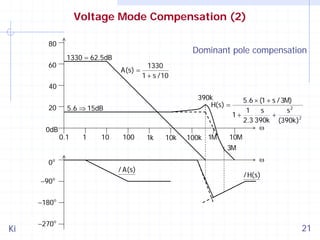
The system loop gain consists of a pair of complex poles, and one
strategy is to use dominant pole compensation.
For a buck converter, the complex pole frequency ωo/2π is 10 to 30
times lower than the switching frequency fs.
Ki

20
Voltage Mode Compensation (2)
80
60

Dominant pole compensation

1330 = 62.5dB
A(s) =

1330
1 + s /10

40
20
0dB

390k
H(s) =

5.6 ⇒ 15dB

0.1

1

10

100

1k

10k

100k 1M

5.6 × (1 + s / 3M)
1
s
s2
1+
+
2.3 390k (390k)2
ω
10M

3M
0o

−90

o

ω
/ A(s)

/ H(s)

−180o

Ki

−270o

21
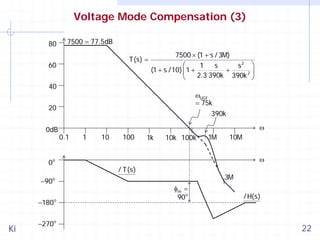
Voltage Mode Compensation (3)
80

7500 = 77.5dB
T(s) =

60

7500 × (1 + s / 3M)
⎛
1
s
s2 ⎞
(1 + s /10) ⎜1 +
+
⎟
2.3 390k 390k 2 ⎠
⎝

40

ωUGF
= 75k

20
0dB

0o

−90 o
−180

Ki

o

−270o

390k

ω
0.1

1

10

100

1k

10k 100k

1M

10M

ω
/ T(s)

3M

φm =
90 o

/ H(s)

22
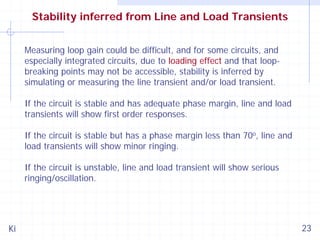
Stability inferred from Line and Load Transients
Measuring loop gain could be difficult, and for some circuits, and
especially integrated circuits, due to loading effect and that loopbreaking points may not be accessible, stability is inferred by
simulating or measuring the line transient and/or load transient.
If the circuit is stable and has adequate phase margin, line and load
transients will show first order responses.
If the circuit is stable but has a phase margin less than 70o, line and
load transients will show minor ringing.
If the circuit is unstable, line and load transient will show serious
ringing/oscillation.

Ki

23
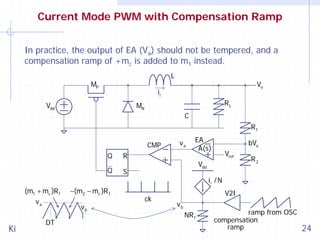
Current Mode PWM with Compensation Ramp
In practice, the output of EA (Va) should not be tempered, and a
compensation ramp of +mc is added to m1 instead.
L

MP

Vo

i

Vdd

RL

MN
C

R1
CMP
Q

(m1 + mc )R f
va

Ki

EA
A(s)

S

−(m2 − mc )R f
vb

DT

R

Q

va

bVo
Vref

Vdd

R2

i /N
ck

V2I
vb
NR f

ramp from OSC
compensation
ramp

24
Loop Gain of Current Mode Buck Converter (1)
The loop gain of a current-mode CCM buck converter with trailingedge modulation is shown below. Others can be found in [Ki 98].
Buck:

1
1
(1 + sCR esr )
CR f n1D ' T
T(s) = A(s) ×
⎛ 1
1 ⎞
1 1 ⎛ 1 (n1D '− D)T ⎞
2
+
+
+
s + s⎜
⎟
CR L n1D ' T ⎟ n1D ' T C ⎜ R L
L
⎝
⎠
⎝
⎠
b×

mc
m
2 −D
, mc > 2 ⇒ n1 >
m1
2
2D '
2L
and R L <
D' T
with n1 = 1 +

The two poles are in general real.

Ki

25
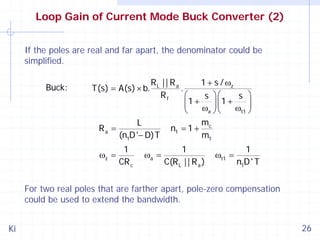
Loop Gain of Current Mode Buck Converter (2)
If the poles are real and far apart, the denominator could be
simplified.
Buck:

R L || R a
1 + s / ωz
.
Rf
⎛
s ⎞⎛
s ⎞
1+
1+
⎜
ωa ⎟ ⎜
ωt1 ⎟
⎝
⎠⎝
⎠
m
L
Ra =
n1 = 1 + c
(n1D '− D)T
m1

T(s) = A(s) × b.

ωz =

1
CR c

ωa =

1
C(R L || R a )

ωt1 =

1
n1D ' T

For two real poles that are farther apart, pole-zero compensation
could be used to extend the bandwidth.
Ki

26
Current Mode Compensation (1)
Example: Consider a current mode buck converter with the same
parameters as those of the voltage mode converter for comparison.
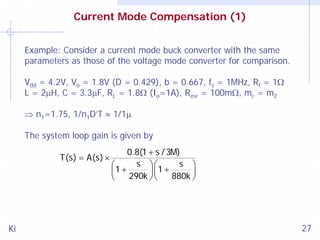
Vdd = 4.2V, Vo = 1.8V (D = 0.429), b = 0.667, fs = 1MHz, Rf = 1Ω
L = 2μH, C = 3.3μF, RL = 1.8Ω (Io=1A), Resr = 100mΩ, mc = m2
⇒ n1=1.75, 1/n1D’T ≈ 1/1μ
The system loop gain is given by
T(s) = A(s) ×

Ki

0.8(1 + s / 3M)
s ⎞⎛
s ⎞
⎛
1+
1+
⎜
⎟⎜
⎟
290k ⎠ ⎝
880k ⎠
⎝

27
Current Mode Compensation (2)
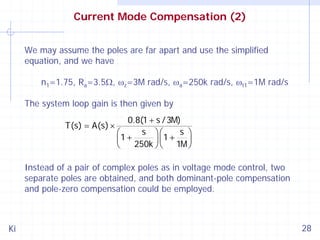
We may assume the poles are far apart and use the simplified
equation, and we have
n1=1.75, Ra=3.5Ω, ωz=3M rad/s, ωa=250k rad/s, ωt1=1M rad/s
The system loop gain is then given by
T(s) = A(s) ×

0.8(1 + s / 3M)
s ⎞⎛
s ⎞
⎛
1+
1+
⎜
⎟⎜
⎟
250k ⎠ ⎝
1M ⎠
⎝

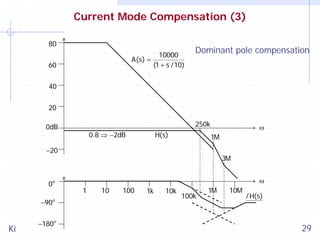
Instead of a pair of complex poles as in voltage mode control, two
separate poles are obtained, and both dominant-pole compensation
and pole-zero compensation could be employed.

Ki

28
Current Mode Compensation (3)
80
10000
A(s) =
(1 + s /10)

60

Dominant pole compensation

40
20

250k

0dB

0.8 ⇒ −2dB

H(s)

ω
1M

−20

0o
−90

Ki

o

−180o

3M

ω
1

10

100

1k

10k

100k

1M

10M

/ H(s)

29
Current Mode Compensation (4)
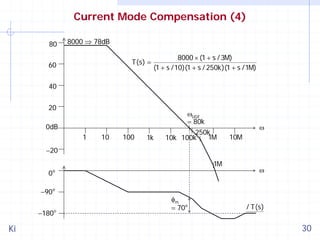
80

8000 ⇒ 78dB
T(s) =

60

8000 × (1 + s / 3M)
(1 + s /10)(1 + s / 250k)(1 + s /1M)

40
20

ωUGF
= 80k

0dB

1

10

100

1k

250k
1M
10k 100k

ω
10M

−20

1M
0

o

−90 o
−180

Ki

o

φm
= 70 o

ω

/ T(s)

30
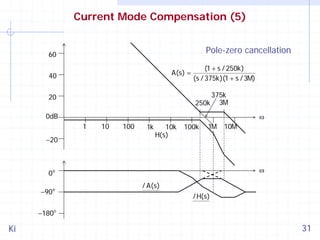
Current Mode Compensation (5)
Pole-zero cancellation

60
A(s) =

40

(1 + s / 250k)
(s / 375k)(1 + s / 3M)
375k
250k 3M

20
0dB

ω
1

−20

10

100

1k

10k
H(s)

100k

1M

ω

0o
−90

o

10M

/ A(s)
/ H(s)

−180o

Ki

31
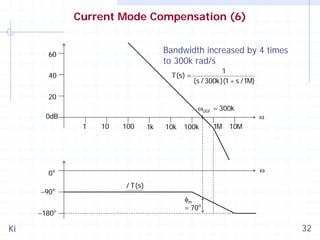
Current Mode Compensation (6)
Bandwidth increased by 4 times
to 300k rad/s

60

T(s) =

40

1
(s / 300k)(1 + s /1M)

20
ωUGF = 300k

0dB

1

10

100

1k

10k

100k

−90

−180o

Ki

10M

ω

0o
o

1M

ω

/ T(s)
φm
= 70 o

32
References: Switching Converter Compensation
[Brown 01] M. Brown, Power Supply Cookbook, EDN, 2001.
[Ki 98]

[Ma 03a]

D. Ma, W. H. Ki, C. Y. Tsui and P. Mok, "Single-inductor multiple-output
switching converters with time-multiplexing control in discontinuous
conduction mode", IEEE J. of Solid-State Circ., pp.89-100, Jan. 2003.

[Ma 03b]

Ki

W. H. Ki, "Signal flow graph in loop gain analysis of DC-DC PWM CCM
switching converters," IEEE Trans. on Circ. and Syst. 1, pp.644-655, June
1998.

D. Ma, W. H. Ki and C. Y. Tsui, "A pseudo-CCM / DCM SIMO switching
converter with freewheel switching," IEEE J. of Solid-State Circ., pp.10071014, June 2003.

33
SUPPLEMENTS

Ki

34
Voltage Mode Converters: Loop Gain Function
In discussing fast-transient converters, one important parameter
is the loop bandwidth.
The loop gain function of the buck converter with voltage mode
control operating in CCM ignoring ESR is given by [Ki 98]
T(s) = A(s) ×

bVo
.
DVm

1
1+

sL
+ s 2LC
RL

The resonance frequency ωo and the pole-Q are
ωo

=

1
LC

Q

=R

C
L

The converter enters DCM at
R L(BCM) =

Ki

2L
D'T

⇒

QBCM =

2 1
D ' ωo T

35
Voltage Mode Converters: Bandwidth Limitation
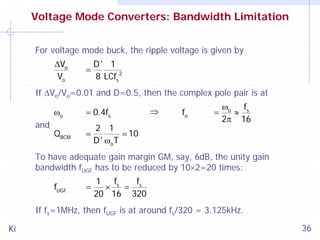
For voltage mode buck, the ripple voltage is given by

ΔVo
Vo

=

D' 1
8 LCfs 2

If ΔVo/Vo=0.01 and D=0.5, then the complex pole pair is at

ωo
and

= 0.4fs

QBCM

=

2 1
= 10
D ' ωo T

⇒

fo

=

ωo fs
≈
2π 16

To have adequate gain margin GM, say, 6dB, the unity gain
bandwidth fUGF has to be reduced by 10×2=20 times:
fUGF

=

1
f
f
× s = s
20 16 320

If fs=1MHz, then fUGF is at around fs/320 = 3.125kHz.
Ki

36
VM Buck: Loop Gain Function with Rδ
The unity gain frequency fUGF of fs/320 is too low. Fortunately (or
unfortunately), the converter inevitably has parasitic resistors
such as RESR, Rℓ (inductor series resistor), Rs (switch resistance)
and Rd (diode resistance), and the loop gain function is [Ki 98]
T(s)

≈ A(s) ×

where
Rδ

bVo
.
DVm

1

⎛ L
⎞ 2
1+ s⎜
+ CR δ ⎟ + s LC
⎝ RL
⎠

≈ R ESR + R + DR s + D'R d

This Rδ is at least 200mΩ, thus reducing QBCM to around 3. With
GM to be 6dB, fUGF is reduced by 3×2=6 times, and
fUGF
Ki

=

1 fs
f
×
≈ s
6 16 100

If fs=1MHz, then fUGF is at around fs/100 = 10kHz.

37
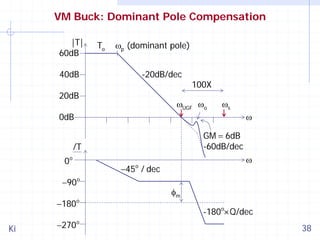
VM Buck: Dominant Pole Compensation
|T|
60dB

To

ωp (dominant pole)
-20dB/dec

40dB
20dB

100X

ωUGF ωo

ωs
ω

0dB
GM = 6dB
-60dB/dec

/T
0o

−90 o
−180 o
Ki

−270 o

ω

o

−45 / dec
φm

-180o×Q/dec
38
Current Mode Converters: Loop Gain Function
The loop gain function of the buck converter with current mode
control operating in CCM ignoring ESR is given by [Ki 98]

1
1
CR f n1D ' T
T(s) =
⎛ 1
1 ⎞
1 1 ⎛ 1 (n1D '− D)T ⎞
+
+
s2 + s ⎜
⎟ n D' T C ⎜R +
⎟
CR L n1D ' T ⎠
L
⎝
⎝ L
⎠
1
A(s)b ×

with
n1 = 1 +

and

mc
m
2−D
, mc > 2 ⇒ n1 >
m1
2
2D '

R L(BCM) = 2L
D'T

In general, the two poles are real, as discussed next.
Ki

39
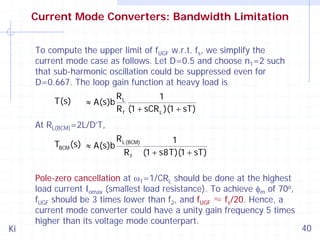
Current Mode Converters: Bandwidth Limitation
To compute the upper limit of fUGF w.r.t. fs, we simplify the
current mode case as follows. Let D=0.5 and choose n1=2 such
that sub-harmonic oscillation could be suppressed even for
D=0.667. The loop gain function at heavy load is
T(s)

≈ A(s)b

RL
1
R f (1 + sCR L )(1 + sT)

At RL(BCM)=2L/D’T,
TBCM (s) ≈ A(s)b

Ki

R L(BCM)
Rf

1
(1 + s8T)(1 + sT)

Pole-zero cancellation at ω1=1/CRL should be done at the highest
load current Iomax (smallest load resistance). To achieve φm of 70o,
fUGF should be 3 times lower than f2, and fUGF ≈ fs/20. Hence, a
current mode converter could have a unity gain frequency 5 times
higher than its voltage mode counterpart.

40

IC Design of Power Management Circuits (III)

  • 1.
    IC Design of PowerManagement Circuits (III) Wing-Hung Ki Integrated Power Electronics Laboratory ECE Dept., HKUST Clear Water Bay, Hong Kong www.ee.ust.hk/~eeki International Symposium on Integrated Circuits Singapore, Dec. 14, 2009
  • 2.
  • 3.
    Content Stability and Compensation Nyquistcriteria System loop gain Phase margin vs transient response Type I, II, III compensators Compensation for voltage mode control Compensation for current mode control Ki 3
  • 4.
    Feedback Systems Consider thefeedback system: in F(s) out G(s) Note that F(s) and G(s) are ratios of polynomials in s, that is, F(s) = nF (s) dF (s) G(s) = nG (s) dG (s) The closed loop transfer function is H(s) = out F(s) F(s) = = in 1 + F(s)G(s) 1 + T(s) and the loop gain is T(s) = F(s)G(s) = Ki n(s) d(s) 4
  • 5.
    Stability Criteria Local stability:all poles of T(s) (= all roots of d(s)) are in LHP System stability: ∗ all poles of H(s) are in LHP ⇒ all zeros of (1+T(s)) are in LHP ⇒ all roots of (n(s)+d(s)) are in LHP If all functional blocks satisfy local stability, the Nyquist criterion for system stability is: ∗ Nyquist plot of 1+T(s) does not encircle (0,0) ⇒ Nyquist plot of T(s) does not encircle (-1,0) If all functional blocks satisfies local stability, the Bode plot criteria for system stability is: phase margin φm>0o and gain margin GM>0dB Ki 5
  • 6.
    1st Order LoopGain Function T(s) = Bode Plots To |T| s 1+ p1 To Nyquist Plot p1 Im ωUGF ω stable unit circle −∞ 0 −1 ω = +∞ To 1 -45 o 0− Re ω = 0+ To / 2 /A ω −45o −90 o ωUGF p1 Ki 6
  • 7.
    2nd Order LoopGain Function T(s) = Bode Plots To ⎛ s ⎞⎛ s ⎞ ⎜1 + p ⎟ ⎜1 + p ⎟ ⎝ 1 ⎠⎝ 2 ⎠ |T| To p1 p2 Nyquist Plot ωUGF Im ω stable /A −1 φm ωUGF 0 To Re ω −90 o −180 Ki o φm 7
  • 8.
    3rd Order LoopGain Function T(s) = Bode Plots To |T| ⎛ s ⎞⎛ s ⎞⎛ s ⎞ ⎜1 + p ⎟ ⎜1 + p ⎟ ⎜1 + p ⎟ ⎝ 1 ⎠⎝ 2 ⎠⎝ 3 ⎠ To p1 p2 p3 Nyquist Plot ωUGF Im unstable ωUGF (encirclement of -1) φm −1 ω 0 /A To Re ω −90 o −180o Ki −270o φm < 0 8
  • 9.
    Observations on LoopGain Function • 1st order systems are unconditional stable. • 2nd order systems are stable, but a high damping factor would cause large overshoot and excessive ringing before settling to the steady state. • For 3rd order systems, if the 3rd pole p3 is less than 10X of the unity gain frequency ωUGF, the system is unstable. Hence, for a stable system, the loop gain function could be approximated by a 2nd order loop gain function with the 2nd pole p2 usually larger than ωUGF to achieve small overshoot. Ki 9
  • 10.
    Loop Gain Functionand Transient Response The transient response of a feedback system is given by F(s) ⎞ ⎛1 ⎛1 ⎞ v o (s) = L−1 ⎜ × H(s) ⎟ = L−1 ⎜ × ⎟ ⎝s ⎠ ⎝ s 1 + T(s) ⎠ where L-1(⋅) is the inverse Laplace transform of (⋅). The exact transient response is affected by F(s), however, if only T(s) is considered, we may consider the modified feedback system: in F(s) out in' T(s) 1 G(s) H(s) = Ki F(s) 1 + T(s) out ' H'(s) = T(s) 1 + T(s) 10
  • 11.
    Compensator Considerations For aloop gain function approximated by a 2-pole function: T(s) = To 1 ≈ ⎛ s ⎞⎛ s ⎞ s ⎛ s ⎞ 1 + ⎟ ⎜1 + ⎟ 1+ ⎟ ⎜ p1 ⎠ ⎝ p2 ⎠ ωUGF ⎜ p2 ⎠ ⎝ ⎝ The closed loop function (with unity gain feedback) is T(s) 1 H'(s) = = 1 + T(s) s s2 1+ + ωUGF ωUGFp2 Ki Write H'(s) in standard 2nd order form: 1 ωo = ωUGFp2 H'(s) = 2 1 s s 1+ + 2 ωUGF Q ωo ωo Q= p2 |T| p1 ωUGF p2 /T −90 o −180 o φm 11
  • 12.
    Relationship between p2/ωUGFand φm k p2 ωUGF Q ωUGF 1 = p2 k overshoot e − π 2 4Q −1 phase margin φm = tan−1 1.316 0.275 30 o 1 1 0.163 45o 3 = 1.73 0.76 0.064 60 o 0.605 ≈ 0.6 0.01 70 o 1 / 3 = 0.577 2.73 ≈ 3 Ki p2 ωUGF Note that φm=60o gives an overshoot of 6.4%, and the 1% settling time (tset) would be very long. By setting p2=3ωUGF, then φm=70o, and the overshoot is only 1%. 12
  • 13.
    Type I Compensator(0Z1P) The simplest Type I compensator is an integrator with ωUGF = 1/C1R1. C1 R1 |A| Vin Vout Vref Vout 1 = − A(s) = − Vin sC1R1 Assume Aop(s) is first order with ωt >> 1/C1R1: A op 1 ≈ A op (s) = 1 + s / ω1 s / ωt 1 ⇒ A(s) ≈ sC1R1 (1 + s / ωt ) Ki ωUGF = 1 C1R1 ω ωt /A ω −90 o −180o 13
  • 14.
    Type I Compensator(0Z1P) Type I compensator can be implemented using transconductance amplifier (OTA). OTA has a very high output resistance ro and cannot drive resistive loads. |A| Vin Vref gm Vout ro Using OTA may save one IC pin. Ki ωUGF = Co Vout gmro = − A(s) = − Vin 1 + sC oro gmro 1 / C oro gm Co ω /A ω −90 o 14
  • 15.
    Type II Compensator(1Z2P) Type II compensator consists of a pole-zero pair with ωz<ωp, and a maximum phase boosting of 90o is possible. R2 |A| C2 1 C2R 2 C1 ωUGF = 1 / C1R1 R1 Vin Vref Vout Vout 1 + sC2R 2 =− Vin s(C1 + C 2 )R1 [1 + s(C1 || C 2 )R 2 ] A(s) ≈ Ki (1 + sC2R 2 ) sC2R1 (1 + sC1R 2 ) 1 C1R 2 (C1 << C2 ) 1 / C2R1 ω /A ω 90 o phase boosting −90 o 15
  • 16.
    Type II Compensator(1Z1P) Type II compensator can also be implemented using OTA. |A| Vin Vref gm 1 C2R 2 Vout ro R2 C2 Vout g r (1 + sC2R 2 ) = − A(s) = − m o Vin 1 + sC2 (ro + R 2 ) A(s) ≈ Ki gmro (1 + sC2R 2 ) (1 + sC2ro ) gmro 1 C2ro ωUGF g = m C2 ω /A ω −90 o 16
  • 17.
    Type III Compensator(2Z3P) Type III compensator consists of two pole-zero pairs, and phase boosting of 180o is possible to compensate for complex poles. R2 R3 Vin C3 R1 Vref |A| C2 1 C2R 2 C1 Vout 1 C2R1 /A Vout (1 + sC 2R 2 )[1 + sC3 (R1 + R 3 )] =− +90 o Vin s(C1 + C2 )R1 (1 + sC1 || C2R 2 )(1 + sC3R 3 ) (1 + sC2R 2 )(1 + sC 3R1 ) A(s) ≈ sC2R1 (1 + sC1R 2 )(1 + sC 3R 3 ) Ki (C1 <<C2 , R1>>R 3 ) 1 C3R1 1 1 C1R 2 C3R 3 ωUGF 1 = C1R 3 180o boosting ω ω −90 o 17
  • 18.
    PWM Voltage ModeControl A regulated switching converter consists of the power stage and the feedback circuit. MP Vo L Vg MN RL ck C R1 CMP Q R Q va EA A(s) S va bVo Vref ramp Q R2 va Q ramp ck Ki For a buck converter, if an on-chip charge pump is not available, then the NMOS power switch is replaced by a PMOS power switch. 18
  • 19.
    Loop Gains ofVoltage Mode CCM Converters The system loop gain is T(s) = A(s)×H(s), where A(s) is the frequency response of the EA (compensator). Loop gains of voltage mode PWM CCM converters with trailing-edge modulation are compiled. Parasitic resistances except ESR are excluded [Ki 98]. Buck: Boost: T(s) = A(s) × bVo 1 + sCR esr . sL DVm + s 2LC 1+ RL bVo [1 − sL / (D '2 R L )] T(s) = A(s) × . D ' Vm sL s 2LC + 1+ 2 D ' R L D '2 b | Vo | [1 − sDL / (D '2 R L )] . Buck-boost: T(s) = A(s) × DD ' Vm sL s 2LC + 1+ 2 D ' R L D '2 Ki 19
  • 20.
    Voltage Mode Compensation(1) Example: Consider a buck converter with the following parameters: Vdd=4.2V, Vo=1.8V (D=0.429), Vm=0.5V, b=0.667 L=2μH, C=3.3μF, RL=1.8Ω (Io=1A), Resr=100mΩ, fs=1MHz The system loop gain is given by T(s) = A(s) ⋅ 5.6 × [1 + s /(3M)] A(s) × 5.6 × [1 + s /(3M)] = 1 s s2 1 s s2 + + 2 1+ 1+ 2 2.3 390k (390k) Q ωo ωo The system loop gain consists of a pair of complex poles, and one strategy is to use dominant pole compensation. For a buck converter, the complex pole frequency ωo/2π is 10 to 30 times lower than the switching frequency fs. Ki 20
  • 21.
    Voltage Mode Compensation(2) 80 60 Dominant pole compensation 1330 = 62.5dB A(s) = 1330 1 + s /10 40 20 0dB 390k H(s) = 5.6 ⇒ 15dB 0.1 1 10 100 1k 10k 100k 1M 5.6 × (1 + s / 3M) 1 s s2 1+ + 2.3 390k (390k)2 ω 10M 3M 0o −90 o ω / A(s) / H(s) −180o Ki −270o 21
  • 22.
    Voltage Mode Compensation(3) 80 7500 = 77.5dB T(s) = 60 7500 × (1 + s / 3M) ⎛ 1 s s2 ⎞ (1 + s /10) ⎜1 + + ⎟ 2.3 390k 390k 2 ⎠ ⎝ 40 ωUGF = 75k 20 0dB 0o −90 o −180 Ki o −270o 390k ω 0.1 1 10 100 1k 10k 100k 1M 10M ω / T(s) 3M φm = 90 o / H(s) 22
  • 23.
    Stability inferred fromLine and Load Transients Measuring loop gain could be difficult, and for some circuits, and especially integrated circuits, due to loading effect and that loopbreaking points may not be accessible, stability is inferred by simulating or measuring the line transient and/or load transient. If the circuit is stable and has adequate phase margin, line and load transients will show first order responses. If the circuit is stable but has a phase margin less than 70o, line and load transients will show minor ringing. If the circuit is unstable, line and load transient will show serious ringing/oscillation. Ki 23
  • 24.
    Current Mode PWMwith Compensation Ramp In practice, the output of EA (Va) should not be tempered, and a compensation ramp of +mc is added to m1 instead. L MP Vo i Vdd RL MN C R1 CMP Q (m1 + mc )R f va Ki EA A(s) S −(m2 − mc )R f vb DT R Q va bVo Vref Vdd R2 i /N ck V2I vb NR f ramp from OSC compensation ramp 24
  • 25.
    Loop Gain ofCurrent Mode Buck Converter (1) The loop gain of a current-mode CCM buck converter with trailingedge modulation is shown below. Others can be found in [Ki 98]. Buck: 1 1 (1 + sCR esr ) CR f n1D ' T T(s) = A(s) × ⎛ 1 1 ⎞ 1 1 ⎛ 1 (n1D '− D)T ⎞ 2 + + + s + s⎜ ⎟ CR L n1D ' T ⎟ n1D ' T C ⎜ R L L ⎝ ⎠ ⎝ ⎠ b× mc m 2 −D , mc > 2 ⇒ n1 > m1 2 2D ' 2L and R L < D' T with n1 = 1 + The two poles are in general real. Ki 25
  • 26.
    Loop Gain ofCurrent Mode Buck Converter (2) If the poles are real and far apart, the denominator could be simplified. Buck: R L || R a 1 + s / ωz . Rf ⎛ s ⎞⎛ s ⎞ 1+ 1+ ⎜ ωa ⎟ ⎜ ωt1 ⎟ ⎝ ⎠⎝ ⎠ m L Ra = n1 = 1 + c (n1D '− D)T m1 T(s) = A(s) × b. ωz = 1 CR c ωa = 1 C(R L || R a ) ωt1 = 1 n1D ' T For two real poles that are farther apart, pole-zero compensation could be used to extend the bandwidth. Ki 26
  • 27.
    Current Mode Compensation(1) Example: Consider a current mode buck converter with the same parameters as those of the voltage mode converter for comparison. Vdd = 4.2V, Vo = 1.8V (D = 0.429), b = 0.667, fs = 1MHz, Rf = 1Ω L = 2μH, C = 3.3μF, RL = 1.8Ω (Io=1A), Resr = 100mΩ, mc = m2 ⇒ n1=1.75, 1/n1D’T ≈ 1/1μ The system loop gain is given by T(s) = A(s) × Ki 0.8(1 + s / 3M) s ⎞⎛ s ⎞ ⎛ 1+ 1+ ⎜ ⎟⎜ ⎟ 290k ⎠ ⎝ 880k ⎠ ⎝ 27
  • 28.
    Current Mode Compensation(2) We may assume the poles are far apart and use the simplified equation, and we have n1=1.75, Ra=3.5Ω, ωz=3M rad/s, ωa=250k rad/s, ωt1=1M rad/s The system loop gain is then given by T(s) = A(s) × 0.8(1 + s / 3M) s ⎞⎛ s ⎞ ⎛ 1+ 1+ ⎜ ⎟⎜ ⎟ 250k ⎠ ⎝ 1M ⎠ ⎝ Instead of a pair of complex poles as in voltage mode control, two separate poles are obtained, and both dominant-pole compensation and pole-zero compensation could be employed. Ki 28
  • 29.
    Current Mode Compensation(3) 80 10000 A(s) = (1 + s /10) 60 Dominant pole compensation 40 20 250k 0dB 0.8 ⇒ −2dB H(s) ω 1M −20 0o −90 Ki o −180o 3M ω 1 10 100 1k 10k 100k 1M 10M / H(s) 29
  • 30.
    Current Mode Compensation(4) 80 8000 ⇒ 78dB T(s) = 60 8000 × (1 + s / 3M) (1 + s /10)(1 + s / 250k)(1 + s /1M) 40 20 ωUGF = 80k 0dB 1 10 100 1k 250k 1M 10k 100k ω 10M −20 1M 0 o −90 o −180 Ki o φm = 70 o ω / T(s) 30
  • 31.
    Current Mode Compensation(5) Pole-zero cancellation 60 A(s) = 40 (1 + s / 250k) (s / 375k)(1 + s / 3M) 375k 250k 3M 20 0dB ω 1 −20 10 100 1k 10k H(s) 100k 1M ω 0o −90 o 10M / A(s) / H(s) −180o Ki 31
  • 32.
    Current Mode Compensation(6) Bandwidth increased by 4 times to 300k rad/s 60 T(s) = 40 1 (s / 300k)(1 + s /1M) 20 ωUGF = 300k 0dB 1 10 100 1k 10k 100k −90 −180o Ki 10M ω 0o o 1M ω / T(s) φm = 70 o 32
  • 33.
    References: Switching ConverterCompensation [Brown 01] M. Brown, Power Supply Cookbook, EDN, 2001. [Ki 98] [Ma 03a] D. Ma, W. H. Ki, C. Y. Tsui and P. Mok, "Single-inductor multiple-output switching converters with time-multiplexing control in discontinuous conduction mode", IEEE J. of Solid-State Circ., pp.89-100, Jan. 2003. [Ma 03b] Ki W. H. Ki, "Signal flow graph in loop gain analysis of DC-DC PWM CCM switching converters," IEEE Trans. on Circ. and Syst. 1, pp.644-655, June 1998. D. Ma, W. H. Ki and C. Y. Tsui, "A pseudo-CCM / DCM SIMO switching converter with freewheel switching," IEEE J. of Solid-State Circ., pp.10071014, June 2003. 33
  • 34.
  • 35.
    Voltage Mode Converters:Loop Gain Function In discussing fast-transient converters, one important parameter is the loop bandwidth. The loop gain function of the buck converter with voltage mode control operating in CCM ignoring ESR is given by [Ki 98] T(s) = A(s) × bVo . DVm 1 1+ sL + s 2LC RL The resonance frequency ωo and the pole-Q are ωo = 1 LC Q =R C L The converter enters DCM at R L(BCM) = Ki 2L D'T ⇒ QBCM = 2 1 D ' ωo T 35
  • 36.
    Voltage Mode Converters:Bandwidth Limitation For voltage mode buck, the ripple voltage is given by ΔVo Vo = D' 1 8 LCfs 2 If ΔVo/Vo=0.01 and D=0.5, then the complex pole pair is at ωo and = 0.4fs QBCM = 2 1 = 10 D ' ωo T ⇒ fo = ωo fs ≈ 2π 16 To have adequate gain margin GM, say, 6dB, the unity gain bandwidth fUGF has to be reduced by 10×2=20 times: fUGF = 1 f f × s = s 20 16 320 If fs=1MHz, then fUGF is at around fs/320 = 3.125kHz. Ki 36
  • 37.
    VM Buck: LoopGain Function with Rδ The unity gain frequency fUGF of fs/320 is too low. Fortunately (or unfortunately), the converter inevitably has parasitic resistors such as RESR, Rℓ (inductor series resistor), Rs (switch resistance) and Rd (diode resistance), and the loop gain function is [Ki 98] T(s) ≈ A(s) × where Rδ bVo . DVm 1 ⎛ L ⎞ 2 1+ s⎜ + CR δ ⎟ + s LC ⎝ RL ⎠ ≈ R ESR + R + DR s + D'R d This Rδ is at least 200mΩ, thus reducing QBCM to around 3. With GM to be 6dB, fUGF is reduced by 3×2=6 times, and fUGF Ki = 1 fs f × ≈ s 6 16 100 If fs=1MHz, then fUGF is at around fs/100 = 10kHz. 37
  • 38.
    VM Buck: DominantPole Compensation |T| 60dB To ωp (dominant pole) -20dB/dec 40dB 20dB 100X ωUGF ωo ωs ω 0dB GM = 6dB -60dB/dec /T 0o −90 o −180 o Ki −270 o ω o −45 / dec φm -180o×Q/dec 38
  • 39.
    Current Mode Converters:Loop Gain Function The loop gain function of the buck converter with current mode control operating in CCM ignoring ESR is given by [Ki 98] 1 1 CR f n1D ' T T(s) = ⎛ 1 1 ⎞ 1 1 ⎛ 1 (n1D '− D)T ⎞ + + s2 + s ⎜ ⎟ n D' T C ⎜R + ⎟ CR L n1D ' T ⎠ L ⎝ ⎝ L ⎠ 1 A(s)b × with n1 = 1 + and mc m 2−D , mc > 2 ⇒ n1 > m1 2 2D ' R L(BCM) = 2L D'T In general, the two poles are real, as discussed next. Ki 39
  • 40.
    Current Mode Converters:Bandwidth Limitation To compute the upper limit of fUGF w.r.t. fs, we simplify the current mode case as follows. Let D=0.5 and choose n1=2 such that sub-harmonic oscillation could be suppressed even for D=0.667. The loop gain function at heavy load is T(s) ≈ A(s)b RL 1 R f (1 + sCR L )(1 + sT) At RL(BCM)=2L/D’T, TBCM (s) ≈ A(s)b Ki R L(BCM) Rf 1 (1 + s8T)(1 + sT) Pole-zero cancellation at ω1=1/CRL should be done at the highest load current Iomax (smallest load resistance). To achieve φm of 70o, fUGF should be 3 times lower than f2, and fUGF ≈ fs/20. Hence, a current mode converter could have a unity gain frequency 5 times higher than its voltage mode counterpart. 40