Teachers &
Students in
the
Digital Age
Educational Technology
Jugiel C. Villones
“Every journey has its start
and end.”
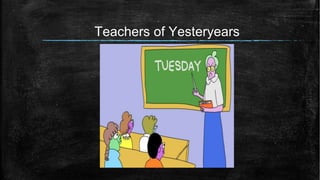
Teachers of Yesteryears
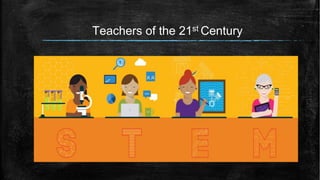
Teachers of the 21st Century
Teachers of the Early
Generations
VS
Teachers of the 21st Century
T e a c h e r s o f t h e E a r l y G e n e r a t i o n s V S
T e a c h e r s o f t h e 2 1 s t C e n t u r y
Teachers of Yesteryears Teachers of the 21st Century
 Disseminate information through lectures
 Require students memorize contents form
textbooks.
 Make use of textbooks and workbooks as their
reference.
 Give assessments through written examination
 Focus on their responsibility and relationship with
the students as receipts of knowledge.
 Followers of policies prescribed by the school.
 Use lecture as teaching method.
 Deliver the same lessons every year.
 Allow students to solve real world problems.
 Allow students to construct their own
understanding of the subject matter.
 Make use of manipulative materials; makes use of
multitude of prints and electronic sources.
 Give performance – based assessments
(Performance based)
 Widen their responsibility and their relationship
with colleagues, community and other
stakeholders.
 Participate in the decision – making in schools.
 Use of variety of teaching methods appropriate in
the student’s learning
 Spend time in researching new updates
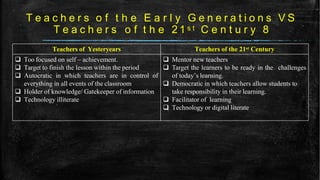
T e a c h e r s o f t h e E a r l y G e n e r a t i o n s V S
T e a c h e r s o f t h e 2 1 s t C e n t u r y 8
Teachers of Yesteryears Teachers of the 21st Century
 Too focused on self – achievement.
 Target to finish the lesson within the period
 Autocratic in which teachers are in control of
everything in all events of the classroom
 Holder of knowledge/ Gatekeeper of information
 Technology illiterate
 Mentor new teachers
 Target the learners to be ready in the challenges
of today’s learning.
 Democratic in which teachers allow students to
take responsibility in their learning.
 Facilitator of learning
 Technology or digital literate
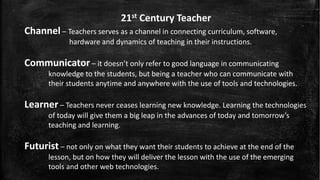
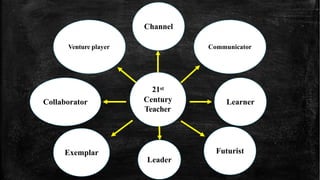
21st Century Teacher
Channel – Teachers serves as a channel in connecting curriculum, software,
hardware and dynamics of teaching in their instructions.
Communicator – it doesn’t only refer to good language in communicating
knowledge to the students, but being a teacher who can communicate with
their students anytime and anywhere with the use of tools and technologies.
Learner – Teachers never ceases learning new knowledge. Learning the technologies
of today will give them a big leap in the advances of today and tomorrow’s
teaching and learning.
Futurist – not only on what they want their students to achieve at the end of the
lesson, but on how they will deliver the lesson with the use of the emerging
tools and other web technologies.
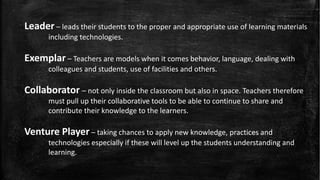
Leader – leads their students to the proper and appropriate use of learning materials
including technologies.
Exemplar – Teachers are models when it comes behavior, language, dealing with
colleagues and students, use of facilities and others.
Collaborator – not only inside the classroom but also in space. Teachers therefore
must pull up their collaborative tools to be able to continue to share and
contribute their knowledge to the learners.
Venture Player – taking chances to apply new knowledge, practices and
technologies especially if these will level up the students understanding and
learning.
21st
Century
Teacher
Channel
Communicator
Venture player
Learner
Collaborator
Exemplar Futurist
Leader
Students of the Early
Generations
VS
Students of the 21st Century
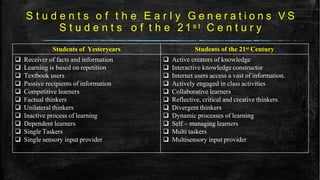
S t u d e n t s o f t h e E a r l y G e n e r a t i o n s V S
S t u d e n t s o f t h e 2 1 s t C e n t u r y
Students of Yesteryears Students of the 21st Century
 Receiver of facts and information
 Learning is based on repetition
 Textbook users
 Passive recipients of information
 Competitive learners
 Factual thinkers
 Unilateral thinkers
 Inactive process of learning
 Dependent learners
 Single Taskers
 Single sensory input provider
 Active creators of knowledge
 Interactive knowledge constructor
 Internet users access a vast of information.
 Actively engaged in class activities
 Collaborative learners
 Reflective, critical and creative thinkers
 Divergent thinkers
 Dynamic processes of learning
 Self – managing learners
 Multi taskers
 Multisensory input provider
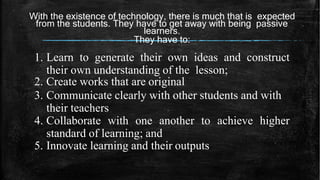
With the existence of technology, there is much that is expected
from the students. They have to get away with being passive
learners.
They have to:
1. Learn to generate their own ideas and construct
their own understanding of the lesson;
2. Create works that are original
3. Communicate clearly with other students and with
their teachers
4. Collaborate with one another to achieve higher
standard of learning; and
5. Innovate learning and their outputs
Instructions in the early generations
VS
Instructions in the 21st Century
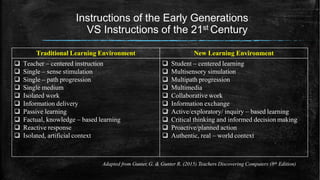
Instructions of the Early Generations
VS Instructions of the 21st Century
Traditional Learning Environment New Learning Environment
 Teacher – centered instruction
 Single – sense stimulation
 Single – path progression
 Single medium
 Isolated work
 Information delivery
 Passive learning
 Factual, knowledge – based learning
 Reactive response
 Isolated, artificial context
 Student – centered learning
 Multisensory simulation
 Multipath progression
 Multimedia
 Collaborative work
 Information exchange
 Active/exploratory/ inquiry – based learning
 Critical thinking and informed decision making
 Proactive/planned action
 Authentic, real – world context
Adapted from Gunter, G. & Gunter R. (2015) Teachers Discovering Computers (8th Edition)
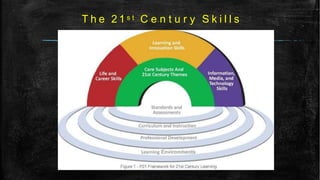
T h e 2 1 s t C e n t u r y S k i l l s
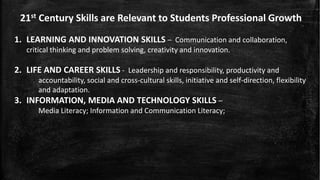
21st Century Skills are Relevant to Students Professional Growth
1. LEARNING AND INNOVATION SKILLS – Communication and collaboration,
critical thinking and problem solving, creativity and innovation.
2. LIFE AND CAREER SKILLS - Leadership and responsibility, productivity and
accountability, social and cross-cultural skills, initiative and self-direction, flexibility
and adaptation.
3. INFORMATION, MEDIA AND TECHNOLOGY SKILLS –
Media Literacy; Information and Communication Literacy;
Suggested Key Elements Fostering 21st Century Learning
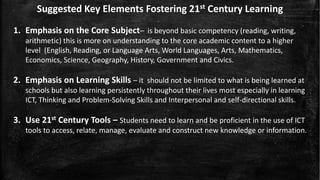
1. Emphasis on the Core Subject– is beyond basic competency (reading, writing,
arithmetic) this is more on understanding to the core academic content to a higher
level (English, Reading, or Language Arts, World Languages, Arts, Mathematics,
Economics, Science, Geography, History, Government and Civics.
2. Emphasis on Learning Skills – it should not be limited to what is being learned at
schools but also learning persistently throughout their lives most especially in learning
ICT, Thinking and Problem-Solving Skills and Interpersonal and self-directional skills.
3. Use 21st Century Tools – Students need to learn and be proficient in the use of ICT
tools to access, relate, manage, evaluate and construct new knowledge or information.
Suggested Key Elements Fostering 21st Century Learning
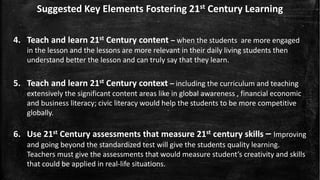
4. Teach and learn 21st Century content – when the students are more engaged
in the lesson and the lessons are more relevant in their daily living students then
understand better the lesson and can truly say that they learn.
5. Teach and learn 21st Century context – including the curriculum and teaching
extensively the significant content areas like in global awareness , financial economic
and business literacy; civic literacy would help the students to be more competitive
globally.
6. Use 21st Century assessments that measure 21st century skills – Improving
and going beyond the standardized test will give the students quality learning.
Teachers must give the assessments that would measure student’s creativity and skills
that could be applied in real-life situations.
Technology in teaching
and learning
International Society for Technology in
Education (ISTE)
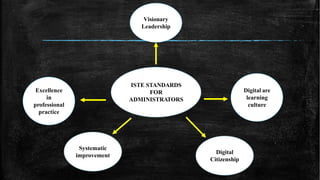
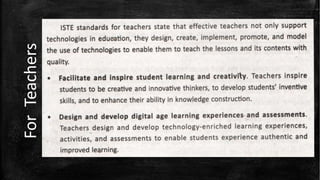
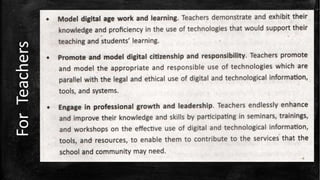
1.STANDARDS FOR ADMINISTRATORS
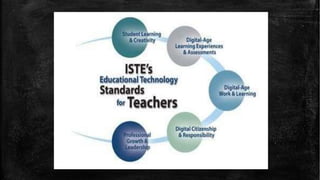
2.STANDARDS FOR TEACHERS
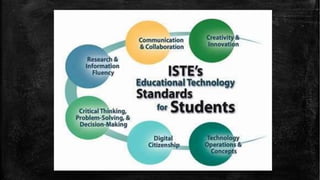
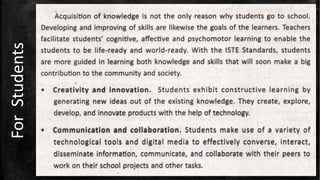
3.STANDARDS FOR STUDENTS
ISTE STANDARDS
FOR
ADMINISTRATORS
Visionary
Leadership
Digital are
learning
culture
Excellence
in
professional
practice
Systematic
improvement
Digital
Citizenship
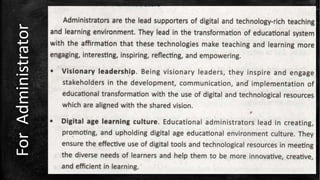
For
Administrator
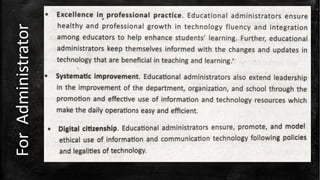
For
Administrator
For
Teachers
For
Teachers
For
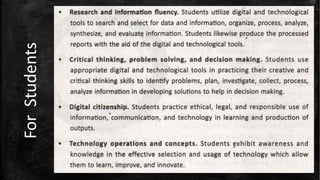
Students
For
Students
Edtech CHAPTER 1.pptx

Edtech CHAPTER 1.pptx

  • 1.
    Teachers & Students in the DigitalAge Educational Technology Jugiel C. Villones
  • 2.
    “Every journey hasits start and end.”
  • 3.
  • 4.
    Teachers of the21st Century
  • 5.
    Teachers of theEarly Generations VS Teachers of the 21st Century
  • 6.
    T e ac h e r s o f t h e E a r l y G e n e r a t i o n s V S T e a c h e r s o f t h e 2 1 s t C e n t u r y Teachers of Yesteryears Teachers of the 21st Century  Disseminate information through lectures  Require students memorize contents form textbooks.  Make use of textbooks and workbooks as their reference.  Give assessments through written examination  Focus on their responsibility and relationship with the students as receipts of knowledge.  Followers of policies prescribed by the school.  Use lecture as teaching method.  Deliver the same lessons every year.  Allow students to solve real world problems.  Allow students to construct their own understanding of the subject matter.  Make use of manipulative materials; makes use of multitude of prints and electronic sources.  Give performance – based assessments (Performance based)  Widen their responsibility and their relationship with colleagues, community and other stakeholders.  Participate in the decision – making in schools.  Use of variety of teaching methods appropriate in the student’s learning  Spend time in researching new updates
  • 7.
    T e ac h e r s o f t h e E a r l y G e n e r a t i o n s V S T e a c h e r s o f t h e 2 1 s t C e n t u r y 8 Teachers of Yesteryears Teachers of the 21st Century  Too focused on self – achievement.  Target to finish the lesson within the period  Autocratic in which teachers are in control of everything in all events of the classroom  Holder of knowledge/ Gatekeeper of information  Technology illiterate  Mentor new teachers  Target the learners to be ready in the challenges of today’s learning.  Democratic in which teachers allow students to take responsibility in their learning.  Facilitator of learning  Technology or digital literate
  • 8.
    21st Century Teacher Channel– Teachers serves as a channel in connecting curriculum, software, hardware and dynamics of teaching in their instructions. Communicator – it doesn’t only refer to good language in communicating knowledge to the students, but being a teacher who can communicate with their students anytime and anywhere with the use of tools and technologies. Learner – Teachers never ceases learning new knowledge. Learning the technologies of today will give them a big leap in the advances of today and tomorrow’s teaching and learning. Futurist – not only on what they want their students to achieve at the end of the lesson, but on how they will deliver the lesson with the use of the emerging tools and other web technologies.
  • 9.
    Leader – leadstheir students to the proper and appropriate use of learning materials including technologies. Exemplar – Teachers are models when it comes behavior, language, dealing with colleagues and students, use of facilities and others. Collaborator – not only inside the classroom but also in space. Teachers therefore must pull up their collaborative tools to be able to continue to share and contribute their knowledge to the learners. Venture Player – taking chances to apply new knowledge, practices and technologies especially if these will level up the students understanding and learning.
  • 10.
  • 11.
    Students of theEarly Generations VS Students of the 21st Century
  • 12.
    S t ud e n t s o f t h e E a r l y G e n e r a t i o n s V S S t u d e n t s o f t h e 2 1 s t C e n t u r y Students of Yesteryears Students of the 21st Century  Receiver of facts and information  Learning is based on repetition  Textbook users  Passive recipients of information  Competitive learners  Factual thinkers  Unilateral thinkers  Inactive process of learning  Dependent learners  Single Taskers  Single sensory input provider  Active creators of knowledge  Interactive knowledge constructor  Internet users access a vast of information.  Actively engaged in class activities  Collaborative learners  Reflective, critical and creative thinkers  Divergent thinkers  Dynamic processes of learning  Self – managing learners  Multi taskers  Multisensory input provider
  • 13.
    With the existenceof technology, there is much that is expected from the students. They have to get away with being passive learners. They have to: 1. Learn to generate their own ideas and construct their own understanding of the lesson; 2. Create works that are original 3. Communicate clearly with other students and with their teachers 4. Collaborate with one another to achieve higher standard of learning; and 5. Innovate learning and their outputs
  • 14.
    Instructions in theearly generations VS Instructions in the 21st Century
  • 15.
    Instructions of theEarly Generations VS Instructions of the 21st Century Traditional Learning Environment New Learning Environment  Teacher – centered instruction  Single – sense stimulation  Single – path progression  Single medium  Isolated work  Information delivery  Passive learning  Factual, knowledge – based learning  Reactive response  Isolated, artificial context  Student – centered learning  Multisensory simulation  Multipath progression  Multimedia  Collaborative work  Information exchange  Active/exploratory/ inquiry – based learning  Critical thinking and informed decision making  Proactive/planned action  Authentic, real – world context Adapted from Gunter, G. & Gunter R. (2015) Teachers Discovering Computers (8th Edition)
  • 16.
    T h e2 1 s t C e n t u r y S k i l l s
  • 17.
    21st Century Skillsare Relevant to Students Professional Growth 1. LEARNING AND INNOVATION SKILLS – Communication and collaboration, critical thinking and problem solving, creativity and innovation. 2. LIFE AND CAREER SKILLS - Leadership and responsibility, productivity and accountability, social and cross-cultural skills, initiative and self-direction, flexibility and adaptation. 3. INFORMATION, MEDIA AND TECHNOLOGY SKILLS – Media Literacy; Information and Communication Literacy;
  • 18.
    Suggested Key ElementsFostering 21st Century Learning 1. Emphasis on the Core Subject– is beyond basic competency (reading, writing, arithmetic) this is more on understanding to the core academic content to a higher level (English, Reading, or Language Arts, World Languages, Arts, Mathematics, Economics, Science, Geography, History, Government and Civics. 2. Emphasis on Learning Skills – it should not be limited to what is being learned at schools but also learning persistently throughout their lives most especially in learning ICT, Thinking and Problem-Solving Skills and Interpersonal and self-directional skills. 3. Use 21st Century Tools – Students need to learn and be proficient in the use of ICT tools to access, relate, manage, evaluate and construct new knowledge or information.
  • 19.
    Suggested Key ElementsFostering 21st Century Learning 4. Teach and learn 21st Century content – when the students are more engaged in the lesson and the lessons are more relevant in their daily living students then understand better the lesson and can truly say that they learn. 5. Teach and learn 21st Century context – including the curriculum and teaching extensively the significant content areas like in global awareness , financial economic and business literacy; civic literacy would help the students to be more competitive globally. 6. Use 21st Century assessments that measure 21st century skills – Improving and going beyond the standardized test will give the students quality learning. Teachers must give the assessments that would measure student’s creativity and skills that could be applied in real-life situations.
  • 20.
  • 21.
    International Society forTechnology in Education (ISTE) 1.STANDARDS FOR ADMINISTRATORS 2.STANDARDS FOR TEACHERS 3.STANDARDS FOR STUDENTS
  • 22.
  • 23.
  • 24.
  • 26.
  • 27.
  • 29.
  • 30.