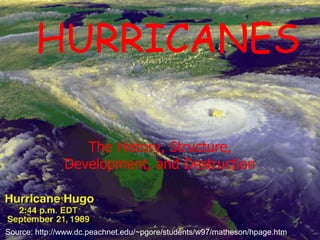
HURRICANES
The History, Structure,
Development, and Destruction
Source: http://www.dc.peachnet.edu/~pgore/students/w97/matheson/hpage.htm
What is a hurricane?
 Violent
cyclonic storm
that develops
in the tropical
region
 Wind speeds
are > 74 mph Source: http://earthobservatory.nasa.gov/
Newsroom/NewImages/images.php3?img_id=680
Rotation and Pressure
In which direction does a hurricane
rotate?
COUNTERCLOCKWISE
Is the atmospheric pressure inside the
hurricane high or low?
LOW
When is Hurricane Season?
June 1st
through
November
31st
What is the role of the
National Weather Service
during hurricane season?
 Provides weather information,
such as data from satellites
 Responsible for issuing watches
and warnings to the media and
general public
Watch vs. Warning
 What is the difference between a
Hurricane Watch and a Hurricane
Warning?
 Watch – Tropical storm poses a threat to
coastal areas within 36 hours
 Warning - Tropical storm conditions are
expected in a coastal area within 24 hours
What conditions must be present
for a hurricane to develop?
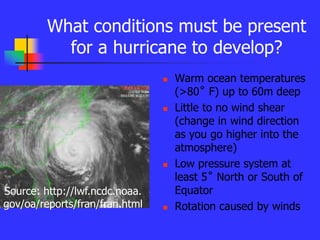
 Warm ocean temperatures
(>80˚ F) up to 60m deep
 Little to no wind shear
(change in wind direction
as you go higher into the
atmosphere)
 Low pressure system at
least 5˚ North or South of
Equator
 Rotation caused by winds
Source: http://lwf.ncdc.noaa.
gov/oa/reports/fran/fran.html
What is the major source of
energy fueling a hurricane?
Heat Energy evaporating from
the ocean surface
Source: http://ww2010.atmos.uiuc.edu/(Gh)/guides/mtr/hyd/evap.rxml
Hurricane Anatomy
Source: http://hurricanes.noaa.gov/prepare/structure.htm
Another look at the Structure
Source: http://hurricanes.noaa.gov/prepare/structure.htm
Comparison of Terms
 Tropical Disturbance
Group of thunderstorms in the tropics that are
present for at least 24 hours
 Tropical Wave
lack of circulation, winds <25 mph in every
direction
 Tropical Depression
closed circulation but disorganized, winds at least
25 mph.
Comparison of Terms
Tropical Storm
Shower and thunderstorm moves over closed
circulation, winds greater than 39 mph
Hurricane
Eye is developed, winds > 74 mph
Compare the Following
Source: http://ww2010.atmos.uiuc.edu/(Gh)/guides/mtr/hurr/stages/home.rxml
By what two factors is hurricane
strength measured?
Wind Speed
Barometric (air) Pressure
What is the Scale Used to
Categorize Hurricanes?
Saffir-Simpson Scale
Category Max Wind Speed
(mph)
Min. Surface
Pressure (mb)
Storm Surge m
(ft)
1 74-96 > 980 1-1.7 (3-5)
2 97-111 979-965 1.8-2.6 (6-8)
3 112-131 964-945 2.7-3.8 (9-12)
4 132-155 944-920 3.9-5.6 (13-18)
5 > 155 < 920 > 5.7 (>19)
Source: http://kids.earth.nasa.gov/archive/hurricane/saffir-simpson.html
What causes the
damage in a hurricane?
Winds
Flooding
Storm Surge
What is a storm surge?
 Large wall or dome of
water that rushes into
the coastline as a
result of a hurricane
making landfall
 To the right are the
areas affected by high
storm surges
Souce: http://www.wkrg.com/hurricanecenter/surge/SE.jpg
What destroys a hurricane?
 Strong vertical winds
 Cold water
 Movement over land
 Friction
 Lack of moisture
What are the five costliest
hurricanes in the United States?
1. Hurricane Katrina – 2005 (105 billion)
2. Hurricane Andrew – 1992 (45 billion)
3. Hurricane Ike – 2008 (27 billion)
4. Hurricane Wilma – 2005 (20 Billion)
5. Hurricane Ivan – 2004 (19 billion)
Explain why the majority of the
costliest storms are relatively recent
 Damage is a
result of
development
 There are more
developed
areas and
possessions
than in the past
Source: http://www.nhc.noaa.gov/1992andrew.html
What are the five deadliest
hurricanes in the United States?
1. Galveston – 1900 (8,000)
2. Southeast Florida – 1928 (2,500)
3. Katrina – 2005 (1200)
4. Chenier Caminanda – 1893 (1100 –
1400)
5. Sea Islands – 1893 (1000-2000)
Explain why the deadliest storms
were mostly longer ago.
 Lack of weather instruments to predict and
track storms
 People were not warned of the incoming
danger
Source: http://www.1900storm.com/photographs/photo10.html
Results of the Galveston Hurricane
http://cindi.usgs.gov/cindi/hazard/event/floyd/ncflood/mediums/img023.jpg
Mrs. Parker’s
Old House
Final Water Level
Flooding of Tar River as result of
Hurricanes Dennis and Floyd
Dockside
Tar River
Estates
Damage to Greenville
 Extensive Flooding
 Extended Power
outages
 Flood Related
Deaths
 Property Damage
US 264 Bridge
Source: http://cindi.usgs.gov/cindi
/hazard/event/floyd/ncflood/
mediums/img022.jpg
Damage to Greenville
Source: http://www.guc.com/about/floyd.htm
Protection
 Listen to warnings
 Take all warnings seriously
 Follow evacuations
 Prepare Food and Water for
extensive power outages
Source: http://www.dc.peachnet.edu/~pgore/students/w97/matheson/hpage.htm

Hurricanes

  • 1.
    HURRICANES The History, Structure, Development,and Destruction Source: http://www.dc.peachnet.edu/~pgore/students/w97/matheson/hpage.htm
  • 2.
    What is ahurricane?  Violent cyclonic storm that develops in the tropical region  Wind speeds are > 74 mph Source: http://earthobservatory.nasa.gov/ Newsroom/NewImages/images.php3?img_id=680
  • 3.
    Rotation and Pressure Inwhich direction does a hurricane rotate? COUNTERCLOCKWISE Is the atmospheric pressure inside the hurricane high or low? LOW
  • 4.
    When is HurricaneSeason? June 1st through November 31st
  • 5.
    What is therole of the National Weather Service during hurricane season?  Provides weather information, such as data from satellites  Responsible for issuing watches and warnings to the media and general public
  • 6.
    Watch vs. Warning What is the difference between a Hurricane Watch and a Hurricane Warning?  Watch – Tropical storm poses a threat to coastal areas within 36 hours  Warning - Tropical storm conditions are expected in a coastal area within 24 hours
  • 7.
    What conditions mustbe present for a hurricane to develop?  Warm ocean temperatures (>80˚ F) up to 60m deep  Little to no wind shear (change in wind direction as you go higher into the atmosphere)  Low pressure system at least 5˚ North or South of Equator  Rotation caused by winds Source: http://lwf.ncdc.noaa. gov/oa/reports/fran/fran.html
  • 8.
    What is themajor source of energy fueling a hurricane? Heat Energy evaporating from the ocean surface Source: http://ww2010.atmos.uiuc.edu/(Gh)/guides/mtr/hyd/evap.rxml
  • 9.
  • 10.
    Another look atthe Structure Source: http://hurricanes.noaa.gov/prepare/structure.htm
  • 11.
    Comparison of Terms Tropical Disturbance Group of thunderstorms in the tropics that are present for at least 24 hours  Tropical Wave lack of circulation, winds <25 mph in every direction  Tropical Depression closed circulation but disorganized, winds at least 25 mph.
  • 12.
    Comparison of Terms TropicalStorm Shower and thunderstorm moves over closed circulation, winds greater than 39 mph Hurricane Eye is developed, winds > 74 mph
  • 13.
    Compare the Following Source:http://ww2010.atmos.uiuc.edu/(Gh)/guides/mtr/hurr/stages/home.rxml
  • 14.
    By what twofactors is hurricane strength measured? Wind Speed Barometric (air) Pressure
  • 15.
    What is theScale Used to Categorize Hurricanes? Saffir-Simpson Scale Category Max Wind Speed (mph) Min. Surface Pressure (mb) Storm Surge m (ft) 1 74-96 > 980 1-1.7 (3-5) 2 97-111 979-965 1.8-2.6 (6-8) 3 112-131 964-945 2.7-3.8 (9-12) 4 132-155 944-920 3.9-5.6 (13-18) 5 > 155 < 920 > 5.7 (>19) Source: http://kids.earth.nasa.gov/archive/hurricane/saffir-simpson.html
  • 16.
    What causes the damagein a hurricane? Winds Flooding Storm Surge
  • 17.
    What is astorm surge?  Large wall or dome of water that rushes into the coastline as a result of a hurricane making landfall  To the right are the areas affected by high storm surges Souce: http://www.wkrg.com/hurricanecenter/surge/SE.jpg
  • 18.
    What destroys ahurricane?  Strong vertical winds  Cold water  Movement over land  Friction  Lack of moisture
  • 19.
    What are thefive costliest hurricanes in the United States? 1. Hurricane Katrina – 2005 (105 billion) 2. Hurricane Andrew – 1992 (45 billion) 3. Hurricane Ike – 2008 (27 billion) 4. Hurricane Wilma – 2005 (20 Billion) 5. Hurricane Ivan – 2004 (19 billion)
  • 20.
    Explain why themajority of the costliest storms are relatively recent  Damage is a result of development  There are more developed areas and possessions than in the past Source: http://www.nhc.noaa.gov/1992andrew.html
  • 21.
    What are thefive deadliest hurricanes in the United States? 1. Galveston – 1900 (8,000) 2. Southeast Florida – 1928 (2,500) 3. Katrina – 2005 (1200) 4. Chenier Caminanda – 1893 (1100 – 1400) 5. Sea Islands – 1893 (1000-2000)
  • 22.
    Explain why thedeadliest storms were mostly longer ago.  Lack of weather instruments to predict and track storms  People were not warned of the incoming danger Source: http://www.1900storm.com/photographs/photo10.html Results of the Galveston Hurricane
  • 23.
    http://cindi.usgs.gov/cindi/hazard/event/floyd/ncflood/mediums/img023.jpg Mrs. Parker’s Old House FinalWater Level Flooding of Tar River as result of Hurricanes Dennis and Floyd Dockside Tar River Estates
  • 24.
    Damage to Greenville Extensive Flooding  Extended Power outages  Flood Related Deaths  Property Damage US 264 Bridge Source: http://cindi.usgs.gov/cindi /hazard/event/floyd/ncflood/ mediums/img022.jpg
  • 25.
    Damage to Greenville Source:http://www.guc.com/about/floyd.htm
  • 26.
    Protection  Listen towarnings  Take all warnings seriously  Follow evacuations  Prepare Food and Water for extensive power outages
  • 27.