Download to read offline
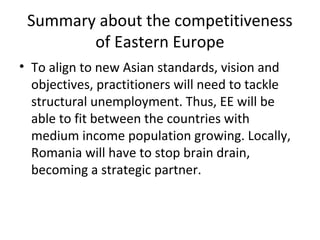
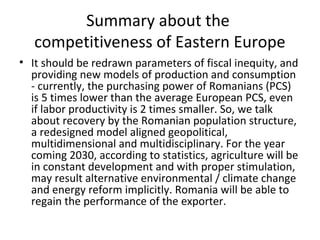
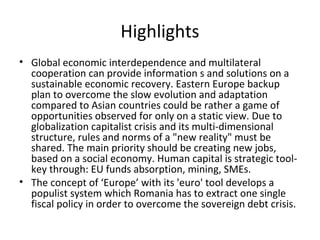
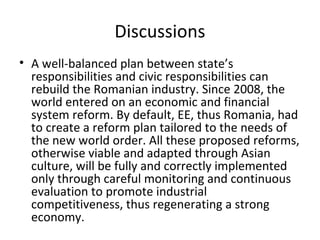
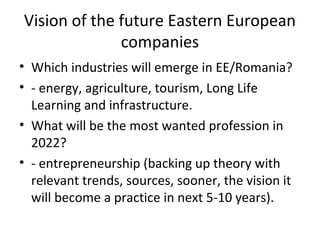
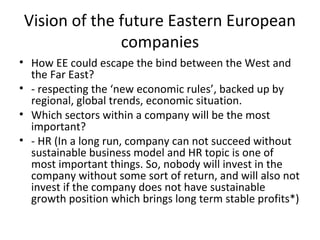
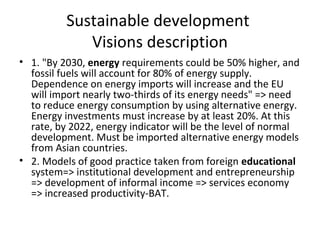
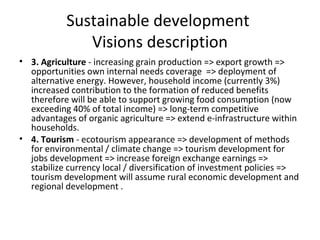
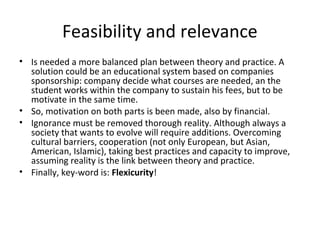

The document discusses strategies for improving competitiveness in Eastern Europe, specifically Romania. It proposes tackling structural unemployment, stopping brain drain, and redesigning fiscal and production models to increase purchasing power. Agriculture and renewable energy are seen as growth areas that could make Romania a stronger exporter by 2030 if given proper support. Close monitoring of reforms adapted from Asian models will be needed to promote sustainable economic recovery and competitiveness in the region.


![[Challenge:Future] SAKSHAM- Act to Impact](https://cdn.slidesharecdn.com/ss_thumbnails/challengefuture-saksham-act-to-impact1519-130228013851-phpapp02-thumbnail.jpg?width=640&height=640&fit=bounds)


![[Challenge:Future] 8ball: The Future of Work - Innovation](https://cdn.slidesharecdn.com/ss_thumbnails/challengefuture-8ball-the-future-of-work-innovation3307-130301044809-phpapp02-thumbnail.jpg?width=640&height=640&fit=bounds)
![[Challenge:Future] BUILDING SUSTAINABLE & CREATIVE EASTERN EUROPE](https://cdn.slidesharecdn.com/ss_thumbnails/challengefuture-building-sustainable-creative-eastern-europe2750-130226113504-phpapp01-thumbnail.jpg?width=640&height=640&fit=bounds)
![[Challenge:Future] Noctiluca: The Future of Work](https://cdn.slidesharecdn.com/ss_thumbnails/challengefuture-noctiluca-the-future-of-work566-130228022014-phpapp01-thumbnail.jpg?width=640&height=640&fit=bounds)
![[Challenge:Future] Noctiluca: The Future of Work](https://cdn.slidesharecdn.com/ss_thumbnails/challengefuture-noctiluca-the-future-of-work3157-130228033411-phpapp02-thumbnail.jpg?width=640&height=640&fit=bounds)

![[Challenge:Future] IQ: Anti-Trend](https://cdn.slidesharecdn.com/ss_thumbnails/challengefuture-iq-antitrend4077-130228030554-phpapp01-thumbnail.jpg?width=640&height=640&fit=bounds)


![[Challenge:Future] NLY solution: Network Growth Pole](https://cdn.slidesharecdn.com/ss_thumbnails/challengefuture-nly-solution-network-growth-pole4494-130228145807-phpapp02-thumbnail.jpg?width=640&height=640&fit=bounds)

![[Challenge:Future] A Paradigm Shift in Eastern Europe: Moving Towards a Knowl...](https://cdn.slidesharecdn.com/ss_thumbnails/challengefuture-a-paradigm-shift-in-eastern-europe-moving-towards-a-knowledgebased-economy2573-130228020326-phpapp01-thumbnail.jpg?width=640&height=640&fit=bounds)
![[Challenge:Future] Better possibilities](https://cdn.slidesharecdn.com/ss_thumbnails/challengefuture-better-possibilities2382-130228071205-phpapp02-thumbnail.jpg?width=640&height=640&fit=bounds)
![[Challenge:Future] The Vision: The Future of Work](https://cdn.slidesharecdn.com/ss_thumbnails/challengefuture-the-vision-the-future-of-work1430-130228022416-phpapp01-thumbnail.jpg?width=640&height=640&fit=bounds)
![[Challenge:Future] W-E have the solution](https://cdn.slidesharecdn.com/ss_thumbnails/challengefuture-we-have-the-solution4035-130228032818-phpapp02-thumbnail.jpg?width=640&height=640&fit=bounds)
![[Challenge:Future] W-E have the solution](https://cdn.slidesharecdn.com/ss_thumbnails/challengefuture-we-have-the-solution4849-130228033813-phpapp01-thumbnail.jpg?width=640&height=640&fit=bounds)
![[Challenge:Future] Mega Minds: Moving Forward, The Virtual Way!](https://cdn.slidesharecdn.com/ss_thumbnails/challengefuture-mega-minds-moving-forward-the-virtual-way1442-130224131510-phpapp02-thumbnail.jpg?width=640&height=640&fit=bounds)
![[Challenge:Future] Mech: The Future of Work](https://cdn.slidesharecdn.com/ss_thumbnails/challengefuture-mech-the-future-of-work1373-130225075007-phpapp01-thumbnail.jpg?width=640&height=640&fit=bounds)
![[Challenge:Future] CroTNT: The Future of Work- Malcolm in the middle](https://cdn.slidesharecdn.com/ss_thumbnails/challengefuture-crotnt-the-future-of-work-malcolm-in-the-middle1049-130228020816-phpapp01-thumbnail.jpg?width=640&height=640&fit=bounds)
![[Challenge:Future] CroTNT: The Future of Work- Malcolm in the middle](https://cdn.slidesharecdn.com/ss_thumbnails/challengefuture-crotnt-the-future-of-work-malcolm-in-the-middle3301-130228021009-phpapp01-thumbnail.jpg?width=640&height=640&fit=bounds)
![[Challenge:Future] CroTNT: The Future of Work- Malcolm in the middle](https://cdn.slidesharecdn.com/ss_thumbnails/challengefuture-crotnt-the-future-of-work-malcolm-in-the-middle1875-130228021203-phpapp02-thumbnail.jpg?width=640&height=640&fit=bounds)
![[Challenge:Future] Think twice before quitting](https://cdn.slidesharecdn.com/ss_thumbnails/challengefuture-think-twice-before-quitting951-150214074403-conversion-gate01-thumbnail.jpg?width=640&height=640&fit=bounds)
![[Challenge:Future] My Career Tip for 2015](https://cdn.slidesharecdn.com/ss_thumbnails/challengefuture-my-career-tip-for-20153724-150119150629-conversion-gate01-thumbnail.jpg?width=640&height=640&fit=bounds)
![[Challenge:Future] Faith in humanity](https://cdn.slidesharecdn.com/ss_thumbnails/challengefuture-faith-in-humanity2748-141218140104-conversion-gate01-thumbnail.jpg?width=640&height=640&fit=bounds)
![[Challenge:Future] " The Secret of Happiness."](https://cdn.slidesharecdn.com/ss_thumbnails/challengefuture-the-secret-of-happiness3329-150202124318-conversion-gate01-thumbnail.jpg?width=640&height=640&fit=bounds)
![[Challenge:Future] Do not delay it!](https://cdn.slidesharecdn.com/ss_thumbnails/challengefuture-do-not-delay-it2242-150129172304-conversion-gate01-thumbnail.jpg?width=640&height=640&fit=bounds)
![[Challenge:Future] Hard work, Dedication & Patience!](https://cdn.slidesharecdn.com/ss_thumbnails/challengefuture-hard-work-dedication-patience94-150128133507-conversion-gate02-thumbnail.jpg?width=640&height=640&fit=bounds)
![[Challenge:Future] What is life?](https://cdn.slidesharecdn.com/ss_thumbnails/challengefuture-what-is-life1507-150131153303-conversion-gate02-thumbnail.jpg?width=640&height=640&fit=bounds)
![[Challenge:Future] Lifelong Learning](https://cdn.slidesharecdn.com/ss_thumbnails/challengefuture-lifelong-learning3412-150105134404-conversion-gate02-thumbnail.jpg?width=640&height=640&fit=bounds)
![[Challenge:Future] The magic world of Homo Ludens](https://cdn.slidesharecdn.com/ss_thumbnails/challengefuture-the-magic-world-of-homo-ludens3765-150113074618-conversion-gate01-thumbnail.jpg?width=640&height=640&fit=bounds)
![[Challenge:Future] Smile And Accept the Challange](https://cdn.slidesharecdn.com/ss_thumbnails/challengefuture-smile-and-accept-the-challange4466-150104005903-conversion-gate01-thumbnail.jpg?width=640&height=640&fit=bounds)
![[Challenge:Future] Break the Borders](https://cdn.slidesharecdn.com/ss_thumbnails/challengefuture-break-the-borders2417-150112055706-conversion-gate02-thumbnail.jpg?width=640&height=640&fit=bounds)
![[Challenge:Future] Always rely only on yourself](https://cdn.slidesharecdn.com/ss_thumbnails/challengefuture-always-rely-only-on-yourself4726-150129133806-conversion-gate02-thumbnail.jpg?width=640&height=640&fit=bounds)
![[Challenge:Future] box of choices](https://cdn.slidesharecdn.com/ss_thumbnails/challengefuture-box-of-choices459-150118141228-conversion-gate02-thumbnail.jpg?width=640&height=640&fit=bounds)
![[Challenge:Future] BE YOURSELF](https://cdn.slidesharecdn.com/ss_thumbnails/challengefuture-be-yourself2860-150107152106-conversion-gate01-thumbnail.jpg?width=640&height=640&fit=bounds)
![[Challenge:Future] Guard Your Soul](https://cdn.slidesharecdn.com/ss_thumbnails/challengefuture-guard-your-soul3130-150120050804-conversion-gate01-thumbnail.jpg?width=640&height=640&fit=bounds)
![[Challenge:Future] Passion](https://cdn.slidesharecdn.com/ss_thumbnails/challengefuture-passion3521-150109034003-conversion-gate02-thumbnail.jpg?width=640&height=640&fit=bounds)
![[Challenge:Future] The Power of Happiness](https://cdn.slidesharecdn.com/ss_thumbnails/challengefuture-the-power-of-happiness4947-150131104822-conversion-gate01-thumbnail.jpg?width=640&height=640&fit=bounds)
![[Challenge:Future] Raft Guide Job](https://cdn.slidesharecdn.com/ss_thumbnails/challengefuture-raft-guide-job815-150205081913-conversion-gate01-thumbnail.jpg?width=640&height=640&fit=bounds)
![[Challenge:Future] HELP YOURSELF AND LIVE](https://cdn.slidesharecdn.com/ss_thumbnails/challengefuture-help-yourself-and-live870-141223142803-conversion-gate02-thumbnail.jpg?width=640&height=640&fit=bounds)
![[Challenge:Future] I give you this medal as a sign](https://cdn.slidesharecdn.com/ss_thumbnails/challengefuture-i-give-you-this-medal-as-a-sign4652-150120121011-conversion-gate02-thumbnail.jpg?width=640&height=640&fit=bounds)