Overview
• The Economy of India is the ninth largest in the world by nominal GDP and
  the fourth largest by purchasing power parity (PPP).
• The famous Goldman Sachs report ( Dreaming with BRICs: The Path to 2050 )
  states that, among Brazil, Russia, India and China, India will grow the fastest
  over the next 30 to 50 years by leveraging its demographic advantages and
  through continued development
• India’s GDP will exceed Italy’s in 2016, France’s in 2019, Germany’s in 2023
  and Japan’s in 2032

• INDIA TO BECOME THE 3RD LARGEST ECONOMY IN THE WORLD BY 2032
                                AND…

                         THE STORY BEGAN IN 1947
Pre LPG

•   Social democratic policies governed India's economy from 1947 to 1991.

•   The economy was characterized by

    Extensive regulation

    Protectionism

    Public ownership

    Pervasive corruption and

    Slow growth.
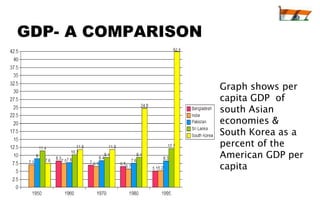
GDP- A COMPARISON


                    Graph shows per
                    capita GDP of
                    south Asian
                    economies &
                    South Korea as a
                    percent of the
                    American GDP per
                    capita
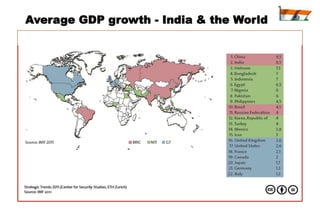
Average GDP growth - India & the World
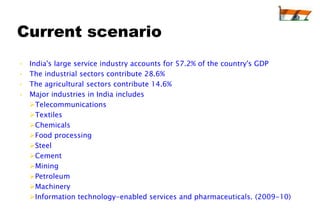
Current scenario
•   India's large service industry accounts for 57.2% of the country's GDP
•   The industrial sectors contribute 28.6%
•   The agricultural sectors contribute 14.6%
•   Major industries in India includes
    Telecommunications
    Textiles
    Chemicals
    Food processing
    Steel
    Cement
    Mining
    Petroleum
    Machinery
    Information technology-enabled services and pharmaceuticals. (2009-10)
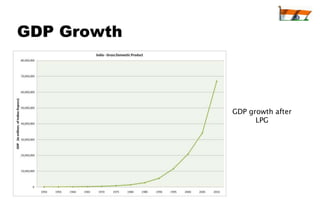
GDP Growth


             GDP growth after
                   LPG
Introduction to LPG
• July 1991,India has taken a series of measures to structure the economy and
   improve the BOP position. The new economic policy introduced changes in
   several areas.

• The policy have salient feature which are: -

    Liberalization (internal and external)

    Extending Privatization

    Globalization of the economy
The path to Liberalization
• Relief for foreign investors

• Devaluation of Indian rupees

• New industrial Policy

• New trade policy

• Removal of import Restrictions

• Liberalization of NRI remittances

• Freedom to import technology

• Encouraging foreign tie-ups

• MRTP relaxation

• Privatization of public sector
Examples
 National Thermal Power Corporation

 Indian Oil Corporation

 Mananegar Telephone Nigam Limited

 Steel Authority India Limited

 Bharat Petroleum Corporation Limited

 Hindustan Petroleum Corporation Limited

 Bharat Heavy Electronics Limited
The path to Privatization

• Liberalization Approach

• Relative Share Enlargement Approach

• Association of Private Sector Management Approach

• Transfer of Minority Equity Ownership Approach

• Transfer of Complete Ownership Approach
Examples
• Lagan Jute Machinery Company Limited (LJMC)

• Videsh Sanchar Nigam Limited (VSNL)

• Hindustan Zinc Limited (HZL)

• Hotel Corporation Limited of India (HCL)

• Bharat Aluminum Company limited (BALCO)
The path to Globalization
   Exporting

   Licensing/Franchising

   Contract manufacturing

   Management contract

   Assembly operations

   Fully owned manufacturing facilities

   Joint venturing

   Merger and acquisition

   Strategic alliance

   Countertrade
Post LPG
Agriculture
• India
• The world’s most irrigated land mass
• World’s 2nd largest exporter of rice & 5th largest exporter of wheat


• Food production: India’s Ranking in the World


    •     1st            Tea, Milk
    •     2nd   Rice, wheat, sugar
•
Industrialization
• Industry accounts for 28% of the GDP & employs 14% of the total workforce.

• Textile manufacturing is the second largest source of employment after
   agriculture

    It accounts for 20% of manufacturing output

    Provides employment to over 20 million people

    Ludhiana produces 90% of woolens in India and is known as the
       Manchester of India

• India is 13th in services output.

    Provides employment to 23% of the work force

    It has the largest share in the GDP, accounting for 55% in 2007, up from
       15% in 1950
Industrialization
•   Information technology and business process outsourcing are among the
    fastest growing sectors

     Having a cumulative growth rate of revenue 33.6% between 1997–98 and
      2002–03

     In 2009, seven Indian firms were listed among the top 15 technology
      outsourcing companies in the world.

•   Mining forms an important segment of the Indian economy

     The country produces 79 different minerals (excluding fuel and atomic
       resources) in 2009–10

•   Organized retail supermarkets accounts for 24% of the market as of 2008
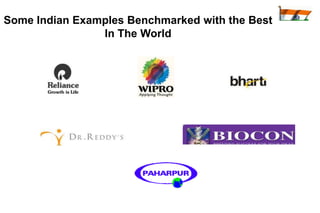
Some Indian Examples Benchmarked with the Best
                In The World
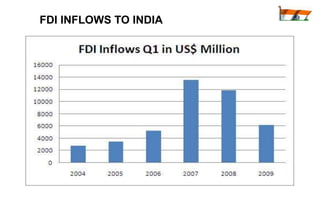
FDI INFLOWS TO INDIA


                       *
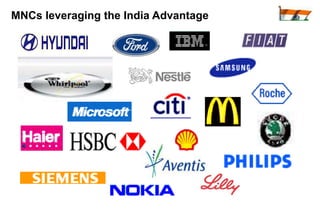
MNCs leveraging the India Advantage
Banking & Finance

• The Indian money market is classified into the organized sector comprising

  Private banks

  Public banks
                                                        as scheduled banks
  Foreign owned commercial banks and

  Cooperative banks

• The unorganized sector includes

  Individual or family owned indigenous bankers or money lenders and non-
  banking financial companies
Banking & Finance

• Prime Minister Indira Gandhi nationalized 14 banks in 1969

• Followed by six others in 1980

• The number of bank branches has increased from

 8,260 in 1969 to 72,170 in 2007

• India's gross domestic saving in 2006–07 as a percentage of GDP stood at a
  high 32.7%
Energy and Power
• India is the fourth largest consumer of oil in the world

• India's oil reserves meet 25% of the country's domestic oil demand

• India imported $82.1 billion worth of oil in the first three quarters of 2010
   which had an adverse effect on its current account deficit.

• The petroleum industry in India mostly consists of public sector companies
   such as

    Oil and Natural Gas Corporation (ONGC)

    Hindustan Petroleum Corporation Limited (HPCL)

    Indian Oil Corporation Limited (IOCL)

    Reliance Industries Limited (RIL) operates the world's largest oil refining
   complex
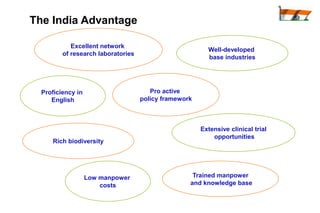
The India Advantage

            Excellent network
                                                         Well-developed
         of research laboratories
                                                         base industries


  Proficiency in                       Pro active
     English                        policy framework


                                                       Extensive clinical trial
                                                           opportunities
     Rich biodiversity


                   Low manpower                     Trained manpower
                       costs                       and knowledge base
Thank
 you

India shining

  • 2.
    Overview • The Economyof India is the ninth largest in the world by nominal GDP and the fourth largest by purchasing power parity (PPP). • The famous Goldman Sachs report ( Dreaming with BRICs: The Path to 2050 ) states that, among Brazil, Russia, India and China, India will grow the fastest over the next 30 to 50 years by leveraging its demographic advantages and through continued development • India’s GDP will exceed Italy’s in 2016, France’s in 2019, Germany’s in 2023 and Japan’s in 2032 • INDIA TO BECOME THE 3RD LARGEST ECONOMY IN THE WORLD BY 2032 AND… THE STORY BEGAN IN 1947
  • 3.
    Pre LPG • Social democratic policies governed India's economy from 1947 to 1991. • The economy was characterized by Extensive regulation Protectionism Public ownership Pervasive corruption and Slow growth.
  • 4.
    GDP- A COMPARISON Graph shows per capita GDP of south Asian economies & South Korea as a percent of the American GDP per capita
  • 5.
    Average GDP growth- India & the World
  • 6.
    Current scenario • India's large service industry accounts for 57.2% of the country's GDP • The industrial sectors contribute 28.6% • The agricultural sectors contribute 14.6% • Major industries in India includes Telecommunications Textiles Chemicals Food processing Steel Cement Mining Petroleum Machinery Information technology-enabled services and pharmaceuticals. (2009-10)
  • 7.
    GDP Growth GDP growth after LPG
  • 8.
    Introduction to LPG •July 1991,India has taken a series of measures to structure the economy and improve the BOP position. The new economic policy introduced changes in several areas. • The policy have salient feature which are: -  Liberalization (internal and external)  Extending Privatization  Globalization of the economy
  • 9.
    The path toLiberalization • Relief for foreign investors • Devaluation of Indian rupees • New industrial Policy • New trade policy • Removal of import Restrictions • Liberalization of NRI remittances • Freedom to import technology • Encouraging foreign tie-ups • MRTP relaxation • Privatization of public sector
  • 10.
    Examples  National ThermalPower Corporation  Indian Oil Corporation  Mananegar Telephone Nigam Limited  Steel Authority India Limited  Bharat Petroleum Corporation Limited  Hindustan Petroleum Corporation Limited  Bharat Heavy Electronics Limited
  • 11.
    The path toPrivatization • Liberalization Approach • Relative Share Enlargement Approach • Association of Private Sector Management Approach • Transfer of Minority Equity Ownership Approach • Transfer of Complete Ownership Approach
  • 12.
    Examples • Lagan JuteMachinery Company Limited (LJMC) • Videsh Sanchar Nigam Limited (VSNL) • Hindustan Zinc Limited (HZL) • Hotel Corporation Limited of India (HCL) • Bharat Aluminum Company limited (BALCO)
  • 13.
    The path toGlobalization  Exporting  Licensing/Franchising  Contract manufacturing  Management contract  Assembly operations  Fully owned manufacturing facilities  Joint venturing  Merger and acquisition  Strategic alliance  Countertrade
  • 14.
  • 15.
    Agriculture • India • Theworld’s most irrigated land mass • World’s 2nd largest exporter of rice & 5th largest exporter of wheat • Food production: India’s Ranking in the World • 1st Tea, Milk • 2nd Rice, wheat, sugar •
  • 16.
    Industrialization • Industry accountsfor 28% of the GDP & employs 14% of the total workforce. • Textile manufacturing is the second largest source of employment after agriculture  It accounts for 20% of manufacturing output  Provides employment to over 20 million people  Ludhiana produces 90% of woolens in India and is known as the Manchester of India • India is 13th in services output.  Provides employment to 23% of the work force  It has the largest share in the GDP, accounting for 55% in 2007, up from 15% in 1950
  • 17.
    Industrialization • Information technology and business process outsourcing are among the fastest growing sectors  Having a cumulative growth rate of revenue 33.6% between 1997–98 and 2002–03  In 2009, seven Indian firms were listed among the top 15 technology outsourcing companies in the world. • Mining forms an important segment of the Indian economy  The country produces 79 different minerals (excluding fuel and atomic resources) in 2009–10 • Organized retail supermarkets accounts for 24% of the market as of 2008
  • 18.
    Some Indian ExamplesBenchmarked with the Best In The World
  • 19.
  • 20.
    MNCs leveraging theIndia Advantage
  • 21.
    Banking & Finance •The Indian money market is classified into the organized sector comprising Private banks Public banks as scheduled banks Foreign owned commercial banks and Cooperative banks • The unorganized sector includes Individual or family owned indigenous bankers or money lenders and non- banking financial companies
  • 22.
    Banking & Finance •Prime Minister Indira Gandhi nationalized 14 banks in 1969 • Followed by six others in 1980 • The number of bank branches has increased from  8,260 in 1969 to 72,170 in 2007 • India's gross domestic saving in 2006–07 as a percentage of GDP stood at a high 32.7%
  • 23.
    Energy and Power •India is the fourth largest consumer of oil in the world • India's oil reserves meet 25% of the country's domestic oil demand • India imported $82.1 billion worth of oil in the first three quarters of 2010 which had an adverse effect on its current account deficit. • The petroleum industry in India mostly consists of public sector companies such as  Oil and Natural Gas Corporation (ONGC)  Hindustan Petroleum Corporation Limited (HPCL)  Indian Oil Corporation Limited (IOCL)  Reliance Industries Limited (RIL) operates the world's largest oil refining complex
  • 24.
    The India Advantage Excellent network Well-developed of research laboratories base industries Proficiency in Pro active English policy framework Extensive clinical trial opportunities Rich biodiversity Low manpower Trained manpower costs and knowledge base
  • 25.