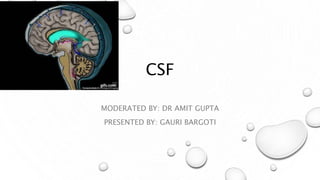
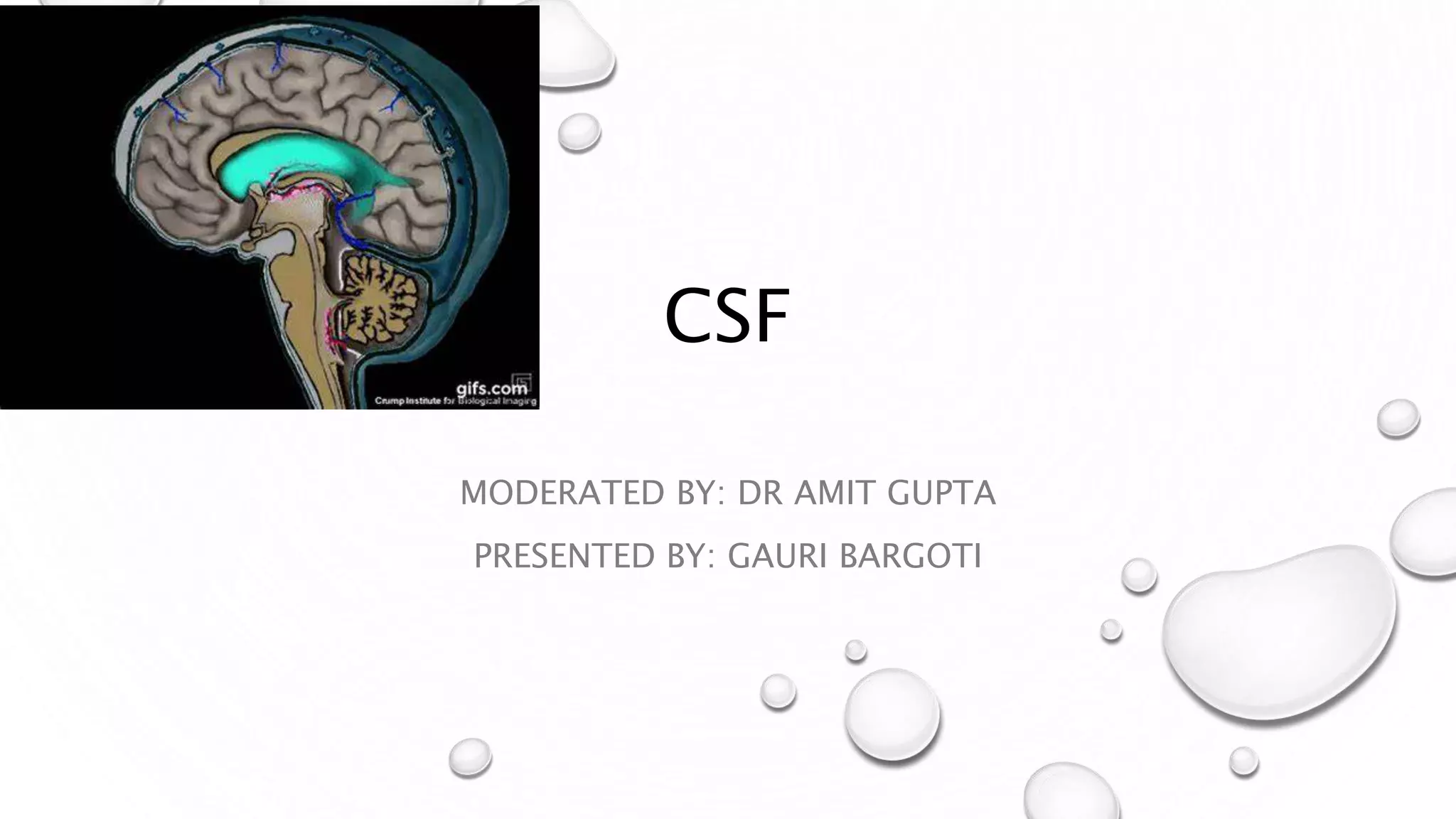
CSF
MODERATED BY: DR AMIT GUPTA
PRESENTED BY: GAURI BARGOTI
CONTENTS
• INTRODUCTION
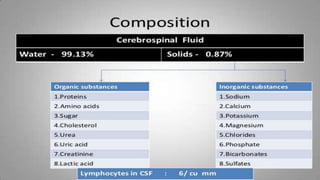
• COMPOSITION
• FORMATION
• CIRCULATION
• ABSORPTION
• FUNCTION
• PRESSURE OF CSF
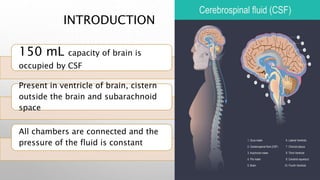
INTRODUCTION
150 mL capacity of brain is
occupied by CSF
Present in ventricle of brain, cistern
outside the brain and subarachnoid
space
All chambers are connected and the
pressure of the fluid is constant
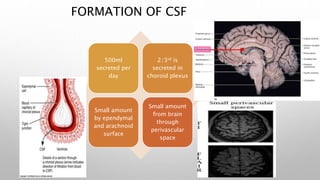
FORMATION OF CSF
500ml
secreted per
day
2/3rd is
secreted in
choroid plexus
Small amount
by ependymal
and arachnoid
surface
Small amount
from brain
through
perivascular
space
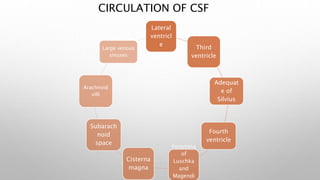
CIRCULATION OF CSF
Lateral
ventricl
e
Third
ventricle
Adequat
e of
Silvius
Fourth
ventricle
Foramina
of
Luschka
and
Magendi
Cisterna
magna
Subarach
noid
space
Arachnoid
villi
Large venous
sinuses
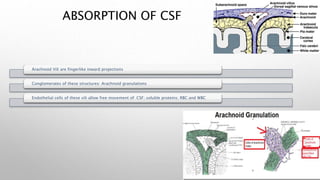
ABSORPTION OF CSF
Arachnoid Vili are fingerlike inward projections
Conglomerates of these structures: Arachnoid granulations
Endothelial cells of these vili allow free movement of: CSF; soluble proteins; RBC and WBC
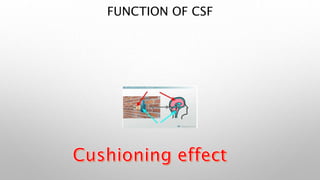
FUNCTION OF CSF
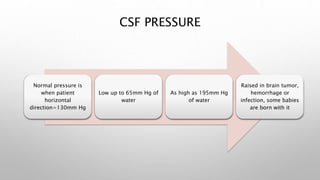
CSF PRESSURE
Normal pressure is
when patient
horizontal
direction=130mm Hg
Low up to 65mm Hg of
water
As high as 195mm Hg
of water
Raised in brain tumor,
hemorrhage or
infection, some babies
are born with it
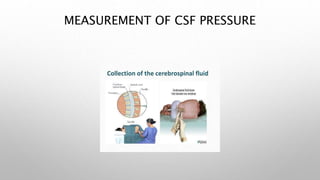
MEASUREMENT OF CSF PRESSURE
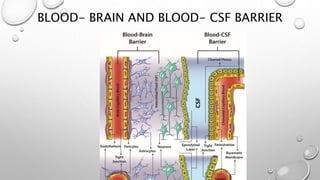
BLOOD- BRAIN AND BLOOD- CSF BARRIER
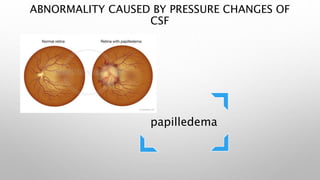
ABNORMALITY CAUSED BY PRESSURE CHANGES OF
CSF
papilledema
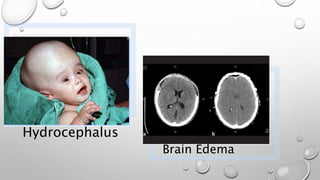
Hydrocephalus
Brain Edema
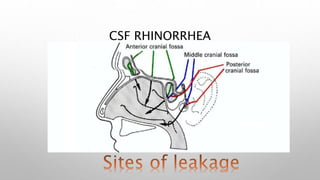
CSF RHINORRHEA
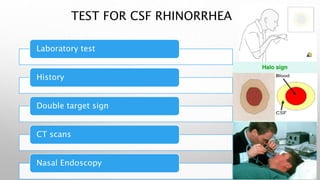
TEST FOR CSF RHINORRHEA
Laboratory test
History
Double target sign
CT scans
Nasal Endoscopy
REFERENCES
• GUYTON AND HALL TEXTBOOK OF PHYSIOLOGY
• ORAL & MAXILLOFACIAL SURGERY FONSECA TRAUMA

CSF.pptx