
SEDATION
DENTISTRY
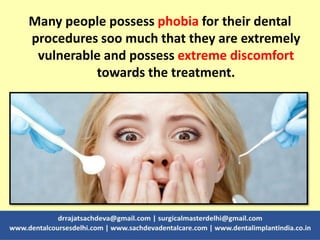
Many people possess phobia for their dental
procedures soo much that they are extremely
vulnerable and possess extreme discomfort
towards the treatment.
• Sedation dentistry includes techniques to
either calm a patient before and during a
dental procedure or to make patients more
comfortable during long procedures.
• The pharmacological agents (sedatives),
depresses the central nervous system,
specifically those areas concerned
with conscious awareness.
• Actually, you will remain conscious during
conscious sedation. You will also be able to
understand and respond to requests.
However, you may not remember much
about the procedure.
Phases Of Sedation
• Minimal sedation - you are awake but relaxed.
• Moderate sedation / Conscious sedation - you are
awake but you speech is slurred, and you may or may
not remember much of the procedure.
• Deep sedation - you are asleep and can still breathe
on your own but can't remember anything about the
procedure afterwards.
• General anesthesia - you are completely unconscious,
your reflexes are absent and you need assistance in
breathing.
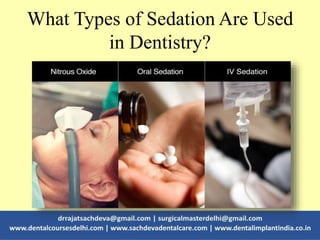
What Types of Sedation Are Used
in Dentistry?
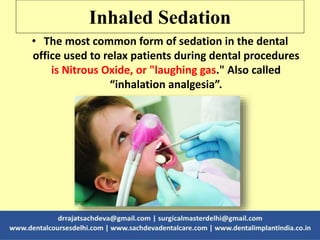
Inhaled Sedation
• The most common form of sedation in the dental
office used to relax patients during dental procedures
is Nitrous Oxide, or "laughing gas." Also called
“inhalation analgesia”.
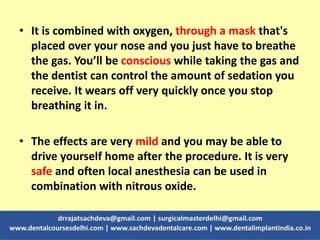
• It is combined with oxygen, through a mask that's
placed over your nose and you just have to breathe
the gas. You’ll be conscious while taking the gas and
the dentist can control the amount of sedation you
receive. It wears off very quickly once you stop
breathing it in.
• The effects are very mild and you may be able to
drive yourself home after the procedure. It is very
safe and often local anesthesia can be used in
combination with nitrous oxide.
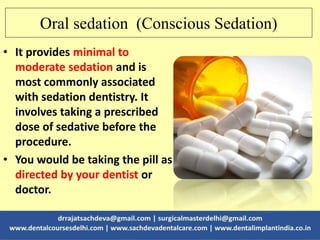
Oral sedation (Conscious Sedation)
• It provides minimal to
moderate sedation and is
most commonly associated
with sedation dentistry. It
involves taking a prescribed
dose of sedative before the
procedure.
• You would be taking the pill as
directed by your dentist or
doctor.
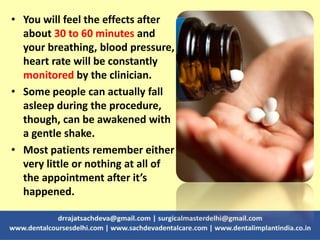
• You will feel the effects after
about 30 to 60 minutes and
your breathing, blood pressure,
heart rate will be constantly
monitored by the clinician.
• Some people can actually fall
asleep during the procedure,
though, can be awakened with
a gentle shake.
• Most patients remember either
very little or nothing at all of
the appointment after it’s
happened.
• Often recommended for people who have
higher levels of anxiety, benefit from this
type of dentistry.
• The sedative will leave you feeling sleepy, but
by the next day all the effects will have worn
off.
• You’ll need a ride home accompanying a
friend / family from the clinic.
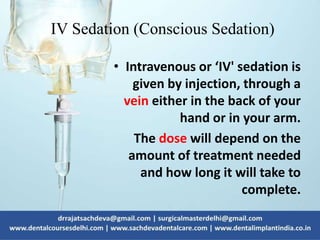
IV Sedation (Conscious Sedation)
• Intravenous or ‘IV' sedation is
given by injection, through a
vein either in the back of your
hand or in your arm.
The dose will depend on the
amount of treatment needed
and how long it will take to
complete.
• IV sedation is used for patients who have more
severe dental anxiety, special needs, or other health
issues. You become drowsy and are not aware of
having any treatment, but you are still able to co-
operate with the dentist.
• The effects take some time to wear off and your
dentist will tell you how long the drugs will take to
clear from your body. You need to have someone
bring them to and from their appointment and stay
with them for the remainder of the day won't be
able to drink alcohol, drive or work during this time.
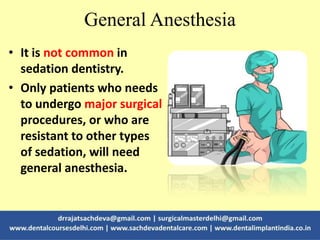
General Anesthesia
• It is not common in
sedation dentistry.
• Only patients who needs
to undergo major surgical
procedures, or who are
resistant to other types
of sedation, will need
general anesthesia.
• With general anesthesia, you’re totally
unconscious and cannot be easily awakened
until the effects of the anesthesia wear off or
are reversed with medication.
• This kind of sedation needs to happen in a
hospital or a specialized clinic with an
anesthesiologist administering the sedative
and monitoring your vital signs.
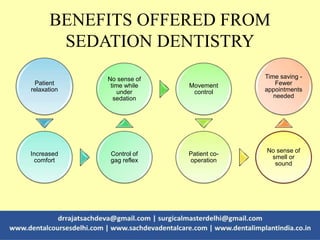
BENEFITS OFFERED FROM
SEDATION DENTISTRY
Patient
relaxation
Increased
comfort
Control of
gag reflex
No sense of
time while
under
sedation
Movement
control
Patient co-
operation
No sense of
smell or
sound
Time saving -
Fewer
appointments
needed
Side effects of conscious sedation
• Sedation may slow your breathing and the
you will be given oxygen for that.
• Your blood pressure may be affected and you
may get IV fluids to stabilize your blood
pressure.
• Because sedation effects may linger, you may
have a headache, nausea, and feel sleepy for
several hours.
Special Instructions after Sedation
• For your safety, a responsible adult must escort you
home. It is recommended that you have someone
with you for the remainder of the day until you are
fully alert.
• You will not be allowed to take a bus or taxicab
without a responsible adult to ride with you.
• Do not drive, drink alcohol, use machinery, or sign
legal documents for 24 hours after receiving sedation.
• Don’t perform any strenuous activities.
• Don’t eat a heavy meal immediately only light meals.
• Take any medications as directed by the clinician.
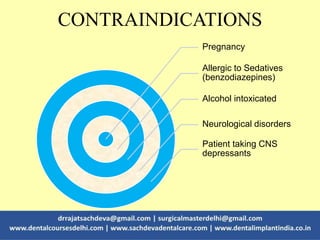
CONTRAINDICATIONS
Pregnancy
Allergic to Sedatives
(benzodiazepines)
Alcohol intoxicated
Neurological disorders
Patient taking CNS
depressants
How safe is sedation?
• Until and unless administered by experienced
professional, there is always some risk
associated with sedation.
• But when it’s, like our Dr Sachdeva’s Facial
Aesthetic Team, it is extremely safe.
• What are the drugs that are used?
• Benzodiazepine, usually midazolam, is used. A
typical IV session takes up to 1 1/2 hours.
• Is it necessary to be numbed with local
anaesthetic inspite of being sedated?
• In reality, the drugs which are usually used for
IV sedation are not painkillers. While they
relax you, you will still need to be numbed.
What if a person is needle phobic too ?
• If you are needle phobic there may be other
sedation options, like sublingual (under the
tongue) drugs, or inhalation sedation (nitrous
oxide inhalation).
• But all of this will depend on the medical
history of the patient and suitability to use
these sedation methods.
• How much is the cost for undergoing sedation
dentistry?
• The cost of sedation depends on the method
used for your treatment whichever suits you
best and medically apt for you.
• The team at Dr Sachdeva’s Dental Institute offers a
variety of anesthesia and sedation services for patients
undergoing dental treatments. If you have additional
questions you may contact ;
• Dr Sachdeva’s Dental Institute
• Clinic: 011-42464041
• Phone: +91 9818894041
• www.sachdevadentalcare.com
• www.dentalclinicindelhi.com
• www.dentalcoursesdelhi.com
• www.dentalimplantindia.co.in
• www.facialaestheticsdelhi.com
@dentalcoursesdelhi
drrajatsachdeva
drrajatsachdeva
drrajatsachdeva@surgicalmasterrajat
www.facialaestheticsdelhi.com
To book an appmt. contact
Dr.Rajat Sachdeva
Dr Sachdeva’s Dental
Aesthetic & Implant Institute
I 101, Ashok Vihar Phase 1,
Delhi- 110052
Contact us at
Phone : +919818894041
01142464041
www.facialaestheticsdelhi.com

Sedation in dentistry | Pediatric Sedation | Conscious Sedation

  • 1.
  • 2.
    Many people possessphobia for their dental procedures soo much that they are extremely vulnerable and possess extreme discomfort towards the treatment.
  • 3.
    • Sedation dentistryincludes techniques to either calm a patient before and during a dental procedure or to make patients more comfortable during long procedures. • The pharmacological agents (sedatives), depresses the central nervous system, specifically those areas concerned with conscious awareness.
  • 4.
    • Actually, youwill remain conscious during conscious sedation. You will also be able to understand and respond to requests. However, you may not remember much about the procedure.
  • 5.
    Phases Of Sedation •Minimal sedation - you are awake but relaxed. • Moderate sedation / Conscious sedation - you are awake but you speech is slurred, and you may or may not remember much of the procedure. • Deep sedation - you are asleep and can still breathe on your own but can't remember anything about the procedure afterwards. • General anesthesia - you are completely unconscious, your reflexes are absent and you need assistance in breathing.
  • 6.
    What Types ofSedation Are Used in Dentistry?
  • 7.
    Inhaled Sedation • Themost common form of sedation in the dental office used to relax patients during dental procedures is Nitrous Oxide, or "laughing gas." Also called “inhalation analgesia”.
  • 8.
    • It iscombined with oxygen, through a mask that's placed over your nose and you just have to breathe the gas. You’ll be conscious while taking the gas and the dentist can control the amount of sedation you receive. It wears off very quickly once you stop breathing it in. • The effects are very mild and you may be able to drive yourself home after the procedure. It is very safe and often local anesthesia can be used in combination with nitrous oxide.
  • 9.
    Oral sedation (ConsciousSedation) • It provides minimal to moderate sedation and is most commonly associated with sedation dentistry. It involves taking a prescribed dose of sedative before the procedure. • You would be taking the pill as directed by your dentist or doctor.
  • 10.
    • You willfeel the effects after about 30 to 60 minutes and your breathing, blood pressure, heart rate will be constantly monitored by the clinician. • Some people can actually fall asleep during the procedure, though, can be awakened with a gentle shake. • Most patients remember either very little or nothing at all of the appointment after it’s happened.
  • 11.
    • Often recommendedfor people who have higher levels of anxiety, benefit from this type of dentistry. • The sedative will leave you feeling sleepy, but by the next day all the effects will have worn off. • You’ll need a ride home accompanying a friend / family from the clinic.
  • 12.
    IV Sedation (ConsciousSedation) • Intravenous or ‘IV' sedation is given by injection, through a vein either in the back of your hand or in your arm. The dose will depend on the amount of treatment needed and how long it will take to complete.
  • 13.
    • IV sedationis used for patients who have more severe dental anxiety, special needs, or other health issues. You become drowsy and are not aware of having any treatment, but you are still able to co- operate with the dentist. • The effects take some time to wear off and your dentist will tell you how long the drugs will take to clear from your body. You need to have someone bring them to and from their appointment and stay with them for the remainder of the day won't be able to drink alcohol, drive or work during this time.
  • 14.
    General Anesthesia • Itis not common in sedation dentistry. • Only patients who needs to undergo major surgical procedures, or who are resistant to other types of sedation, will need general anesthesia.
  • 15.
    • With generalanesthesia, you’re totally unconscious and cannot be easily awakened until the effects of the anesthesia wear off or are reversed with medication. • This kind of sedation needs to happen in a hospital or a specialized clinic with an anesthesiologist administering the sedative and monitoring your vital signs.
  • 16.
    BENEFITS OFFERED FROM SEDATIONDENTISTRY Patient relaxation Increased comfort Control of gag reflex No sense of time while under sedation Movement control Patient co- operation No sense of smell or sound Time saving - Fewer appointments needed
  • 17.
    Side effects ofconscious sedation • Sedation may slow your breathing and the you will be given oxygen for that. • Your blood pressure may be affected and you may get IV fluids to stabilize your blood pressure. • Because sedation effects may linger, you may have a headache, nausea, and feel sleepy for several hours.
  • 18.
    Special Instructions afterSedation • For your safety, a responsible adult must escort you home. It is recommended that you have someone with you for the remainder of the day until you are fully alert. • You will not be allowed to take a bus or taxicab without a responsible adult to ride with you. • Do not drive, drink alcohol, use machinery, or sign legal documents for 24 hours after receiving sedation. • Don’t perform any strenuous activities. • Don’t eat a heavy meal immediately only light meals. • Take any medications as directed by the clinician.
  • 19.
    CONTRAINDICATIONS Pregnancy Allergic to Sedatives (benzodiazepines) Alcoholintoxicated Neurological disorders Patient taking CNS depressants
  • 20.
    How safe issedation? • Until and unless administered by experienced professional, there is always some risk associated with sedation. • But when it’s, like our Dr Sachdeva’s Facial Aesthetic Team, it is extremely safe.
  • 21.
    • What arethe drugs that are used? • Benzodiazepine, usually midazolam, is used. A typical IV session takes up to 1 1/2 hours. • Is it necessary to be numbed with local anaesthetic inspite of being sedated? • In reality, the drugs which are usually used for IV sedation are not painkillers. While they relax you, you will still need to be numbed.
  • 22.
    What if aperson is needle phobic too ? • If you are needle phobic there may be other sedation options, like sublingual (under the tongue) drugs, or inhalation sedation (nitrous oxide inhalation). • But all of this will depend on the medical history of the patient and suitability to use these sedation methods.
  • 23.
    • How muchis the cost for undergoing sedation dentistry? • The cost of sedation depends on the method used for your treatment whichever suits you best and medically apt for you.
  • 24.
    • The teamat Dr Sachdeva’s Dental Institute offers a variety of anesthesia and sedation services for patients undergoing dental treatments. If you have additional questions you may contact ; • Dr Sachdeva’s Dental Institute • Clinic: 011-42464041 • Phone: +91 9818894041 • www.sachdevadentalcare.com • www.dentalclinicindelhi.com • www.dentalcoursesdelhi.com • www.dentalimplantindia.co.in • www.facialaestheticsdelhi.com
  • 25.
  • 26.
    To book anappmt. contact Dr.Rajat Sachdeva Dr Sachdeva’s Dental Aesthetic & Implant Institute I 101, Ashok Vihar Phase 1, Delhi- 110052 Contact us at Phone : +919818894041 01142464041
  • 27.