9
This presentation is owned by
ABUL KALAM AZAD PATWARY
“for class 9-10[accounting]”
What is a Trial Balance?
Trial Balance is a list of closing balances of ledger
accounts on a certain date and is the first step towards
the preparation of financial statements. It is usually
prepared at the end of an accounting period to assist
in the drafting of financial statements. Ledger
balances are segregated into debit balances and credit
balances. Asset and expense accounts appear on the
debit side of the trial balance whereas liabilities,
capital and income accounts appear on the credit side.
If all accounting entries are recorded correctly and all
the ledger balances are accurately extracted, the total
of all debit balances appearing in the trial balance
must equal to the sum of all credit balances.
Purpose of a Trial Balance
1) Trial Balance acts as the first step in the preparation of
financial statements. It is a working paper that accountants use as
a basis while preparing financial statements.
2) Trial balance ensures that for every debit entry recorded, a
corresponding credit entry has been recorded in the books in
accordance with the double entry concept of accounting. If the
totals of the trial balance do not agree, the differences may be
investigated and resolved before financial statements are
prepared. Rectifying basic accounting errors can be a much
lengthy task after the financial statements have been prepared
because of the changes that would be required to correct the
financial statements.
3) Trial balance ensures that the account balances are accurately
extracted from accounting ledgers.
4) Trail balance assists in the identification and rectification of
errors.
FEATURES OF TRAIL BALANCES
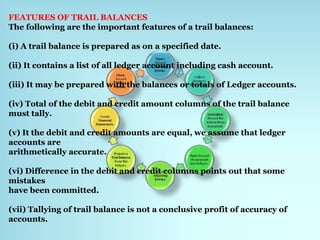
The following are the important features of a trail balances:
(i) A trail balance is prepared as on a specified date.
(ii) It contains a list of all ledger account including cash account.
(iii) It may be prepared with the balances or totals of Ledger accounts.
(iv) Total of the debit and credit amount columns of the trail balance
must tally.
(v) It the debit and credit amounts are equal, we assume that ledger
accounts are
arithmetically accurate.
(vi) Difference in the debit and credit columns points out that some
mistakes
have been committed.
(vii) Tallying of trail balance is not a conclusive profit of accuracy of
accounts.
LIMITATIONS OF TRAIL BALANCE
The following are the important limitations of trail balances:
(i) The trail balance can be prepared only in those concerns
where double entry system of book- keeping is adopted. This
system is too costly.
(ii) A trail balance is not a conclusive proof of the
arithmetical accuracy of the books of account. It the trail
balance agrees, it does not mean that now there are
absolutely no errors in books. On the other hand, some
errors are not disclosed by the trail balance.
(iii) It the trail balance is wrong, the subsequent preparation
of Trading, P&L Account and Balance Sheet will not reflect
the true picture of the concern.
METHODS OF PREPARING TRAIL BALANCE
A trail balance refers to a list of the ledger balances as on a
particular date. It can be prepared in the following manner:
Total Method
According to this method, debit total and credit total of each
account of ledger are recorded in the trail balance.
Balance Method
According to this method, only balance of each account of ledger is
recordedin trail balance. Some accounts may have debit balance
and the other may have credit
balance. All these debit and credit balances are recorded in it. This
method is widely
used.
Trial Balance disclosed by the Errors
i) Wrong totaling of subsidiary books
ii) Posting of an amount on the wrong
side
iii) Omission to post an amount into
ledger
iv) Double posting or omission of posting
v) Posting wrong amount
vi) Error in balancing
Trail Balance not disclosed by the
Errors
i) Error of principle
ii) Error of omission
iii) Errors of Commission
iv) Recording wrong amount in the
books of original entry
v) Compensating errors
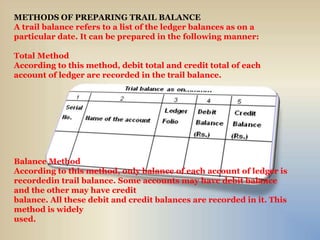
Brief explanation of different columns of a trial balance is
given below:
1. Serial/Code No.: If there is any code no. of accounts then those code
no. is put, otherwise the serial no. of ledger accounts are written in this
column. Such as 1, 2, 3 etc.
2. Name of the Accounts/ Particulars: The full name of ledger
accounts whose serial numbers have been written in the first column are
put in this column. Such as, capital, furniture, cash etc.
3. L.F. (Ledger Folio): The page/pages of the ledger, where the
balances of the concerned accounts are shown, are written in this
column. By doing so errors can easily be identified and rectified.
4. Debit Balance: The amounts of the debit balances of the ledger
accounts are written in this column.
5. Credit Balance: The amounts of the credit balances of the ledger
accounts are written in this column.
Errors which are not disclosed by a Trial Balance/Limitations of a Trial
Balance
The following errors cannot be detected by a Trial Balance :
(a)Errors of Ommission : When the transaction is not at all recorded in
the books of accounts,
i.e. neither in the debit sider nor in the credit side of the account –
trial balance will agree.
(b) Errors of Commission : Where there is any variation in
figure/amount, e.g. instead of Rs.
800 either Rs. 80 or Rs. 8,000 is recorded, in both sides of ledger
accounts – trial balance
will agree.
(c) Errors of Principal : Where wrong posting is made in the books of
accounts, i.e. accounts
are prepared not according to double entry principle e.g. Purchased a
Plant wrongly
debited to Purchase Account – Trial balance will agree.
ERRORS NOT DETECTED BY TRIALBALANCE
d) Errors of Misposting : When wrong posting is made to a wrong
account instead of a
correct one although amount is correctly recorded, e.g., sold goods
to B but wrongly
debited to D’s Account – trial balance will agree.
(e) Compensating Errors : When one error is compensated by
another error e.g. Discount
allowed Rs. 100 not debited to discount allowed account, whereas
interest received Rs.
100, but not credit to Interest Account – trial balance will agree.
Errors which are disclosed by a Trial
Balance/Advantages of a Trial Balance
It has already been stated earlier that Trial Balance is a way to test the
arithmetical accuracy of the records in the books of accounts. If any error,
whether clerical or otherwise, exists in the books of accounts the same
will cause for disagreement of a Trial Balance. The following errors may
be noted :
(i) Wrong Posting : Posting on the wrong side of an account and posting of
a wrong amount in a ledger account, will cause disagreement of Trial
Balance.
(ii) Omission of Posting : Omission of posting of an entry from the
subsidiary Book will cause disagreement.
(iii) Errors in casting or Totalling : Errors in casting or totalling or
totalling of subsidiary books of accounts will cause disagreement.
(iv) Errors in Balancing : If any errors arises as a result of balancing of an
amount, the same will cause disagreements.
(v) Double Posting : If any item is posted twice in a ledger account from a
subsidiary book, the same will create disagreement.
Is Trial Balance indispensable ?
It is a mere statement prepared by the accountants for
his own convenience and if it agrees, it is assumed that
at least arithmetical accuracy has been done although
there may be
a lot of errors.
Trial Balance is not a process of accounts. But its
preparation helps us to finalize the accounts.
Since it is prepared on a particular date, as at ........ / as
on ........ is stated.
Preparation of a Trial Balance
1. It may be prepared on a loose sheet of paper.
2. The ledger accounts are balanced at first. They
will have either “debit-balance” or “credit
balance” or “nil-balance”.
3. The accounts having debit-balance is written on
the debit column and those having credit balance
are written on the credit coloumn.
4.The sum total of both the balances must be equal,
for “Every debit has its corresponding and equal
credit”.
Summary of Rules
Debit Balance — All
Assets, Drawings,
Debtors, Expenses and
losses.
Credit Balance — All
liabilities, Capital,
Creditors, Gains and
Incomes.
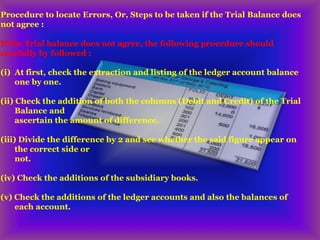
Procedure to locate Errors, Or, Steps to be taken if the Trial Balance does
not agree :
If the Trial balance does not agree, the following procedure should
carefully by followed :
(i) At first, check the extraction and listing of the ledger account balance
one by one.
(ii) Check the addition of both the columns (Debit and Credit) of the Trial
Balance and
ascertain the amount of difference.
(iii) Divide the difference by 2 and see whether the said figure appear on
the correct side or
not.
(iv) Check the additions of the subsidiary books.
(v) Check the additions of the ledger accounts and also the balances of
each account.
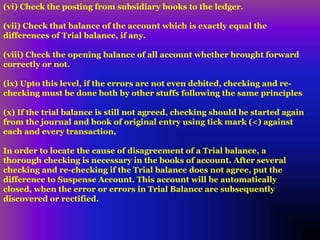
(vi) Check the posting from subsidiary books to the ledger.
(vii) Check that balance of the account which is exactly equal the
differences of Trial balance, if any.
(viii) Check the opening balance of all account whether brought forward
correctly or not.
(ix) Upto this level, if the errors are not even debited, checking and re-
checking must be done both by other stuffs following the same principles
(x) If the trial balance is still not agreed, checking should be started again
from the journal and book of original entry using tick mark (<) against
each and every transaction,
In order to locate the cause of disagreement of a Trial balance, a
thorough checking is necessary in the books of account. After several
checking and re-checking if the Trial balance does not agree, put the
difference to Suspense Account. This account will be automatically
closed, when the error or errors in Trial Balance are subsequently
discovered or rectified.
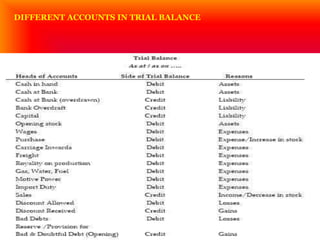
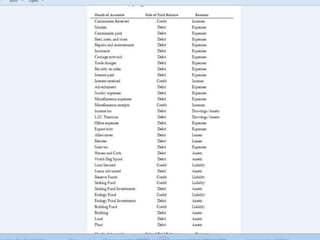
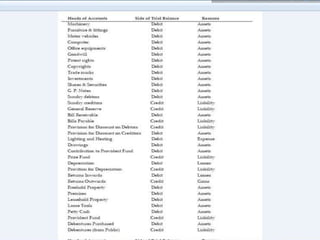
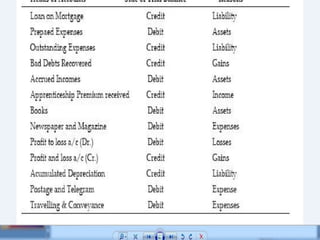
DIFFERENT ACCOUNTS IN TRIAL BALANCE
SUSPENSE ACCOUNT
A suspense account is an account in the
general ledger that temporarily stores any
transactions for which there is uncertainty
about the account in which they should be
recorded. Once the accounting staff
investigates and clarifies the purpose of this
type of transaction, it shifts the transaction
out of the suspense account and into the
correct account(s). An entry into a suspense
account may be a debit or a credit.
It is useful to have a suspense account, rather
than not recording transactions at all until there
is sufficient information available to create an
entry to the correct account(s). Otherwise, larger
unreported transactions may not be recorded by
the end of a reporting period, resulting in
inaccurate financial results.
For example, a customer sends in a payment for $1,000
but does not specify which open invoices it intends to
pay. Until the accounting staff can ascertain which
invoices to charge, it temporarily parks the $1,000 in
the suspense account. In this case, the initial entry to
place the funds in the suspense account is:
CASH A/C ---- DR
SUSPENSE A/C ----CR
Accounting chapter-9

Accounting chapter-9

  • 2.
    9 This presentation isowned by ABUL KALAM AZAD PATWARY “for class 9-10[accounting]”
  • 3.
    What is aTrial Balance? Trial Balance is a list of closing balances of ledger accounts on a certain date and is the first step towards the preparation of financial statements. It is usually prepared at the end of an accounting period to assist in the drafting of financial statements. Ledger balances are segregated into debit balances and credit balances. Asset and expense accounts appear on the debit side of the trial balance whereas liabilities, capital and income accounts appear on the credit side. If all accounting entries are recorded correctly and all the ledger balances are accurately extracted, the total of all debit balances appearing in the trial balance must equal to the sum of all credit balances.
  • 4.
    Purpose of aTrial Balance 1) Trial Balance acts as the first step in the preparation of financial statements. It is a working paper that accountants use as a basis while preparing financial statements. 2) Trial balance ensures that for every debit entry recorded, a corresponding credit entry has been recorded in the books in accordance with the double entry concept of accounting. If the totals of the trial balance do not agree, the differences may be investigated and resolved before financial statements are prepared. Rectifying basic accounting errors can be a much lengthy task after the financial statements have been prepared because of the changes that would be required to correct the financial statements. 3) Trial balance ensures that the account balances are accurately extracted from accounting ledgers. 4) Trail balance assists in the identification and rectification of errors.
  • 5.
    FEATURES OF TRAILBALANCES The following are the important features of a trail balances: (i) A trail balance is prepared as on a specified date. (ii) It contains a list of all ledger account including cash account. (iii) It may be prepared with the balances or totals of Ledger accounts. (iv) Total of the debit and credit amount columns of the trail balance must tally. (v) It the debit and credit amounts are equal, we assume that ledger accounts are arithmetically accurate. (vi) Difference in the debit and credit columns points out that some mistakes have been committed. (vii) Tallying of trail balance is not a conclusive profit of accuracy of accounts.
  • 6.
    LIMITATIONS OF TRAILBALANCE The following are the important limitations of trail balances: (i) The trail balance can be prepared only in those concerns where double entry system of book- keeping is adopted. This system is too costly. (ii) A trail balance is not a conclusive proof of the arithmetical accuracy of the books of account. It the trail balance agrees, it does not mean that now there are absolutely no errors in books. On the other hand, some errors are not disclosed by the trail balance. (iii) It the trail balance is wrong, the subsequent preparation of Trading, P&L Account and Balance Sheet will not reflect the true picture of the concern.
  • 7.
    METHODS OF PREPARINGTRAIL BALANCE A trail balance refers to a list of the ledger balances as on a particular date. It can be prepared in the following manner: Total Method According to this method, debit total and credit total of each account of ledger are recorded in the trail balance. Balance Method According to this method, only balance of each account of ledger is recordedin trail balance. Some accounts may have debit balance and the other may have credit balance. All these debit and credit balances are recorded in it. This method is widely used.
  • 8.
    Trial Balance disclosedby the Errors i) Wrong totaling of subsidiary books ii) Posting of an amount on the wrong side iii) Omission to post an amount into ledger iv) Double posting or omission of posting v) Posting wrong amount vi) Error in balancing
  • 9.
    Trail Balance notdisclosed by the Errors i) Error of principle ii) Error of omission iii) Errors of Commission iv) Recording wrong amount in the books of original entry v) Compensating errors
  • 10.
    Brief explanation ofdifferent columns of a trial balance is given below: 1. Serial/Code No.: If there is any code no. of accounts then those code no. is put, otherwise the serial no. of ledger accounts are written in this column. Such as 1, 2, 3 etc. 2. Name of the Accounts/ Particulars: The full name of ledger accounts whose serial numbers have been written in the first column are put in this column. Such as, capital, furniture, cash etc. 3. L.F. (Ledger Folio): The page/pages of the ledger, where the balances of the concerned accounts are shown, are written in this column. By doing so errors can easily be identified and rectified. 4. Debit Balance: The amounts of the debit balances of the ledger accounts are written in this column. 5. Credit Balance: The amounts of the credit balances of the ledger accounts are written in this column.
  • 11.
    Errors which arenot disclosed by a Trial Balance/Limitations of a Trial Balance The following errors cannot be detected by a Trial Balance : (a)Errors of Ommission : When the transaction is not at all recorded in the books of accounts, i.e. neither in the debit sider nor in the credit side of the account – trial balance will agree. (b) Errors of Commission : Where there is any variation in figure/amount, e.g. instead of Rs. 800 either Rs. 80 or Rs. 8,000 is recorded, in both sides of ledger accounts – trial balance will agree. (c) Errors of Principal : Where wrong posting is made in the books of accounts, i.e. accounts are prepared not according to double entry principle e.g. Purchased a Plant wrongly debited to Purchase Account – Trial balance will agree. ERRORS NOT DETECTED BY TRIALBALANCE
  • 12.
    d) Errors ofMisposting : When wrong posting is made to a wrong account instead of a correct one although amount is correctly recorded, e.g., sold goods to B but wrongly debited to D’s Account – trial balance will agree. (e) Compensating Errors : When one error is compensated by another error e.g. Discount allowed Rs. 100 not debited to discount allowed account, whereas interest received Rs. 100, but not credit to Interest Account – trial balance will agree.
  • 13.
    Errors which aredisclosed by a Trial Balance/Advantages of a Trial Balance It has already been stated earlier that Trial Balance is a way to test the arithmetical accuracy of the records in the books of accounts. If any error, whether clerical or otherwise, exists in the books of accounts the same will cause for disagreement of a Trial Balance. The following errors may be noted : (i) Wrong Posting : Posting on the wrong side of an account and posting of a wrong amount in a ledger account, will cause disagreement of Trial Balance. (ii) Omission of Posting : Omission of posting of an entry from the subsidiary Book will cause disagreement. (iii) Errors in casting or Totalling : Errors in casting or totalling or totalling of subsidiary books of accounts will cause disagreement. (iv) Errors in Balancing : If any errors arises as a result of balancing of an amount, the same will cause disagreements. (v) Double Posting : If any item is posted twice in a ledger account from a subsidiary book, the same will create disagreement.
  • 14.
    Is Trial Balanceindispensable ? It is a mere statement prepared by the accountants for his own convenience and if it agrees, it is assumed that at least arithmetical accuracy has been done although there may be a lot of errors. Trial Balance is not a process of accounts. But its preparation helps us to finalize the accounts. Since it is prepared on a particular date, as at ........ / as on ........ is stated.
  • 15.
    Preparation of aTrial Balance 1. It may be prepared on a loose sheet of paper. 2. The ledger accounts are balanced at first. They will have either “debit-balance” or “credit balance” or “nil-balance”. 3. The accounts having debit-balance is written on the debit column and those having credit balance are written on the credit coloumn. 4.The sum total of both the balances must be equal, for “Every debit has its corresponding and equal credit”.
  • 16.
    Summary of Rules DebitBalance — All Assets, Drawings, Debtors, Expenses and losses. Credit Balance — All liabilities, Capital, Creditors, Gains and Incomes.
  • 17.
    Procedure to locateErrors, Or, Steps to be taken if the Trial Balance does not agree : If the Trial balance does not agree, the following procedure should carefully by followed : (i) At first, check the extraction and listing of the ledger account balance one by one. (ii) Check the addition of both the columns (Debit and Credit) of the Trial Balance and ascertain the amount of difference. (iii) Divide the difference by 2 and see whether the said figure appear on the correct side or not. (iv) Check the additions of the subsidiary books. (v) Check the additions of the ledger accounts and also the balances of each account.
  • 18.
    (vi) Check theposting from subsidiary books to the ledger. (vii) Check that balance of the account which is exactly equal the differences of Trial balance, if any. (viii) Check the opening balance of all account whether brought forward correctly or not. (ix) Upto this level, if the errors are not even debited, checking and re- checking must be done both by other stuffs following the same principles (x) If the trial balance is still not agreed, checking should be started again from the journal and book of original entry using tick mark (<) against each and every transaction, In order to locate the cause of disagreement of a Trial balance, a thorough checking is necessary in the books of account. After several checking and re-checking if the Trial balance does not agree, put the difference to Suspense Account. This account will be automatically closed, when the error or errors in Trial Balance are subsequently discovered or rectified.
  • 19.
    DIFFERENT ACCOUNTS INTRIAL BALANCE
  • 23.
    SUSPENSE ACCOUNT A suspenseaccount is an account in the general ledger that temporarily stores any transactions for which there is uncertainty about the account in which they should be recorded. Once the accounting staff investigates and clarifies the purpose of this type of transaction, it shifts the transaction out of the suspense account and into the correct account(s). An entry into a suspense account may be a debit or a credit.
  • 24.
    It is usefulto have a suspense account, rather than not recording transactions at all until there is sufficient information available to create an entry to the correct account(s). Otherwise, larger unreported transactions may not be recorded by the end of a reporting period, resulting in inaccurate financial results. For example, a customer sends in a payment for $1,000 but does not specify which open invoices it intends to pay. Until the accounting staff can ascertain which invoices to charge, it temporarily parks the $1,000 in the suspense account. In this case, the initial entry to place the funds in the suspense account is: CASH A/C ---- DR SUSPENSE A/C ----CR