PA9.3
DESCRIBE THE HLA SYSTEM & THE IMMUNE
PRINCIPLES INVOLVED IN TRANSPLANT &
MECHANISM OF TRANSPLANT REJECTION
Dr IRA BHARADWAJ
MCI TEACHER ID: PAT 2300569
KUHS FACULTY ID: M21512
TEXT BOOK REFRENCES
• ROBBINS BASIC PATHOLOGY
• HARSH MOHAN TEXTBOOK OF PATHOLOGY
• SELF ASSESSMENT & REVIEW OF PATHOLOGY BY ARVIND ARORA
• TEXTBOOK OF MICROBIOLOGY BY DR C P BAVEJA
• OTHER STANDARD REFRENCES
SPECIFIC LEARNING OBJECTIVES
• ROLE OF HLA / MHC IN IMMUNITY
• ROLE OF HLA A,B,D [MHC 1&2] IN IMMUNITY
• TYPES OF TRANSPLANTED GRAFTS
• ALLOGRAFTS
• TYPES OF TRANSPLANT REJECTIONS
• PATHOGENESIS OF SOLID ORGAN REJECTION
• TYPES OF SOLID ORGAN REJECTION
• GRAFT VS HOST DISEASE
• TYPES OF GVHD
• MCQs
HLA / MHC
Major Histocompatibility Complex
• MHC is a genetic “LOCUS” on Chromosome 6p, which codes
for cell surface compatibility i.e., they regulate expression of
cell surface antigen
• Also called HLA (Human Leukocyte Antigens) in humans and
H-2 in mice
• It’s major job is to make sure all self cell antigens are
recognized and “tolerated”, because the general rule of the
immune system is that all UN-recognized cells will NOT be
tolerated
MHC MOLECULES
(Gene Products)
HLA A & B [MHC 1]
• Expressed on all nucleated cells and platelets on the surface
of the cell,
• It is a glycoprotein & antigenic.
•T8 lymphocytes recognize & interact with it to
become activated & cause cytolysis
• They are involved in graft rejection
MHC MOLECULES
(Gene Products)
HLA D [MHC II]
• Expressed on all APC’s, i.e., Langerhans cells, macrophages,
dendritic cells & B lymphocytes on cell surface
• It is a glycoprotein & antigenic
•T4 lymphocytes interact with it and are activated
immunologically
• It is primarily responsible for graft vs host disease
TYPES OF GRAFTS [TRANSPLANTS]
• AUTOGRAFT ( autogenic ) – graft from self eg, skin grafting
• ISOGRAFT ( syngraft ) – graft from identical twin
• ALLOGRAFT ( homograft ) - graft from genetically unrelated
member of same species
• XENOGRAFT( heterograft ) – graft from different species
ALLOGRAFT
• Allograft is the most commonly performed transplant
procedure
• Main problem of this procedure is rejection of the
transplanted tissue
• Most common transplanted organ is kidney
TRANSPLANT REJECTION
Two main types of rejections occur
• GRAFT REJECTION BY HOST seen in solid organ transplant
e.g. kidney
• HOST REJECTION BY GRAFT known as GRAFT Vs HOST
DISEASE ( GVHS ) occurs in hematopoietic tissue transplant
e.g. bone marrow
REJECTION OF TRANSPLANT [SOLID ORGAN]
PATHOGENESIS
• PRESENCE OF PREFORMED ANTI DONOR ANTIBODIES
• RECOGNITION OF FOREIGN MHC MOLECULES ON GRAFT BY
HOST IMMUNE SYSTEM
DIRECT RECOGNITION via DONOR MHC
INDIRECT RECOGNITION VIA HOST APC
REJECTION OF SOLID ORGAN TRANSPLANT
PREFORMED ANTI DONOR ANTIBODIES
PRESENCE OF PREFORMED ANTI DONOR ANTIBODIES ARE
SEEN IN:
• Pre transfused host
• Multiparous women
• Patient with previously rejected transplant
REJECTION OF SOLID ORGAN TRANSPLANT
DIRECT RECOGNITION via DONOR MHC
DIRECT RECOGNITION OF FOREIGN MHC MOLECULES ON
GRAFT BY HOST IMMUNE SYSTEM
DIRECT RECOGNITION – via donor MHC 1 on all nucleated
donor cells
MHC I (HLA-A,B) on donor cells is
• Recognized directly by CD8+TL of host,
• Which are then activated to form cytotoxic T lymphocytes
[CTL],
• Causing apoptosis of donor cells
REJECTION OF SOLID ORGAN TRANSPLANT
DIRECT RECOGNITION via DONOR MHC
DIRECT RECOGNITION OF FOREIGN MHC MOLECULES ON
GRAFT BY HOST IMMUNE SYSTEM
DIRECT RECOGNITION – via donor MHC II on all donor antigen
presenting cells
MHC II (HLA-D) on donor APC cells - Directly activate CD4+TL
of host, leading to production of:
• Cytokines and
• Activation of BL to produce antibodies against donor cells
• This causes necrosis & inflammation of donor tissue
REJECTION OF SOLID ORGAN TRANSPLANT
INDIRECT RECOGNITION via HOST APC
INDIRECT RECOGNITION OF FOREIGN ANTIGENS ON GRAFT
BY HOST ANTIGEN PRESENTING CELLS
Donor antigens, which are foreign to the host are picked up
by host APC (dendritic cells, macrophages & B Lymphocytes)
• Leading to activation of host immune system
• Especially via CD4+TL, which secrete cytokines & enhance
antibody production
• Leading to necrosis & inflammation of graft tissue
REJECTION OF SOLID ORGAN TRANSPLANT
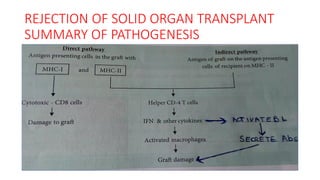
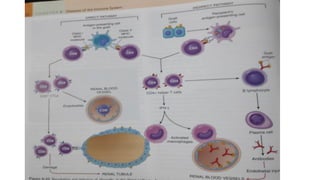
SUMMARY OF PATHOGENESIS
REJECTION OF SOLID ORGAN TRANSPLANT
ROLE OF CD 8+ T LYMPHOCYTES
CD8+TL ARE IMMUNOLOGICALLY ACTIVATED TO TRANSFORM
INTO CYTOTOXIC T LYMPHOCYTES, WHICH RESULT IN:
• Apoptosis / necrosis of donor parenchymal cells
• Apoptosis / necrosis vascular endothelium [donor tissue],
leading to
• Thrombosis & ischemia
• All above factors contribute to necrosis of graft i.e., rejection
of graft
REJECTION OF SOLID ORGAN TRANSPLANT
ROLE OF CD 4+ T LYMPHOCYTES
CD4+TL ARE IMMUNOLOGICALLY ACTIVATED AND
TRANSFORM INTO VARIOUS SUBSETS LIKE Th 1 & Th 17
Activated Th1 &17 subsets leads to type 4 [delayed type of]
hypersensitivity reaction, as well as activation of B
lymphocytes to produce antibodies
• DTH & PROLONGED DTH lead to inflammation & granuloma
formation
• ANTIBODIES formed against donor vascular endothelium are
most important and lead to type 2&3 hypersensitivity
reactions, which activate complement – inflammation -
TYPES OF SOLID ORGAN [KIDNEY] REJECTION
• HYPERACUTE
• ACUTE
• SUBACUTE
• CHRONIC
HYPERACUTE REJECTION
• Occurs due to preformed anti donor antibodies in recipient,
rare now due to screening of recipient Abs for donor Ags
• It is seen within minutes of vascular anastomosis
• Kidney is cyanotic, mottled & flaccid, no urine/ few drops of
hemorrhagic fluid may be excreted
• Histology – all vessels show acute fibrinoid necrosis,
precipitate of fibrin & cellular debris is seen in lumen of
blood vessels
ACUTE REJECTION
OCCURS WITHIN DAYS DUE TO CELLULAR & HUMORAL
REACTIONS
CELLULAR RECATIONS
CD8+TL & CD4+TL ( DTH ) reaction, leading to
• Endothelitis of glomerular & peritubular capillaries,
• Infiltration by lymphocytes,
• Edema & hemorrhage,
• Necrosis of tubular cells, causing acute renal failure [ARF]
ACUTE REJECTION
HUMORAL REACTION
Type 2 &3 hypersensitivity reactions due to anti donor
antibodies, leading to
• ACUTE NECROTIZING VASCULITIS – Ag-Ab complexes
deposited in wall of BV cause
• Necrosis & inflammation, followed by
• Thrombosis & consequent ischemia, which leads to
• Atrophy & necrosis of graft
SUB ACUTE REJECTION
More frequently due to Ag-Ab COMPLEX (type III
hypersensitivity reaction) which lead to
• Inflammation &
• Cytokines which cause proliferation of fibroblasts, myocytes
in BVs,
• Narrowing the vascular lumen, leading to ischemia, atrophy
& infarction of graft
D/D OF REJECTION
• Cyclosporine toxicity which shows arteriolar hyaline
deposits in renal biopsy, may also present with similar
clinical features & should be considered in D/D of acute
rejection
• Arteriosclerosis is an important D/D of sub acute rejection
& can be distinguished by renal biopsy which shows
presence of complement breakdown products, like C4d in
rejection
CHRONIC REJECTION
Appears much later, after many months & years
• It is due to cytokines, which cause
• Proliferation of vascular intimal smooth muscles & increased
extracellular matrix
• Narrowing of lumen of BV – decreased blood flow & slow
ischemia, resulting in
• Atrophy & fibrosis of glomeruli, tubules & interstium, leading
to chronic renal failure[CRF]
METHODS OF IMPROVING GRAFT SURVIVAL
• SCREENING RECIPIENT BLOOD FOR PREFORMED DONOR
ANTIBODIES
• HLA MATCHING OF RECIPIENT & DONOR (HLA controls
expression of MHC I & II )
• IMMUNOSUPPRESSIVE THERAPY – main side effects are
infections & tumors
GRAFT Vs HOST DISEASE
• IMMUNOCOMPETENT DONOR T LYMPHOCYTES [CD 4&8]
PERCEIVE RECIPIENT (HOST) Ags AS FORGIEN & REACT
• HOST IS IMMUNOCOMPROMISED, NO HOST REACTION TO
DONOR CELLS
[before hematopoietic transplant , host is immune depleted]
GRAFT Vs HOST DISEASE
ACUTE GVHD – (days to wks) – epithelial necrosis in gut, skin,
liver
CHRONIC GVHD – (late) characterized by
• Autoimmune diseases
• Immunodeficiency
MCQ
HLA-I present on
a)All nucleated cells b) Only on cells of immune system
c) Only on B- cells d) Only on T-cells
Grafting done between genetically different individuals of the
same species is
a)Autograft b) Allograft
c) Isograft d) Xenograft
MCQ
Preformed antibodies cause
a) Hyperacute rejection b) Acute rejection
c) Chronic rejection d) Acute humoral rejection
Graft rejection is
a) Cell mediated b) Humoral c) Both
d) none
MCQ
Cell responsible for GVHD is
a) Immunocompetent T cell donor
b) Immunocompetent T cell recipient
c) Immunocompetent B cell donor
d) Immunocompetent B cell recipient
MCQ
Cyclosporine toxicity, following renal transplant; presents as
a) acute renal failure
b) Chronic renal failure
c) Fibrinoid necrosis
d) Coagulative necrosis
MCQ
Type of necrosis seen in transplant rejection is
a) Coagulative necrosis
b) Fat necrosis
c) Fibrinoid necrosis
d) Liquefactive necrosis
MCQ
Chronic solid organ transplant rejection is due to
a) Antibodies
b) Cytokines
c) Chemokines
d) Antigens
MCQ
MHC II is present on all except
a) Langerhans cell
b) Langhans cell
c) Macrophage
d) Dendritic cell
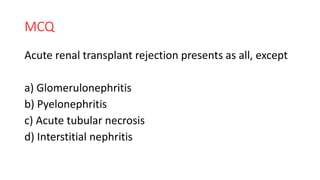
MCQ
Acute renal transplant rejection presents as all, except
a) Glomerulonephritis
b) Pyelonephritis
c) Acute tubular necrosis
d) Interstitial nephritis

TRANSPLANT REJECTION - TYPES & MECHANISM

  • 1.
    PA9.3 DESCRIBE THE HLASYSTEM & THE IMMUNE PRINCIPLES INVOLVED IN TRANSPLANT & MECHANISM OF TRANSPLANT REJECTION Dr IRA BHARADWAJ MCI TEACHER ID: PAT 2300569 KUHS FACULTY ID: M21512
  • 2.
    TEXT BOOK REFRENCES •ROBBINS BASIC PATHOLOGY • HARSH MOHAN TEXTBOOK OF PATHOLOGY • SELF ASSESSMENT & REVIEW OF PATHOLOGY BY ARVIND ARORA • TEXTBOOK OF MICROBIOLOGY BY DR C P BAVEJA • OTHER STANDARD REFRENCES
  • 3.
    SPECIFIC LEARNING OBJECTIVES •ROLE OF HLA / MHC IN IMMUNITY • ROLE OF HLA A,B,D [MHC 1&2] IN IMMUNITY • TYPES OF TRANSPLANTED GRAFTS • ALLOGRAFTS • TYPES OF TRANSPLANT REJECTIONS • PATHOGENESIS OF SOLID ORGAN REJECTION • TYPES OF SOLID ORGAN REJECTION • GRAFT VS HOST DISEASE • TYPES OF GVHD • MCQs
  • 4.
    HLA / MHC MajorHistocompatibility Complex • MHC is a genetic “LOCUS” on Chromosome 6p, which codes for cell surface compatibility i.e., they regulate expression of cell surface antigen • Also called HLA (Human Leukocyte Antigens) in humans and H-2 in mice • It’s major job is to make sure all self cell antigens are recognized and “tolerated”, because the general rule of the immune system is that all UN-recognized cells will NOT be tolerated
  • 5.
    MHC MOLECULES (Gene Products) HLAA & B [MHC 1] • Expressed on all nucleated cells and platelets on the surface of the cell, • It is a glycoprotein & antigenic. •T8 lymphocytes recognize & interact with it to become activated & cause cytolysis • They are involved in graft rejection
  • 6.
    MHC MOLECULES (Gene Products) HLAD [MHC II] • Expressed on all APC’s, i.e., Langerhans cells, macrophages, dendritic cells & B lymphocytes on cell surface • It is a glycoprotein & antigenic •T4 lymphocytes interact with it and are activated immunologically • It is primarily responsible for graft vs host disease
  • 7.
    TYPES OF GRAFTS[TRANSPLANTS] • AUTOGRAFT ( autogenic ) – graft from self eg, skin grafting • ISOGRAFT ( syngraft ) – graft from identical twin • ALLOGRAFT ( homograft ) - graft from genetically unrelated member of same species • XENOGRAFT( heterograft ) – graft from different species
  • 8.
    ALLOGRAFT • Allograft isthe most commonly performed transplant procedure • Main problem of this procedure is rejection of the transplanted tissue • Most common transplanted organ is kidney
  • 9.
    TRANSPLANT REJECTION Two maintypes of rejections occur • GRAFT REJECTION BY HOST seen in solid organ transplant e.g. kidney • HOST REJECTION BY GRAFT known as GRAFT Vs HOST DISEASE ( GVHS ) occurs in hematopoietic tissue transplant e.g. bone marrow
  • 10.
    REJECTION OF TRANSPLANT[SOLID ORGAN] PATHOGENESIS • PRESENCE OF PREFORMED ANTI DONOR ANTIBODIES • RECOGNITION OF FOREIGN MHC MOLECULES ON GRAFT BY HOST IMMUNE SYSTEM DIRECT RECOGNITION via DONOR MHC INDIRECT RECOGNITION VIA HOST APC
  • 11.
    REJECTION OF SOLIDORGAN TRANSPLANT PREFORMED ANTI DONOR ANTIBODIES PRESENCE OF PREFORMED ANTI DONOR ANTIBODIES ARE SEEN IN: • Pre transfused host • Multiparous women • Patient with previously rejected transplant
  • 12.
    REJECTION OF SOLIDORGAN TRANSPLANT DIRECT RECOGNITION via DONOR MHC DIRECT RECOGNITION OF FOREIGN MHC MOLECULES ON GRAFT BY HOST IMMUNE SYSTEM DIRECT RECOGNITION – via donor MHC 1 on all nucleated donor cells MHC I (HLA-A,B) on donor cells is • Recognized directly by CD8+TL of host, • Which are then activated to form cytotoxic T lymphocytes [CTL], • Causing apoptosis of donor cells
  • 13.
    REJECTION OF SOLIDORGAN TRANSPLANT DIRECT RECOGNITION via DONOR MHC DIRECT RECOGNITION OF FOREIGN MHC MOLECULES ON GRAFT BY HOST IMMUNE SYSTEM DIRECT RECOGNITION – via donor MHC II on all donor antigen presenting cells MHC II (HLA-D) on donor APC cells - Directly activate CD4+TL of host, leading to production of: • Cytokines and • Activation of BL to produce antibodies against donor cells • This causes necrosis & inflammation of donor tissue
  • 14.
    REJECTION OF SOLIDORGAN TRANSPLANT INDIRECT RECOGNITION via HOST APC INDIRECT RECOGNITION OF FOREIGN ANTIGENS ON GRAFT BY HOST ANTIGEN PRESENTING CELLS Donor antigens, which are foreign to the host are picked up by host APC (dendritic cells, macrophages & B Lymphocytes) • Leading to activation of host immune system • Especially via CD4+TL, which secrete cytokines & enhance antibody production • Leading to necrosis & inflammation of graft tissue
  • 15.
    REJECTION OF SOLIDORGAN TRANSPLANT SUMMARY OF PATHOGENESIS
  • 17.
    REJECTION OF SOLIDORGAN TRANSPLANT ROLE OF CD 8+ T LYMPHOCYTES CD8+TL ARE IMMUNOLOGICALLY ACTIVATED TO TRANSFORM INTO CYTOTOXIC T LYMPHOCYTES, WHICH RESULT IN: • Apoptosis / necrosis of donor parenchymal cells • Apoptosis / necrosis vascular endothelium [donor tissue], leading to • Thrombosis & ischemia • All above factors contribute to necrosis of graft i.e., rejection of graft
  • 18.
    REJECTION OF SOLIDORGAN TRANSPLANT ROLE OF CD 4+ T LYMPHOCYTES CD4+TL ARE IMMUNOLOGICALLY ACTIVATED AND TRANSFORM INTO VARIOUS SUBSETS LIKE Th 1 & Th 17 Activated Th1 &17 subsets leads to type 4 [delayed type of] hypersensitivity reaction, as well as activation of B lymphocytes to produce antibodies • DTH & PROLONGED DTH lead to inflammation & granuloma formation • ANTIBODIES formed against donor vascular endothelium are most important and lead to type 2&3 hypersensitivity reactions, which activate complement – inflammation -
  • 19.
    TYPES OF SOLIDORGAN [KIDNEY] REJECTION • HYPERACUTE • ACUTE • SUBACUTE • CHRONIC
  • 20.
    HYPERACUTE REJECTION • Occursdue to preformed anti donor antibodies in recipient, rare now due to screening of recipient Abs for donor Ags • It is seen within minutes of vascular anastomosis • Kidney is cyanotic, mottled & flaccid, no urine/ few drops of hemorrhagic fluid may be excreted • Histology – all vessels show acute fibrinoid necrosis, precipitate of fibrin & cellular debris is seen in lumen of blood vessels
  • 21.
    ACUTE REJECTION OCCURS WITHINDAYS DUE TO CELLULAR & HUMORAL REACTIONS CELLULAR RECATIONS CD8+TL & CD4+TL ( DTH ) reaction, leading to • Endothelitis of glomerular & peritubular capillaries, • Infiltration by lymphocytes, • Edema & hemorrhage, • Necrosis of tubular cells, causing acute renal failure [ARF]
  • 22.
    ACUTE REJECTION HUMORAL REACTION Type2 &3 hypersensitivity reactions due to anti donor antibodies, leading to • ACUTE NECROTIZING VASCULITIS – Ag-Ab complexes deposited in wall of BV cause • Necrosis & inflammation, followed by • Thrombosis & consequent ischemia, which leads to • Atrophy & necrosis of graft
  • 23.
    SUB ACUTE REJECTION Morefrequently due to Ag-Ab COMPLEX (type III hypersensitivity reaction) which lead to • Inflammation & • Cytokines which cause proliferation of fibroblasts, myocytes in BVs, • Narrowing the vascular lumen, leading to ischemia, atrophy & infarction of graft
  • 24.
    D/D OF REJECTION •Cyclosporine toxicity which shows arteriolar hyaline deposits in renal biopsy, may also present with similar clinical features & should be considered in D/D of acute rejection • Arteriosclerosis is an important D/D of sub acute rejection & can be distinguished by renal biopsy which shows presence of complement breakdown products, like C4d in rejection
  • 25.
    CHRONIC REJECTION Appears muchlater, after many months & years • It is due to cytokines, which cause • Proliferation of vascular intimal smooth muscles & increased extracellular matrix • Narrowing of lumen of BV – decreased blood flow & slow ischemia, resulting in • Atrophy & fibrosis of glomeruli, tubules & interstium, leading to chronic renal failure[CRF]
  • 26.
    METHODS OF IMPROVINGGRAFT SURVIVAL • SCREENING RECIPIENT BLOOD FOR PREFORMED DONOR ANTIBODIES • HLA MATCHING OF RECIPIENT & DONOR (HLA controls expression of MHC I & II ) • IMMUNOSUPPRESSIVE THERAPY – main side effects are infections & tumors
  • 27.
    GRAFT Vs HOSTDISEASE • IMMUNOCOMPETENT DONOR T LYMPHOCYTES [CD 4&8] PERCEIVE RECIPIENT (HOST) Ags AS FORGIEN & REACT • HOST IS IMMUNOCOMPROMISED, NO HOST REACTION TO DONOR CELLS [before hematopoietic transplant , host is immune depleted]
  • 28.
    GRAFT Vs HOSTDISEASE ACUTE GVHD – (days to wks) – epithelial necrosis in gut, skin, liver CHRONIC GVHD – (late) characterized by • Autoimmune diseases • Immunodeficiency
  • 29.
    MCQ HLA-I present on a)Allnucleated cells b) Only on cells of immune system c) Only on B- cells d) Only on T-cells Grafting done between genetically different individuals of the same species is a)Autograft b) Allograft c) Isograft d) Xenograft
  • 30.
    MCQ Preformed antibodies cause a)Hyperacute rejection b) Acute rejection c) Chronic rejection d) Acute humoral rejection Graft rejection is a) Cell mediated b) Humoral c) Both d) none
  • 31.
    MCQ Cell responsible forGVHD is a) Immunocompetent T cell donor b) Immunocompetent T cell recipient c) Immunocompetent B cell donor d) Immunocompetent B cell recipient
  • 32.
    MCQ Cyclosporine toxicity, followingrenal transplant; presents as a) acute renal failure b) Chronic renal failure c) Fibrinoid necrosis d) Coagulative necrosis
  • 33.
    MCQ Type of necrosisseen in transplant rejection is a) Coagulative necrosis b) Fat necrosis c) Fibrinoid necrosis d) Liquefactive necrosis
  • 34.
    MCQ Chronic solid organtransplant rejection is due to a) Antibodies b) Cytokines c) Chemokines d) Antigens
  • 35.
    MCQ MHC II ispresent on all except a) Langerhans cell b) Langhans cell c) Macrophage d) Dendritic cell
  • 36.
    MCQ Acute renal transplantrejection presents as all, except a) Glomerulonephritis b) Pyelonephritis c) Acute tubular necrosis d) Interstitial nephritis