

Transmultiplexer as Precoders
in Modern Digital Communication
Presented By,
Nirnay Ranjan (1128731038)
Shashank Shukla (1128731058)
(ECE 3rd year)
Electronics & Communication
Engineering
Content
 Summary
 Introduction
 Transmultiplexer System
 Precoder
 Controlling Bandwidth Efficiency
 Optimizing for Noise
 Blind Identification
 Conclusion
 Refrences
Naraina College Of Engg. & Technology , Electronics & Communication Engineering.Naraina College Of Engg. & Technology , Electronics & Communication Engineering.
Summary
 This Seminar presents a system of modern communication which is
used to convert from time multiplexed components of a signal to a
frequency multiplexed version.
 In this Seminar we review the fundamental infrastructure behind these
methods. the transmultiplexer system is introduced and the
mathematical framework develope. we present the theory behind the
cancellation of multiuser interference and Amour system. We make
brief remarks on handling the effects of channel Noise.The
fundamentals behind blind identification of channels using
transmultiplexers is reviewed.
Naraina College Of Engg. & Technology , Electronics & Communication Engineering.
Introduction
 Transmultiplexers have been known in digital communications
for many years.
 Historically the transmultiplexer has been viewed as a system
that converts from time multiplexed components of a signal to
a frequency multiplexed version.
 The role of transmultiplexers in digital communications has
gained new importance because of many recent results in filter
bank precoders.
Naraina College Of Engg. & Technology , Electronics & Communication Engineering.
Transmultiplexer System
Naraina College Of Engg. & Technology , Electronics & Communication Engineering.
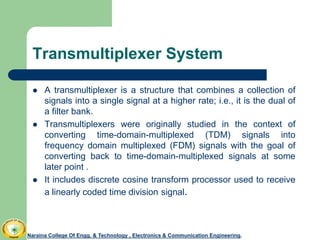
 A transmultiplexer is a structure that combines a collection of
signals into a single signal at a higher rate; i.e., it is the dual of
a filter bank.
 Transmultiplexers were originally studied in the context of
converting time-domain-multiplexed (TDM) signals into
frequency domain multiplexed (FDM) signals with the goal of
converting back to time-domain-multiplexed signals at some
later point .
 It includes discrete cosine transform processor used to receive
a linearly coded time division signal.
Block Diagram of Transmux System
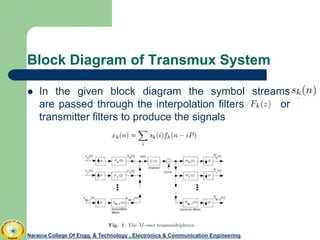
 In the given block diagram the symbol streams
are passed through the interpolation filters or
transmitter filters to produce the signals
Naraina College Of Engg. & Technology , Electronics & Communication Engineering.
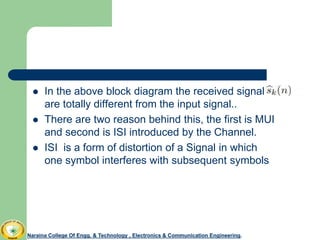
 In the above block diagram the received signal
are totally different from the input signal..
 There are two reason behind this, the first is MUI
and second is ISI introduced by the Channel.
 ISI is a form of distortion of a Signal in which
one symbol interferes with subsequent symbols
Naraina College Of Engg. & Technology , Electronics & Communication Engineering.Naraina College Of Engg. & Technology , Electronics & Communication Engineering.
Generalization of M-userTransmux
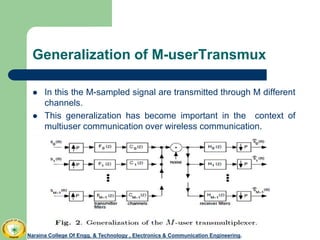
 In this the M-sampled signal are transmitted through M different
channels.
 This generalization has become important in the context of
multiuser communication over wireless communication.
Naraina College Of Engg. & Technology , Electronics & Communication Engineering.
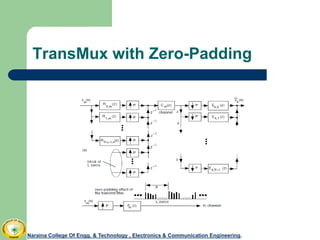
Zero-Padding
 Zero-Padding is a simple concept, used to
adding an additional Zeroes at the ending of
any time domain symbol stream.
 Zero-Padding is used to increase the length
of a time domain symbol stream.
 It is used to counter the IBI (Inter Block
Interference).
Naraina College Of Engg. & Technology , Electronics & Communication Engineering.
TransMux with Zero-Padding
Naraina College Of Engg. & Technology , Electronics & Communication Engineering.
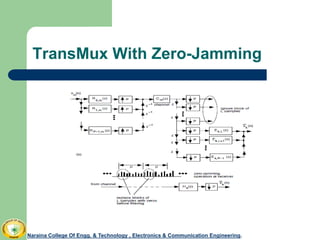
Zero-Jamming
 Zero-Jamming is a simple concept, used to
adding an additional Zeroes at the Begining
of the successive received signal.
 It is used to counter the IBI (Inter Block
Interference).
Naraina College Of Engg. & Technology , Electronics & Communication Engineering.
TransMux With Zero-Jamming
Naraina College Of Engg. & Technology , Electronics & Communication Engineering.
Precoding
 Precoding is a generalization of beamforming to support multi-
stream (or multi-layer) transmission in multi-antenna wireless
communications.
 In point-to-point systems, precoding means that multiple data
streams are emitted from the transmit antennas with
independent and appropriate weightings such that the link
throughput is maximized at the receiver output.
Naraina College Of Engg. & Technology , Electronics & Communication Engineering.
Controlling Bandwidth Efficiency
 This is known precisely as AMOUR system
developed by Giannakis et al.
 AMOUR means A Mutually-Orthogonal Usercode-
Receiver.
 From the figure of transmux,it consists of M
independent symbol stream. If these have to be
separated successfully later, then the spacing
between the samples of sk (n) must be at least M
times larger than the spacing T between the symbols
entering the channels Ck (n).
Naraina College Of Engg. & Technology , Electronics & Communication Engineering.
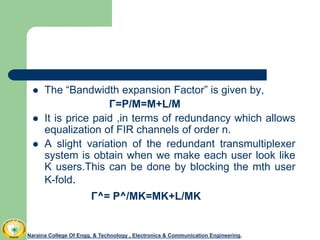
 The “Bandwidth expansion Factor” is given by,
Γ=P/M=M+L/M
 It is price paid ,in terms of redundancy which allows
equalization of FIR channels of order n.
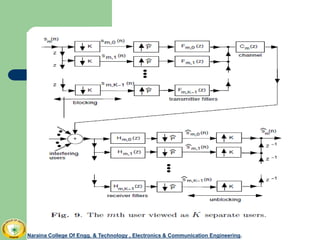
 A slight variation of the redundant transmultiplexer
system is obtain when we make each user look like
K users.This can be done by blocking the mth user
K-fold.
Γ^= P^/MK=MK+L/MK
Naraina College Of Engg. & Technology , Electronics & Communication Engineering.
Optimizing For Noise
 It is known that noise can never be eliminated
completely, but can only be reduced to optimum
value .
 Consider a transmultiplexer. Assume that the filters
have order < P so E (z) and R (z) are constants.
 All systems described in the preceding paragraphs
fall under the category of zero-forcing equalizers .
Naraina College Of Engg. & Technology , Electronics & Communication Engineering.
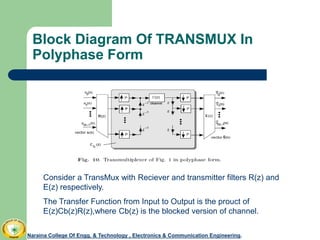
Block Diagram Of TRANSMUX In
Polyphase Form
Naraina College Of Engg. & Technology , Electronics & Communication Engineering.
Consider a TransMux with Reciever and transmitter filters R(z) and
E(z) respectively.
The Transfer Function from Input to Output is the prouct of
E(z)Cb(z)R(z),where Cb(z) is the blocked version of channel.
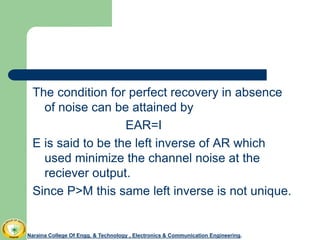
The condition for perfect recovery in absence
of noise can be attained by
EAR=I
E is said to be the left inverse of AR which
used minimize the channel noise at the
reciever output.
Since P>M this same left inverse is not unique.
Naraina College Of Engg. & Technology , Electronics & Communication Engineering.
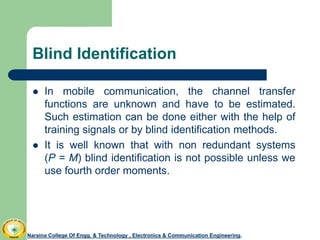
Blind Identification
 In mobile communication, the channel transfer
functions are unknown and have to be estimated.
Such estimation can be done either with the help of
training signals or by blind identification methods.
 It is well known that with non redundant systems
(P = M) blind identification is not possible unless we
use fourth order moments.
Naraina College Of Engg. & Technology , Electronics & Communication Engineering.Naraina College Of Engg. & Technology , Electronics & Communication Engineering.
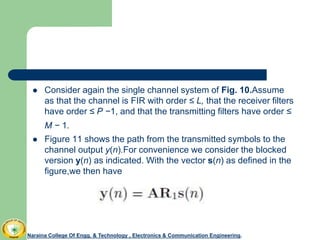
 Consider again the single channel system of Fig. 10.Assume
as that the channel is FIR with order ≤ L, that the receiver filters
have order ≤ P −1, and that the transmitting filters have order ≤
M − 1.
 Figure 11 shows the path from the transmitted symbols to the
channel output y(n).For convenience we consider the blocked
version y(n) as indicated. With the vector s(n) as defined in the
figure,we then have
Naraina College Of Engg. & Technology , Electronics & Communication Engineering.
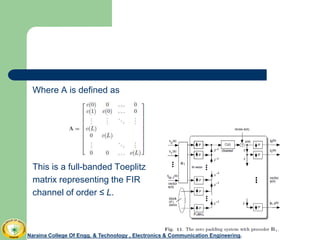
Where A is defined as
This is a full-banded Toeplitz
matrix representing the FIR
channel of order ≤ L.
Naraina College Of Engg. & Technology , Electronics & Communication Engineering.
Conclusion
 As all know that no system whether in
communication field or electronic field is perfect.
 In this topic One problem which was not addressed
in this review is the minimization of redundancy in
the precoder.
 Another important aspects was not defined is
resistance to channel nulls.
Naraina College Of Engg. & Technology , Electronics & Communication Engineering.
References:-
 A tutorial review of “Transmultiplexer as precoder”.
 Akansu, A. N., Duhamel, P., Lin, X., and Courville, M. de. “Orthogonal
transmultiplexers in communications: a review,” IEEE Trans. SP, April
1998.
 Giannakis, G. B. “Filter banks for blind channel identification and equalization,”
IEEE Signal Processing Letters.
 Giannakis, G. B., Wang, Z., Scaglione, A., and Barbarossa, S., “Amour—
generalized multicarrier transceivers for blind CDMA regardless of multipath,”
IEEE Trans. Comm., pp 2064–2076, Dec. 2000.
 Precoding Techniques for Digital Communication Systems www.springer.com
 Precoding - Wikipedia the free encyclopedia
 www.en.wikipedia.org
 Decimation (Digital Filter Design Toolkit) - LabVIEW 2013 Digital Filter Design
Toolkit Help - National Instruments
 www.zone.ni.com
 www.google.com
Naraina College Of Engg. & Technology , Electronics & Communication Engineering.
Transmultiplexer as precoder

Transmultiplexer as precoder

  • 1.
    Transmultiplexer as Precoders inModern Digital Communication Presented By, Nirnay Ranjan (1128731038) Shashank Shukla (1128731058) (ECE 3rd year) Electronics & Communication Engineering
  • 2.
    Content  Summary  Introduction Transmultiplexer System  Precoder  Controlling Bandwidth Efficiency  Optimizing for Noise  Blind Identification  Conclusion  Refrences Naraina College Of Engg. & Technology , Electronics & Communication Engineering.Naraina College Of Engg. & Technology , Electronics & Communication Engineering.
  • 3.
    Summary  This Seminarpresents a system of modern communication which is used to convert from time multiplexed components of a signal to a frequency multiplexed version.  In this Seminar we review the fundamental infrastructure behind these methods. the transmultiplexer system is introduced and the mathematical framework develope. we present the theory behind the cancellation of multiuser interference and Amour system. We make brief remarks on handling the effects of channel Noise.The fundamentals behind blind identification of channels using transmultiplexers is reviewed. Naraina College Of Engg. & Technology , Electronics & Communication Engineering.
  • 4.
    Introduction  Transmultiplexers havebeen known in digital communications for many years.  Historically the transmultiplexer has been viewed as a system that converts from time multiplexed components of a signal to a frequency multiplexed version.  The role of transmultiplexers in digital communications has gained new importance because of many recent results in filter bank precoders. Naraina College Of Engg. & Technology , Electronics & Communication Engineering.
  • 5.
    Transmultiplexer System Naraina CollegeOf Engg. & Technology , Electronics & Communication Engineering.  A transmultiplexer is a structure that combines a collection of signals into a single signal at a higher rate; i.e., it is the dual of a filter bank.  Transmultiplexers were originally studied in the context of converting time-domain-multiplexed (TDM) signals into frequency domain multiplexed (FDM) signals with the goal of converting back to time-domain-multiplexed signals at some later point .  It includes discrete cosine transform processor used to receive a linearly coded time division signal.
  • 6.
    Block Diagram ofTransmux System  In the given block diagram the symbol streams are passed through the interpolation filters or transmitter filters to produce the signals Naraina College Of Engg. & Technology , Electronics & Communication Engineering.
  • 7.
     In theabove block diagram the received signal are totally different from the input signal..  There are two reason behind this, the first is MUI and second is ISI introduced by the Channel.  ISI is a form of distortion of a Signal in which one symbol interferes with subsequent symbols Naraina College Of Engg. & Technology , Electronics & Communication Engineering.Naraina College Of Engg. & Technology , Electronics & Communication Engineering.
  • 8.
    Generalization of M-userTransmux In this the M-sampled signal are transmitted through M different channels.  This generalization has become important in the context of multiuser communication over wireless communication. Naraina College Of Engg. & Technology , Electronics & Communication Engineering.
  • 9.
    Zero-Padding  Zero-Padding isa simple concept, used to adding an additional Zeroes at the ending of any time domain symbol stream.  Zero-Padding is used to increase the length of a time domain symbol stream.  It is used to counter the IBI (Inter Block Interference). Naraina College Of Engg. & Technology , Electronics & Communication Engineering.
  • 10.
    TransMux with Zero-Padding NarainaCollege Of Engg. & Technology , Electronics & Communication Engineering.
  • 11.
    Zero-Jamming  Zero-Jamming isa simple concept, used to adding an additional Zeroes at the Begining of the successive received signal.  It is used to counter the IBI (Inter Block Interference). Naraina College Of Engg. & Technology , Electronics & Communication Engineering.
  • 12.
    TransMux With Zero-Jamming NarainaCollege Of Engg. & Technology , Electronics & Communication Engineering.
  • 13.
    Precoding  Precoding isa generalization of beamforming to support multi- stream (or multi-layer) transmission in multi-antenna wireless communications.  In point-to-point systems, precoding means that multiple data streams are emitted from the transmit antennas with independent and appropriate weightings such that the link throughput is maximized at the receiver output. Naraina College Of Engg. & Technology , Electronics & Communication Engineering.
  • 14.
    Controlling Bandwidth Efficiency This is known precisely as AMOUR system developed by Giannakis et al.  AMOUR means A Mutually-Orthogonal Usercode- Receiver.  From the figure of transmux,it consists of M independent symbol stream. If these have to be separated successfully later, then the spacing between the samples of sk (n) must be at least M times larger than the spacing T between the symbols entering the channels Ck (n). Naraina College Of Engg. & Technology , Electronics & Communication Engineering.
  • 15.
     The “Bandwidthexpansion Factor” is given by, Γ=P/M=M+L/M  It is price paid ,in terms of redundancy which allows equalization of FIR channels of order n.  A slight variation of the redundant transmultiplexer system is obtain when we make each user look like K users.This can be done by blocking the mth user K-fold. Γ^= P^/MK=MK+L/MK Naraina College Of Engg. & Technology , Electronics & Communication Engineering.
  • 16.
    Naraina College OfEngg. & Technology , Electronics & Communication Engineering.
  • 17.
    Optimizing For Noise It is known that noise can never be eliminated completely, but can only be reduced to optimum value .  Consider a transmultiplexer. Assume that the filters have order < P so E (z) and R (z) are constants.  All systems described in the preceding paragraphs fall under the category of zero-forcing equalizers . Naraina College Of Engg. & Technology , Electronics & Communication Engineering.
  • 18.
    Block Diagram OfTRANSMUX In Polyphase Form Naraina College Of Engg. & Technology , Electronics & Communication Engineering. Consider a TransMux with Reciever and transmitter filters R(z) and E(z) respectively. The Transfer Function from Input to Output is the prouct of E(z)Cb(z)R(z),where Cb(z) is the blocked version of channel.
  • 19.
    The condition forperfect recovery in absence of noise can be attained by EAR=I E is said to be the left inverse of AR which used minimize the channel noise at the reciever output. Since P>M this same left inverse is not unique. Naraina College Of Engg. & Technology , Electronics & Communication Engineering.
  • 20.
    Blind Identification  Inmobile communication, the channel transfer functions are unknown and have to be estimated. Such estimation can be done either with the help of training signals or by blind identification methods.  It is well known that with non redundant systems (P = M) blind identification is not possible unless we use fourth order moments. Naraina College Of Engg. & Technology , Electronics & Communication Engineering.Naraina College Of Engg. & Technology , Electronics & Communication Engineering.
  • 21.
     Consider againthe single channel system of Fig. 10.Assume as that the channel is FIR with order ≤ L, that the receiver filters have order ≤ P −1, and that the transmitting filters have order ≤ M − 1.  Figure 11 shows the path from the transmitted symbols to the channel output y(n).For convenience we consider the blocked version y(n) as indicated. With the vector s(n) as defined in the figure,we then have Naraina College Of Engg. & Technology , Electronics & Communication Engineering.
  • 22.
    Where A isdefined as This is a full-banded Toeplitz matrix representing the FIR channel of order ≤ L. Naraina College Of Engg. & Technology , Electronics & Communication Engineering.
  • 23.
    Conclusion  As allknow that no system whether in communication field or electronic field is perfect.  In this topic One problem which was not addressed in this review is the minimization of redundancy in the precoder.  Another important aspects was not defined is resistance to channel nulls. Naraina College Of Engg. & Technology , Electronics & Communication Engineering.
  • 24.
    References:-  A tutorialreview of “Transmultiplexer as precoder”.  Akansu, A. N., Duhamel, P., Lin, X., and Courville, M. de. “Orthogonal transmultiplexers in communications: a review,” IEEE Trans. SP, April 1998.  Giannakis, G. B. “Filter banks for blind channel identification and equalization,” IEEE Signal Processing Letters.  Giannakis, G. B., Wang, Z., Scaglione, A., and Barbarossa, S., “Amour— generalized multicarrier transceivers for blind CDMA regardless of multipath,” IEEE Trans. Comm., pp 2064–2076, Dec. 2000.  Precoding Techniques for Digital Communication Systems www.springer.com  Precoding - Wikipedia the free encyclopedia  www.en.wikipedia.org  Decimation (Digital Filter Design Toolkit) - LabVIEW 2013 Digital Filter Design Toolkit Help - National Instruments  www.zone.ni.com  www.google.com Naraina College Of Engg. & Technology , Electronics & Communication Engineering.