A seminar report
On
IBOC TECHNOLOGY
Submitted in partially fulfilment of the requirement
For the award of Degree
Of
BACHELOR’S OF TECHNOLOGY
IN
ELECTRONICS AND COMMUNICATION ENGINEERING
Submitted By:
VISHAL KUMAR
(ROLL NO. 77)
Under the guidance of:
MR. VIVEK KUMAR
Department of Electronics and Communication Engineering
Faculty of Engineering & Technology
Gurukul Kangri University
Haridwar (Uttrakhand)
CERTIFICATION
This is to certify that this Seminar report was written by VISHAL KUMAR
with registration number 146320087, department of Electronics and
Communication Engineering of Faculty of Engineering and Technology, Gurukul
Kangri University, Haridwar.
Seminar Supervisor
Mr. Vivek Kumar
Date
Seminar coordinator
Mr. Anuj Sharma
Date
ACKNOWLEDGEMENT
I wish to express my sincere gratitude to respected Mr. Vipul Sharma H.O.D of
Electronics and Communication Engineering of Faculty of Engineering and
Technology, GurukulKangri University, Haridwar for providing me an opportunity
to present my seminar report on “IBOC Technology”.
An undiluted appreciation goes to my Project Guide, Mr. Vivek kumar of ECE
Department for the guidance and morale boost he gave me in carrying out this
seminar report, without whom this success couldn’t be achieved.
Last but not the least Special thanks to Mr. Anuj Sharma and Mr. Atul Varshney
for their tireless effort in ensuring that I deliver the best and also for constantly
egging me on. I have learnt a lot within these few weeks of our work together for
this report.
TABLE OF CONTENTS
Certification…………………………………………………………………………..………….…i
Dedication………………………………………………………………….………….……………ii
Acknowledgement……………………………………………………………….….………..…iii
Abstract……………………………………………………………………………….….………..…iv
Table of Contents…………………………………………………………………..…………….v
List of Figures……………………………………………………………………..…..…..………vii
CHAPTER ONE
INTRODUCTION
1.0 Background ………….………………………...………………………………………….....1
1.1 Objectives ……………………………………………………………………..……….……...2
1.2 Scope ………………………………………………………………………….…………….…...3
1.3 Significance ………………………..………………………………………………….….…...3
1.4 Report Overview ……………………………..…………………………………….……….3
CHAPTER TWO
FM TRANSMITTERS
2.0 Overview…………………………………………………………………….……….………..4
2.1 Block Diagram……………………………………………………………………….….……5
2.2 Circuit Design………………………..……………………………………………….………7
2.3 FM Transmitter Limitations……………………………………………………...….…8
2.4 FM Transmitter Optimization………………………………………………….……..9
CHAPTER THREE
MODERN RADIO TRANSMISSION TECHNOLOGIES
3.0 IOBC Hybrid Digital (HD) Radio ………………………………………………..……..…13
3.1 Working Principle of HD Radio.…………………………………………..……..13
3.2 IBOCCAPABILITIES……………………………………………………………………15
3.3 FM Transmission Using HD Radio Technology …………….……..….…16
3.4 Benefits of HD Radio Technology ……………………………….……..……….18
3.5 Disadvantages of HD Radio Technology ………………………..….…….….19
CHAPTER FOUR
4.0 Challenges
4.1 Conclusion……………… ………………………………………………….…………..…20
Reference …..………………………………..……………………………….………….…….20
LIST OF FIGURES
Fig 2.1 Block diagram of an FM transmitter…………………………….………....5
Fig 2.2 Calculation of inductor value…………………………………………….…....6
Fig 2.3 Calculation of Frequency Value.………….……………………….............6
Fig 2.4 Schematic of FM Transmitter…….….……………………….………..........7
Fig 2.5 An FM signal with Noise……..………………………………..………………..10
Fig 2.6 Pre-emphasis Circuit .…………………………………………………….…...…..11
Fig 2.7 Block Diagramof a Basic PLL .……………………….………………………..12
Fig 3.1 How HD Radio Works .……………………………………………………..…...14
Fig 3.2 FM HD Radio Hybrid Mode .…………………….……………………….…...16
Fig 3.3 FM HD Radio Extended Hybrid Mode……………………………………..17
Fig 3.4 FM HD Radio All Digital Mode……….……………………………………….18
IN BAND ON CHANNEL (IBOC) TECHNOLOGY
ABSTRACT
FM Transmitter is a device which generates frequency modulated signal. It is one element
of a radio system which, with the aid of an antenna, propagates an electromagnetic signal. Standard
FM broadcasts are based in the 88 – 108 MHz range. Advancements have been made in the way
FM is broadcast. This includes utilizing such technologies as Hybrid Digital (HD) Radio, Software
Defined Radio (SDR) and Cognitive Radio.
HD Radio uses IBOC (In-Band On-Channel) as a method of broadcasting digital radio
signals on the same FM channel, and at the same time as the conventional analog signal while
Software defined radio (SDR) is the term used to describe radio technology where some or the
entire wireless physical layer functions are software defined.
The In-Band On-Channel (IBOC) solution to replace stereo quality FM transmission with
CD quality sound using the same FM channel has had further advances in the USA. The National
Radio Systems Committee (NRSC) has evaluated the iBiquity Digital Corporations. FM IBOC
System to determine the compatibility of IBOC operation with analog reception of existing FM
stations. This paper outlines the basic technical fundamentals of IBOC, the current status of the
technology and the possible impact of IBOC on the Australian broadcasting environment.
In-band on-channel (IBOC) is a hybrid method of transmitting digital radio and analog radio
broadcast signals simultaneously on the same frequency.
By utilizing additional digital subcarriers or sidebands, digital information is "multiplexed" on an
AM or FM analog signal, thus avoiding re-allocation of the broadcast bands. However, by putting
RF energy outside of the normally-defined channel, interference to adjacent channel stations is
increased when using digital sidebands.
IBOC does allow for multiple program channels, though this can entail taking some existing
subcarriers off the air to make additional bandwidth available in the modulation baseband. On FM,
this could eventually mean removing stereo. On AM, IBOC is incompatible with analog stereo,
and any additional channels are limited to highly compressed voice, such as traffic and weather.
Eventually, stations can go from hybrid mode (both analog and digital) to all-digital, by
eliminating the baseband monophonic audio.
The IBOC technology developed by iBiquity Digital Corporation focuses on a transition to
digital that works within existing broadcasting infrastructure. The IBOC digital signal is placed
within the existing analog FM spectral emissions mask, and as a result IBOC is proposed as the
digital solution which may be implemented without the need for new frequency allocations or
without disruption to the existing broadcasting infrastructure.
CHAPTER 1
INTRODUCTION
1.0 BACKGROUND
Frequency modulation (FM) is a technique for wireless transmission of information where the
frequency of a high frequency carrier is changed in proportion to message signal which contains
the information according to [1]. FM was invented and developed by Edwin Armstrong in the
1920’s and 30’s. Frequency modulation was demonstrated to the Federal Communications
Commission (FCC) for the first time in 1940, and the first commercial FM radio station began
broadcasting in 1945 [2]. FM is not a new concept. However, the concept of FM is essential to a
wide gamut of radio frequency wireless devices and is therefore worth studying. This seminar will
explain the design decisions that should be made in the process of design and construction of an
FM transmitter. The design has also been simulated. For a long time radio was the largest mass
media but in recent years it has lost a number of listeners. In contrast, total media consumption has
increased. Young people are abandoning traditional media and want to decide on where, when and
how they receive media content, for example via Internet and mobile telephones. Listeners are
most interested in easily being able to select radio stations, to have better sound quality and
audibility and to increase accessibility for people with visual and auditory impairments.
Listeners also want a wider range of radio channels over the whole country. Consumers ‘needs
must be met hence the need for advancements in the field of radio broadcast.
New technology creates the necessary conditions for improvements. This seminar also evaluates
the different technologies on the basis of questions like:
 How well does the technology satisfy consumers’ needs?
 What functionality does the technology offer?
 How efficiently does the technology utilize the available spectrum?
 What financial conditions are available for the technology?
Standardization policy for the technology.
1.1 OBJECTIVES
The objectives of this seminar are:
i. To review present-day FM transmitters and their limitations.
ii. To present some modern digital technologies that has been developed for effective FM
signal generation.
iii. To provide an overview of the Radio communicationissues that might be improved
through the use of Hybrid Digital Radio (HD Radio), Software Defined Radio
(SDR) and Cognitive Radio Systems (CRS).
iv. To accusatively compare these technologies.
1.2 SCOPE
This seminar covers the design of FM transmitters for quality audio transmission and explains
some of the modern trends in FM signal generation, highlighting their prospects. It also covers
the advantages these technologies offer over traditional radio broadcasting and brings to light
various distinguishing features possessed by these technologies.
1.3 SIGNIFICANCE
The rolethat radio plays in thesociety is an important issueto consider in discussionsabout
which technology can best distributeradio in thefuture. Thefact that radio has an
important rolein society can beclearly seen in thenumber of listeners. Despitetherisein
thetotal consumption of media, radio has lost a number of listeners according to a survey
reported in [3, pp. 40-49].
The medium of radio has many positivecharacteristics for listeners. It is:
i. Free from subscriptioncharges
ii. Simpleto use
iii. Possibleto listen to everywhere, including sparsely populated areas and whilein
motion in cars and trains.
iv. Possibleto listen to whiledoing something else
v. Important as a channel of information, especially in crises and catastrophes.
vi. An important medium for traffic information, shipping and mountain rescue.
Radio needs to be developed to satisfy theneeds of future consumers, hence
the need for this study.
1.4 REPORT OVERVIEW
Chapter oneprovides an overview of theseminar by giving description of thetopic.
Chapter two deals with FM transmitters, their drawbacks and how they are
overcome.
Chapter three covers modern radio transmission technologies: IBOC Hybrid Digital
(HD) Radio and Software Defined Radio (SDR); explaining their advantages,
limitations and how they enhance radio communication.
In chapter four, SDR and HD radio technologies werecompared with other radio
technologies. It also includes theconclusion.
CHAPTER 2
FM TRANSMITTERS
2.0 OVERVIEW
An FM Transmitter is a devicewhich generates frequency modulated signal. It is one
element of a radio system which, with theaid of an antenna, propagates an
electromagnetic signal [3]. Someof its applications include:
• Non-commercial broadcasting.
• Commercial broadcasting.
• Television audio.
• Public Service communications.
• Radio Service Communications.
• Point-to-point microwave links used by telecommunications
companies.
FM transmitters work on the principle of frequency modulation which compares to
the other most common transmission method, Amplitude Modulation (AM). AM
broadcasts vary the amplitude of the carrier wave according to an input signal.
Standard FM broadcasts arebased in the88 - 108 MHzrange; otherwiseknown as the
RF or Radio Frequency range.
However,they canbe inany range, aslong asa receiver has been tunedto demodulatethem.
Thus the RF carrier wave and the input signal can't do much by themselves they must be
modulated. That is the basis of a transmitter.
Fig 2.1: Block diagram of an FM transmitter
The diagram above is the basic building block of every FM transmitter. It consists of
an AF (Audio Frequency) Amplifier that amplifies the audio voltage from the
microphoneand feeds this signal into an RF oscillator for modulation. The oscillator
produces thecarrier frequency in the88-108MHZ FM band. Thelow power of theFM
modulated carrier is then boosted by thepower amplifier. A buffer amplifier is placed
between the RF oscillator and the power amplifier to eliminate loading of the
oscillator. A low pass filter is also present lo limit the RF signal to a range of choice
while the antenna radiates it.
The design of an FM transmitter must consider multiple technical factors such as
frequency of operation, the stability and purity of the resulting signal, the efficiency
2.1 BLOCK DIAGRAM
AF Amplifier PowerAmpBuffer AmpRFOscillator Low PassFilter
of power use, and the power level required to meet the system design objectives.
Some pre-design considerations include:
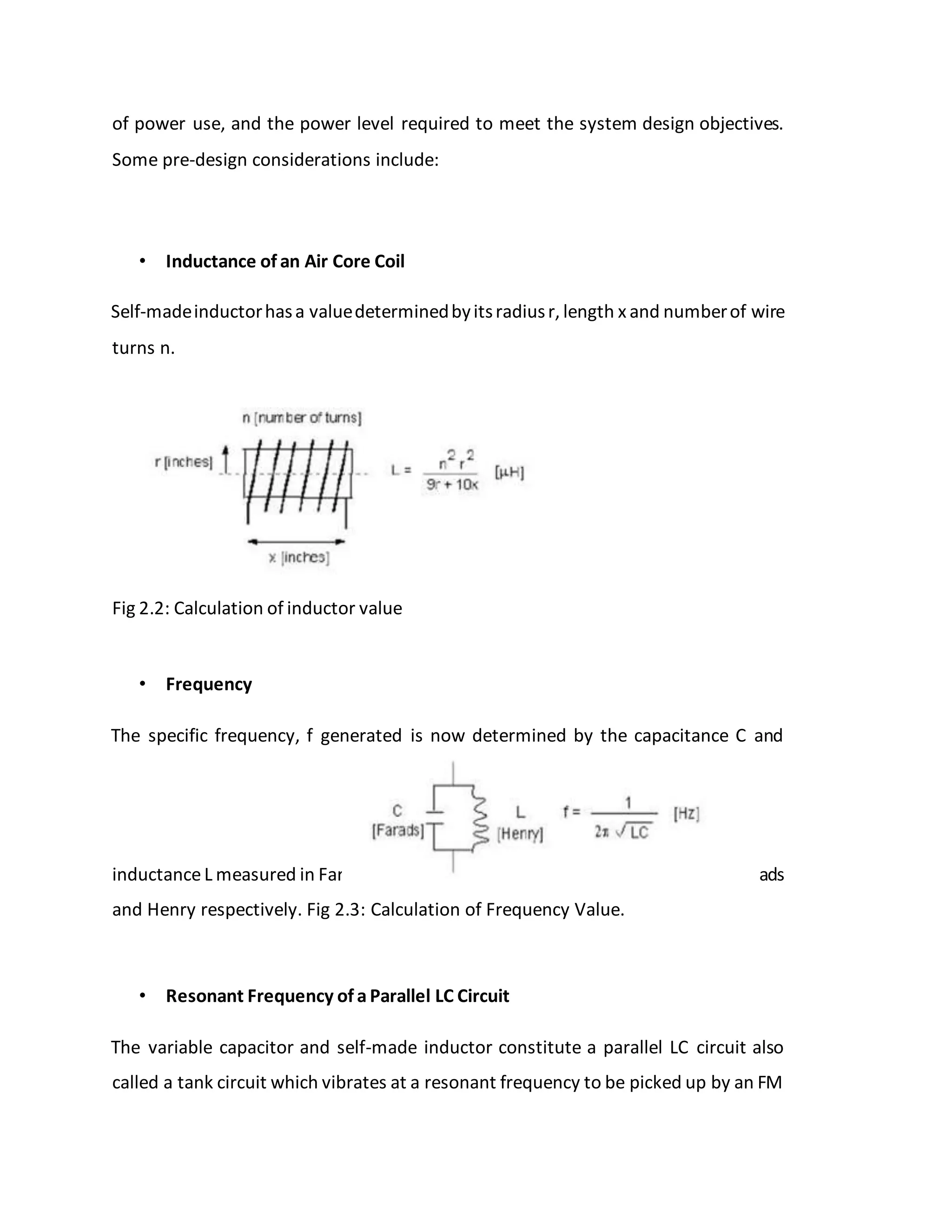
• Inductance of an Air Core Coil
Self-madeinductorhasa valuedeterminedbyitsradiusr, length x and numberof wire
turns n.
Fig 2.2: Calculation of inductor value
• Frequency
The specific frequency, f generated is now determined by the capacitance C and
inductanceL measured in Far ads
and Henry respectively. Fig 2.3: Calculation of Frequency Value.
• Resonant Frequency of a Parallel LC Circuit
The variable capacitor and self-made inductor constitute a parallel LC circuit also
called a tank circuit which vibrates at a resonant frequency to be picked up by an FM
radio. The underlying physics is that a capacitor stores energy in the electric field
between its plates, depending on thevoltageacross it, and an inductor stores energy
in its magnetic field, depending on the current through it. Theoscillation frequency is
determined by the capacitance and inductance values.
2.2 CIRCUIT DESIGN
Fig 2.4: Schematic of FM Transmitter.
In theory, as long as thereis a supply voltageacross theparallel inductorand variable
capacitor, it should vibrate at the resonant frequency indefinitely. Referring to the
schematic above, C2 and C4 act as decoupling capacitors and typically 0.01 uF (or 0.1
uF) are used. C4 attempts to maintain a constant voltage across the entire circuit
despite voltage fluctuations as the battery dies. A capacitor can be thought of as a
frequency dependent resistor (called reactance). Speech consists of different
frequencies and the capacitor C1 impedes them. The net effect is that C1 modulates
the current going into the transistor.
Using a largevaluefor C1 reinforces bass (low frequencies) whilesmaller values boost
treble (high frequencies). The C3 capacitor across the 2N2222A transistor serves to
keep thetankcircuitvibrating.Inrealityhowever,thefrequency decaysdueto heating
losses.C3isusedtopreventdecay andthe2N2222Aspecsheetsuggestsacapacitance
between 4 to 10 pF.
The C3 capacitor across the 2N2222A transistor serves to keep the tank circuit
vibrating. In theory, as long as there is a supply voltage across the parallel inductor
and variable capacitor, it should vibrate at the resonant frequency indefinitely. In
reality however, the frequency decays due to heating losses. C3 is used to prevent
decay and the 2N2222A spec sheet suggests a capacitance between 4 to 10 pF.
The 2N2222A transistor has rated maximums thusdemanding a voltagedivider made
with R2 and R3 and emitter current limiting with R4. The 2N2222A'smaximumrated
power is Pmax = 0.5 W. This power ultimately affects the distance you can transmit.
Overpowering the transistor will heat and destroy it. To avoid this, one can calculate
that the FM transmitter outputsapproximately 124 mW and is well below the rated
maximum.
2.3 FM TRANSMITTER LIMITATIONS
The major drawbacks experienced by FM transmitters are noise and frequency
control.
• FREQUENCY CONTROL This arises fromthepresenceof frequency synthesizers
(oscillators). Dueto limited bandwidth, it is necessary for thecarrier frequency of a
radio transmitter to beas exact as possible. Issues relating to this include:
Poor frequency Accuracy: The transmitter must be on the exact
frequency that the receiver is expecting it to be. This is primarily
determined by the master reference oscillator.
Undesired Spurious Generation: The synthesizer must also minimize
spurious signalswhich corrupt thetransmitted signaland makereceiver
demodulation difficult.
• NOISE
Noise is typically narrow spikes of voltage with lots of harmonics and other high
frequency components that add to a signal, interferes with it and sometimes,
completely obliterates the signal information. [4]
FM systems are generally better at rejecting noise than AM systems. Poor design
resultsinexcessivePhaseNoise,a “smearing”oftheTransmitterLocalOscillatorsignal
that the Receiver interprets as noise, making accurate demodulation difficult and a
corresponding high probabilityof error. Noisecan also result frompoorpower supply
regulation and/or filtering.
2.4 FM TRANSMITTER OPTIMISATION
Having discussed the drawbacks of an FM transmitter, techniques employed in
mitigating them include:
• Use of Limiter Circuits:
Limiter circuits can be embedded into FM transmitters to deliberately restrict the
amplitudeof received signals. This is based on thefact that FM signals haveconstant
modulated carrier amplitude. Any amplitudevariationsoccurring on theFMsignalare
effectively clipped by these circuits. This amplitudevariation in turn does not affect
the information content of the FM signal, since it is contained solely within the
frequency variations of the carrier.
Fig 2.5: An FM signal with Noise.
• Pre-emphasis:
Noise can interfere with an FM signal and particularly with the high-frequency
components of themodulating signal. This techniqueis used to overcomethese high
frequency noises. A simplehigh-pass filter can serveas a transmitter’spre-emphasis
circuit. A sample pre-emphasis circuit is shown below:
Fig 2.6: Pre-emphasis Circuit.
• Phase Locked Loop (PLL):
PLL is basically a closed loop frequency control system whosefunctioning is based on
thephase sensitivedetection of phasedifferencebetween theinput and output
signals of thecontrolled oscillator according to [6]. It is used to lock thecentral
frequency of a transmitter to a stablecrystalreferencefrequency. A basic phase
locked loop consists of three(3) elements:
Phase Comparator:This circuit block within thePLL compares thephase
of two signals and generates a voltageaccording to thephase
difference between thetwo signals.
Loop filter: This filter is used to filter theoutput from thephase
comparator in thePLL. It is used to removeany components of the
signals of which thephaseis being compared from theVCO line. It also
governs many of thecharacteristics of theloop and its stability.
Voltage controlled oscillator (VCO): The voltagecontrolled oscillator is
thecircuit block that generates theoutput radio frequency signal. Its
frequency can be controlled and swung over theoperational frequency
band for theloop.
Fig 2.7: Block Diagram of a Basic PLL.
Reference Phase Comparator
Voltage Controlled
Oscillator
Loop Filter
Error Voltage Generated
by the phase detector.
Tuned voltage used
to control VCO.
CHAPTER 3
MODERN RADIO TRANSMISSION TECHNOLOGIES
3.0 In-Band On-Channel (IBOC) HYBRID DIGITAL (HD) RADIO
HD Radio IBOC (In-Band On-Carrier) is a method of broadcasting digital radio signals on the
same channel, and at the same time as the conventional AM or FM signal. iBiquity Digital
Corporation developed this solution in response to the need for a digital system that didn’t require
additional frequency bands which were not available. IBOC is an evolutionary system, allowing
increased performance as the number of digital receivers increase. [8]
Renee [7], points out that HD Radio is a new technology that enables AM and FM Radio stations
to broadcast their programs digitally, a tremendous technological leap from today's familiar analog
broadcasts. HD Radio is the only current digital radio solution which operates in the existing FM
band. It allows the transmission of the existing unchanged FM analog signal along with digital
subcarriers which provide CD quality audio – as well as the possibility of multiple digital channels.
Both the conventional FM analog signal and the digital sidebands fit within the typical spectral
mask allocated for FM stations (i.e. same spot on the FM dial). [9]
3.1WORKING PRINCIPLEOF HD RADIO
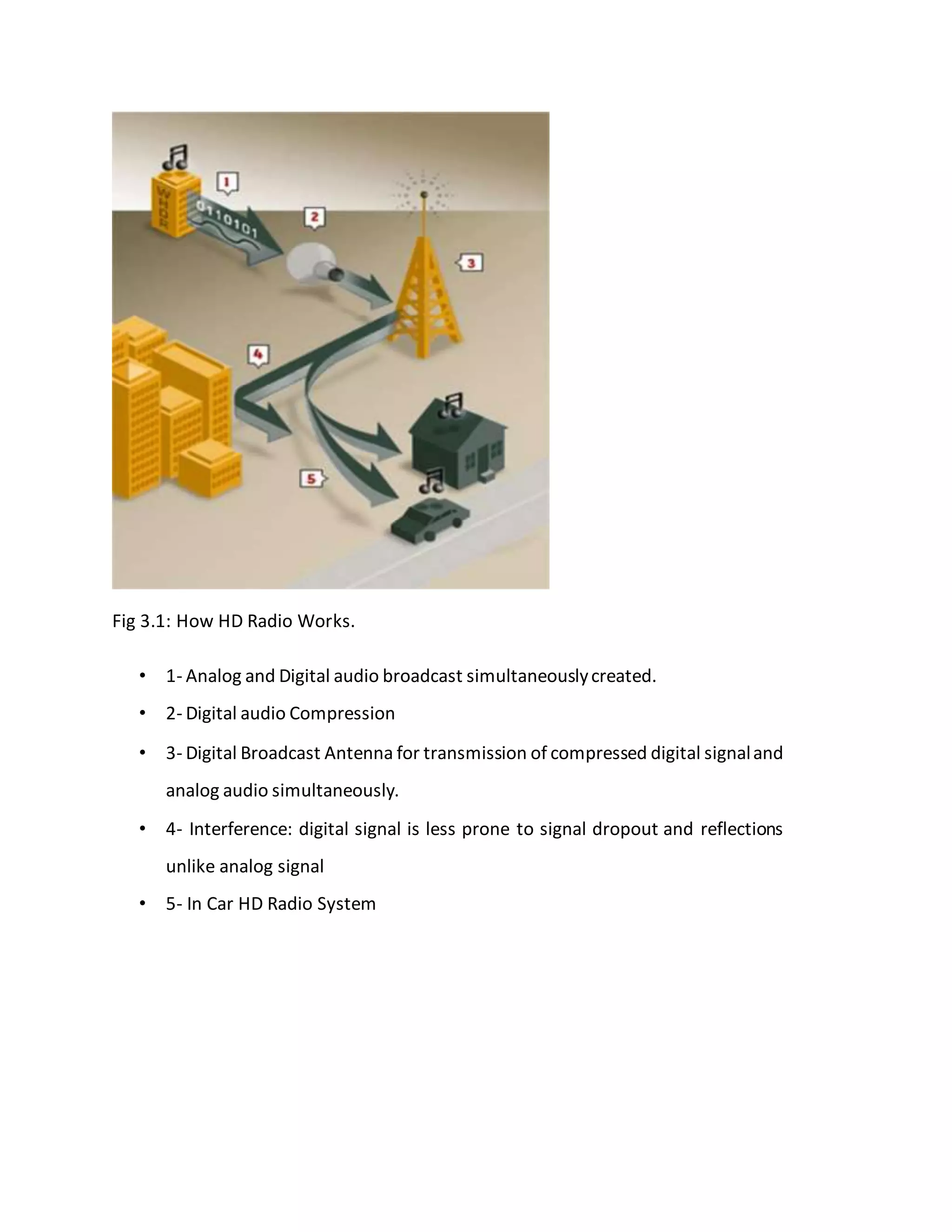
Firstly, the radio station simultaneously creates a digital and analog audio broadcast.
The digital signal is then compressed for multicasting and enhanced services while the analog
signal is left untouched, both of which are transmitted at the same time. Signal travels through the
broadcast area while receivers shoot trough bounced signals to enhance clarity.
Fig 3.1: How HD Radio Works.
• 1- Analog and Digital audio broadcast simultaneouslycreated.
• 2- Digital audio Compression
• 3- Digital Broadcast Antenna for transmission of compressed digital signaland
analog audio simultaneously.
• 4- Interference: digital signal is less prone to signal dropout and reflections
unlike analog signal
• 5- In Car HD Radio System
3.2 IBOC CAPABILITIES
IBOC enables the broadcaster to select the desired audio quality and data transmission rate
however, as expected, there is a tradeoff between audio quality and the data transmission rate.
The audio quality at 96 kb/s is near CD quality but in Hybrid mode this only allows 1 kb/s for data.
IBOC allows the bit rate to be adjusted in 8 kb/s steps. By transmitting audio at the satellite DARS3
bit rate of 64 kb/s, additional data capacity, exceeding that of the current generation of mobile
phones (9 . 19kb/s), is available. At times when audio quality is not as important, the audio bit rate
may be reduced to as low as 48 kb/s but audio quality will be reduced to near telephone audio
quality.
IBOC incorporates a 4.5 second delay between the analog and digital audio signals. The receiver
initially acquires the analog signal and takes a few seconds to begin to decode the audio on the
digital sidebands. If 10% of the digital data blocks sent are corrupted during transmission, the
IBOC receiver reverts to the analog signal. This is referred to as the .blend-to-analog. Feature of
IBOC. The blend process is perceived to have the same quality as the analog audio and the process
itself does not degrade the audio quality below that of analog.
Field tests indicate that Hybrid FM IBOC digital coverage is comparable to analog coverage but
IBOC reception can be obtained in areas where the analog service is currently of an unacceptable
quality due to interference such as co-channel interference, impulse noise and multi-path fading.
The enhancements claimed over traditional analog FM broadcasting include:
• Almost full immunity from typical FM multipath reception problems;
• Significantly improved full stereo coverage;
• Flexible datacasting opportunities: and
• Efficient means for FM broadcasters to begin the transition to digital broadcasting
• Use of OFDM in IBOC allows on-channel digital repeaters.
It is expected that there will be a trade off in audio signal-to-noise ratios in some areas where 1st
adjacent (IBOC) stations overlap, but this is only expected where 1st adjacent interference
currently exists with adjacent channel analog services.
The iBiquity field tests conducted with eight FM broadcasting stations in the US, concluded that
digital coverage with one hundredth the power (-20dB) of analog, extended to the 45 - 50 dBu
signal level.
3.3 FM TRANSMISSION USING HD RADIO TECHNOLOGY
OR, IBOC Modes of Operation
FM IBOC is an OFDM (Orthogonal Frequency Division Multiplex) system which creates a set of
digital sidebands each side of the normal FM signal. The combined FM and IBOC signal fits in
the same spectral mask as is specified for conventional FM. The system allows for growth towards
eventual full utilization of the spectrum by the digital signal in three steps: Hybrid, Extended
Hybrid, and Full Digital.
HybridMode. In this mode the digital signal is inserted within a 69.041 kHz bandwidth,
129.361 kHz on either side of the analog FM signal.
Fig 3.2 FM HD Radio Hybrid Mode
The IBOC Hybrid mode digital signal is transmitted in sidebands either side of the analog FM
signal and each sideband is approximately 23 dB below the total power in the FM signal. The
hybrid sidebands are referred to as Primary Main (PM) sidebands.
The host analog signal may be mono or stereo, and may include subsidiary communication
channels. The total power of the digital sidebands is 20 dB below the nominal power of the FM
analog carrier with power relative to the total analog FM power of .41.39 dB/kHz.
ExtendedHybridMode.
This mode includes the hybrid mode and additional digital signals are inserted closer to the
analog signal, utilizes a 27.617 kHz bandwidth, 101.744 kHz on either side of the analog FM
signal.
The IBOC Extended Hybrid mode digital sidebands are extended towards the analog FM signal
to increase digital capacity. The extended hybrid sidebands are referred to as Primary Extended
(PX) sidebands. The total power of the digital sidebands is 20 dB below the nominal power of
the FM analog carrier with power relative to total analog FM power of .41.39 dB/kHz.
All Digital Mode.This mode replaces the analog signal with additional digital signals and also
includes the digital signals of the Hybrid and Extended Hybrid modes.
With IBOC All Digital, the primary digital sidebands are extended as in IBOC Extended Hybrid
and the analog signal is removed and replaced by lower power digital secondary sidebands, thus
expanding the digital capacity. The total power of the digital sidebands is 10 dB below the nominal
power of the replaced FM analog carrier with power relative to total analog FM power of .31.39
dB/kHz.
3.4 BENEFITSOF HD RADIO TECHNOLOGY
The advantages HDRadio offers include:
It renders new and crisp, crystal-clear sound without pops, hiss, or fades (i.e. enhanced
sound fidelity)
It provides advanced data and audio services which include
 Surround sound.
 Multi-casting - Multipleaudio sourcesat thesamedial position.
 On-demand audio services -Will giveusers instant access to news and
Information.
 Store-and-replay –Will allow listeners rewind a song they just heard or storea
radio program for replay later.
 “Buy” button- Will turn theradio into an interactivedevicefor ecommerce,
allowing for instant purchases of concert tickets to advertised products.
• It usestheadvancedtechnologytodisplayinformationtextontheradioscreen.
• This advanced display mechanism of theHDRadio hasnow enabled syndicated
radio programs to provide regional and local information in a text format.
• Itsconversionprocessisuniqueandeasy becausethereisno servicedisruption
and same dial position.No new networks need to be constructed to introduce
HD radio
• It’s free, No subscription fees: It is not a subscription servicelikesatelliteradio.
It is the same free, over-the-air broadcast radio only better.
• It provides a seamless transition for customers.
3.5 DISADVANTAGES OF HD RADIO TECHNOLOGY
WhileHDRadioseemstohavea lottooffer a radioconsumer,therearesomeinherent
disadvantages. These are:
• An HD Station’s broadcasting range is only equal to the range of a terrestrial
broadcasting tower so doesn’t cover a wider area as would satellite radio.
• HD Radio is not able to speak with a disc jockey because it is designed to
automate. Customers therefore will not get live assistance.
• Cost of equipment is quite high.
CHAPTER 4
4.0 Challenges
AM IBOC in the United States still faces some serious technological challenges of its own,
including nighttime interference with other stations iBiquity was previously using PAC (also used
at a higher bitrate in Sirius satellite radio, Digital Audio Radio Service), but in August 2003 a
switch to HDC (based-upon ACC) was made to rectify these problems. HDC has been customized
for IBOC, and it is also likely that the patent rights and royalties for every transmitter and receiver
can be retained longer by creating a more proprietary system. Digital Radio Mondale is also
developing an IBOC system, likely to be used worldwide with AM shortwave radio, and possibly
with broadcast AM and FM. Neither of those have been approved yet for ITU region 2 (the
Americas). The system, however, unlike HD Radio, does not permit the existing analog signal and
the digital signal to live together in the same channel. DRM requires an additional channel to
maintain both signals.
Both AM and FM IBOC signals cause interference to adjacent-channel stations, but not within the
station’s interference-free protected contours designated by the U.S. Federal Communications
Commission (FCC). It has led to derogatory terms such as IBAC (In-band adjacent-channel) and
IBUZ (since the interference sounds like a buzz.) The range of a station on an HD Radio receiver
is somewhat less than its analog signal. However, in June, 2008, a group of US broadcasters and
equipment manufacturers requested that the U.S. FCC increase the permissible FM IBOC power
from 1% (currently) to a maximum of 10% of the analog power. On January 29, 2010, the FCC
approved the request.[10] In addition, tropospheric ducting and e-skip can reduce the range of the
digital signal, as well as the analog.
In-band on-channel digital radios using iBiquity's standard are being marketed under the brand
"HD Radio" to highlight the purported quality of reception. As of June 2008, over 60 different
receiver models have been made, and stations have received blanket (no longer individual and
experimental) authorization from the U.S. FCC to transmit in a multiplexed multichannel mode on
FM. Originally, the use of HD Radio transmission on AM was limited to daytime only, and not
allowed at night due to potential problems with sky wave radio propagation. The FCC lifted this
restriction in early 2007. DRM, however, is being used across Europe on shortwave, which is
entirely AM sky wave without issue. With the proper receiver, many of those stations can be heard
in North America as well, sans the analog signal.
4.1 Conclusions
FM transmission is an area of communication that is always moving with technological
advancements. As the new digital radios become more available, dramatic improvements will be
heard by listeners. Careful design of the new transmissions systems will pay off with reduced costs
and improved performance and reliability. HD Radio FM is both robust and efficient in the difficult
mobile environment, SDR provides flexibility and Cognitive Radio will definitely define a whole
new level of FM transmission.
References
[1] Russell Mohn, “A Three Transistor Discrete FM Transmitter,” ELEN 4314
Communications Circuits - Design Project, pp. 1, April 2007.
[2] “FM broadcasting in theUnited States” Ibiquity /ATTC/ Dynasat FM IBOC Test Data Report,
Aug 2001
[3] T.U.M Swarna kumara et al., “A Mini Project on SimpleFM-Transmitter”.
[4] E. F. Louis, Principles of Electronic CommunicationSystems. McGraw-Hill, 2008
[5] “The Futureof Radio”. The Swedish Radio and TV Authority, 2008.
[6] Holm, Steve (2007). "Lydkvalitetet i DAB digitalradio". Digitale Utgivelser ved UiO. Retrieved
2009-01-03. (Norwegian).
[7] C. Renee, “An Industrial WhitePaper: HDRadio”
[8] C. W. Kelly, “Digital HD Radio AM/FM Implementation Issues”, USA.
[9] C. W. Kelly, “HD-Radio: Real World Results in Asia”, USA.
[10] Groome B., “HD Radio (I.B.O.C)”,TMH Publication 3rd
edition 1999.
[11] Robinson, David J. M. (2002-07-09). "DAB sound quality". OFCOM: Regulation in digital
broadcasting: DAB digital radio bitrates and audio quality; Dynamic range compression and
loudness. Retrieved 2009-01-03.

Report on In Band On Channel

  • 1.
    A seminar report On IBOCTECHNOLOGY Submitted in partially fulfilment of the requirement For the award of Degree Of BACHELOR’S OF TECHNOLOGY IN ELECTRONICS AND COMMUNICATION ENGINEERING Submitted By: VISHAL KUMAR (ROLL NO. 77) Under the guidance of: MR. VIVEK KUMAR Department of Electronics and Communication Engineering Faculty of Engineering & Technology Gurukul Kangri University Haridwar (Uttrakhand)
  • 2.
    CERTIFICATION This is tocertify that this Seminar report was written by VISHAL KUMAR with registration number 146320087, department of Electronics and Communication Engineering of Faculty of Engineering and Technology, Gurukul Kangri University, Haridwar. Seminar Supervisor Mr. Vivek Kumar Date Seminar coordinator Mr. Anuj Sharma Date
  • 3.
    ACKNOWLEDGEMENT I wish toexpress my sincere gratitude to respected Mr. Vipul Sharma H.O.D of Electronics and Communication Engineering of Faculty of Engineering and Technology, GurukulKangri University, Haridwar for providing me an opportunity to present my seminar report on “IBOC Technology”. An undiluted appreciation goes to my Project Guide, Mr. Vivek kumar of ECE Department for the guidance and morale boost he gave me in carrying out this seminar report, without whom this success couldn’t be achieved. Last but not the least Special thanks to Mr. Anuj Sharma and Mr. Atul Varshney for their tireless effort in ensuring that I deliver the best and also for constantly egging me on. I have learnt a lot within these few weeks of our work together for this report.
  • 4.
    TABLE OF CONTENTS Certification…………………………………………………………………………..………….…i Dedication………………………………………………………………….………….……………ii Acknowledgement……………………………………………………………….….………..…iii Abstract……………………………………………………………………………….….………..…iv Tableof Contents…………………………………………………………………..…………….v List of Figures……………………………………………………………………..…..…..………vii CHAPTER ONE INTRODUCTION 1.0 Background ………….………………………...………………………………………….....1 1.1 Objectives ……………………………………………………………………..……….……...2 1.2 Scope ………………………………………………………………………….…………….…...3 1.3 Significance ………………………..………………………………………………….….…...3 1.4 Report Overview ……………………………..…………………………………….……….3 CHAPTER TWO FM TRANSMITTERS 2.0 Overview…………………………………………………………………….……….………..4 2.1 Block Diagram……………………………………………………………………….….……5 2.2 Circuit Design………………………..……………………………………………….………7 2.3 FM Transmitter Limitations……………………………………………………...….…8 2.4 FM Transmitter Optimization………………………………………………….……..9 CHAPTER THREE
  • 5.
    MODERN RADIO TRANSMISSIONTECHNOLOGIES 3.0 IOBC Hybrid Digital (HD) Radio ………………………………………………..……..…13 3.1 Working Principle of HD Radio.…………………………………………..……..13 3.2 IBOCCAPABILITIES……………………………………………………………………15 3.3 FM Transmission Using HD Radio Technology …………….……..….…16 3.4 Benefits of HD Radio Technology ……………………………….……..……….18 3.5 Disadvantages of HD Radio Technology ………………………..….…….….19 CHAPTER FOUR 4.0 Challenges 4.1 Conclusion……………… ………………………………………………….…………..…20 Reference …..………………………………..……………………………….………….…….20 LIST OF FIGURES Fig 2.1 Block diagram of an FM transmitter…………………………….………....5 Fig 2.2 Calculation of inductor value…………………………………………….…....6 Fig 2.3 Calculation of Frequency Value.………….……………………….............6 Fig 2.4 Schematic of FM Transmitter…….….……………………….………..........7 Fig 2.5 An FM signal with Noise……..………………………………..………………..10 Fig 2.6 Pre-emphasis Circuit .…………………………………………………….…...…..11 Fig 2.7 Block Diagramof a Basic PLL .……………………….………………………..12 Fig 3.1 How HD Radio Works .……………………………………………………..…...14 Fig 3.2 FM HD Radio Hybrid Mode .…………………….……………………….…...16
  • 6.
    Fig 3.3 FMHD Radio Extended Hybrid Mode……………………………………..17 Fig 3.4 FM HD Radio All Digital Mode……….……………………………………….18
  • 7.
    IN BAND ONCHANNEL (IBOC) TECHNOLOGY ABSTRACT FM Transmitter is a device which generates frequency modulated signal. It is one element of a radio system which, with the aid of an antenna, propagates an electromagnetic signal. Standard FM broadcasts are based in the 88 – 108 MHz range. Advancements have been made in the way FM is broadcast. This includes utilizing such technologies as Hybrid Digital (HD) Radio, Software Defined Radio (SDR) and Cognitive Radio. HD Radio uses IBOC (In-Band On-Channel) as a method of broadcasting digital radio signals on the same FM channel, and at the same time as the conventional analog signal while Software defined radio (SDR) is the term used to describe radio technology where some or the entire wireless physical layer functions are software defined. The In-Band On-Channel (IBOC) solution to replace stereo quality FM transmission with CD quality sound using the same FM channel has had further advances in the USA. The National Radio Systems Committee (NRSC) has evaluated the iBiquity Digital Corporations. FM IBOC System to determine the compatibility of IBOC operation with analog reception of existing FM stations. This paper outlines the basic technical fundamentals of IBOC, the current status of the technology and the possible impact of IBOC on the Australian broadcasting environment. In-band on-channel (IBOC) is a hybrid method of transmitting digital radio and analog radio broadcast signals simultaneously on the same frequency. By utilizing additional digital subcarriers or sidebands, digital information is "multiplexed" on an AM or FM analog signal, thus avoiding re-allocation of the broadcast bands. However, by putting RF energy outside of the normally-defined channel, interference to adjacent channel stations is increased when using digital sidebands. IBOC does allow for multiple program channels, though this can entail taking some existing subcarriers off the air to make additional bandwidth available in the modulation baseband. On FM, this could eventually mean removing stereo. On AM, IBOC is incompatible with analog stereo, and any additional channels are limited to highly compressed voice, such as traffic and weather. Eventually, stations can go from hybrid mode (both analog and digital) to all-digital, by eliminating the baseband monophonic audio. The IBOC technology developed by iBiquity Digital Corporation focuses on a transition to digital that works within existing broadcasting infrastructure. The IBOC digital signal is placed within the existing analog FM spectral emissions mask, and as a result IBOC is proposed as the
  • 8.
    digital solution whichmay be implemented without the need for new frequency allocations or without disruption to the existing broadcasting infrastructure. CHAPTER 1 INTRODUCTION 1.0 BACKGROUND Frequency modulation (FM) is a technique for wireless transmission of information where the frequency of a high frequency carrier is changed in proportion to message signal which contains the information according to [1]. FM was invented and developed by Edwin Armstrong in the 1920’s and 30’s. Frequency modulation was demonstrated to the Federal Communications Commission (FCC) for the first time in 1940, and the first commercial FM radio station began broadcasting in 1945 [2]. FM is not a new concept. However, the concept of FM is essential to a wide gamut of radio frequency wireless devices and is therefore worth studying. This seminar will explain the design decisions that should be made in the process of design and construction of an FM transmitter. The design has also been simulated. For a long time radio was the largest mass media but in recent years it has lost a number of listeners. In contrast, total media consumption has increased. Young people are abandoning traditional media and want to decide on where, when and how they receive media content, for example via Internet and mobile telephones. Listeners are most interested in easily being able to select radio stations, to have better sound quality and audibility and to increase accessibility for people with visual and auditory impairments. Listeners also want a wider range of radio channels over the whole country. Consumers ‘needs must be met hence the need for advancements in the field of radio broadcast. New technology creates the necessary conditions for improvements. This seminar also evaluates the different technologies on the basis of questions like:  How well does the technology satisfy consumers’ needs?  What functionality does the technology offer?  How efficiently does the technology utilize the available spectrum?  What financial conditions are available for the technology? Standardization policy for the technology. 1.1 OBJECTIVES The objectives of this seminar are: i. To review present-day FM transmitters and their limitations. ii. To present some modern digital technologies that has been developed for effective FM signal generation.
  • 9.
    iii. To providean overview of the Radio communicationissues that might be improved through the use of Hybrid Digital Radio (HD Radio), Software Defined Radio (SDR) and Cognitive Radio Systems (CRS). iv. To accusatively compare these technologies. 1.2 SCOPE This seminar covers the design of FM transmitters for quality audio transmission and explains some of the modern trends in FM signal generation, highlighting their prospects. It also covers the advantages these technologies offer over traditional radio broadcasting and brings to light various distinguishing features possessed by these technologies. 1.3 SIGNIFICANCE The rolethat radio plays in thesociety is an important issueto consider in discussionsabout which technology can best distributeradio in thefuture. Thefact that radio has an important rolein society can beclearly seen in thenumber of listeners. Despitetherisein thetotal consumption of media, radio has lost a number of listeners according to a survey reported in [3, pp. 40-49]. The medium of radio has many positivecharacteristics for listeners. It is: i. Free from subscriptioncharges ii. Simpleto use iii. Possibleto listen to everywhere, including sparsely populated areas and whilein motion in cars and trains. iv. Possibleto listen to whiledoing something else v. Important as a channel of information, especially in crises and catastrophes. vi. An important medium for traffic information, shipping and mountain rescue. Radio needs to be developed to satisfy theneeds of future consumers, hence the need for this study.
  • 10.
    1.4 REPORT OVERVIEW Chapteroneprovides an overview of theseminar by giving description of thetopic. Chapter two deals with FM transmitters, their drawbacks and how they are overcome. Chapter three covers modern radio transmission technologies: IBOC Hybrid Digital (HD) Radio and Software Defined Radio (SDR); explaining their advantages, limitations and how they enhance radio communication. In chapter four, SDR and HD radio technologies werecompared with other radio technologies. It also includes theconclusion. CHAPTER 2 FM TRANSMITTERS 2.0 OVERVIEW An FM Transmitter is a devicewhich generates frequency modulated signal. It is one element of a radio system which, with theaid of an antenna, propagates an electromagnetic signal [3]. Someof its applications include: • Non-commercial broadcasting. • Commercial broadcasting. • Television audio. • Public Service communications. • Radio Service Communications. • Point-to-point microwave links used by telecommunications companies.
  • 11.
    FM transmitters workon the principle of frequency modulation which compares to the other most common transmission method, Amplitude Modulation (AM). AM broadcasts vary the amplitude of the carrier wave according to an input signal. Standard FM broadcasts arebased in the88 - 108 MHzrange; otherwiseknown as the RF or Radio Frequency range. However,they canbe inany range, aslong asa receiver has been tunedto demodulatethem. Thus the RF carrier wave and the input signal can't do much by themselves they must be modulated. That is the basis of a transmitter. Fig 2.1: Block diagram of an FM transmitter The diagram above is the basic building block of every FM transmitter. It consists of an AF (Audio Frequency) Amplifier that amplifies the audio voltage from the microphoneand feeds this signal into an RF oscillator for modulation. The oscillator produces thecarrier frequency in the88-108MHZ FM band. Thelow power of theFM modulated carrier is then boosted by thepower amplifier. A buffer amplifier is placed between the RF oscillator and the power amplifier to eliminate loading of the oscillator. A low pass filter is also present lo limit the RF signal to a range of choice while the antenna radiates it. The design of an FM transmitter must consider multiple technical factors such as frequency of operation, the stability and purity of the resulting signal, the efficiency 2.1 BLOCK DIAGRAM AF Amplifier PowerAmpBuffer AmpRFOscillator Low PassFilter
  • 12.
    of power use,and the power level required to meet the system design objectives. Some pre-design considerations include: • Inductance of an Air Core Coil Self-madeinductorhasa valuedeterminedbyitsradiusr, length x and numberof wire turns n. Fig 2.2: Calculation of inductor value • Frequency The specific frequency, f generated is now determined by the capacitance C and inductanceL measured in Far ads and Henry respectively. Fig 2.3: Calculation of Frequency Value. • Resonant Frequency of a Parallel LC Circuit The variable capacitor and self-made inductor constitute a parallel LC circuit also called a tank circuit which vibrates at a resonant frequency to be picked up by an FM
  • 13.
    radio. The underlyingphysics is that a capacitor stores energy in the electric field between its plates, depending on thevoltageacross it, and an inductor stores energy in its magnetic field, depending on the current through it. Theoscillation frequency is determined by the capacitance and inductance values. 2.2 CIRCUIT DESIGN Fig 2.4: Schematic of FM Transmitter. In theory, as long as thereis a supply voltageacross theparallel inductorand variable capacitor, it should vibrate at the resonant frequency indefinitely. Referring to the schematic above, C2 and C4 act as decoupling capacitors and typically 0.01 uF (or 0.1 uF) are used. C4 attempts to maintain a constant voltage across the entire circuit despite voltage fluctuations as the battery dies. A capacitor can be thought of as a frequency dependent resistor (called reactance). Speech consists of different frequencies and the capacitor C1 impedes them. The net effect is that C1 modulates the current going into the transistor.
  • 14.
    Using a largevalueforC1 reinforces bass (low frequencies) whilesmaller values boost treble (high frequencies). The C3 capacitor across the 2N2222A transistor serves to keep thetankcircuitvibrating.Inrealityhowever,thefrequency decaysdueto heating losses.C3isusedtopreventdecay andthe2N2222Aspecsheetsuggestsacapacitance between 4 to 10 pF. The C3 capacitor across the 2N2222A transistor serves to keep the tank circuit vibrating. In theory, as long as there is a supply voltage across the parallel inductor and variable capacitor, it should vibrate at the resonant frequency indefinitely. In reality however, the frequency decays due to heating losses. C3 is used to prevent decay and the 2N2222A spec sheet suggests a capacitance between 4 to 10 pF. The 2N2222A transistor has rated maximums thusdemanding a voltagedivider made with R2 and R3 and emitter current limiting with R4. The 2N2222A'smaximumrated power is Pmax = 0.5 W. This power ultimately affects the distance you can transmit. Overpowering the transistor will heat and destroy it. To avoid this, one can calculate that the FM transmitter outputsapproximately 124 mW and is well below the rated maximum. 2.3 FM TRANSMITTER LIMITATIONS The major drawbacks experienced by FM transmitters are noise and frequency control. • FREQUENCY CONTROL This arises fromthepresenceof frequency synthesizers (oscillators). Dueto limited bandwidth, it is necessary for thecarrier frequency of a radio transmitter to beas exact as possible. Issues relating to this include:
  • 15.
    Poor frequency Accuracy:The transmitter must be on the exact frequency that the receiver is expecting it to be. This is primarily determined by the master reference oscillator. Undesired Spurious Generation: The synthesizer must also minimize spurious signalswhich corrupt thetransmitted signaland makereceiver demodulation difficult. • NOISE Noise is typically narrow spikes of voltage with lots of harmonics and other high frequency components that add to a signal, interferes with it and sometimes, completely obliterates the signal information. [4] FM systems are generally better at rejecting noise than AM systems. Poor design resultsinexcessivePhaseNoise,a “smearing”oftheTransmitterLocalOscillatorsignal that the Receiver interprets as noise, making accurate demodulation difficult and a corresponding high probabilityof error. Noisecan also result frompoorpower supply regulation and/or filtering. 2.4 FM TRANSMITTER OPTIMISATION Having discussed the drawbacks of an FM transmitter, techniques employed in mitigating them include:
  • 16.
    • Use ofLimiter Circuits: Limiter circuits can be embedded into FM transmitters to deliberately restrict the amplitudeof received signals. This is based on thefact that FM signals haveconstant modulated carrier amplitude. Any amplitudevariationsoccurring on theFMsignalare effectively clipped by these circuits. This amplitudevariation in turn does not affect the information content of the FM signal, since it is contained solely within the frequency variations of the carrier. Fig 2.5: An FM signal with Noise. • Pre-emphasis: Noise can interfere with an FM signal and particularly with the high-frequency components of themodulating signal. This techniqueis used to overcomethese high
  • 17.
    frequency noises. Asimplehigh-pass filter can serveas a transmitter’spre-emphasis circuit. A sample pre-emphasis circuit is shown below: Fig 2.6: Pre-emphasis Circuit. • Phase Locked Loop (PLL): PLL is basically a closed loop frequency control system whosefunctioning is based on thephase sensitivedetection of phasedifferencebetween theinput and output signals of thecontrolled oscillator according to [6]. It is used to lock thecentral frequency of a transmitter to a stablecrystalreferencefrequency. A basic phase locked loop consists of three(3) elements: Phase Comparator:This circuit block within thePLL compares thephase of two signals and generates a voltageaccording to thephase difference between thetwo signals.
  • 18.
    Loop filter: Thisfilter is used to filter theoutput from thephase comparator in thePLL. It is used to removeany components of the signals of which thephaseis being compared from theVCO line. It also governs many of thecharacteristics of theloop and its stability. Voltage controlled oscillator (VCO): The voltagecontrolled oscillator is thecircuit block that generates theoutput radio frequency signal. Its frequency can be controlled and swung over theoperational frequency band for theloop. Fig 2.7: Block Diagram of a Basic PLL. Reference Phase Comparator Voltage Controlled Oscillator Loop Filter Error Voltage Generated by the phase detector. Tuned voltage used to control VCO.
  • 19.
    CHAPTER 3 MODERN RADIOTRANSMISSION TECHNOLOGIES 3.0 In-Band On-Channel (IBOC) HYBRID DIGITAL (HD) RADIO HD Radio IBOC (In-Band On-Carrier) is a method of broadcasting digital radio signals on the same channel, and at the same time as the conventional AM or FM signal. iBiquity Digital Corporation developed this solution in response to the need for a digital system that didn’t require additional frequency bands which were not available. IBOC is an evolutionary system, allowing increased performance as the number of digital receivers increase. [8] Renee [7], points out that HD Radio is a new technology that enables AM and FM Radio stations to broadcast their programs digitally, a tremendous technological leap from today's familiar analog broadcasts. HD Radio is the only current digital radio solution which operates in the existing FM band. It allows the transmission of the existing unchanged FM analog signal along with digital subcarriers which provide CD quality audio – as well as the possibility of multiple digital channels. Both the conventional FM analog signal and the digital sidebands fit within the typical spectral mask allocated for FM stations (i.e. same spot on the FM dial). [9] 3.1WORKING PRINCIPLEOF HD RADIO Firstly, the radio station simultaneously creates a digital and analog audio broadcast. The digital signal is then compressed for multicasting and enhanced services while the analog signal is left untouched, both of which are transmitted at the same time. Signal travels through the broadcast area while receivers shoot trough bounced signals to enhance clarity.
  • 20.
    Fig 3.1: HowHD Radio Works. • 1- Analog and Digital audio broadcast simultaneouslycreated. • 2- Digital audio Compression • 3- Digital Broadcast Antenna for transmission of compressed digital signaland analog audio simultaneously. • 4- Interference: digital signal is less prone to signal dropout and reflections unlike analog signal • 5- In Car HD Radio System
  • 21.
    3.2 IBOC CAPABILITIES IBOCenables the broadcaster to select the desired audio quality and data transmission rate however, as expected, there is a tradeoff between audio quality and the data transmission rate. The audio quality at 96 kb/s is near CD quality but in Hybrid mode this only allows 1 kb/s for data. IBOC allows the bit rate to be adjusted in 8 kb/s steps. By transmitting audio at the satellite DARS3 bit rate of 64 kb/s, additional data capacity, exceeding that of the current generation of mobile phones (9 . 19kb/s), is available. At times when audio quality is not as important, the audio bit rate may be reduced to as low as 48 kb/s but audio quality will be reduced to near telephone audio quality. IBOC incorporates a 4.5 second delay between the analog and digital audio signals. The receiver initially acquires the analog signal and takes a few seconds to begin to decode the audio on the digital sidebands. If 10% of the digital data blocks sent are corrupted during transmission, the IBOC receiver reverts to the analog signal. This is referred to as the .blend-to-analog. Feature of IBOC. The blend process is perceived to have the same quality as the analog audio and the process itself does not degrade the audio quality below that of analog. Field tests indicate that Hybrid FM IBOC digital coverage is comparable to analog coverage but IBOC reception can be obtained in areas where the analog service is currently of an unacceptable quality due to interference such as co-channel interference, impulse noise and multi-path fading. The enhancements claimed over traditional analog FM broadcasting include: • Almost full immunity from typical FM multipath reception problems; • Significantly improved full stereo coverage; • Flexible datacasting opportunities: and • Efficient means for FM broadcasters to begin the transition to digital broadcasting • Use of OFDM in IBOC allows on-channel digital repeaters. It is expected that there will be a trade off in audio signal-to-noise ratios in some areas where 1st adjacent (IBOC) stations overlap, but this is only expected where 1st adjacent interference currently exists with adjacent channel analog services. The iBiquity field tests conducted with eight FM broadcasting stations in the US, concluded that digital coverage with one hundredth the power (-20dB) of analog, extended to the 45 - 50 dBu signal level.
  • 22.
    3.3 FM TRANSMISSIONUSING HD RADIO TECHNOLOGY OR, IBOC Modes of Operation FM IBOC is an OFDM (Orthogonal Frequency Division Multiplex) system which creates a set of digital sidebands each side of the normal FM signal. The combined FM and IBOC signal fits in the same spectral mask as is specified for conventional FM. The system allows for growth towards eventual full utilization of the spectrum by the digital signal in three steps: Hybrid, Extended Hybrid, and Full Digital. HybridMode. In this mode the digital signal is inserted within a 69.041 kHz bandwidth, 129.361 kHz on either side of the analog FM signal. Fig 3.2 FM HD Radio Hybrid Mode
  • 23.
    The IBOC Hybridmode digital signal is transmitted in sidebands either side of the analog FM signal and each sideband is approximately 23 dB below the total power in the FM signal. The hybrid sidebands are referred to as Primary Main (PM) sidebands. The host analog signal may be mono or stereo, and may include subsidiary communication channels. The total power of the digital sidebands is 20 dB below the nominal power of the FM analog carrier with power relative to the total analog FM power of .41.39 dB/kHz. ExtendedHybridMode. This mode includes the hybrid mode and additional digital signals are inserted closer to the analog signal, utilizes a 27.617 kHz bandwidth, 101.744 kHz on either side of the analog FM signal. The IBOC Extended Hybrid mode digital sidebands are extended towards the analog FM signal to increase digital capacity. The extended hybrid sidebands are referred to as Primary Extended (PX) sidebands. The total power of the digital sidebands is 20 dB below the nominal power of the FM analog carrier with power relative to total analog FM power of .41.39 dB/kHz.
  • 24.
    All Digital Mode.Thismode replaces the analog signal with additional digital signals and also includes the digital signals of the Hybrid and Extended Hybrid modes. With IBOC All Digital, the primary digital sidebands are extended as in IBOC Extended Hybrid and the analog signal is removed and replaced by lower power digital secondary sidebands, thus expanding the digital capacity. The total power of the digital sidebands is 10 dB below the nominal power of the replaced FM analog carrier with power relative to total analog FM power of .31.39 dB/kHz. 3.4 BENEFITSOF HD RADIO TECHNOLOGY The advantages HDRadio offers include: It renders new and crisp, crystal-clear sound without pops, hiss, or fades (i.e. enhanced sound fidelity) It provides advanced data and audio services which include  Surround sound.  Multi-casting - Multipleaudio sourcesat thesamedial position.  On-demand audio services -Will giveusers instant access to news and Information.  Store-and-replay –Will allow listeners rewind a song they just heard or storea radio program for replay later.
  • 25.
     “Buy” button-Will turn theradio into an interactivedevicefor ecommerce, allowing for instant purchases of concert tickets to advertised products. • It usestheadvancedtechnologytodisplayinformationtextontheradioscreen. • This advanced display mechanism of theHDRadio hasnow enabled syndicated radio programs to provide regional and local information in a text format. • Itsconversionprocessisuniqueandeasy becausethereisno servicedisruption and same dial position.No new networks need to be constructed to introduce HD radio • It’s free, No subscription fees: It is not a subscription servicelikesatelliteradio. It is the same free, over-the-air broadcast radio only better. • It provides a seamless transition for customers. 3.5 DISADVANTAGES OF HD RADIO TECHNOLOGY WhileHDRadioseemstohavea lottooffer a radioconsumer,therearesomeinherent disadvantages. These are: • An HD Station’s broadcasting range is only equal to the range of a terrestrial broadcasting tower so doesn’t cover a wider area as would satellite radio. • HD Radio is not able to speak with a disc jockey because it is designed to automate. Customers therefore will not get live assistance. • Cost of equipment is quite high.
  • 26.
    CHAPTER 4 4.0 Challenges AMIBOC in the United States still faces some serious technological challenges of its own, including nighttime interference with other stations iBiquity was previously using PAC (also used at a higher bitrate in Sirius satellite radio, Digital Audio Radio Service), but in August 2003 a switch to HDC (based-upon ACC) was made to rectify these problems. HDC has been customized for IBOC, and it is also likely that the patent rights and royalties for every transmitter and receiver can be retained longer by creating a more proprietary system. Digital Radio Mondale is also developing an IBOC system, likely to be used worldwide with AM shortwave radio, and possibly with broadcast AM and FM. Neither of those have been approved yet for ITU region 2 (the Americas). The system, however, unlike HD Radio, does not permit the existing analog signal and the digital signal to live together in the same channel. DRM requires an additional channel to maintain both signals. Both AM and FM IBOC signals cause interference to adjacent-channel stations, but not within the station’s interference-free protected contours designated by the U.S. Federal Communications Commission (FCC). It has led to derogatory terms such as IBAC (In-band adjacent-channel) and IBUZ (since the interference sounds like a buzz.) The range of a station on an HD Radio receiver is somewhat less than its analog signal. However, in June, 2008, a group of US broadcasters and equipment manufacturers requested that the U.S. FCC increase the permissible FM IBOC power from 1% (currently) to a maximum of 10% of the analog power. On January 29, 2010, the FCC approved the request.[10] In addition, tropospheric ducting and e-skip can reduce the range of the digital signal, as well as the analog. In-band on-channel digital radios using iBiquity's standard are being marketed under the brand "HD Radio" to highlight the purported quality of reception. As of June 2008, over 60 different receiver models have been made, and stations have received blanket (no longer individual and experimental) authorization from the U.S. FCC to transmit in a multiplexed multichannel mode on FM. Originally, the use of HD Radio transmission on AM was limited to daytime only, and not allowed at night due to potential problems with sky wave radio propagation. The FCC lifted this restriction in early 2007. DRM, however, is being used across Europe on shortwave, which is entirely AM sky wave without issue. With the proper receiver, many of those stations can be heard in North America as well, sans the analog signal. 4.1 Conclusions FM transmission is an area of communication that is always moving with technological advancements. As the new digital radios become more available, dramatic improvements will be heard by listeners. Careful design of the new transmissions systems will pay off with reduced costs
  • 27.
    and improved performanceand reliability. HD Radio FM is both robust and efficient in the difficult mobile environment, SDR provides flexibility and Cognitive Radio will definitely define a whole new level of FM transmission. References [1] Russell Mohn, “A Three Transistor Discrete FM Transmitter,” ELEN 4314 Communications Circuits - Design Project, pp. 1, April 2007. [2] “FM broadcasting in theUnited States” Ibiquity /ATTC/ Dynasat FM IBOC Test Data Report, Aug 2001 [3] T.U.M Swarna kumara et al., “A Mini Project on SimpleFM-Transmitter”. [4] E. F. Louis, Principles of Electronic CommunicationSystems. McGraw-Hill, 2008 [5] “The Futureof Radio”. The Swedish Radio and TV Authority, 2008. [6] Holm, Steve (2007). "Lydkvalitetet i DAB digitalradio". Digitale Utgivelser ved UiO. Retrieved 2009-01-03. (Norwegian). [7] C. Renee, “An Industrial WhitePaper: HDRadio” [8] C. W. Kelly, “Digital HD Radio AM/FM Implementation Issues”, USA. [9] C. W. Kelly, “HD-Radio: Real World Results in Asia”, USA. [10] Groome B., “HD Radio (I.B.O.C)”,TMH Publication 3rd edition 1999. [11] Robinson, David J. M. (2002-07-09). "DAB sound quality". OFCOM: Regulation in digital broadcasting: DAB digital radio bitrates and audio quality; Dynamic range compression and loudness. Retrieved 2009-01-03.