TRANSLATION
STRATEGIES &
PROCEDURES
• Word-for-word translation → When we translate literally (т.е. буквально), we are
translating one word at a time, hence, word-for-word translation (FORMAL
TRANSLATION APPROACH)
Formerly reffered to the term ‘formal equivelence’ (Nida).
• Sense-for-sense translation → When we translate creatively, we are rendering
the MESSAGE/IDEA of the sentence, hence, sense-for-sense.
Formerly reffered to the term ‘dynamic equivelence’ (Nida).
TRANSLATION STRATEGIES VS. TRANSLATION
PROCEDURES
Translation strategy: (called ‘translation method’ by Newmark): the overall
strategy you apply to a text as a whole – the primary choice you have to make here
is how close to the source text you want your target text to be. → TEXT LEVEL /
ХАРАКТЕРИСТИКА ПЕРЕВОДА В ЦЕЛОМ!
Translation procedure: procedures you apply in the translation of
individual expressions in the source text, such as words, grammatical constructions,
idioms etc. → SENTENCE LEVEL
ДЕТАЛЬНАЯ ХАРАКТЕРИСТИКА ПЕРЕВОДА, РАЗБОР
ПРЕДЛОЖЕНИЙ!
TRANSLATION STRATEGIES
TRANSLATION STRATEGIES : 2 GROUPS
(Source
text
oriented
translation
strategies)
(Target
text
oriented
translation
strategies)
Free
translation:
the same
content is
expressed in
the target
text but with
very different
grammatical
structures
Idiomatic
translation:
makes use
of idioms
and
colloquialism
s that are
not present
in the source
text.
Adaptation:
The freest
form of
translation.
More of a
target
language/cult
ure based
interpretation
Communicativ
e translation:
reproducing
the exact
message of
the source text
but with
emphasis on
naturalness.
Word-for-
word
translatio
n: strict
preservatio
n of word
order.
Translation:
As literal as
possible.
Literal
translation:
apart from
literal
translation,
grammatical
structures
are
converted
into the
nearest
target
language
equivalents.
Faithful
translation
: still tries to
preserve
the form of
the target
text, but
draws on
certain
contextual
factors.
Semantic
translation:
more emphasis
on naturalness
&
aesthetics than
in faithful
translation +
translation of
certain cultural
words.
TRANSLATION PROCEDURES:
CLASSIFICATION
 Direct procedures → Focus on the Source text/direct
rendering/formal approach;
 Indirect (oblique) procedures → Focues on the Target text &
communicative function. High degree of creativity.
DIRECT TRANSLATION PROCEDURES
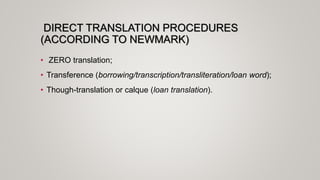
(ACCORDING TO NEWMARK)
• ZERO translation;
• Transference (borrowing/transcription/transliteration/loan word);
• Though-translation or calque (loan translation).
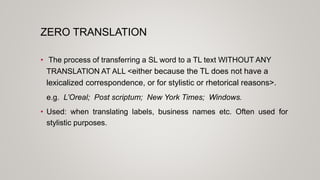
ZERO TRANSLATION
• The process of transferring a SL word to a TL text WITHOUT ANY
TRANSLATION AT ALL <either because the TL does not have a
lexicalized correspondence, or for stylistic or rhetorical reasons>.
e.g. L’Oreal; Post scriptum; New York Times; Windows.
• Used: when translating labels, business names etc. Often used for
stylistic purposes.
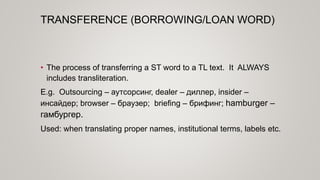
TRANSFERENCE (BORROWING/LOAN WORD)
• The process of transferring a ST word to a TL text. It ALWAYS
includes transliteration.
E.g. Outsourcing – аутсорсинг, dealer – диллер, insider –
инсайдер; browser – браузер; briefing – брифинг; hamburger –
гамбургер.
Used: when translating proper names, institutional terms, labels etc.
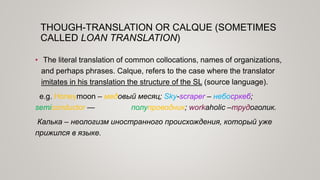
THOUGH-TRANSLATION OR CALQUE (SOMETIMES
CALLED LOAN TRANSLATION)
• The literal translation of common collocations, names of organizations,
and perhaps phrases. Calque, refers to the case where the translator
imitates in his translation the structure of the SL (source language).
e.g. Honeymoon – медовый месяц; Sky-scraper – небосркеб;
semiconductor — полупроводник; workaholic –трудоголик.
Калька – неологизм иностранного происхождения, который уже
прижился в языке.
INDIRECT (OBLIQUE) PROCEDURES
• Transpotition/grammatical shift;
• Modulation;
• Compensation;
• Functional equivalent;
• Cultural equivalent/ adaptation;
• Descriptive equivalent/explanatory translation;
• Synonymy;
• Paraphrase;
• Lexical shifts (omission/addition) – sentence reduction/expansion;
• Notes
TRANSPOSITION/GRAMMATICAL SHIFT
• Operates at the grammatical level. Types of grammatical change: replacement
of a word class by another word class /singular to plural/ change in parts of
speech.
NO changes in meaning!
e.g. To reconstruct (VERB) the city is very important = Реконструкция (NOUN)
города крайне важна.
e.g. He found it difficult (ADJECTIVE) to be a teacher = Он познал всю
сложность (NOUN) учительской работы.
e.g. You have a talent (NOUN)! = Ты талантлив (ADJECTIVE).
e.g. (Oh, you gonna have a baby!) Good News (Plural) ! – Хорошая Новость!
TRANSPOSITION/GRAMMATICAL SHIFT (WORD
ORDER)
EN: A delegation of Moscow State University students arrived in
Gainesville yesterday.
RU: Вчеpa в Гейнзвиль прибыла группа студентов из Московского
государственного университета.
A typical Russian sentence would generally have a reverse word order:
time+place+predicate+subject+object+adverbial adjunct.
MODULATION
• This consists of using a phrase/word different in the source and
target languages to convey the same idea, slightly changing its
meaning:
• “it is not complicated to learn how to dance” = Научиться
танцевать - просто (вместо "это несложно - научиться
танцевать");
• «This flat is huge» - Это просторная квартира (вместо «эта
квартира огромна»).
The same as a paraphrase, but on word level. Paraphrase –
sentence level.
COMPENSATION
• can be used when something cannot be translated, and the meaning that
is lost is expressed somewhere else in the translated text.
Widely used in combination with sentence division.
One example is the problem of translating nuances of formality from
languages that use forms such as Spanish informal tú and formal usted,
French tu and vous, and German du and sie into English which only has
'you‘. There will be a need to express degrees of formality in different way
in the remained part of translation.
FUNCTIONAL EQUIVALENT
• A cat in gloves catches no mice – без труда не выловишь и рыбку из
пруда;
• To born with a silver spoon in mouth – родиться в рубахе;
Подбор выражения- аналога, существующего в другом языке. Перевод
на уровне поговорок, распространенных высказываний.
ADAPTATION/ CULTURAL SUBSTITUTION /
CULTURAL EQUIVALENT
It is a cultural element which replaces the original text with one that is
better suited to the culture of the target language. Level of symbols.
• e.g. baseball ( as the most traditional game in the USA)= футбол (as
the most traditional game in Russia)
• My glass of bourbon = моя рюмка водки/чарка (и бурбон, и водка в
данном случае скорее культурные символы, а не просто напитки).
DESCRIPTIVE EQUIVALENT/EXPLANATORY
TRANSLATION
• In this procedure the meaning of the ST is explained in several
ways.
• e.g. I am PR specialist = Я специалист в области связей с
общественностью (вместо «Я пиар специалист».)
• New IT brands = Новые бренды в сфере высоких/компьютерных
технологий.
Used: when translating some specific terms & unknown concepts
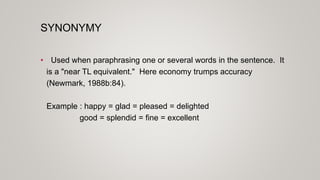
SYNONYMY
• Used when paraphrasing one or several words in the sentence. It
is a "near TL equivalent." Here economy trumps accuracy
(Newmark, 1988b:84).
Example : happy = glad = pleased = delighted
good = splendid = fine = excellent
PARAPHRASE
• In this procedure the meaning of the ST is explained in TOTALLY
different way, distorting/changing the initial message.
e.g. Men and women talk really differently in terms of their use of
linguistic constructions. = Мужчинам и женщинам характерны
принципиально разные манеры словоупотребления.
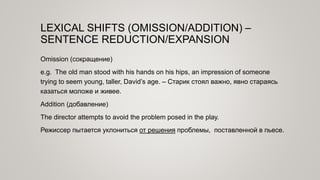
LEXICAL SHIFTS (OMISSION/ADDITION) –
SENTENCE REDUCTION/EXPANSION
Omission (сокращение)
e.g. The old man stood with his hands on his hips, an impression of someone
trying to seem young, taller, David’s age. – Старик стоял важно, явно стараясь
казаться моложе и живее.
Addition (добавление)
The director attempts to avoid the problem posed in the рlау.
Режиссер пытается уклониться от решения проблемы, поставленной в пьесе.
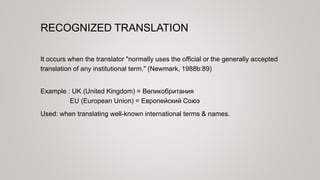
RECOGNIZED TRANSLATION
It occurs when the translator "normally uses the official or the generally accepted
translation of any institutional term." (Newmark, 1988b:89)
Example : UK (United Kingdom) = Великобритания
EU (European Union) = Европейский Союз
Used: when translating well-known international terms & names.
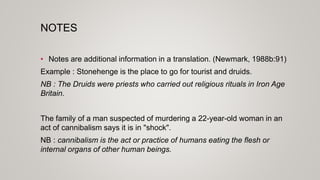
NOTES
• Notes are additional information in a translation. (Newmark, 1988b:91)
Example : Stonehenge is the place to go for tourist and druids.
NB : The Druids were priests who carried out religious rituals in Iron Age
Britain.
The family of a man suspected of murdering a 22-year-old woman in an
act of cannibalism says it is in "shock".
NB : cannibalism is the act or practice of humans eating the flesh or
internal organs of other human beings.

translation procedures 2.pptx

  • 1.
  • 2.
    • Word-for-word translation→ When we translate literally (т.е. буквально), we are translating one word at a time, hence, word-for-word translation (FORMAL TRANSLATION APPROACH) Formerly reffered to the term ‘formal equivelence’ (Nida). • Sense-for-sense translation → When we translate creatively, we are rendering the MESSAGE/IDEA of the sentence, hence, sense-for-sense. Formerly reffered to the term ‘dynamic equivelence’ (Nida).
  • 3.
    TRANSLATION STRATEGIES VS.TRANSLATION PROCEDURES Translation strategy: (called ‘translation method’ by Newmark): the overall strategy you apply to a text as a whole – the primary choice you have to make here is how close to the source text you want your target text to be. → TEXT LEVEL / ХАРАКТЕРИСТИКА ПЕРЕВОДА В ЦЕЛОМ! Translation procedure: procedures you apply in the translation of individual expressions in the source text, such as words, grammatical constructions, idioms etc. → SENTENCE LEVEL ДЕТАЛЬНАЯ ХАРАКТЕРИСТИКА ПЕРЕВОДА, РАЗБОР ПРЕДЛОЖЕНИЙ!
  • 4.
  • 5.
    TRANSLATION STRATEGIES :2 GROUPS (Source text oriented translation strategies) (Target text oriented translation strategies) Free translation: the same content is expressed in the target text but with very different grammatical structures Idiomatic translation: makes use of idioms and colloquialism s that are not present in the source text. Adaptation: The freest form of translation. More of a target language/cult ure based interpretation Communicativ e translation: reproducing the exact message of the source text but with emphasis on naturalness. Word-for- word translatio n: strict preservatio n of word order. Translation: As literal as possible. Literal translation: apart from literal translation, grammatical structures are converted into the nearest target language equivalents. Faithful translation : still tries to preserve the form of the target text, but draws on certain contextual factors. Semantic translation: more emphasis on naturalness & aesthetics than in faithful translation + translation of certain cultural words.
  • 6.
    TRANSLATION PROCEDURES: CLASSIFICATION  Directprocedures → Focus on the Source text/direct rendering/formal approach;  Indirect (oblique) procedures → Focues on the Target text & communicative function. High degree of creativity.
  • 7.
    DIRECT TRANSLATION PROCEDURES (ACCORDINGTO NEWMARK) • ZERO translation; • Transference (borrowing/transcription/transliteration/loan word); • Though-translation or calque (loan translation).
  • 8.
    ZERO TRANSLATION • Theprocess of transferring a SL word to a TL text WITHOUT ANY TRANSLATION AT ALL <either because the TL does not have a lexicalized correspondence, or for stylistic or rhetorical reasons>. e.g. L’Oreal; Post scriptum; New York Times; Windows. • Used: when translating labels, business names etc. Often used for stylistic purposes.
  • 9.
    TRANSFERENCE (BORROWING/LOAN WORD) •The process of transferring a ST word to a TL text. It ALWAYS includes transliteration. E.g. Outsourcing – аутсорсинг, dealer – диллер, insider – инсайдер; browser – браузер; briefing – брифинг; hamburger – гамбургер. Used: when translating proper names, institutional terms, labels etc.
  • 10.
    THOUGH-TRANSLATION OR CALQUE(SOMETIMES CALLED LOAN TRANSLATION) • The literal translation of common collocations, names of organizations, and perhaps phrases. Calque, refers to the case where the translator imitates in his translation the structure of the SL (source language). e.g. Honeymoon – медовый месяц; Sky-scraper – небосркеб; semiconductor — полупроводник; workaholic –трудоголик. Калька – неологизм иностранного происхождения, который уже прижился в языке.
  • 11.
    INDIRECT (OBLIQUE) PROCEDURES •Transpotition/grammatical shift; • Modulation; • Compensation; • Functional equivalent; • Cultural equivalent/ adaptation; • Descriptive equivalent/explanatory translation; • Synonymy; • Paraphrase; • Lexical shifts (omission/addition) – sentence reduction/expansion; • Notes
  • 12.
    TRANSPOSITION/GRAMMATICAL SHIFT • Operatesat the grammatical level. Types of grammatical change: replacement of a word class by another word class /singular to plural/ change in parts of speech. NO changes in meaning! e.g. To reconstruct (VERB) the city is very important = Реконструкция (NOUN) города крайне важна. e.g. He found it difficult (ADJECTIVE) to be a teacher = Он познал всю сложность (NOUN) учительской работы. e.g. You have a talent (NOUN)! = Ты талантлив (ADJECTIVE). e.g. (Oh, you gonna have a baby!) Good News (Plural) ! – Хорошая Новость!
  • 13.
    TRANSPOSITION/GRAMMATICAL SHIFT (WORD ORDER) EN:A delegation of Moscow State University students arrived in Gainesville yesterday. RU: Вчеpa в Гейнзвиль прибыла группа студентов из Московского государственного университета. A typical Russian sentence would generally have a reverse word order: time+place+predicate+subject+object+adverbial adjunct.
  • 14.
    MODULATION • This consistsof using a phrase/word different in the source and target languages to convey the same idea, slightly changing its meaning: • “it is not complicated to learn how to dance” = Научиться танцевать - просто (вместо "это несложно - научиться танцевать"); • «This flat is huge» - Это просторная квартира (вместо «эта квартира огромна»). The same as a paraphrase, but on word level. Paraphrase – sentence level.
  • 15.
    COMPENSATION • can beused when something cannot be translated, and the meaning that is lost is expressed somewhere else in the translated text. Widely used in combination with sentence division. One example is the problem of translating nuances of formality from languages that use forms such as Spanish informal tú and formal usted, French tu and vous, and German du and sie into English which only has 'you‘. There will be a need to express degrees of formality in different way in the remained part of translation.
  • 16.
    FUNCTIONAL EQUIVALENT • Acat in gloves catches no mice – без труда не выловишь и рыбку из пруда; • To born with a silver spoon in mouth – родиться в рубахе; Подбор выражения- аналога, существующего в другом языке. Перевод на уровне поговорок, распространенных высказываний.
  • 17.
    ADAPTATION/ CULTURAL SUBSTITUTION/ CULTURAL EQUIVALENT It is a cultural element which replaces the original text with one that is better suited to the culture of the target language. Level of symbols. • e.g. baseball ( as the most traditional game in the USA)= футбол (as the most traditional game in Russia) • My glass of bourbon = моя рюмка водки/чарка (и бурбон, и водка в данном случае скорее культурные символы, а не просто напитки).
  • 18.
    DESCRIPTIVE EQUIVALENT/EXPLANATORY TRANSLATION • Inthis procedure the meaning of the ST is explained in several ways. • e.g. I am PR specialist = Я специалист в области связей с общественностью (вместо «Я пиар специалист».) • New IT brands = Новые бренды в сфере высоких/компьютерных технологий. Used: when translating some specific terms & unknown concepts
  • 19.
    SYNONYMY • Used whenparaphrasing one or several words in the sentence. It is a "near TL equivalent." Here economy trumps accuracy (Newmark, 1988b:84). Example : happy = glad = pleased = delighted good = splendid = fine = excellent
  • 20.
    PARAPHRASE • In thisprocedure the meaning of the ST is explained in TOTALLY different way, distorting/changing the initial message. e.g. Men and women talk really differently in terms of their use of linguistic constructions. = Мужчинам и женщинам характерны принципиально разные манеры словоупотребления.
  • 21.
    LEXICAL SHIFTS (OMISSION/ADDITION)– SENTENCE REDUCTION/EXPANSION Omission (сокращение) e.g. The old man stood with his hands on his hips, an impression of someone trying to seem young, taller, David’s age. – Старик стоял важно, явно стараясь казаться моложе и живее. Addition (добавление) The director attempts to avoid the problem posed in the рlау. Режиссер пытается уклониться от решения проблемы, поставленной в пьесе.
  • 22.
    RECOGNIZED TRANSLATION It occurswhen the translator "normally uses the official or the generally accepted translation of any institutional term." (Newmark, 1988b:89) Example : UK (United Kingdom) = Великобритания EU (European Union) = Европейский Союз Used: when translating well-known international terms & names.
  • 23.
    NOTES • Notes areadditional information in a translation. (Newmark, 1988b:91) Example : Stonehenge is the place to go for tourist and druids. NB : The Druids were priests who carried out religious rituals in Iron Age Britain. The family of a man suspected of murdering a 22-year-old woman in an act of cannibalism says it is in "shock". NB : cannibalism is the act or practice of humans eating the flesh or internal organs of other human beings.